Becoming a Coach with Hélène Feuillat: Leadership Training and Multicultural Insights
with Hélène Feuillat, Executive Coach, Assertiveness
Transcript
Edited for readability: filler words removed, names checked. It may still contain errors. The audio is the source of truth.
Pre-Theme Teaser
Hélène Feuillat
I really wanted to coach women back to business, because I realized how difficult it was for many young women, after having a child, to come back to work with a certain self confidence.
I wasn't making money. And I realized very quickly that with coaching only, individual coaching, only B2C, I was not going to make a decent revenue.
You need to be curious. Test things out. If it's not working, it's not a problem. You will learn a lot and you will be able to twist your message.
Theme[00:00:37] Welcome
Tobi
Welcome to the Making of a Coach, where we unpack how coaches managed to turn a passion into their profession.
I'm Tobi, co-founder of metaFox Coaching Tools, and today I am meeting Hélène Feuillat.
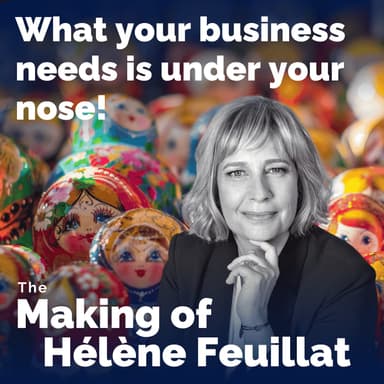
Hélène runs a leadership training business in Brussels and coaches leaders one on one. This time too we started our conversation with a picture card warm up. I asked Hélène to pick a picture that describes her coaching journey. Out of 52 different cards she chose a photo of Russian dolls, very colorful wooden figures standing in a row.
You can see the photo she chose on our episode cover as well as on the video. So let's get started and hear from Hélène.
Hélène Feuillat
Fantastic.
My God. There are so many images that are speaking.
Well, you know what? If I have to choose one, I would choose the Russian dolls.
Tobi
How does that represent your journey as a coach?
Hélène Feuillat
I became a coach while I already had previous professional experience.
So there has been some transformation. What I like about the symbolism of the Russian dolls is also that at every moment in my life I grew closer to who I am, if I can say it that way. And not only have I experienced this myself, I think it is also something I am contributing as a coach: to bring others closer to themselves too.
That's why I chose it. It's very colorful, and I think my professional path and my personal path have been very colorful too. Sometimes I also wonder how many little voices there are in my head, with all the thousands of ideas that I have.
So this picture is actually quite me, if I can say so.
Tobi
Great.
Multicultural Influences
Tobi
You grew up in Belgium, and your mother tongue sounds French, but you said you actually grew up in Flanders, in the Flemish part.
Your husband is Portuguese. You have lived in Japan, India, Thailand. So how did that very multicultural background influence you?
Hélène Feuillat
I'm sure it has. First of all, we say that travel contributes to seeing the world differently.
And really seeing how people live on a daily basis is very different from traveling into a country as a tourist. So, being able to be close to people from completely different cultures, and also to adapt.
I always find it very interesting: how was it that I could connect with people although I wasn't understanding a word they were saying? When I was in Japan I was working in an office in the center of the city, but I was living one and a half hours outside the city.
In the dormitory for girls from the Nissan company. So going to the office was quite an adventure. And there was this girl who was working in the same office as me. She wasn't speaking a word of English, and she would take me by the hand every morning to bring me to the metro station. We would go on the train together, and it was just fabulous.
So this cultural diversity is something that I won't be able to get rid of, and obviously I don't want to.
Tobi
Can you take us with you on this timeline?
Early Career Adventures
Hélène Feuillat
Oh my God, it was in 93.
93 is quite a long time ago. Without WhatsApp, without internet, without this huge touristic enthusiasm for Asia. I was sent to Japan by my new job.
It was an events management job. I was supposed to manage a congress which would be organized in Japan with public private partnerships. And I think I was naive, looking at life from the most enthusiastic perspective, so everything seemed an adventure. I don't know whether you know Pippi Longstocking.
Pippi Longstocking has this great quote that I like: I have never done it before, so I think I can do it.
And that was a little bit my mindset. It wasn't easy every day, but every day was a new day. So this definitely helped as well.
Tobi
I guess today we would call it growth mindset, this Pippi Longstocking attitude of, I have never done it, so I know I can do it. Is that something you always had, or would you say it also developed?
Hélène Feuillat
I think it has developed, although, you know, nature and nurture. Probably there was already some nature, but definitely I think it has been nurtured.
I came from quite a strict education, with a lot of rules. And I am the middle of two brothers. My oldest brother was, I'd say, more intellectual, reasonable, obedient.
So you can already imagine, Tobi, I came just after that and I was the opposite. I was not obedient. I was testing my parents in every way I could. I think it was a way for me to differentiate myself from my brother, probably.
Tobi
And is that something you would say you can also see in clients today, a dimension you think about, this nature and nurture of growth mindset and this drive for learning?
Hélène Feuillat
Yes, absolutely. I can tell you that most of the people who do not have a growth mindset will most probably not get into a coaching adventure, unless they're forced to.
And we know that if someone is forced into coaching, it is not going to work. You need to be open. It doesn't mean you need to have all the answers, or the full plan, but you need to be somehow committed to changing. The first coaching mission is maybe to bring people to that level of awareness before more in-depth work can be done.
I think it's great to see some people who were, let's say, more in sleeping mode waking up and suddenly seeing their reality from a different perspective. I think that is the first step towards transformation: awareness.
Tobi
First realizing I could change. Secondly, I want to change.
And then do it.
Let's go back a bit into your biography and into your journey.
Transition to Coaching
Hélène Feuillat
I went to school in a European school, and European schools are usually open for children whose parents work for a European institution, which was not the case for my parents. But somehow there was a European school not very far from my house.
And so, under certain conditions, we were allowed to attend that school. This European dream is something you get really on a daily basis at a European school. It is really about the strength of Europe. So me arriving in this European organization, there were a lot of things I could already recognize in that organization, and I could really relate to experiences I had had in the past. So having this job was like pinching myself. It was absolutely fantastic. I could hear all the languages that were there.
There were Germans, Belgians, Italians, Spanish. It was absolutely amazing. I worked there for about 10 years.
I was in the right system, and content wise I'd say more than 80 percent of the things I was doing were great. I was traveling a lot, I had contacts with important stakeholders, I had fun. It was amazing.
Inspiration for "Back to Business"
Hélène Feuillat
What made me leave was more some conditions that might have inspired me for my coaching business, actually.
When I became pregnant with my first child, I was the first woman working in that organization who was pregnant and who was going to be a mother. The majority of my colleagues were men, and the women who were working with me either had no children, or no children yet.
So it was a little bit like a test. And at some point I didn't feel the recognition that I deserved. I had the impression that I was put, not on a sidetrack, but that I received these messages that I was supposed to take care of my family first.
That it's great to have ambitions, but why don't you take care of your family first? And I disagreed. It's not that I didn't want to take care of my family, but I also wanted to take care of my career. So at some point I decided to leave. And I think it was a great decision.
I think my time was up there, and I was ready for something different and something new.
Tobi
This experience of having to slow down her career due to pregnancy was very influential for Hélène's first coaching business. With Back to Business, her first brand, she turned this own experience into her mission.
But before we get there, there is one more stop in Hélène's making of story, and one key ingredient that helped her build a coaching business.
Toyota
Hélène Feuillat
There is one important thing that I think characterizes me, and it helps me today in developing my business too. It is that I have always been a very good networker. Already at that period of time I was very good at remaining in touch with people without necessarily needing anything from them.
And so when I decided to leave this European organization, I started to look at where my next step was going to be. We moved house during that period, we bought a house in Brussels, and close to that house was the head office of Toyota Motor Europe.
And this European organization I was working for was into transport telematics, so I thought, okay, there is a link. Why not work for Toyota? It is next to my house. And then I started thinking, who do I know at Toyota?
And then a name popped up and I sent a message. And this person said, you know what, I happen to be the vice president of the department of product communication and events, and we are looking for someone. Why don't you come over and have a coffee? So I went there for a coffee, and a week later I started.
And after two, three months, I basically knew everyone.
People asked me, how long have you been here? How many years have you been here? I said, well, I have actually been here only three months. They could not believe it. So I knew quite quickly who to talk to, who was doing what. Because of the job, it was in PR, we were also discussing with a lot of internal and external stakeholders.
It was really a job for me. I knew nothing about cars, but it didn't matter. I knew everything about events. I had a great team and a great boss, an Italian boss, Fabio. So I was again in events, and after the first year my boss asked me, at an end of year evaluation.
And he said, Hélène, with his Italian accent, Hélène, where do you see yourself within the organization? Because at Toyota it was really the tradition and the culture to do a lot of internal rotations. I said, Fabio, cars, I'm really not interested. I don't see myself anywhere else than where I am.
And he said something very interesting at that time, that I will never forget, and I thanked him for it afterwards, years after. He said to me, well, that's so obvious, I see you somewhere. That is so obvious. Yes, where do you see me then? And he said, training. I said, okay. I had no clue.
And it is only a couple of years later that I indeed started with coaching and training, because I forgot about that idea. It went somewhere in the back of my head.
But afterwards, with reflection, I remembered that it was also coming from him. We don't meet people by chance. They all have somehow a message to convey. And I think he was important, this person was important in seeing something in me that I did not see at that time.
Tobi
And now, looking back, you can connect the dots.
Hélène Feuillat
Exactly. And then things started to go a bit faster.
Starting Back to Business
Hélène Feuillat
I worked for a Belgian company for a couple of months, and suddenly I woke up with an idea: to coach women back to business.
I woke up and I said to my husband, I have an idea.
And he went, oh my God. So over summer I started digging into that idea and checking, okay, how am I going to make this work? And I really wanted to coach women back to business, because I realized how difficult it was for many young women, after having a child, to come back to work with a certain self confidence.
It was very common for Belgians to come back to work after three months. And then you hear that you have been replaced, and that you should not worry because they found someone wonderful to replace you.
Well, how does that feel?
And so even before I started my coaching training, I knew exactly what I wanted to do. I found someone through the internet in Australia who was doing exactly what I wanted to do. I sent her a message, we had a Skype call, and she explained to me what she was doing.
And I thought, you know what, this is exactly what I want to do. So I thank this person also for her time. And then I started my coaching training.
Tobi
There are two interesting things I see here. First you say you started with a very clear niche in mind, which is something I think many coaches, or also entrepreneurs, struggle with: having to say no to a certain group of clients or customers.
And you came from the other direction, with a societal mission too, helping coach women back to business. I also liked the alliteration, back to business. And then also the international role model. There was already someone else who has done what you want to do.
One key conversation I had when starting this podcast was also with a friend who asked, is there an American role model podcast that you can mimic, that you can take inspiration from? At that point I didn't have one, but then I started thinking, let me dig in and do some research.
Who is doing what we have in mind? That also helped me a lot, not to do exactly what they do, but to draw inspiration and become more clear about the vision for the service, for the product. It sounds like these two elements are very clear here too.
Absolutely.
Hélène Feuillat
And there is one very important word you have been using a couple of times since our conversation started. It is inspiration. To get inspiration elsewhere and then make it your own thing. I have this belief that there is enough room for everyone on this planet.
And this is a message to all the coaches and future coaches who are listening to us: there is room for everyone. Everyone who wants to do things seriously and who really wants to have a mission about helping others. So I think it is very important to get inspiration elsewhere, and it helps our own thinking path.
We don't need to have the most unique idea. We can inspire ourselves from something that already exists. Then it's about owning it.
Tobi
There is one other thing I found interesting when researching you and your brand. It is this, "with Hélène".
What is it about this "with" that seems to play a strong role in what you're doing?
Hélène Feuillat
With plays a very strong role. You must know that when I started my activity it was called Back to Business. But in 2008 I very clearly understood that the economic environment I was in, in Belgium, wasn't really jumping with excitement about the project.
Today it's very different, obviously. So I also realized that if I wanted to make a living I could not focus my activities only on women. I was invited by someone who was actually looking for a partner in the training and coaching business.
And so we decided to work together, we chose a common name, and we worked together for quite a number of years. But at some point I had the impression I was hiding behind this name, and maybe before that I was lacking credibility. So I think it was in 2018 that I realized I wanted to be, I call it, free. No one had imprisoned me before. It was more my own way of looking at my reality then. So I thought, okay, I am mature enough, maybe competent enough, to be in the world under my own name, without having to hide behind anyone or anything.
And the "with" comes from this, I find, collaborative energy of the with. It is not this or that, it is this with this. It is a little bit of this with a little bit of this. It is how we spice up a dish. I'm not sure what your favorite dish is.
Tobi
There's plenty. Let's say pizza.
Hélène Feuillat
Pizza. Well, the question is, what would you add on your pizza to make it even better? Do you ask for extra cheese? Do you ask for hot sauce? What is it that you put on it to spice it up? It is with something. So this with became really important for me, because I see the world in combining.
Not associating, but combining. And so this word became really my identity.
Tobi
What I also like about it is the collaborative aspect. A coaching journey, or also a training, is not delivered by you, it is a collaborative process where the client actually takes responsibility for their own change.
And it's not you who can just make it happen like that. That is in fact also something, if I look back at the first flip charts I prepared in the organization where I became a trainer. We had this habit of creating fancy title flip charts, and in the very first ones I always wrote "Meeting facilitation by Tobi".
And then, I think one year in, I changed that to "with Tobi". For me that was also this realization. I'm just the, in engineering we would say, I'm missing the word. The activator, basically. The initiator.
Hélène Feuillat
Activator, propeller, messenger. You know, I call this partnership.
And it is what I say to my clients today, mainly in all my training missions. I do not come to deliver half a day of a workshop and then I'm gone. I'm not interested. I only go for partnership missions. First, there needs to be a clear goal. I need to be aligned with that mission. And I want to work midterm, long term together.
I am not interested in doing a hop on hop off bus, like you see in the majority of the capitals, in big cities. Not interested. I want to make a difference. And this difference, well, there might be other ways of making a difference, but I think I make my difference best when I am partnering with my clients.
Tobi
The power of with. But if I understand correctly, this was then already your second brand as a coach. Let's go back to number one, your first coaching education, starting with Back to Business, your first session, maybe your first training. How were these early days for you?
Challenges and Early Successes
Hélène Feuillat
It was absolutely amazing. What I did though is, I resigned and I started my coaching training without having a job. I did some freelance events management just to have some income, because my husband said it was all great and well to do what you love and find your passion and a mission, but he was not going to sponsor me.
At that time I was quite upset, because I found him not very supportive. But probably he did what was best, because he made sure I would make this work. So I resigned in October, I started my coaching training in October, and every coaching day I went to I was like a little child in front of a Christmas tree.
It was incredible. And on the other hand it was a bit scary, because I realized how incompetent I was. I thought I could listen well. I realized I could not listen. I thought I could ask questions. I realized I could not ask open questions. I thought I could show empathy. I realized I was not that empathic.
So it was confronting, and on the other hand it was absolutely amazing. I have incredible memories of that moment and of that period, which lasted a small year, of course not full time. It was a couple of days per month, and we also had some work to do in between. I still have very close friends that I made during this period.
So it was amazing, really.
Tobi
Was it a certain type of coaching education, a certain framework?
Hélène Feuillat
No, it was really a mix. You had NLP, you had transactional analysis, you had some other tools, so it was a little bit of everything. That is actually what I also like.
I also liked the fact that not every module was given by the same trainer, which gives you a feel for what kind of trainer you want to be as well. Although at that period I had no clue I was going to become a trainer. I was really more into coaching in my mind.
It was quite generalist, which I would actually recommend. Because the coaching training is never finished. My biggest challenge is actually to pick one training a year, otherwise I would myself be constantly in training. So there are plenty of opportunities afterwards to deep dive into the tools that speak most to a person.
Tobi
And I see you have a very long list of frameworks and types of education. Let's get there in a minute, but I would like to dig a bit more into your start as a coaching business. You wanted to become a coach.
You also became a trainer. Where were your first clients coming from?
Hélène Feuillat
You know, I realized that our brain recognizes what it knows. It is the power of attention. I had my project. I started in October 2008, and a couple of months later, end of the year, early 2009, I was in my car stuck in traffic.
And I saw this ad at a tram halt. It was a sports coach, a famous tennis coach, famous in Belgium. And he was looking at me in the eyes, the paper guy obviously, not the real person. He was looking me in the eyes and it was written: are you the next business personality of the year?
And it was sponsored by Toyota. I thought, you are talking to the right person. So I went online to have a look. What was this business personality thing? I registered. I had my project. It was about having a project, about living your project and being the personality required to make this project work.
So I went through the different steps. I eventually ended up with the 11 other finalists. We went on this long weekend where we had all kinds of tests and presentations and conversations about our project and how we wanted to present it to the world. I met fantastic people, and then I won a car. I won a Toyota, but I already had my car, so I sold it, Tobi, and so I had some money.
And so the pressure went poof. Not only did I then have some income, I also received, well, Belgium is a very small country and a very small world, press visibility. So I started to get phone calls. I was asked by a women's clinic that was going to open whether I was interested in having a coaching practice there, together with psychologists who looked at me like, what is this coach going to do here?
But I had a conversation with the director of this women's clinic. He was a gynecologist, and he saw how many young women were really needing help he could not provide. He was sending them to therapy while actually they needed something different. So it all made sense.
But again, had I not seen this paper commercial, my life would have been different. So I think it is very important to believe in the power of attention, to clean your glasses and to look at what is right under your nose. No need to go to San Francisco, to Silicon Valley or God knows where, to come up with the most fantastic idea or the most fantastic plan.
It is very often under our nose.
Tobi
With this mission, partnering with a gynecologist is totally obvious and at the same time so not obvious, because he is in a different area of that problem space, but in a way dealing with the same people, who have the problem you are helping solve.
Exactly.
Hélène Feuillat
And he was smart enough to recognize that I had something I could bring that he could not bring. This person was the one selecting which professionals were going to be able to have their practice in that women's clinic, and it was a really famous hospital in Brussels.
It gave me the credibility. So I made my business cards and I could write that I was certified, or approved, by this clinic to be able to work there. Which was a huge thing for me in terms of credibility and feeling legitimate. It was really important.
Tobi
And that program sounded a bit like a business incubator program, but then also a bit like a competition where winning got you the attention.
I imagine that in order to win that competition you also already had quite a clear cut vision and a way to present your vision and your business. How did you get that?
Hélène Feuillat
First of all, I went there a little bit like Pippi Longstocking. I had nothing to lose. I thought it was going to be great.
I was going to meet nice people in any case. It was in a beautiful environment. There was nothing to lose. So I went already with that spirit. But indeed, my project was already very, very clear. And on top of that, it was new. There was no one coaching women specifically. No one.
Tobi
So you were new, you were the first one in Belgium, and at the same time you had the role model from Australia, as we noted earlier, and the partnership with the clinic.
It sounds to me like you started with individual women, so B2C clients. How was that? Did you actually make money with those individual women?
Hélène Feuillat
I didn't make money at that time. I probably lost some money, because I had to get to the clinic.
It was an expensive area. I got lots of parking fines. I also had to pay the rent for my office. So no, I was definitely not making money, but I was making experience. I do have to apologize to my first clients, because I did the best I could, and definitely my coaching skills then were not what they are today. But you have to start somewhere.
Now, as it was a new topic, I think people were more inclined to come and test it out. They were paying. I remember my price was 60 euros, which at that time was not cheap. But again, I think every hour needs to be rewarded. So I did not start coaching for free, or for whatever you want to give me.
No, that was my price. So no, I wasn't making money. And I realized very quickly that with coaching only, individual coaching, only B2C, I was not going to make a decent revenue. That is why, I am sure, when someone came to me about partnering for training, I thought, yes, this makes sense.
And that is when you asked me also, how did I get my first corporate clients?
Growth and Corporate Training
Hélène Feuillat
It was working with this other person who already had a lot of experience. And I was bringing the Flemish side of things. She needed a bilingual person, and she was ready to train me. So I was very fortunate to have her as a mentor.
And I started to talk to my network, sports network, friends, and that is how I got my first missions. People knew who I was. They knew I was serious in what I was doing. And they also knew I was partnering with someone who had over 10 years of experience in the training business.
So it's a combination.
Tobi
And what I hear is, there is this growth mindset, courage attitude. There is then getting the first experience in B2C individual coaching. And then there is a partnership that gets you on the one hand to training, on the other also to bigger business clients.
Hélène Feuillat
Yes.
Tobi
And in that partnership you could bring this hard skill that actually hasn't anything to do with coaching: speaking another language, speaking Dutch, I guess.
Hélène Feuillat
Yes.
Tobi
That also brought value into the partnership with a more experienced person.
Hélène Feuillat
Yes. And this person also had very much the Belgian profile. I had a very international profile. She was a psychologist but had never really worked in the corporate world, which I had. So we had a lot of complementarities.
And that is why for almost 10 years, nine years, we were both very successful.
Tobi
And this is when you really started making money and were able to live from coaching and training. At this point, how was the split back then? How is it today?
Hélène Feuillat
So here we are looking at early 2010. It was, I'd say, 85 percent training and 15 percent coaching. And the coaching was mainly people who were paying for their coaching session out of their own pocket, which I'm not doing anymore, or hardly. Today it's more about 50:50, and the coaching that I do is individual coaching financed by the companies.
They encourage their managers and individual contributors to get coached. That's great, because it is a different price. I cannot ask an individual to pay the same price for a coaching session as a company. So it is a very different story.
Tobi
What's the price if you ask a company?
Hélène Feuillat
With a company it turns around 300 euros. But actually I am not selling per hour, I'm selling per package. In the package it is obviously the time for the coaching, but also preparation, and availability in between coaching sessions.
It is also some tools that I reach out for. And it is all the experience that I have. So I think it is not the right way of thinking, in hours. I think you should think in value.
Tobi
And I'm wondering, I don't see that on your website, do I?
So how do you communicate this offering to a business?
Hélène Feuillat
They know and they contact me. I don't do any prospecting. For coaching, my best clients come through training, in the sense that whenever I train within an organization, every participant is a potential future coachee, or would recommend me to one of his or her team members or colleagues.
So that is why I think being a trainer and a coach is a great commercial combination, because the two are different although linked. And once you are within an organization, you can provide both.
Impact of the Pandemic on Coaching
Hélène Feuillat
If I look back at the last years, I think the pandemic has very much influenced my reality today. Doing individual coaching online has become the norm. Although I still have an office in Brussels that I love, where my clients can come for their coaching sessions, even those living or working in Brussels often do it virtually, because of traffic, waste of time and so on.
So this has really increased the possibilities for coaching sessions, because I spend my time between Brussels and Lisbon. Every time I'm in Lisbon I am doing my online coaching sessions, while when I'm in Brussels I'm mainly in trainings, whether in Belgium, the Netherlands or France, which are my three big markets.
So that is a little bit how the split happens.
Advice for New Coaches
Tobi
Interesting. That sounds like a great place to be in. But let's assume you weren't, and you were a new coach starting out today. What would be your recommendation for them?
Hélène Feuillat
I think it is important to know what differentiates you. As I said, you don't need a revolutionary idea, but you need to know your added value. And one of the added values I have in Belgium makes a lot of sense.
It is being able to give a training in French, in Flemish, in English, and even mix it all together. This is also one of my big added values. So you need to know your added value, and you need to know the topics you are really passionate about.
I would definitely not recommend anyone to give a training on something he or she doesn't like, because you don't do it well. And in training you have only one chance. No one will take you back if your training was perceived as bad quality. Learning managers do not want to take the chance of getting bad feedback themselves.
So you need to be sure of what you want to offer. The topic needs to be very clear.
Importance of Added Value and Credibility
Hélène Feuillat
You need also to check your credibility, and credibility is also a perception. Your topic needs to make sense. I am mentoring coaches, and for example I have one coach who is academically a psychologist.
When she talks about burnout and stress and mental resilience, it makes absolute sense with her academic background. So you need to have some kind of link, whether it is experience or academic references. It is not reading one good book. That's not enough.
Choosing the Right Environment
Hélène Feuillat
I think it is important to know first, do you want to work in the corporate environment?
Do you like to work in the corporate environment? Some people had such a bad experience themselves in a corporate environment that they still feel sick every time they push the door of a big company. Well, then it is maybe not the right environment for you. So I think it is very important to choose that environment.
Also, talk to people, but don't talk only to your first circle of friends.
These are not the people who are going to give you a contract. They don't want to mess with your friendship. They might be ambassadors, but they will not be contractors. You need to look further, at people you know a bit, but who will take the risk of hiring you.
Does that sound logical?
Tobi
That sounds very logical. So I hear clarity, I hear authenticity, I hear competence. And I think maybe this knowledge that I can iterate and I can change is what also helps you to be clear. Because what I often see in myself, but also in other coaches I get to talk to, is this:
I want to do this and that and everything, because I find this framework great and also that one, and I want to work with these clients but also with those. I think oftentimes that doesn't help with clarity. Yes, maybe it is also authentic to have many faces in a way. But it's not clear.
And what I always then say is, you cannot live many lives in parallel, but maybe you can live many lives iteratively. So one after the other, and you can be the guy, the girl for X, and then later also be the girl for Y, and in that way have this clarity. I think that is what I hear a bit here too.
And what I heard earlier with the Back to Business offering.
How did you get your first corporate client with that?
The Journey with MBTI
Hélène Feuillat
I think the first official certification I went for, after my coaching certification, was MBTI.
My colleague was certified in MBTI. It is through her that I learned about MBTI. I was following her, shadowing her in the training she was giving, and I fell in love with MBTI. So I went to certify myself in MBTI. And I started speaking MBTI all over the place, to all my friends, all my network, at my sports activities, at school, to the parents of my children.
And it resonated with some. They had heard about it before, or they were implementing MBTI within their organization. So they asked us to come and deliver their MBTI trainings. And from one comes the other. MBTI was very hot. Today MBTI is a little less hot. We see some waves. Now it's more Insights.
I'm not Insights certified. I will not do it, because I prefer MBTI. So I think sometimes you need to focus and choose. But that's how it started.
Using Various Tools in Coaching
Tobi
A trained psychologist who likes MBTI, I don't come across that often, in terms of your partner. If you say she was doing that first.
Hélène Feuillat
Yes.
Tobi
And then this was one of your first tools that you applied to organizational problems. What I'm wondering is, what were clients interested in?
Was it, ah, you do MBTI, that's interesting? Or did they come with, ah, we have this team dynamic problem, or we need a team building? Did they come from the problem space, or were they actually interested in the solution?
Hélène Feuillat
I think it really depends. It depends on the awareness of the HR manager or the learning and development manager. At the time there was definitely a bit of both. I'd say learning managers were definitely more aware of, for example, MBTI, while team managers realized there was a problem in their team.
Now, what I always advise learning managers and HR managers to do within the organization is to stick with one tool. You need to be serious, and it doesn't make sense to go from DISC to Insights to MBTI and to DISC again, then Lumina, then Enneagram and so on. I think it is important to be a little bit consistent.
And I have no problem if someone tells me, you know what, in our organization we use Insights and that's it. I say, that's fine. But I know the tool well enough to be able to show them the limits of the tool. And that is where I can come with something extra that will not be a competitive tool, but an addition.
So I think it is very important, if you are not certified in a certain tool, that you still know enough to know the benefits of it but also the disadvantages, and then to come with a suggestion that can be added to the tool they are already using. Because it doesn't make any sense if I come to an HR manager and say, oh, you know what,
I don't believe in Insights, I'm an MBTI fan and you're using Insights, really, why aren't you changing? They might have used this for the last 10 years. Everyone has their profile. It doesn't make any sense. I would probably say, well, you have done your Insights, it might be worthwhile to do a little refresh and to put the things together.
And everyone comes with their Insights report. Let's put the things on the table and see where we see that we are not communicating well enough. What does it have to do with? Is it because there is too much red energy? Does it have to do with assertiveness? Does it have to do with maybe cultural differences?
Let's see this from a different perspective and take what you have already. So this is what I encourage my clients to do every time, to come with what they have so far.
Tobi
And this loyalty to one model within an organization has the benefit of developing a common language. Everybody means the same thing, hopefully, if they speak of extroversion, introversion, or things like these. Or why else would you say have one model and stick to it, at least as a basis?
Hélène Feuillat
Yes. I think it is a common language thing. It is also a budget thing. Once they have already trained a certain number of the population in one tool, if they choose another tool everyone will have to do it all over. So the chances that they say yes will in any case be small. So another piece of advice to all the trainers and coaches out there is to ask the questions: what kind of tools are you currently using?
Since when are you using these tools? How happy are you with the results these tools provide? What is missing with these tools? If there is one extra thing I could provide, what would it be? So ask questions without coming straight in with your own idea of the magic tool that you love.
It's not because you love it that your client will love it.
Tobi
Very nice. You said earlier you started with MBTI, and also that every year you add another education to your toolbox. And I've seen there is MBTI, there is Belbin team roles, there is LEGO Serious Play, there is the Toltec way, there is ontology. Which of these are you using most frequently today, and why?
Hélène Feuillat
It's very hard to pick just like that. I'd say the one I love to use, but practically might not use as often as I would like, is LEGO Serious Play. It requires a setup, it requires a certain budget. It is a way of bringing the link of head and hand, the unconscious to the conscious.
It requires a certain setting. The others I use either consciously or in the back of my head, so I might use some of the tools without the client knowing it. It is a kind of backbone in the questioning that I use in coaching, for example. I like Belbin.
And why? Because it is also behavioral, compared to MBTI or Insights where you go more on personality, and where you might have this shortcut of excuses about, but I have no blue in my profile, I'm not going to do it. Well, in Belbin it is in everything. These nine roles need to be covered whether you like it or not.
I'm alone in my business. I need to cover these nine roles, and some I love and some I don't like. So there is really something more about ownership and responsibility that I really like. Also, it is easy enough to explain without having to fill out a full questionnaire.
So it is also a tool, or a model, that I can use without adding extra costs to my own daily fee. Because oftentimes
Tobi
it's the client who then needs to pay for the MBTI certification fee.
Hélène Feuillat
And the fees for all these trainings, for going to these trainings, are expensive. So you need to make sure you can get some money out of your trainings, because you will need to earn it back. But with MBTI, once you are certified you don't need to pay any additional annual fee, like you do for example with Insights.
Cost Considerations for Clients
Tobi
And how expensive is it for the client?
Hélène Feuillat
If I use Belbin, for example, and the client doesn't have a lot of budget to go through all the tests, the only thing they need to pay is my daily fee, and my daily fee turns around 2,000 to 2,500 euros, excluding VAT.
There is a little bit of material to be printed out. That's it. If there is the need for completing, for example, an MBTI questionnaire, these are prices that need to be added to the daily fee. So it is a question of budget.
Tobi
I see. And for the Belbin team roles example you just gave, you said it is two and a half thousand for a one day training, I assume with a group.
And in this training they wouldn't do any tests that would require extra fees to Belbin, it is just you using the framework with the clients.
Hélène Feuillat
Absolutely. I am Belbin certified. I can use the model without any problem. There is no obligation to use the questionnaire.
Effective Use of MBTI
Hélène Feuillat
For MBTI it is the same. I can do an MBTI training without using the questionnaire, because the questionnaire is only a support. The result is the way we answer questions on a certain day. It is not the truth, it is an indication of the truth.
So the most important is still the training, the debrief and the presentation of the tools, and how it resonates with all the participants so that they can choose.
Tobi
So they are put into a role play. They can observe themselves. How do I feel in certain situations? How do I take decisions in certain situations?
And then I can also judge what type I am.
Hélène Feuillat
I wouldn't call it a role play, because it is really about being themselves. It is more with the questions and the exercises that we do, where I ask them to identify how clear it is for them that they have a preference, for example extrovert versus introvert. And often they are in the middle.
That's fine. It is about clarity, and it might not be very clear to me what my natural preference is. That is why I really like MBTI, because there is this nuance, if you really dig into the depth of the tool and if you don't stay on the surface, where you think your profile is made out of four letters.
It's not true. There is so much more behind it. But again, if you want to get that knowledge, you need time. So it doesn't make any sense to build an MBTI workshop in half a day and hope that people will get it. They won't.
Tobi
Because they need a full day, you think?
Hélène Feuillat
They need more than a full day for an MBTI. If you really want to do it well, you need at least two days.
And that's problematic, because people don't have two days and they don't have the money for two days. But honestly, if you want to do it well, that is really what I encourage.
I encourage people to go for good instead of fast. If people say, I want a half day workshop on MBTI, I say, well, then it's not going to be with me. And that's okay.
Tobi
And where do you compromise? What is the smallest package I can get?
Hélène Feuillat
For MBTI? Well, I'm going to give one soon, actually. I first have an introduction of one and a half hours. This happens virtually. I explain what MBTI is about, and in which mindset you need to put yourself when you complete a questionnaire. Otherwise the risk is that people complete a questionnaire unconsciously the way they would like to be, or the way they think their boss wants them to be. So I give them this one and a half hours. Then we have one full day. In between they fill out their questionnaire, and they don't have the answers yet. And then we have one more half day.
And then we see, after this introduction, one full day, one half day, whether it is enough or whether we need to take it further. And this is for a team of six persons.
Tobi
I see. Let's say we are in a workshop like this now and I want to find out. We talked about introversion, extroversion. I think another dimension of MBTI is thinking versus feeling.
How do you take decisions? And you said earlier it's not role plays. Can you take me into an exercise that would help with deciding for that preference, thinking versus feeling?
Hélène Feuillat
There are so many exercises. One typically is, okay, your best friend's house has been robbed.
So, write down all the questions you would ask this person. People write down and we see. And again, this is not the only indicator, it is just to give you some insight. We see some people who go straight to, I hope you're not hurt, I hope you're okay, do you want me to come over?
Others would say, how much has been stolen? Have you contacted the insurance company? Has the police come? And these are much more objective, factual elements that are important. One is not better than the other. So you have plenty of exercises during the MBTI training. In the certification training they provide us with tons of exercises that we can test out with teams.
That is why it is so important to do these certification trainings, because otherwise you are only with the theory, which you can get by reading a good book. But if you go to these certification trainings, they also give you lots of exercises you can do with your future teams. So, what would you do if your best friend got robbed?
What is the first question that pops into your mind?
Tobi
It's a good one. I did extensive MBTI training also in 2014, 10 years ago. And back then I was thinking, and I would ask what was stolen.
What can you do? Is there insurance? And I think MBTI was also the framework that showed me, ah, I have this preference, but there is also this other side.
I don't have to. In terms of introversion, extroversion it was also this, oh wow, so this is how other people recharge their batteries. I had no idea. And I have the feeling that over time, back then I was an ENTJ, so extroverted and thinking. Last time I did the test, there is also 16personalities, which I would like to ask you about in a minute.
And last time I took it, I was actually ENFJ. So I changed from thinking to feeling. But in either case, in terms of thinking versus feeling, I'm sort of in the middle. And it probably also depends a bit on the relationship, on my shape that day.
If I may say that, is that a valid thing to say in MBTI?
Hélène Feuillat
No, I wouldn't say it. What I would encourage you to do is one day do the MBTI step two.
I don't know if you are aware of step two. It's very interesting, because every letter has five, what they call, facets. And in these facets it is about quantity. Because if we go into the essence of MBTI, your profile should not change.
But what happens is that when you get older and wiser there is a better combination. It is the width. And what I see today in the facets is that I am clearly still an extroverted preference, but in my facets I have many more introverted facets than I had in the past. The first time I did an MBTI step two, all my extroverted facets were at the maximum.
I was already tired just by looking at my profile. And now I do things in a much more gentle, introverted way. I go alone to the restaurant, no problem. I need my quiet time, no problem. I am actually much more comfortable with silence. I wasn't 10 years ago. I didn't become an I, but I better understood the benefits of it, and I am combining it better.
It is again the nature and nurture thing. So if you want an MBTI step two, I'm certified, I can say that.
Tobi
Thanks for the offer.
Hélène Feuillat
Doing some business here?
Tobi
It's very interesting. For me the model has been, as I said, very transformational. So you're saying my preference in this case for extroversion, introversion stays
the same, but it is the flexibility in behavior that I got.
Hélène Feuillat
Yes. And it is how it blends together in your own reality. How have you been able to incorporate the opposite? That's how we grow. We don't grow by continuing to be a selfish self. We grow by incorporating what we need and did not want to see.
So the complementarity comes also within us, not only in our interactions with others. That is what I call completeness. Instead of being very dichotomous and thinking either E or I. I know the exercise of the hands that you probably had on your first MBTI training.
Right hand, left hand. We have two hands, but which hand do I prefer to write with? It doesn't mean the other hand is cut from my body. I still have it. Am I going to use it or not, and how?
Tobi
I love that. So MBTI is about discovering that you also have a left or a right hand.
And let's say I'm a new coach. I can follow the conversation that Hélène and Tobi are having, but I don't really know much about MBTI. Where can I start? And what do you think about free tests, like 16personalities.com?
Hélène Feuillat
Obviously I'm not a fan. I'm not using it, so there's not much I can say.
I think it is important to use tools that are, I find, certified. I'm not saying it's not going to be a help, but again, it is not the test that is interesting. And by the way, in MBTI we don't talk about tests. We talk about a questionnaire.
And it is not so much the questionnaire that counts. It is the debrief. So I find it very dangerous for people to do these little tests online and then think, I am this or I am that. It's too easy. That's not how it works. You become more blind than clear.
So that is why I wouldn't encourage it. Or, if you do it, it should be a support for a conversation afterwards with your coach or your therapist, to have some kind of start, where do we begin with this conversation. But definitely don't believe the results of any kind of test or questionnaire.
Tobi
It's only an aid for the training and coaching and the reflection process. And so you say, go to the MBTI official organization, get certified there.
Exploring Other Models
Hélène Feuillat
I think you need to decide for yourself.
Where you want to put your money and your time. Because as a trainer and coach, when you go for a training you pay for the training and you do not get paid, because you are not working at your client. So there is a double cost. So I'd say be very certain of the reason that brings you to follow a certain training.
Is there a market for that tool in your country? How beneficial is it? How much do you believe in it? All these questions I think are very important.
Tobi
And at some point you need to switch from exploring and thinking into doing.
Hélène Feuillat
Yes. And again, the way I work is, I cannot use a tool that I don't believe in.
Tobi
Okay.
Starting with MBTI Certification
Tobi
And to finalize our conversation, let's say I got curious about MBTI and I want to take the first step. What is the first step?
Hélène Feuillat
You type MBTI and your country, you will get the list of trainings, and you apply and you follow the training.
I think it is very, very easy. The good thing about MBTI is that when you are certified you can access their platform, and you can also ask for their questionnaires in many different languages. So it's not because you follow MBTI in German that you cannot ask for questionnaires later in English, in French, in Spanish, depending on your clients.
So I find them very dynamic. Now, I have not been paid by MBTI to give them five stars or anything like that. But that is valid for all the tools. You need to know why you want to get certified in a certain tool. What makes sense to you? I think that is also very personal.
Tobi
And if I'm not yet certified and I first want to find my own profile and experience that from a client perspective, then I contact Hélène, or what would be your advice?
Hélène Feuillat
You can contact me, or you can contact any MBTI certified coach. I think on the website of MBTI they also have their certified coaches listed by country.
But definitely, it is very easy to find someone who is MBTI certified.
It should not be difficult to find someone who can help you out with this. By the way, there are plenty of other tools. One of them that I really like, and I'm not fully certified in it but it's on my list,
is the StrengthsFinder from Gallup. So go and have a look.
Tobi
I had an extensive look there. We are in fact building a tool that goes in that direction right now.
Hélène Feuillat
Nice.
Tobi
Thanks for this deep dive into MBTI.
Final Thoughts on Coaching
Tobi
And for all the people who have now listened to your story and to this journey of making it as a coach, what would you say is the one thing you would like to write on a screen and put in front of their face?
Hélène Feuillat
Well, first of all, I think it is the most fantastic job that exists.
Because I am paid to meet new people every day and to genuinely do my best to help them grow. So I think it is really a mission. It is a fantastic job. What I also think is that it is a job that requires training and awareness of ourselves. It is not like working in a shop where clients come in and out.
And sometimes you can just sit back at your counter and be tired, upset or whatsoever. That is not possible in our job. We need to take care of ourselves as well. It is important to have supervision. It is important to have serious training. You don't become a coach in three days online with God knows what kind of approach. I think that is very important.
You cannot play with the lives and the despair of others. So it is a great job, and it requires respect for the job as well and respect for others. So if you go for a coaching role, I think you really need to understand what makes you go there. And it needs to be well thought through.
You need to know what kind of clients you want to attract, what kind of problems you would like to solve, where your added value is. Otherwise it will not work, or it will not be sustainable. You need to do some research, and some inner research as well, before you start on this fantastic journey.
That's what I would say.
Tobi
So a word of caution, after hearing a lot about the Pippi Longstocking spirit that you also had for yourself.
Hélène Feuillat
You see, it is daring with also some reality check, and asking yourself, okay, how is this working for me? And then taking baby steps.
Discussing with people, having conversations, testing things out. I think that is very powerful as well.
Tobi
Thanks so much, this has been a pleasure. I really love it that we ended up going so deep into MBTI, which, as said, has also been one of the defining models for me in my personal development. And thanks for being here.
Hélène Feuillat
Most welcome, Tobi. Thank you so much for having invited me on this podcast.
Tobi
This was my conversation with Hélène Feuillat. I found her Pippi Longstocking mindset of, I have never tried it so I can do it, quite inspiring, to get some lightness into my first times. And many of these first times these days are related to this podcast for me. So if you enjoyed it, please leave a rating.
And share the link to this episode with a fellow coach or trainer. If you're curious to look up or get in touch with Hélène, go to helenefeuillat.com. In the show notes you'll also find the link to the MBTI personality types model that we discussed.
If you're looking for more tangible how-tos for your coaching conversations and workshops, I can also recommend the metaFox Coaching Tools Handbook, our free and brand new ebook with plenty of practical methods for working with pictures, strengths or values.
That's it for today. On our next episode we venture from the heart of Europe in Brussels, where we were today, to Asia, and meet Nami, a Japanese coach who is currently living in Indonesia. Until then, try a few new things. All the best. Cheers.