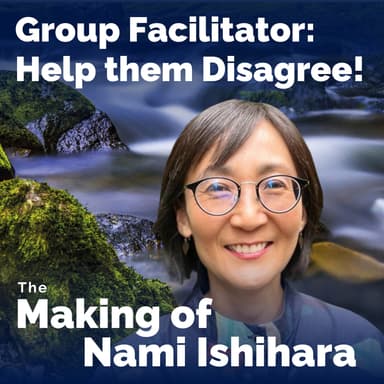
Becoming a Coach with Nami Ishihara: Navigating Belbin Team Roles & Intercultural Communication
with Nami Ishihara, Facilitator improving team performance
Transcript
Edited for readability: filler words removed, names checked. It may still contain errors. The audio is the source of truth.
Introduction and Initial Frustrations
Nami Ishihara
I really couldn't stand their meetings. Everyone was required to attend.
And these meetings would go on for hours. It was just really long and terrible and boring.
I don't want to generalize, but I'm going to generalize.
Cultural Insights and Personal Journey
Nami Ishihara
In Japan people don't like to be openly confrontational. We all know that different opinions, and allowing people to feel free to express those differences, ultimately lead to a better decision.
But people have to feel safe enough to do that.
Tobi
Today I spoke with Nami Ishihara, a group facilitator and team building expert.
Nami's Professional Path and Challenges
Tobi
She works with the Belbin team roles, and on this podcast we really unpacked the Belbin process from a facilitator perspective.
Intro
Tobi
As usual, we started our conversation with a deep pictures warm up, and we worked with the metaFox positive psychology cards.
Nami chose an image of an unsteady river flowing over mossy rocks. For her this was a metaphor of her unsteady path, living abroad and working different roles in management consulting and in academia.
Finally coming to terms with the fact that she failed, or at least stopped, her PhD, and then taking ownership of her own story and going her own path towards group facilitation as a profession.
Nami Ishihara
When I saw this image, I pictured a river flowing, but it's not straight. There are lots of bends, there are lots of rocks, and there are some side currents flowing off to the side. So I can imagine that if I'm floating down this river, maybe I'm trying to get somewhere, but the water is carrying me somewhere different. Those are the features that stood out for me.
Because fundamentally, being a facilitator is not something that I chose from the beginning. It's something I kind of fell into. It wasn't a path that I set for myself and said, okay, I'm going to be this.
And then I've moved around a lot. So every time I've had to move I had to adapt my practice to where I was moving. So I think that is the river part: being able to adapt, and also being thrown into different situations.
Cont[00:02:24] Childhood and Cultural Identity
Tobi
So you are Japanese. You grew up in Japan, but then you just told me you actually lived in the US and in Laos, and that's also where your two children were born. And right now you're based in Indonesia, right?
Nami Ishihara
Yep.
Long story short, I was born in Japan. My parents are both Japanese. My father worked for a Japanese company that had offices in the US, and we lived in the US for eight years when I was growing up as a child. I have always felt part of me Japanese, part of me American.
And I went to school in both countries, moving back and forth. As I pursued my studies, I became interested in the Middle East.
Academic Pursuits and Life Changes
Nami Ishihara
So I majored in political science. I studied politics of the Middle East. I actually lived in Israel for a year. And I've always considered myself an outsider-insider type person, because I have never really fully belonged in any one culture.
I've often been a kind of cultural bridge between my parents or my friends. After a lot of different life events, I started to work with groups, facilitating their workshops and retreats, helping groups make decisions together and also plan effectively.
When I started doing that work, I think my upbringing of living in different places really influenced my outlook as a facilitator. I think being a bridge is one of the threads throughout my life.
Tobi
Let's stay in your childhood experience. You said you went to school in Japan and in the US.
Looking at these two systems and ways of education, how did you perceive that?
Nami Ishihara
Well, as a child you experience it thrown into it. You don't have other frames of reference, so I did the best I could. I lived in the US from age 6 to about 13, so you can say that my base was already kind of Americanized, at least in terms of my schooling, but at home we were a very Japanese family.
When our family moved back to Japan, I had this strange sensation that I could understand what people were saying, but I couldn't really understand what was going on.
Wanting to fit in, but not really wanting to fit in. I remember that being a big struggle in junior high and high school.
Tobi
Listening to you, I was reminded of watching Shogun, the Netflix series about this British guy arriving in Japan in the 16th century or so. There are many small instances of individualist culture, which I guess you have a lot of in the US and also Europe, and then the Japanese understanding of being part of a society, a strong sense of honor and duty.
Nami Ishihara
There are elements of that. I think the honor and duty part is over-glamorized, or something. In the public school in Japan, one of the first things I noticed was that we were expected to do things in groups.
It was called han, which is groups of maybe four or five kids.
That is certainly one element. Although it always seemed a little too simplistic to divide cultures in terms of individualist or group. Back in those days, 20, 30 years ago, people really thought in binary terms: you're either American or Japanese, or you're Western, Eastern, Oriental.
I take issue with that, because I found a lot of elements in American society where it is actually very conformist. Japanese society does tend to be more group oriented, but at the same time
there is room for individual expression.
Tobi
I see. I can see lots of foreshadowing of you then working with groups on the one hand, but then also working with Belbin team roles instead of, let's say, MBTI personality types.
Transition to Facilitation
Nami Ishihara
Basically I worked for a while as a management consultant, doing international work, and then I thought that I really wanted to teach, to go deeper into research. I've always loved to figure things out and to teach.
So I did a master's in political science and then went on to do a PhD. But in the middle of my PhD I had some major life changes. My husband found a good career move for him.
We decided to move to Vientiane, Laos. I thought, maybe if I move to another country it might help me overcome this block.
And in hindsight, maybe I was trying to escape my troubles. So we moved to Laos as a family. But then I found myself in a very far away country, with no work because I had to stop teaching.
Two really young children, in a totally different country, and no idea what to do. So this was my first crisis. It was like a life crisis.
Tobi
And if you look back at that, how did that mold you into the group facilitator you eventually became today?
Nami Ishihara
It was maybe the hardest decision in my life, to quit the PhD.
And I think if someone asked me, what was your first step to becoming a facilitator, I would probably say the first step was to quit my PhD. For practical reasons I needed to finish that chapter and say, okay, I'm not going to pursue this path anymore. Until then I was constantly thinking, maybe I can go back to it, maybe I'll try to find a job in a related field. And I was doing short term consultancies, like two or three months.
But they were not exactly what I wanted to be doing. So when I decided to completely quit, it was difficult, because I had to admit to myself that it was not right for me, and that yes, I made some bad choices.
I had some responsibility. And I felt guilty, because there were many people who sponsored me and I felt like I was letting people down. So that was really hard.
But I said, okay, I'm going to close that door. And then other doors started to open.
Tobi
You just mentioned the word defeat, and it sounds tough. At the same time it sounds very empowered. You take ownership and say, okay, this is not it, I will now do that instead. It also seems like a powerful switch towards self employment, taking charge of your own path.
Did you experience it like that? Or does it only look like that when you look back at it, and it looked very different in the moment?
Nami Ishihara
That sounds nice, the way you read it. But the way I was experiencing it, it dragged on for two years. So it took me two years to really make that decision. I wish it didn't take so long. But you know what, it is a kind of regret.
Tobi
What advice would you give yourself back then, and maybe other people who are in a similar spot right now?
Nami Ishihara
Quitting something is actually courageous. It takes a lot of courage. Because for me it meant, I didn't think that I was a failure, but I was telling myself that, okay, you're a failure.
You failed at something. And I didn't want to think of myself as a failure. But the reality is, yes, I stopped the PhD, so I failed in that. And at the same time I think it was brave. It was brave of me to say that. And I kept getting questions from people.
Why did you quit? Are you going to go back? And I say, nope, no.
Tobi
What role does culture play here? Because I imagine you were also exposed to the American spirit of being proud of failure, thinking of this startup culture. You could look at it as, your first venture failed, now you learned this and that, and now you move on to your next one. It doesn't sound like you saw it that way, despite having grown up in the US to some extent.
Nami Ishihara
No, I didn't, because I had already invested a lot of time and money into it. But then I'm sure the startups would do that too. And I guess in terms of culture, there is a self imposed part, but also from society, from my parents. They were like, what went wrong?
Why are you doing this? And of course I didn't have any other prospects, which was worse. It's like being unemployed. And then also the identity issue of, you're just a stay at home mom, you're a trailing spouse, you're just following your husband.
All that kind of labeling that I put on myself, and that I think people also put on me, that I was very aware of.
Tobi
And how did you work yourself out of that?
Nami Ishihara
I didn't like it. Of course, no one likes to be labeled in those ways. But at the same time, some of it was true. Yes, I am a stay-at-home mom. And I am also interested in a lot of things.
Volunteering and Leadership
Nami Ishihara
Maybe this could transition into the volunteer work that I started when I lived in Laos. I met a group of other women who were part of this volunteer group. It was called the Women's International Group. It was a group of mostly expat, or foreign, women.
Many were spouses of men working in different organizations. When I first met them, to be honest, I thought, people looked at them as just housewives.
The reality was very different. I met women mostly older than me by decades, 10, 20 years older, who had taken care of many children, who had managed multiple moves across continents, and who had lived in a lot of tough situations in different countries in Africa or the Middle East, not safe countries.
And they were very brave, and they did what they could. I really respected their lives.
Tobi
You focus a lot now on the wife aspect, but you had seen a world that other people can only dream of. You had worked as a management consultant. You had maybe not finished the PhD, but you had got that exposure to academia at a very reputable university. And yet you don't seem to see that much yourself.
Nami Ishihara
I think at the time I really went back to asking myself, who am I and what can I do? What's my value? And yes, from my experience, my upbringing, my education, maybe I have a wider perspective.
Academia is a quite narrow, very specialized field where everyone is like each other.
People tend to be similar. You go into academia, you're competing over the same grants, you're writing papers and you're critiquing each other. It's a pretty narrow scope of people, and a specific kind of intelligence is valued. It's very verbal.
It's very cerebral. It's critique based. So it was that kind of world that I was in. And then going from that to meeting a very wide range of people. Just very different kinds of people than I was used to.
It really made me realize that the world is actually wider than what I know.
Tobi
And what resource did you take from that for your group facilitator role in future?
Nami Ishihara
I think because I had to change careers, and as I said I quit my PhD, I feel like I can connect with a wide range of people. I can talk with them and I'm interested in where they're from or what they're doing.
What do they find challenging? Who are they? What do they care about? And being a mother helps. I'm not saying you have to be a mom to connect with other moms, but it helps to have kids and to experience that. So since then, when I moved to different places, I don't feel that intimidated talking to people who come from very different backgrounds.
I just talk with them as they are, as people, and I assume that they're interesting. I assume that their lives are very interesting.
If you think that you know it all, and I have to admit I do have this tendency, like, I think I know it, I know what you're going to say. But we have to have that curiosity. It's so important.
Tobi
I agree. I think it's such a powerful connection skill.
Facilitator vs Coach
Tobi
I would like to cycle back to our first conversation, when I said it would be great to get you on the Making of a Coach podcast. And you were very focused on that point: I'm not a coach, I'm a group facilitator. Why do you find this difference important?
Nami Ishihara
In the practice that I follow, being a professional with the IAF, the International Association of Facilitators, a global professional association and accreditation body, the actual term is group process facilitation. So it is the work of helping groups achieve their goal.
It can be to make a decision, a plan, or maybe to improve the way they're working together. Whatever they want to achieve, a facilitator is someone who helps guide the process. It is a focus on the group dynamics and the group conversations. I regard my job as helping those conversations go deeper, be more meaningful, go more smoothly, making sure that they arrive where they want to go.
And coaching, I'm not a coach, but I know many colleagues who have also trained as a coach. Coaching is more individual. I know there are also coaches who work with groups, so more group coaching. And there is a certain degree of overlap.
But that said, there is certainly a different set of skills, and maybe the competencies are pretty different too.
Tobi
Makes sense. How did you then get from this volunteering work onto this path to become a facilitator?
Nami Ishihara
For me it was two paths that converged. The first path was that I started volunteering with this organization. This was a group that did fundraising and then used the money on small projects to benefit the local community.
I became the project manager. I was helping organize volunteers, helping raise money.
Tobi
You also had a leadership role there, right? You were leading a group or a team of 170 people from 30 countries.
Nami Ishihara
Yes, I was. The reason why I started doing that is that I really couldn't stand their meetings. I first started as a regular volunteer and then I became the manager of the health project. And everyone who was a manager was required to attend executive committee meetings once a month.
And these meetings would go on for hours. It was just really long and terrible and boring. There was a lot of under the table fighting, political trafficking, all these things.
And this is a volunteer group, but these were pretty serious conflicts going on in there. I just couldn't stand it. I thought, okay, I love what we're doing, but I hate the meetings. And at a certain point I thought, I want to become the president so I can change the meetings.
Tobi
Which again is some foreshadowing of a future group process facilitation role.
Nami Ishihara
Yes. I thought these meetings were so bad. Do you know Robert's Rules of Order? It's this book that was popular in the US, I guess in the 1950s or something. It's a rule book that many nonprofits use as a procedure book for meetings.
There are certain rules, like you have to say a certain thing to raise a motion. But the point is that people have to follow these steps, and if you don't follow them it's not valid. There is a lot of emphasis on this procedural aspect and not so much on the conversation or the real discussion.
So the real discussion was not happening. Maybe that's what's happening in our politics today. There was a lot of posturing and a lot of positioning, but not a lot of, let's explore this together, or what could be a different way of looking at it, or are we really considering other points of view?
Let's hear from other people who are not part of this, let's cast a wider net, and not just take a vote. How about we consider the issues a little bit more before we take things to a vote.
So there were a lot of things about the decision making that really bothered me, that I wanted to change.
Tobi
Maybe at this point let's break the chronological order of your journey a bit and go right into this consensus finding process.
Facilitation Techniques and Challenges
Tobi
Because I read this article of yours where you describe the fine art of fostering dissent in a group as a facilitator, and doing that in an authentic way. Can you take us into this problem space, maybe on the one hand from your participant perspective back then as a volunteer leader, and also today from a facilitation perspective?
Some cuts
Nami Ishihara
For me it's a really interesting topic. I'll tell a short story. This happened with this particular volunteer group. I remember walking into this meeting, there were about 20 people seated in somebody's living room.
The regular members were talking and they were coming to a decision about something really important. And then this lady walks in, she's from another project, and she says, I don't know why you guys are all spending this money on this one person, one child. Wouldn't the money be better spent if it were more evenly distributed, so that you can help a larger number of people rather than putting it all on one person?
Why are we arbitrarily choosing this? And then the room just went up. Everybody created this whole uproar. And I remember thinking,
as an outsider who had just come in as a new member, she has a point, actually. But they shot her down. She didn't even have any time to go further.
But I thought, that's an example, especially if you have several members in there who have power, or who are especially passionate, or who are invested in an issue.
People tend to follow the opinions of those who are stronger or more powerful, or who have the louder voices. And I saw it in action: the drive towards consensus, when other options aren't considered, when there's no space for that discussion, doesn't always lead to the best decision.
I remember seeing that and experiencing that. And then later on, when I learned about different techniques for helping groups make decisions together, usually the emphasis is on the building consensus part. It is an important part. But I'm always reminded of that incident, and of the value of having that dissent, of that person or those people in the room who don't agree or who have a different viewpoint. Even if the viewpoint is wrong, even if the viewpoint is an old way of thinking, there's value in it. Because if that person can have the space to speak freely, then it gives another person the courage to say, actually, I have another idea. It opens up the space.
Tobi
That reminds me of a book we read in the metaFox leadership team this year, The Five Dysfunctions of a Team.
I took one point from this book, which is that successful teams know how to argue well, and do argue.
How do you make that happen as a facilitator?
Nami Ishihara
That's hard. Especially if you're in a conflict avoidant kind of culture. Usually people are really scared of conflict. I don't want to generalize, but I'm going to generalize: in Asia, or I know in Japan certainly,
people don't like to be openly confrontational. But we all know that conflict, or disagreements, different opinions, allowing people to feel free to express those differences, ultimately leads to a stronger, better decision.
So it's actually better. But people have to feel safe enough to do that. There are some practical things you can do. One, give people time and space to write, to write on paper first before calling on people.
Asking them to express something, or asking people to write anonymously. Maybe using an app like Slido or Mentimeter, using it online so that nobody knows. Or, if you're in a group that is hierarchical, where there are managers and non-managers and people doing different roles, I might divide people up so that people at the same level are together. Rather than have the boss and the subordinates in one group, I might separate the management from the group and have them discuss amongst themselves, if that hierarchy is a factor.
Tobi
The boss being in one breakout together with other team members would basically sabotage the group, even without intending to, by voicing his intention.
Nami Ishihara
Even the most understanding, most open minded person. Even then, just the presence of that person could impede expression.
Tobi
So number one was, ask people to write down first and only then go into discussion. I imagine that helps because people have written this down, and then they are more likely to express their original idea. Even if somebody else expressed something opposing, I still have it in my notes.
Nami Ishihara
Yes. Having it written down is great, powerful.
Another technique, maybe you've heard of one, two, four, all. It's this gradual progression of sharing or expressing your thoughts, first as an individual.
So you have a few minutes to reflect and think by yourself before you hear what other people are thinking. You first have a chance to formulate your ideas on your own, and then maybe you share with another person, in pairs, so it feels a little bit safer than having to share it in a group. And then once you get the confidence, oh okay, I'm not the only person who thinks this, you have the chance to modify a little bit, or maybe you get a different idea from the other person, and then you can move on to share that idea with a larger group of people, let's say four people or six.
So that's another technique that a lot of facilitators use.
Tobi
Did you know that when you were leading these large groups and the large meetings in the volunteer work? How did that come about?
Nami Ishihara
Around the same time that I became very active in the volunteer group, I started getting requests to facilitate staff retreats for international development agencies based in Laos. This was by chance, because a friend of mine happened to recommend me to be a facilitator because I used to teach.
For her, that was qualification enough. And I was so clueless. Probably the person hiring me wasn't particularly picky about facilitation. In the beginning I didn't know that there was even such a thing as facilitation. I was like, what is a facilitator? What does a facilitator do? I didn't even know.
They wanted to play some team building games. So I just searched team building games on the internet. I put on my teacher hat, I guess. And then gradually I started doing a bit of research. What is facilitation? What are the tools? What are some of the techniques? I was very lucky, because I had this volunteer group that I could work with.
And experiment on. So I tried out a lot of these techniques that I was reading about with this group. I also gathered a group of friends who were interested in facilitation, and we started a study group. Because in Laos at the time there was obviously no school and no training course that we could take.
I bought a few books, made photocopies, and we went through them chapter by chapter. That also helped.
Discovering the Facilitation Community
Nami Ishihara
And then about two years after that I attended my first conference, the IAF, International Association of Facilitators, Asia conference in Singapore. That was in 2014.
And that was the defining moment for me, to be in a room full of facilitators. Really an amazing experience.
Tobi
Because until that point you had been sort of an autodidact, coming from these very long meetings, then having teams where this productive dissent didn't work. And coming from this frustration you said, okay, let me learn this. And let me also try this, because you were in this volunteering that you perceived as a safe environment to experiment and learn by doing. And I guess then, getting in touch with IAF, this world opened up. Wow, there are so many people who actually do this for a living. How was that?
Nami Ishihara
It was really eye opening. Because until that point I was not really knowing whether other people also experienced what I was doing, or the things I was struggling with. And I also didn't know where to start. Other than just buying books and reading them, how can I learn more?
And then when I went to this conference I met other facilitators from Singapore, from Australia, from all different parts of the world, and they each had different paths. Some people worked within a bigger organization as an internal facilitator. Some people came from the agile world, which is really interesting too.
Other people came from an education background, they were using facilitation as educators, and then also people who do graphic recording and graphic facilitation. And this group was just very welcoming and friendly, and very curious and open, learning from each other.
So I really thought, I want to be part of this. And I heard about this certification that they were doing. I thought, okay, if I'm going to make facilitation my career, I want to be able to call myself a facilitator. So I want to try to get this certification.
And that's when I started to intentionally try to learn more about facilitation and get more training in it.
Midway?
Tobi
And how did you decide your own path? How did you eventually end up with Happy Teams? How was this path of arriving at this brand, and what makes it unique?
Nami Ishihara
I have to adapt always to where I am, to the context. Where I started facilitating in Laos I was very lucky, because it was a fairly small community of international organizations that I was working with, and it was pretty easy to get jobs. They were looking for not very specific types of facilitation, but rather general things, like meeting management and team retreats. So I could be a generalist. I didn't have to say, this is the specific kind of facilitation that I do.
But then, when I moved to Washington DC with my family because my husband got another job, it was totally different, because the market is much bigger.
There are a lot more facilitators, consultants, coaches, people doing similar types of work. And when I would mention, oh, I'm a facilitator, I want to do group facilitation, they would say, well, what kind of clients, what kind of issues? Because at that point I didn't really have a specialty.
I said, well, different kinds, and quickly realized that this is not enough. I needed to have a niche. And for a while I thought, okay, what can I do? Because of my background, it's probably to do something about intercultural work, helping groups of people from different backgrounds talk to each other, and something about building teams, because that was what I was really passionate about.
So the idea of focusing on teamwork I started developing in the US. And the happy part, I have always thought that being happy is a condition for success, not the other way around. Happy in the sense of really doing meaningful work, doing things for others.
Happy as in fulfilled, and happy as in our relationships.
Creating a Safe Space for Team Members
Tobi
And maybe also happy as in safe to disagree.
Nami Ishihara
Yes, and being accepted for who you are, having the feeling of, okay, I can be myself, I can say what I want, what I think, in this group. I don't have to feel like I have to police myself. And at the same time it's not only about me, it's about other people.
Okay, how can we do this together? It's that spark, or that sense of, we're doing something that's about more than just me.
Tobi
So I learned that coming out of this frustration of being a leader of large volunteering teams, having meetings that drag on, having people who have good ideas but are not able to be heard because of a tendency for consensus, that is what drove you to professionalize in the facilitation world.
And then when people asked you, okay, what is it that we can get from you, you started to make teams really your thing.
Introduction to Belbin Team
Tobi
And if I look at what you do today, I think one of your most important tools in working with teams are the Belbin team roles. Can you explain a bit, what are these, and what do you appreciate most about them?
Nami Ishihara
Belbin team roles have been around for a long time, since they were developed in the eighties or nineties. What I appreciate most about them is that it's behavior based, meaning it's based on observable behaviors of people in specific team contexts. So it's not so much about who you are internally in terms of your innate personality.
It's more about the observable clusters of behaviors, as they say, of how you contribute and how you are on a team. Because I deal with teamwork, I find that it gives people a language to talk about their own strengths and contributions, and how they like to work, their preferred work styles, in a language that is not judgmental, because there's no right or wrong, better or worse.
It's just your type. And I also like the fact that you're usually not one type, you're a mixture. Usually you have one or two dominant or strong roles, and you have a few weaker roles that you don't like to do and that you're not that good at.
Understanding Strengths and Weaknesses
Nami Ishihara
And there is this idea that your strength is also your weakness. So what you're good at, if you're not careful, the flip side of the coin, has the danger that it will detract from your strength.
For example, there's one role that's called a shaper, someone who is very driven and can drive the team to get results. They're the ones saying, come on, we need to do this, driving towards results. That can be a very positive thing. But the flip side is that they could be, unintentionally or intentionally, hurting people's feelings, or ignoring people who have different ideas.
So if you think about it, every strength is also a potential weakness.
And then there is also this idea that we are adaptable. So in a different context you might have to stretch yourself a little bit to fill a role if there's nobody else doing that role. For example, someone who's checking the details, dotting the i's, making sure that the document is well prepared and there are no spelling mistakes.
If there's nobody on the team doing that, it might not be your number one preferred role, but it might be something you could stretch and do.
Tobi
So I have certain roles, certain preferences, maybe like in other personality type models, but it's all focused on the outside behavior. And let's say I'm usually not the one focused very much on the nitty gritty details,
but now we are in a situation where we want to launch this new product and we really need to make sure it's getting out right, because we want to print 500 pieces of it. Then I can stretch to do this detailed work, even though it's not my number one preference.
Nami Ishihara
Yes. You can think of it in terms of strength. And usually, when I do this workshop, I'll often start off with an exercise where
I ask the group to do something together. Let's say I give them instructions and say, okay, you're going to draw a picture of something that represents what you have in common.
And then you always find that there's always somebody who's like, okay, let's do this idea, or who translates the ideas into action. So in any team effort there is a similar set of, you can call them roles, or behaviors, or you can call them strengths, a combination of strengths that are required for any team endeavor.
And it's pretty universal if you think about it. And usually one person could fill multiple roles, strengths or roles, and you'll find that happening a lot. It's this idea that we are flexible to a point. You can be flexible to a point, but we are most successful when we are playing to our strengths.
Tobi
That makes a lot of sense. I really like it.
The Belbin Assessment Process
Tobi
And what does that look like? If I now engage in a Belbin journey with you as a facilitator, what does that look like from a participant, team member perspective? Do we start with an assessment and then we meet for a workshop? Can you take us into the step by step process?
Nami Ishihara
I would ask each of the members of the team to complete the assessment. The assessment itself takes about 20 minutes to complete, but you are required to ask a minimum of four, maximum of six external observers to assess you. And you can choose who you want to ask, but usually it should be at least several people from your own team that you work with on a regular basis.
So you have what you think of yourself, and then you have what other people think of you. At the workshop, as a facilitator, I would share the results. You get to see if there's a difference between how you see your own contributions on the team and what the other team members see.
And that's a very, very important aspect of it.
Tobi
I can imagine, to have my own self image reality checked with how other people see me.
How do I ask these other people? Do I send them a survey invite?
Nami Ishihara
Yes, it's all done through the Belbin website, and if you check, it's pretty straightforward.
There's almost no point in doing it just for yourself. You really need to have the external observers for it to be a complete profile.
Tobi
And how does it continue in the workshop then?
Applying Belbin Insights in Workshops
Nami Ishihara
I would probably first start out by looking at the report.
We also talk about your strengths. Are you exhibiting those behaviors in that team? And if so, what aspects would you like to become better at, or emphasize more? So there's a personal aspect, but there's also the relationship with the team aspect.
So part one would be reading, thinking, reflecting on your personal strengths and maybe the gap between how you see yourself and how others see you. And then part two would be, let's draw a picture of what roles or what strengths we have in our team. When we look at the collective picture, what strengths do we have on the team?
Where are the gaps?
Tobi
Let's say in a team where we have 10 people, there are usually two where there is really a significant gap between self perception and outside perception. How do you unpack that? Is that a self reflection? Is that a peer to peer coaching process? Or do you do that in front of the entire group?
Nami Ishihara
I do a combination. So first individual reflection, and then I give a couple of prompt questions for them to discuss in pairs.
It's usually something very simple, like, do you notice a gap between the strength that you mentioned and the way that others see you?
What could be the possible reasons behind it? Because it takes a little bit of time just to look at the results and understand them and wrap your head around them.
Real-World Examples and Personal Experiences
Nami Ishihara
And actually, when I first took the assessment, I was one of those people. I had a big gap between how I saw myself and how others saw me.
In my case, a lot of my responsibilities as the leader of the nonprofit group were, I thought, external relationship work. We call it connections: finding opportunities externally and bringing those opportunities back.
I thought I was doing that. I thought I was doing a lot of coordinator work, coordinating roles, coordinating jobs. And then how other people saw me: they saw me as quite detail oriented and quite specialist, having a very deep knowledge about one subject. Which was quite surprising for me.
So other people were not seeing what I was doing. That's one example.
Tobi
And how did that change your behavior as a team leader?
Nami Ishihara
It gave me options.
For example, I can continue to do what I think is important, but improve my communication.
I can say, listen, this is what I'm doing, this is what I'm good at, and I want to do this more, and I want to get your understanding. That's one option. Another option is to be honest with myself and say,
this is something that I'm doing, but actually I'm not that into it, I'm not that enthusiastic about it. So maybe I should just ask Susan, she's more suited to it and she would probably do better at it than I am, so I can shift some of the responsibility to her. And instead I do more of the fact checking, taking care of the details, doing the completer finisher role, which is one of the other roles.
And then I could own my detail orientedness more. That way I'd be spending more time doing something that I'm stronger at anyway.
It's a choice. It's opening up.
Tobi
The awareness gives you the ability to own also your weaknesses, if we want to name it like that, and to proudly delegate the things that other people can do better. And if we go through this Belbin experience as a team, then it also brings transparency about who these people actually are.
Probably there is some level of transparency already, but especially when maybe not every team member is super self aware, I guess it can also be really powerful to cultivate this common language of having this role and that role. And now I will always ask you for help when it comes to detail orientation, fact checking.
Nami Ishihara
It's in the language of non judgment. That's really important, because it's easy to fall into labeling or attaching negative connotations to certain people. And using Belbin, or actually any other kind of assessment, if you use it properly, can be very powerful, because it gives people a language to talk with each other in a non threatening way. It also makes people think about leadership in a different way, because leaders are often expected to have certain
attributes which sometimes they don't have. They're strong in other ways, and there are many different ways to be a leader in a team.
And it opens up the discussion for that. I've been in many instances where groups will say, huh, the most junior person is actually the shaper role, they're the driver or the motivator. And the team leader doesn't have to be that shaper, they could delegate more.
They could be stronger in other roles. So it allows the team to have that discussion about who do we go to when, for example, we need to put ideas into reality? Who do we go to when we need to set up a system to do things, to make things orderly? Or who do we go to when we need some out of the box, creative ideas?
Who's good at that?
Ad Break
Tobi
I found this phase of our conversation very fascinating, because right now we are working on something quite similar at metaFox. Nami describes the power of helping clients compare their self perception with an outside perspective. And at metaFox we're building the metaFox Strengths Explorer, which helps you with exactly that, not only in a team building process as Nami describes it here, but also in a one on one coaching journey.
I experienced this myself when I was doing a mindfulness based strengths practice course, and the realization of, ah, this is how other people see me versus this is how I see myself,
was a very powerful experience. This is exactly the tool we are building right now at metaFox. And if you want to try it out, go to metaFox.eu/strengths. And back to our conversation.
Back to the session room
Tobi
So at this point let's go back to our facilitator shoes and to this process. We said there is this pre survey where I, as a participant, ask people how they see me.
Then in the workshop room we have these peer to peer conversations about our results, self perception versus perception of others. And then in part two, you said we take a step back from our own results and look at the entire team results and the composition of our team. How exactly do you do that in the session room?
Nami Ishihara
What I do is, I draw a big circle. In the Belbin method there are nine different roles, and as I mentioned before, usually each person will have two or three strengths. And then I would ask people to write their top two strengths, to write their initials or their name on the circle.
And then we look at it together and I ask them, not knowing that this is your team, just looking at the distribution of where the people are, what would you guess about this team? Because sometimes you'll have teams where a lot of people are clustered in just a few roles or strengths, and then you'll see teams where one role is missing, nobody's doing that. And often there's a light bulb moment where they'll say, oh, that's why we've been having these challenges with our team. Because either we don't have the person doing that role, or there are too many people doing the role, or maybe the way the team leader manages their tasks
doesn't play to their strengths, for example.
Tobi
And what can we do then with that, as a team?
Nami Ishihara
I use Belbin not as an end-all. It's not the only tool you can use to improve teamwork. But it does help to be able to appreciate each other's strengths, and to really know that you can make contributions in a different way. You don't have to fit the mold of one type of team player.
Not everybody has to be a team player. You can make a different kind of contribution.
Tobi
And maybe to specify my question, I'm still in my mind in this workshop room and we just had this experience. How do you now accompany this transition from having this Belbin workshop experience back to reality?
Transitioning Belbin Insights to Real-World Teams
Tobi
How do you make it stick, or what are the immediate next steps that you ask for?
Nami Ishihara
It depends on what the team uses it for, because some teams want to use it for a very specific purpose, like how they want to improve their teamwork, or maybe they're having a conflict and they want to resolve it. So it depends on where the team wants to go. Or do they want to recruit new members, for example.
Not just the technical capabilities, but what kind of team strengths are they looking to fill? That could be one conversation. But in general, first you look at the personal strengths, and the gap between self perception and other perception.
And then part two would be looking at the team. What mix of roles do we have? Where are the gaps? How do we fill them? What does this say about how we work together? What are the areas we want to improve and how do we improve them? We have that discussion, and then probably action steps. Okay, number one, number two, what can we do?
Tobi
What are the actions we could take?
And this is what the team comes up with by themselves.
Nami Ishihara
Yes, that's what the facilitator is there for, to help them have that discussion. Usually, what I just described is a day and a half process.
Tobi
Okay. So the Belbin experience, thanks a lot. I'm sure there would be many other methods we could dive into, but before that I would love to also talk about money.
Discussing Workshop Pricing and Logistics
Tobi
Because I think that is a topic that is generally not talked about enough, and yet it's so crucial in this journey of becoming a coach or a group facilitator.
Let's stay there for a minute and shed light on it. If you sell a Belbin workshop to a team, do you sell the entire Belbin experience and the team is just paying you, or do they also get an invoice from the Belbin organization for using the methodology?
Nami Ishihara
The way that I've done it, and I think different trainers or facilitators can have different ways, is that I handle the ordering. So I charge my own fee, and then on top of that I charge for the Belbin individual reports, which are, I forgot exactly, but like 70 euros or something per report. I just add it to my fee when I write my proposal, if I think that that's what they need.
It's pretty straightforward. I just add the cost to my fee.
Tobi
And it's also transparent. The customer sees, okay, Nami says the best thing we can do is this Belbin thing, so now this will add 70 euros per participant to our invoice.
Nami Ishihara
Yes. Anybody can go on the website and see how much it costs, and I charge the same. I just order the reports myself, because it allows me to look at the results before they can download them. I can print them out and take a look before we get into the workshop, so I know in advance what issues we might come up against.
But there are a lot of other assessment methods out there that use different methodology or different systems. I prefer systems where I can control how I sell the workshop. So actually, I don't think I've ever sold a workshop as a Belbin workshop.
Tobi
Okay. So how do you sell your workshops, and to whom?
Nami Ishihara
As team development, within the wider topic of team building usually, or team conflict resolution. And I use Belbin as one tool, but it shouldn't be the main focus. For me anyway, that's how I look at it. It should be a tool to use.
Navigating the International Market
Tobi
Definitely. And you are working with international organizations like UNICEF and GIZ. Now, having learned a lot about your intercultural experience and also about learning to connect to these very different sorts of people, maybe the hard way, that makes a lot of sense. But how did that evolve from a business perspective?
How did you get through your first paid journeys, and how did you manage to get access to this sort of customer group?
Nami Ishihara
In the beginning I was lucky, as I said, because I lived in a place with a high concentration of international organizations in one small city, and I had the background. It's a small town and everybody knows everyone. When I moved to Washington DC I struggled, because it's a much bigger city.
People there have a lot more experience than I have. There are lots of consultants, very excellent, very high level people. But then I thought, okay, what's my niche? What's my background that I could leverage? And for me it happened to be, and this is also my personal preference, that I seem to connect better with mission driven, how should I say, non-governmental or mission driven organizations, groups of people who really believe in the mission of the organization.
And also groups that have people coming from very different backgrounds, cultures or nationalities, because I can relate to them and they can relate to me. That's been a constant for me, the common denominator.
Tobi
How does the sales process look, and how do you charge them differently? What's your pricing and your package for these different sorts of clients?
Nami Ishihara
In the earlier years, when I was starting out, I didn't know how to charge.
Even now I'm not really sure if I know how to charge, but I know how long things take me. For example, if I'm organizing, facilitating and designing a retreat, let's say a two day retreat, I know that it takes me minimum twice as long as the retreat itself.
Realistically, 2.5 times the number of days. And then after that, if they want me to write a report, it takes me another half a day or one day, depending on the kind of report they want. So I know roughly how long it takes me. And then I ask around, what's the rate? Different organizations will have different criteria for how much the day rate is.
I try to ask around. You never really know. Sometimes they say a price and then you don't hear back from them. Or sometimes they get back to me very quickly and say sure, and then I think, oh, maybe I could have charged a little bit more.
Especially when I'm in a new place, I have to ask around, because there's a range and then there's a market.
Tobi
And where would you ask around? Do you ask the client, if you have a trusting relationship there, or is it rather other facilitators?
Nami Ishihara
I would probably ask if they have a budget. How many days are you looking at? How much time do we have? Do you have a budget? And then I would ask my colleagues, my facilitator friends. How much are you charging? And usually people will tell me, if I know them well enough.
Tobi
So does your client get an invoice for a daily rate of X dollars times five days? Or does your client get one price for the entire experience?
Nami Ishihara
I like to give it as a package, for a process or for a series of workshops. And in my package I always include a follow up.
But sometimes, if I'm applying for a request for proposals, they will have a specific specification, where they expect you to write the number of working hours or days that you will spend on this project. In that case I will give an estimate of how long it will take.
Tobi
Let's talk some numbers. What would this one and a half day team building experience be?
Nami Ishihara
It depends on how easy or difficult it is. It also depends on what the group is like. Is it a small group? Is it like 50 people? Will I need to hire an assistant? Will I need to prepare a lot for this, doing surveys, doing pre-interviews?
And then another consideration is the market, where am I based. Based in Indonesia the rate is very different from being based in Washington DC. So I can't charge the same fee that I was charging in Washington DC. I have to be realistic, because the market is different. If the daily rate is anywhere from 800 to 1,500 US dollars in the US, let's say 1,000
that you want to charge for a day, in Indonesia it would be like a third of that.
Tobi
So you actually do make this differentiation, even when working with GIZ, where you could say, well, this is a German customer, I can charge a German level rate. You still say, okay, it's a German customer, but we are in Indonesia, so I charge an Indonesian rate.
Nami Ishihara
I wish I could charge a US or German rate. I kind of play it by ear, because I'm based in Indonesia, and actually it's an advantage that I don't have to travel. I'm closer to my clients, and I think that's the value I can provide. I can do things for slightly cheaper. And there are other facilitators out there who are pretty good, but we do different types of facilitation.
Tobi
So the answer is, yes, it really makes a difference. There is this geographical component that is quite strong, no matter where the customer is coming from.
Nami Ishihara
Yes. I think we get fooled by that.
Tobi
And let's say we as a company have a new leadership team, and we would say, now we take our leadership team to Bali and go through this experience of growing as a team together, maybe bringing up some elephants that are in the room and resolving them, getting to know our strengths.
That is basically the sort of journey we would go on.
Nami Ishihara
Yes. And sometimes different teams will have a different emphasis on what they want to talk about. For example, a common one is, we want to be able to collaborate better across different divisions or silos. That's a really common one that I get.
The other one I hear often is, everybody's doing their own thing, their own project or work, and there's no sense of them working as a team or as a group. And we want to get to know what other people are doing and maybe explore opportunities for more.
I guess that's collaboration.
Tobi
And to whom have you sold this sort of journey?
Nami Ishihara
Different UN or international organizations. I'm still exploring what I can do here, based in Jakarta.
So maybe going to Bali or Singapore, exploring.
Tobi
And what's your next milestone on that journey?
Nami Ishihara
I think the retreats are something I can do, and they are easy for people to understand. They're fairly compact and you get results pretty quickly. It's short and sweet and quite powerful actually. So I want to sell more of those retreats. I'm looking at the retreats as something that doesn't require a very serious time commitment for the client.
The shortest retreat I've done is just a day. And I tell them it can be in Jakarta, or if not your office, you can rent a nice room somewhere. You don't have to go and spend a whole day traveling.
But it's nice to be in a different environment.
Maybe get out of the city a little bit.
Final Thoughts and Reflections
Nami Ishihara
I will say, everyone has their own journey, everyone has their own particular background, and what will be your strengths will be different for each person.
There was a time when I was thinking, I want to become 100 percent process only, only doing a specific type of facilitation. But actually it's not very feasible.
And even the most successful facilitators, I've noticed, or I've heard, don't necessarily do facilitation all the time. So I'm thinking a lot about that, about being flexible, and how I take the skills and experience that I have and market them in a way that will be attractive.
And use a kind of language that people will understand about what value I provide. I think this is the same for everybody.
Tobi
Taking your own unique story and turning it into the coach, the facilitator, that you are.
Nami Ishihara
Yes. In that way nobody will be able to imitate it. Because only you can do it.
Tobi
Thanks so much.
Nami Ishihara
Thank you for having me.
Tobi
This was super interesting. I feel like there could have been many more rabbit holes to dive into, like NVC, Pecha Kucha, or your experience with IAF. These are all things we can maybe have a chat about eventually, but I think for today we have enough. And I also prefer to go deep into one thing rather than touching on many things superficially.
Nami Ishihara
Thank you. I think this process of talking has helped me clarify what I'm thinking, because I'm not always thinking about why I'm doing what I'm doing. So I want to thank you as well.
Tobi
Thanks so much.
Nami Ishihara
Thank you.
Tobi
This was the making of Nami Ishihara on the Making of a Coach podcast. If you want to learn more about Nami and her team building retreats, visit her website at happyteams1.com. And if you want to learn more about the Belbin team roles, go to belbin.com. If you want to create similar strengths-based coaching journeys with the metaFox Strengths Explorer, go to metaFox.eu/strengths.
And the only thing left for me to say is, thanks Nami for this heart to heart conversation. Thanks to Justin from the metaFox team for turning our two and a half hour long talk into this episode. And if you like it, send it to another coach or follow the Making of a Coach. I'm excited to join the next journey on the Making of a Coach next time, on your favorite podcast app.
Hear you then.