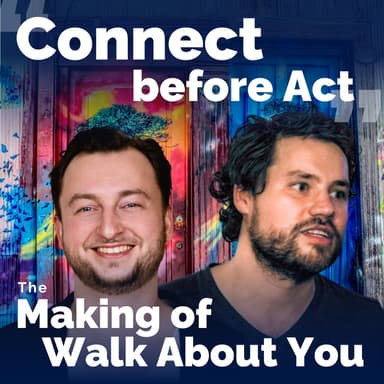
Becoming a Coach with Witali and Kamil: Outdoor Facilitation and Mindfulness Integration
with Witali and Kamil
Transcript
Edited for readability: filler words removed, names checked. It may still contain errors. The audio is the source of truth.
Welcome to the Podcast
Kamil
One of our principles for outdoor facilitation is connect before act. So we go into personal connection, and into group connection, and into connection with nature, before we go into work. We have a business now that works, that we pay our rent from. So it was more about letting things happen and taking time, actually. And this was also a big difference to all the projects we did before. Really taking time, taking time for connection, and not having this fixed plan of how our revenues should be in one year and how our business should be in one year.
So, date before you marry would be my advice. And connect before act.
Tobi
I'll make it as a coach, light the spark inside, empower every soul to turn the tide. I'll make it as a coach, help others grow, changing lives with every story I know.
Welcome to the Making of a Coach, where we unpack how experienced coaches turned their passion into a profession. I'm Tobi, co-founder of metaFox. And this is my conversation with the outdoor coaching collective WalkAboutYou and its two founders, Witali and Kamil.
And while most of my guests here start their journey as a coach with a strong background in psychology and then grow into entrepreneurship, it was the opposite for my two guests today. Coming from careers as company founders, they were striving for simplicity and eventually started offering outdoor coaching with WalkAboutYou.
On this episode we also reshuffled our usual order a bit. So before we unpack Witali's and Kamil's early journeys, let's hop right into the shoes of a team that goes on an outdoor coaching experience with WalkAboutYou.
WalkAboutYou Program Experience
Tobi
Can you take me on a WalkAboutYou experience? Let's say I am part of a sales team with roughly 10 people from a medium sized company.
We have a very diverse team, some young people, some older generation people. And there are also some transitions going on in the business as a whole. How would the experience look?
Witali
Maybe I can start, and Kamil, you can follow with the second part.
We just pick you up at your office. We would start walking quickly. Beforehand we have sent the questionnaire Kamil mentioned, so we are a little prepared. We would start walking and connect people who are not connected within the organization.
There are older people, so we would already say, talk to the person you are not that familiar with. Just go on an easy walk and talk. Like this we would already mingle around and arrive. And then we would take you through a sequence of walk and talk questions.
It is a little bit variable in terms of what you'd rather focus on. Connect before act. On the connection part between the team, we want to derive a certain question: how do we form the organization? What could be a strategic vision of the organization? That is within the sequence of the walk and talk questions.
We would start with opening questions on a certain topic which we would figure out beforehand. And there, as Kamil said, we also have Theory U as an underlying approach. We would guide you through the four levels of listening and talking within Theory U, where they call it downloading, empathic listening and generative listening. We would play around with how deep we go into that topic. Then I pass over to Kamil.
Kamil
Maybe just to add something to what Witali said. Different facilitators, guides, as we call them, have different approaches. Some of them have printed out visuals they take with them, others have moderation cards where you write on them. You can also use flip charts, you can bring whatever fits there. Everything is possible.
The part that Witali described is more like the morning before breakfast. The focus here is mainly connecting, building trust, building psychological safety. And sometimes this topic continues through the whole day. And sometimes we then go deeper into a topic that's important for the whole team.
And that depends on the information, or on what we decided together with the team. After breakfast time, for example, if we do something more on resilience, then we work a lot with outdoor solos, or nature solos, where people go out into nature and have time for themselves, to sit somewhere and reflect on a question.
Which could be with the focus on psychological safety. Find a place where you feel safe. Stay there and observe what happens around you, and ask this place aloud: what do I need to feel safe in this team? And then just listen to what answers come up within you. Reflection exercises in collaboration with nature, for example, and then this is the whole topic of nature coaching. And then you bring the people together and share about that, listen, and come up with conclusions and sharings on this topic. Or we can do something like I told you before, this nature modeling, where instead of using LEGO Serious Play you use natural materials to, for example, build a model of the team.
Of the parts of the team and the relationships. And then we have reflection questions, everybody reflects on the model, and then you build the future with the team and what has to change there, and also maybe what hard conflicts or truths have to be told. So, getting a little bit more into
the emotional part of teamwork. And then, you can do everything. We did something on communication. We did something on feedback. You can do it while standing somewhere. You can do it while walking. If it's cold you do more things while walking. You do appreciation rounds, appreciation showers.
Where you maybe start by appreciating the nature around you, which is easier than appreciating people. And then maybe appreciating colleagues, or yourself, which gets harder depending on what type of person you are. So it's always walking, standing. We also have the context of the breathing group.
People go out, we breathe out, and then they come together, breathe in, and then you have a sharing of what happened there. So you can think of everything, everything is possible in the second part. And the first part is quite often, as Witali mentioned, a lot about connection, a proper check in, a proper time to calm down, and then talking and walking with different levels of listening.
And then we have an end. We take time for a proper beginning, a good middle and a proper end. And sometimes we also ask for commitments from team members. What they're committed to, what little small change they want to bring into the team. Sometimes we also talk about rituals or initiatives the whole team can create around that, so that there is something they can take into daily work life.
And then we have either another seminar or a webinar, where we collect and see what happened there, and from that we move on. This is just to give a picture of how it could be. The second part of the day is more individual. The first part is often similar, because it's about connecting.
Tobi
And in the first part, this is also where you provide content. You introduce people to this, okay, there are different levels of listening, in order to frame the experience and get them into the state of openness, connect before act. While the second part is very experiential, from all the examples you gave. Is that correct?
Kamil
It really depends on the audience. I don't want to put people into boxes, but there are certain types of organizations that are more cognitively focused, and there I sometimes mention a study, or some studies, on why it makes sense to make the path free of skeptical thoughts, and then explain a model upfront.
And sometimes you feel that the group is ready, and then you go directly into the experience. Afterwards you do a sharing and explain what happened there and why it happened. So it depends on how we feel as facilitators, what feels good for us, what feels good for the group. Sometimes
we know the places, sometimes we don't. A basic teaching is handling uncertainty, more than insight.
This is a skill we all need in this world. I would say the high art of working outdoors is spontaneously using the things that outdoors gives you. For example, if there is a steep hill, the question fits better to the group: what's really hard in your team right now?
And talk about it until we're up. You feel it and talk about it. When you go up, you can talk about, okay, what's easy? What helps you to get up this hill? And sometimes animals come. Sometimes other groups of people come. And sometimes you have the intuition and know how to build this in.
And these can be very magical moments, because you can't plan them. We had a couple of times where musicians were suddenly in the forest playing music, and they invited people just to listen to the music, and not to follow the plan that we have. On the other side, you can perfectly also do the same things you do indoors, just outdoors, without talking about any of it, and nature does her work in the background, and it still is different.
These are extreme versions and variations of working outdoors. Everything in between is possible, of course.
Witali
Maybe to add to Kamil, this is also what we try to bring to people in our outdoor facilitation training program: how to build your mindset so that you are able to work with what is around you. What Kamil said, for instance: we were in Hannover at the park, it's a very big park.
We did an exercise on a nature solo, and there was a guy playing the clarinet, because he was hiding from everybody in the forest to play it. And then a huge group from an insurance company came there and everybody was sitting down at some spots. And there was this guy playing, and really well, and this is so magical.
You cannot prepare for that. It takes a certain mindset to build this in. It's goosebumpy, actually, that you can work with that. And indoors doesn't bring you that uncertainty or that playfulness.
Picture Exercise: Describing Your Journey
Tobi
This was a short outdoor coaching experience with WalkAboutYou. Let's cycle back to the beginning of our conversation, when I invited Witali and Kamil to pick a picture that represents their journey as coaches.
And funny enough, out of the 52 deep pictures that I offered them to choose from, both of them selected the same identical photo.
The photo they chose to represent their journey is a photo of two doors, one blue, one red, that you can see on the cover of this episode as well as on video. Let's hear from Witali how he interpreted the photo.
Witali
I have chosen the picture of two doors. Both are next to a tree. And that probably describes the journey well, because I do two very different things. One is where I currently am, let's say an office job, but it's more culturally based, it doesn't have anything to do with outdoors.
And that's my life as an entrepreneur, running a company with almost 80 people now. The other is the coaching thing, where I started by joining programs and seminars. And then I thought, and sometimes still think, oh, this is not that difficult.
Maybe I can do it better. From there I started growing into coaching. That's the other door. Two different colors, two different sides of me.
Tobi
Thanks. How about Kamil? I just clicked the button to change the photo, but we continue to see the photo that Witali has chosen.
How is that for you, Kamil? Is it also the two faces, or did you interpret this differently?
Kamil
I'm surprised we have the same picture. I think you had 52 pictures and your tool is working correctly. We are connected through this. For me the doors symbolize similar topics. I'm also an entrepreneur.
I'm coming from the business background. I'm coming from product development, agile, new work, and all the stuff that's connected to this tech and startup world. And I left this path and focus more on the human side and the natural side of working and living. The left door, the red door with the tree, symbolizes this new path, which is more alive right now, with vivid colors, especially the green tree that's growing, and the red, which shows me that my energy is going more in this direction right now. And the right door, the blue door, for me is more an association with being a little bit cold and not having so much energy, at least in this picture.
This is my old part, about business model design and tech products, which is still important in my work, but not my main topic as a coach or facilitator anymore.
Witali's Entrepreneurial Journey
Tobi
With WalkAboutYou, Witali and Kamil removed the seminar room or the armchair from our usual coaching environment. Their personal journey was a story of reducing complexity. Witali started at an e-commerce business with extremely fast growth and then transitioned into the world of tech startups, with lots of funding, lots of people, lots of moving parts in the product and in the infrastructure.
This made him long for simplicity. His next business, still known today, started as a simple email newsletter that helps you find out which cultural event to attend in your city in Germany. It's called rausgegangen.de.
Thanks a lot for this. And I think we already briefly mentioned it, the first time Witali and I spoke was at an entrepreneurs conference here in Cologne.
The Birth of WalkAboutYou[00:15:10] Kamil's Entrepreneurial Journey[00:15:10] Witali's Entrepreneurial Path
Tobi
So when you look at your making as a coach, at your journey as a coach, how did these entrepreneurial pathways influence your approach to WalkAboutYou?
Kamil
Maybe also related to the story you just told, about how people get into coaching. I think there is also this other way, where people scratch their own issues, because they have a problem, they're going through change, they go to a coach or go to a retreat, and then discover, okay, this is something valuable for many people.
And this was it for me. When I left my company I had time to go on retreats, do inner work, and I never connected it with the idea that I can make a business out of that. I mean, I'm an entrepreneur, but that was not the point why I started to go on these experiences. And then I discovered a course called Search Inside Yourself, designed at Google in 2008, for tech people, by tech people. This connected both of my worlds. And then I thought, okay, it's really possible to bring your startup world and this inner development world together through this program. Visioning and my thoughts came up and said, okay, you can connect that. And it's so valuable for everybody. I wish I had had this five years ago, with lean startup and HR methodologies. Right now at WalkAboutYou we are not the ones who have done coaching for
many years, who have all the certificates, who are the best experts in methodologies and have the best experience. But we reach audiences others don't. This is part of the entrepreneurial DNA we have. We follow a slightly different approach from the book that you get in all the coaching seminars on how to become a coach.
And I had been in this teaching work, this consultant work, a little bit longer than Witali, and Witali came in, and hopefully you will tell your story of how you came to this nature work. Recently I told Witali that I'm happy you're not a consultant or facilitator as your main career, because this brings such a different perspective on the things we do.
And I think this also makes WalkAboutYou different.
Tobi
Kamil, you came from the consultancy world, then you discovered Search Inside Yourself, which brings mindfulness out of the esoteric context into this business context, and they do this really nicely. For me too, reading the Search Inside Yourself book was really transformational. It really resonated with me, coming from an engineering background, how they put this into the business context, and the benefits. Is that how you discovered mindfulness? How was your first time meditating? How were these first steps for you in the mindfulness world?
Kamil
Search Inside Yourself for me was like discovering a new story about mindfulness and inner work. I had a spiritual perspective when I was younger. I remember reading a book by the Dalai Lama, and there was a passage which described meditation, how you do meditation.
And then I practiced it and it worked somehow. I don't know how old I was, maybe 16. And when I was leading my company I used this meditation app that came up at that time. And my partner did yoga and invited me to meditation classes with my teacher Juergen, a regular Cologne guy without too much overload.
And then we went to Asia and Costa Rica, and then Search Inside Yourself came, and this is how it all connected together. But actually the first retreats or programs I took part in were more in this Buddhist direction, the mindfulness foundation within Search Inside Yourself, without talking about it, because it's more based on neuroscience.
But all these things have thousands of years of tradition, wherever you look: Christianity, Buddhism, Hinduism, natural religions, shamanism.
Tobi
If I were to map your journey, you have the consultant business path and the personal development, mindfulness path in parallel. And with Search Inside Yourself and partnering with Witali for WalkAboutYou, you brought these two worlds together. Can you say it like that?
Kamil
Yes, you can say it like that. During my first more intense experiences with mindfulness and inner work, that was where I found the inspiration for WalkAboutYou. With Witali we started to try out things.
Tobi
Witali, let's bring it back to you.
Witali's Transformative Walk
Tobi
I would like to go back to your first years. At some point you said, this is enough, I want to go on a walk. Can you take us back in time? How did this happen? What's the story of you going for a walk?
Witali
It's been five years ago, but I keep saying it's been seven years already. So it actually was seven years. And there I realized that with the company we had gone into a mode of doing things quite complicated. At some point I realized we were working on this cultural space where we say we bring the wine to the people.
This is the claim we use within Rausgegangen, the event discovery platform. And when I looked deep into myself, I realized that I don't want that much wine. I'd rather go for the water. And that's when I realized I have to do something differently. And I didn't know what.
But what I also like about myself is that I'm not thinking too long. I'm just taking the first spark and then following it. And I looked at a map in the museum here in Cologne, and on the map there was a line from Trondheim in Norway to Porto in Portugal. And I had just met my girlfriend a couple of months before, we are married now.
I looked at her and said, oh, let's do that walk from Trondheim to Porto. And she said, oh yes, why not. And, you don't have to tell me why not, because I take it seriously. And then I convinced her, okay, let's do that, and then I started to leave the company gradually.
She left her job, and after that spark of looking at the map, about eight, nine months later, we started in Trondheim to walk to Porto. It was a longer journey.
Tobi
How was that decision making process, leaving your job? Which is something that probably many listeners, aspiring coaches, can relate to. In this case it's not even the self employment, but actually just quitting. Which kind of resistance did you meet, inner and outer? And how was that process?
Witali
First of all, it's the company I created, so leaving that was not that easy emotionally. However, and I see it now looking back, I never left, I just took a longer break. And I realized there already, okay, if I want to return, I can return.
They won't disappear. If I do the process gradually. Because mostly, if you founded a company and leave, it doesn't go well with the partners. I realized by then how much emotion and fire is involved in that process. In terms of who gets how much money and shares, it's not that easy. That took a while. I think I never took too much risk. I never said I'm going to change my life. I just pushed the pause button for five months the first time and took it from there.
After the first five months I thought I'm going to change my life and do everything differently. Then I came back and it didn't last that long, because I went back into my job. I did have quite a lot of energy at that time, but I didn't manage it well.
And then, after working for a couple of months, with this tension of not having finished, I was like, okay, I have to get back on the road.
That took only two months, because I was alone, and I didn't like doing it alone. It was not easy to go through Sweden by myself. And that is also where, since we are talking about WalkAboutYou, the first ideas of taking people on such a journey came up.
And after coming back, a couple of weeks or months later, I met Kamil, and we talked about the journey through Sweden. We thought, why not do something with entrepreneurs? Because that was our matching point. Why not walk with them through Sweden?
That was the first bad idea we had.
Tobi
So it was Kamil coming from innovation on one hand and mindfulness bubbles on the other, basically having that approach to personal development, and you with this self discovery through long hikes, meeting at this intersection of entrepreneurship. Out of that came the idea of taking entrepreneurs on personal development hikes.
Can you summarize it like that, or how was it?
Witali
Perfectly summarized. And we always say, I was the guy walking for thousands of kilometers, and Kamil was the guy sitting and meditating and doing walking meditations for long hours. WalkAboutYou is the intersection of both worlds. And we had the same picture now, I mean, the chance was less than 2 percent, right?
Of picking it. Somehow we very often have the same picture. There is another explanation for sure, but somehow we did those kinds of exercises sometimes, and we often end up with the same pictures. So it was not surprising to me at all.
Tobi
What do you think is the origin of this high alignment in you as a founder team?
Witali
I think culturally, without being able to put it into words, Kamil is coming from Poland, I'm coming from Russia. I think there is a little bit of a better understanding of the background. In the real world it doesn't show up.
But I think there is a little bit of mutual understanding. And also, definitely, that entrepreneurial journey. Even at the same places, we did something completely different, but we were doing it from a coworking space. We were in similar bubbles. What's your perspective?
Kamil
I think our ways are interconnected. Like you mentioned before, Witali, the emotional process of how you left Rausgegangen. You remember one of our first meetings, after I was also in that process with my company and you were still with your company. And we were talking about how to get out, how to stay connected to others. I also can't explain it in words, but we had similar paths and intuitions. Like with the pictures, it's more an intuition thing and not a rational thing that's coming in there, because our approaches are sometimes different. But I think even if they're different, we can understand them, and leave the other their truth.
Tobi
That sounds a bit like a soulmate kind of thing. Of course I'm asking this with other coach entrepreneur partners in mind. Would you have any advice for them from your experience? The different backgrounds or the similar backgrounds aside, is there anything you do on a regular basis to connect and keep that alignment?
Kamil
Yes, there are many things we do. One of our principles for outdoor facilitation is connect before act. We go into personal connection, and into group connection, and into connection with nature, before we go into work. One special thing about where our paths crossed is that we were both open and free and not in a hurry. We didn't have the plan. We have a business now that works, that we pay our rent from. So it was more about letting things happen and taking time, actually. And this was also a big difference to all the projects we did before. Really taking time, taking time for connection, and not having this fixed plan of how our revenues should be in one year and how our business should be in one year.
And at some point you feel it's not working anymore, and that's fine. In our case it worked together and it felt good to go this way. So, date before you marry would be my advice. And connect before act.
Tobi
Connect before act, give it time and stay open. Witali, anything to add?
Witali
I really liked this date before you marry thing. I hadn't heard it from Kamil. It's what I said to my girlfriend when we started the walk. I said, if we're going to keep a hundred days together, walking next to each other and sleeping in a tent, we should probably marry.
That happened, and we have two kids now. So that worked. Date before you marry. Actually in entrepreneurial journeys that is not very often the case. Sometimes you meet somebody and you don't date that long. And I leave it with that.
We had quite a journey before we started WalkAboutYou. When we did our entrepreneurial walk, we went back on the same path where I had walked before, through Sweden, because I had been there already. And it was clear that this was rather a try. There was nothing born at that time, like the idea of creating a whole project out of it. It wasn't the name, but more a placeholder. We just did this first thing together, and there were no strings and no risk attached, except that we put eight people in the wilderness in Sweden, which we had never done before, except me walking alone there. That was a little bit of a risk, but they all survived.
First Steps of WalkAboutYou
Tobi
So let's go back to these early beginnings of WalkAboutYou. How did you find these entrepreneurs who participated in your first experiences, and what did they pay you?
Kamil
As far as I know, before we did the first paid walk we had some smaller things here in the area with friends and colleagues, walking from Cologne to the Bergisches Land around the corner. But this was all experimental. Witali did one and then I joined one. So it was more coming from your experience, Witali, doing the walks.
And then we thought, okay, let's do something and take money for it. The plan came out to go to Sweden for a week, for entrepreneurs and change makers. And we needed a name and a presentation. Me coming from the entrepreneurial world, from the consulting world where I had already sold programs and educational programs, I used my skills there and put a PDF together. I don't know what the pricing was, something like pay what you want, or fixed pricing. Most of the people who actually came with us were good colleagues and friends. They paid for the costs and then gave us something extra, and we had a price just for testing it out. I don't remember so well. And we found the people mostly from our network. And then we did this, and
now, looking back, it was a huge, complex program. From that point on we never did something similar. Shortly after that, it was 2019, Corona came.
So we had to think differently about travel and large groups. But it showed us that we can earn money with this. People liked it, people in decision making positions liked it. And that we can do this together and that we work as a team. With Corona and other small things we got signals that it makes sense to invest more, especially from companies inviting us out with their teams.
To go into the business to business part, where you can make more money and build the organization to be more sustainable on the financial side.
Tobi
So that means the very first steps were locally free walks with friends and family, then you did this complex program. I see a pattern of stripping away complexity, because you never did such a complex program again.
Kamil
It was funny, because I was used to working with groups but I had never done a hike, not even two days, and Witali was used to doing hikes but had never worked with groups for longer. So we added a wilderness guide to our group, so as not to make it too risky.
This was a contact from Italy, so we had at least this part covered. But still we were both overwhelmed with the part we didn't know. So I was really exhausted, and then I was thinking, okay, now I should also guide some exercises. And the people were also completely wasted.
They could barely walk. They didn't want to do any coaching exercises. The second day was really hard, with backpacks and all the stuff. And then we had the sharing circle at the fire. It was raining, cold. The question was, how are you doing?
And people broke out in tears and everything, because there was no protection left anymore. And in the end everything was good. And this is our mantra, and it was always like that. But at some points, at least for me, and I think also for you, Witali, we had to reschedule and replan what we were doing there.
So it was a huge personal development and team development exercise for ourselves in the end.
Tobi
So what I hear is, the team was you two, Witali coming more from the hiking perspective, Kamil coming in more from the group facilitation perspective, and then you had a logistics and security guy so that everybody survives the Swedish wilderness. And then I guess what made this special for the participants was, on the one hand, putting this group of entrepreneurs together.
I think just having this sort of group dynamic of like minded people can already be powerful. And then this element of being outdoors and having this extreme physical experience comes together. You said it was just, how are you. But what else in terms of facilitation approaches did you use?
Kamil
I think we also had walks and talks with question cards that go beyond small talk, to create connection, trust, psychological safety. And some meditations, also some yoga exercises. So a lot of small things, sharings. I don't remember what else, because we stripped it down very much in the end.
And not only the physical exercise helped, it was the nature. We were really remote. It was, I think, one day away from a bus station, a city, a road. It was not like you're at the next corner in one hour. And it was beautiful nature. And it was raining and it was pure and it was raw, and this does something with us.
And this is also the core of WalkAboutYou. We all experienced what it means to be nature, as human beings in a group, and how much that is a part of being human in the end, and how much it is a part of our evolutionary history as a species. And this also brought the connection, the focus.
No phones, no screens, nothing there, and being part of nature. That was a big thing that worked in the background, even without us telling people it works in the background.
Tobi
This was the pilot program for WalkAboutYou. Then you came back and people were happy and giving out recommendations. How did it continue from there?
Witali
I think people were exhausted and happy to be back. But this group actually stayed. All the people who were there, we have, not saying a close relationship, but there are friendships with people we didn't know before. And exactly that group stayed. And then we had to realize, okay, this is way too difficult, what we tried there, also with our skill level. As Kamil said, we had interventions planned, but to be honest we had no plan and no power to do any intervention, except that we had to finish, because it was raining the whole time.
From there we stripped a lot of complexity out of our programs, the way we do them now, based on that experience. It was interesting. First of all a very difficult experience, and then strip it down. We wanted to do similar things for a couple of days, but here close to Cologne.
But those didn't work.
Navigating Challenges and Growth
Witali
First of all because we didn't do good enough marketing, and then Corona came and we had to rethink it anyway. So we didn't have long until Corona, and then we had to rethink anyway. But we tried similar stuff close to here and it didn't work.
Kamil
Yes. And Corona, just mentioning that, also meant for us stripping it down even more, because of travel. We had this advantage, without doing it purposefully, that being outside was actually a good case in Corona times. So it's not a high risk to catch the virus. This was a value proposition we came up with.
Tobi
I imagine it was amazing, perfect timing, because for every coach and facilitator Corona brought a massive change and was a huge disruption. And it was like, okay, now everybody's going outside. We have been doing that anyway.
So at this point, in 2020, you had done the pilot project. The whole project was very important, close to your heart, but it wasn't an actual business for you. You didn't rely on it for income. How did that evolve to become an actual business?
Witali
Maybe I can jump in there, because Kamil said it was not substantial. For me it was actually quite difficult, because I had the other company, Rausgegangen, a cultural discovery thing, and no culture happened. So the company almost went bust at that time.
And this is why I had to be there. We also did WalkAboutYou and all the projects didn't work. So I had both things that didn't work. That was stressful, to be honest. But on the other hand, before that I had lived in a tent for five months and spent 10 euros a day, because that was my budget.
10 euros a day, 300 euros a month. So I was okay with very little, and it was not too stressful in terms of financially sustaining myself. In terms of how that evolved, I also couldn't really tell myself that this coaching aspect can be a project I can live from, because I had never experienced that before.
I had never written substantial invoices for coaching and I didn't know that you can do that. And I also told Kamil, I cannot take money for walking with people, because I want to do it anyway. So why should I take a lot of money? And he was the one trying to convince me.
Let's do it a little bit more business like.
Tobi
What we have here is not just a hobby, but a business.
Witali
Yes, it can become one, because there is a need and companies are paying. They also employ consultants who do strategic things. So why not work on the human level as well? I didn't know this world existed, because I was always trying to sell products for little money.
And now this whole coaching world came into place.
Tobi
Your acquisition strategy, or your target groups, are B2C, and then on top of that, I guess where you actually make the money, is working with businesses. How did you arrive at this model?
Transition to Business Clients
Tobi
How did you acquire your first business customers?
Witali
The business customers came definitely from Kamil, who was more from the B2B world and had his contacts there. He was telling them, I'm now doing this new thing called WalkAboutYou, do you want to try that?
And as we did B2C walks, where people could just join, we got a lot of experience in doing that, and also realized that it works in different constellations, with different group sizes. It gave us a lot of credibility.
We had already done a lot of formats with end users. There the connection didn't really work so well so far. Every end consumer, everyone who takes part in the open programs, is also working somewhere. That connection to B2B doesn't work well so far.
Tobi
So we have both columns. You would say the B2C serves as experimentation and a practice ground to develop the program. And then, I imagine, as you said, to get credibility, to collect testimonials from happy clients. But let's dig into how you got from organizing programs with friends and entrepreneurs,
still friends and consumers, how did that evolve into a profitable business with actual large business customers?
Kamil
If you want to build a business, especially in this coaching sphere. For us it was more an organic process. As we said, we took our time, we experimented, did public programs with friends, then they brought their friends, and most of them work somewhere or have their businesses, and then some of them came to us and asked, hey, do you do these things also for companies?
Can I do something with a team? So this was one way, one approach, how it started with B2B and with paying clients that pay enough that you can do something with it. And another one, especially for me: I was already working with organizations on topics like leadership, like team development, Search Inside Yourself, that I talked with you about, and people knew me and
wanted to work with me, and then they asked me, what can we do with our team and business unit? And then I always recommended, we can go out there and do something outside. And I was convincing, I guess, and also believed this is a good way to do it.
And then we had our first business customers. The first one was also a friend of mine who had a startup at that time and who also likes to hike. I don't know if he was already on the public program, but at least he knew me. He loves nature, he goes hiking, and then he said, okay, let's do something with our team.
Another one was a company I was working with, where I was teaching other programs. And there a person came and said, hey, we have a new team, can we do something for better connection, on values and all the things you can do? And then I said, okay, let's do something outside, let's spend a day outdoors.
The Power of Word of Mouth
Kamil
And this is how the first, not scalable, acquisition channels were born. And from then on, I must say our most important acquisition channel is word of mouth. People love the experiences, they talked about it, posted about it on LinkedIn, and this is still something we are gathering: all the LinkedIn posts where people tell others and their friends why they like it and why this is a good idea.
And this is possible through these great experiences, not only through our work but also through nature, being outside, the full package. We also tried things that others are doing.
Leveraging LinkedIn and Content Marketing
Kamil
We focused for a while on LinkedIn, so we post there. We have a newsletter, we have content, we have tools that people can download where we gather the email addresses and they come into our whole marketing system, which is not perfectly automated and working seamlessly as it could be. We know we have homework to do there, but it's enough for us to move on at our speed. And again, we are working in a network. All the people who work with us also have other projects and other work. So it's not like we have to pay 10 or 20 people on the payroll. We can grow in the way we like to grow.
This depends on our focus and all the things that we do. And there are so many opportunities. The question is,
Exploring New Customer Acquisition Channels
Kamil
what is maybe our next big channel for systematic customer acquisition? We also had webinars, so we tried a lot of things, and now we're at the point where we can maybe double down on a channel or initiative. But right now it's growing organically, and this is enough for this stage.
Tobi
That also sounds a bit like, initially what you had been doing was a cross selling exercise. You were working with businesses as an innovation consultant. They already knew you, they already liked you as a facilitator. And then you were saying, look, guys, I have this new product, we go outside.
We work on you as people. We work on your inner development. We work on your team. And there was already this trust established. Let's say this wasn't there.
Starting Out as a New Coach
Tobi
Let's say I'm a new coach starting out and I would like to make this move, going into B2B acquisition. How did you do it back then, maybe with the Make It company? Any advice or learning points from this journey?
Kamil
It was quite similar. We also had open programs, events, teachings, workshops. When people came there, it was more focused on B2B people, but they came as individuals. And then they liked it and they booked programs for the company.
This is the same thing happening with WalkAboutYou now.
Adapting Public Programs for B2B
Kamil
And our current public programs, we adapted them to fit better for people in the work context. When we do inner development goals, a lot of coaches come there, a lot of people who work with organizations, and not so many private people who want to work on their inner development skills, for example.
The same is the case for, last year, Witali, you did it with Astrid, a focus walk, which is about attention management, a public program. And there the focus was also on how to manage your attention at work and in life. So, having public formats that target human beings as individuals, but in the work context.
And from then on, when people know you and they experience you, this is something that's so important for coaching, because it's always also about you as a person. In this context you can get to know people. Instead of a short public workshop, this can also be a webinar.
We had a webinar series, for example, a free one, where we had half an hour in the morning, where people could come and experience us and knew us as humans. And from that, trust was built and people approached us to do more. So events as a lead generation channel is something that we did.
Tobi
You call it public programs. I imagine this is webinars, Sunday outdoor experiences for individuals. And then, what I sort of implicitly hear, but I think it's not a given, is that you also have a business offer. When you follow up with these people, you have a package that says, this is something you can do with your team, your company, and it costs X. How does that business offering look?
Creating Business Offerings
Kamil
We don't have this explicit business offering publicly on our website yet. We're working on that, with all the knowledge we gathered in the last years. But what we do right now is telling people that we do offerings for companies, for organizations, let's talk. And then we go to a first meeting, and we listen,
and try to understand what the problem is, the challenge behind it. And then we offer something. And of course we have our packages, so we don't have to develop everything from zero. But it's more about getting the first personal contact as fast as possible.
Personalized Client Engagement
Kamil
Listen, what's the challenge, maybe from a half hour meeting. That's my approach: listening 25 minutes, then coming up with, we think we know what to do, we will send you an offer.
Pricing and Packaging Services
Kamil
And then, regarding pricing, we have our official prices which we go in with, and then we see how this evolves. Some organizations can pay that and they don't even ask about the price, others say that's too much, and then we can go into a conversation. So this also depends.
Getting a lead, and then as fast as possible a personal conversation, getting into contact, and then sending out an offer.
Tobi
So there's an individual who attended your program, afterwards you talk about their business, listen, then send an offer. And is that always the same? Or how does it look? Is that a PDF with bullet points and a price tag?
Kamil
We have a PDF now with the core program, the core benefits, value propositions, and also with a price tag, without any big adaptations. And this is something we can send out pretty quickly to give them an overview, and also because sometimes people want to see something before they talk with you.
Then we also send them this PDF. But when we have enough information, we send an individualized offer. So, what we heard you say is, these are the challenges, this is our offer based on that. And then we go into the whole process of yes or no, or maybe, or how to adapt this and how to adapt that.
Tobi
So basically a PDF with a few more pages summarizing what you heard, the current issue, and then saying, let's tackle this with that program.
Kamil
Yes, like the term agile contract development. You get a first draft very quickly, of what you heard and what the proposition is and what we can do. Then you get the response from the client and get into a conversation. It's not assuming all the things in your mind that might be relevant, and then you send it and you do all the work and then the people say, no, I want something else.
It's giving a quick first bite of something to taste, and then getting into a conversation to come up with something that both sides are fine with.
Tobi
How much does it cost if I say, okay, we are a medium sized company, we want to do a program for our sales team? What does the offer look like?
Kamil
How many people are there?
Tobi
We are 10 in the team.
Kamil
10 people. Okay. It depends. Let's say you want to go out one day. Our package includes that we send a questionnaire to your team upfront, and then we will see what the issues are, what the challenges are. We collect some data. We would have another call with you as a team lead, then we will come up with a purpose for this day.
And then we do that day, and after the day we have an online webinar where we gather again and try to integrate it into the daily life of the team. So it's not just a one day experience, but integrated somehow. And for this package, with two facilitators from us, it's 7,200 euros. And with just two facilitators from us, we can do it everywhere. We can come to your location, basically wherever you are, and do it there without additional costs.
Tobi
What is your most important product? Is it the one day example, or longer retreats?
The Importance of Longer Retreats
Kamil
Witali, we decided now that we actually like longer retreats, these offsites. Two or three days, or accompanying a team for a longer time. So for example doing one day and then, in half a year, another one, each quarter a half day. This makes more sense for us and for the team.
Tobi
So that's what you enjoy and what people also enjoy. Is it your bestseller? Or, if you look at the past year's revenue, what did you sell?
Witali
Actually we talked about it a couple of days ago, we have an extra spreadsheet where we have everything. Currently it is definitely this one day, half day, three quarter day program, which we strip down depending on whether we do less, whether we do it with only one person, or we go up in terms of it getting a little bit more extended.
But it's around that one day program, because I think it does take some time to learn about the concept of doing it outdoors. We do quite intense work with people. There are a lot of emotions involved in that, and you need to generate trust.
And after that we can go into the longer ones. Because we already have relationships with teams. They already last for one and a half years. That is where we can do longer programs. It's more interesting for the team, because you can work on stuff.
And for us we get time to deep dive and follow up on topics. And for sure also from the business perspective it's great. It makes more sense.
Tobi
Let's dive into the actual program, how it looks and what methodologies you use, in a minute. One thing I would still like to unpack is something you told me about, Witali. We were talking about the B2B relationship and how that offering evolves.
We learned from Kamil that it's really important to understand the client situation, to listen a lot. But in order to arrive at this first conversation with a potential business client, I learned that you also run open programs, where I as an individual come on a Sunday afternoon, and then it's a two hour thing or something.
How do you advertise that, and how did you price it?
Witali
Historically we started with the one day open, very open topic program, because, as Kamil mentioned, we also try to make it more broad, more business related. Before that it was more personal development, for one day on a Sunday.
But we realized that didn't work well, because we had a price tag of 150 euros per person, and then they say, ah, 150 euros for a walk, I can just do it for free at the same spot, because it was close to Cologne. And it was also really hard to advertise.
The people who did it were really happy. But we always had the difficulty of getting enough people to run it. And at some point, last year, we changed to doing it in the afternoon only, for three or four hours, maybe two hours, but more like three or four hours, and giving it more of a B2B context. Inner development goals, outdoor experience, walk in nature, objective key results, focus walk, focusing on work and personal focus.
And there we do pay-it-forward formats. You can join for free, somebody before you has already paid for you. So they know they come for free, but they have to pay for the next group. And then, after the three or four hours of working together, they receive an email and pay whatever they feel.
We give a price range between 50 and 200 euros, so they have an understanding of where it can be. And people sometimes pay more than 150 euros. Now we do it for a little less time, on a Thursday afternoon, and people start to pay more than we charged before for a full day.
But we changed the topic to be a little bit more business related.
Tobi
You started out asking for 150 euros for an afternoon experience with a personal development focus. Now what you changed is, on the one hand, giving it some sort of business related spin, so that people can maybe book it as work time, or as useful for my professional development, in their minds. And you also changed to a pay what you want model.
And you say you learned, okay, we actually arrive at more or less this price tag of 150 euros on average, sometimes more, sometimes less. How do you present it? Is it on the signup page, pay what you want? And do you explain this whole pay it forward, that you are paying for the people who do the event after you?
Somebody else in the past has paid for you. When do you explain that story?
Kamil
I have to say, there is a whole science and movement behind that. It's not like you can just do it like that, pay what you want or pay what you feel, and then sit at the end and collect money in a box. That's the simplest way to do it. It's more than that. First of all, it's accessible for everybody through that.
Not only for people that have money. This is also on purpose. The story we are using right now is this pay it forward story. There are different stories and different namings you can give this whole process, but it always works the same: people decide how much they give, and pay it forward.
It's more like, okay, the first workshop, we paid it forward as an organization and invited all of you. And then after that, we're working on the topics of sustainability, regenerative transformation, how we can form our economies to better serve us as people and better serve the planet.
And this is about not thinking only about you, but also thinking about others, connecting to other groups, thinking into the future, not only about your personal benefit. We tell people, okay, somebody paid for you. This is how it is.
You can pay for others to have this experience. You're investing in this product, in this topic, you're investing in this education that wants to bring a better economy, life, connection to nature, to ourselves. That's what you can do there. There are many stories you can tell.
One of the quotes that I used recently is the story that in great societies old people are planting trees under which they won't sit themselves. That's a quote that goes in this direction. And you're also bringing people into the process, connecting them to this product.
So it's not, you take it, pay and go. You have to think about it, you think how much is it worth to you, you're more involved. It's actually a coaching intervention to bring the price on the table, and it's more like a marketing tool, at least for us. This is also something we are now looking at very extensively: how to handle money and money flows within the organization, outside the organization, and in the whole world, to discover.
We just stepped in. It's a very, very interesting topic that, especially in the entrepreneurial world we came from before, people didn't know about and didn't talk about at all.
Tobi
Sounds amazing. It reminds me a lot of Reinventing Organizations, which we mentioned previously, and of how this exercise of thinking about myself as a client, as part of a system where somebody else in the past has paid for me, integrates me into this network of participants, of you as an organization.
And then also of the people coming after me. So I am put into this place where I'm not an individual but part of something bigger, which I'm sure makes a great story also for acquisition. And just, again, becoming very practical about acquisition: do you tell that story?
Kamil
We don't mention it in the communication channels, like LinkedIn. We don't talk about it there. And then on the landing page where you can register, it's mentioned there, and you can register for free. We also send out a pre-email before the event, and there it is also explained. And then at the event itself we take time for that. We try to take time and really give people, also when they're not paying immediately. In our flagship open program, the outdoor facilitation training, we have a ritual where people write down something on paper and put it in a box. It's really something where we take time for that. On smaller programs we do it differently, we tell a story. Last time I asked people to imagine a number that feels good in the whole context, and then to take it with them, or to send themselves a message, or write themselves an email, to have it in mind when they receive the email in the next days, so that they can put it in.
Tobi
So that means the sales part of this whole program actually happens after I have experienced the program. As a consumer I have gone through the experience, tasted the product, and then the actual payment happens afterwards, in a follow up email, where I pay online.
Kamil
On the small programs, yes. I would say the money part takes place at the end, but the sales part, the time investment and people coming there, starts already in the beginning. But there we just want the time. Sometimes it's easier.
Witali
Also, just to mention, because I'm not sure if you know that, Tobi: on our flagship program, the outdoor facilitation training, where, as Kamil said at the beginning, we train coaches to use our methodology, mostly it's coaches who run indoor programs, and we do the same there.
So it's our flagship process. They pay the accommodation and the food. So everything we pay, they pay upfront. But at the end, they actually decide what they give us as facilitators for the whole program. It's quite risky for us, because we cannot calculate beforehand. However, we are covered on our costs.
Not on our time. And we invest, especially Kamil invests, a lot of time into the program. And then the outcome comes at the end, after they have experienced the whole program. In my view it works quite well, actually. They do acknowledge it.
Tobi
Interesting. Now we're opening the third box. We started with the B2B company team development programs, where you said, okay, for 7k I can get a one day experience for my team, for my company. Then we have the pay it
forward model for individuals. And now you're mentioning the flagship program, training coaches in outdoor facilitation.
How did you end up with this target group?
Kamil
As far as I remember, we took part in a workshop. We do that regularly, and it was the Theory U basics workshop in Berlin, two or three years ago. Theory U is a framework we like to use in our methodologies. And there was this exercise of mapping our organization, looking into the future and creating a model of the future of our organization.
And there was this initiative, one point that can bring us further, and I think on our last offsite three or four months ago we said, okay, this is one of our main focuses for creating the impact we want: making working outdoors as normal as online and indoors. It's our biggest impact group, because they're multipliers.
And on the other side, people invest in their career and their business and have new opportunities with clients. So they can earn money with that. They invest money and really want to do it. They're not like in some teams, where you have people who are directed to this program. Here people want to do it and they are already passionate about it. So it's also great work with people like that, spending time with them.
Tobi
It's great working with coaches. I also love that. And if we look at WalkAboutYou as a business, what role, if you want to disclose some numbers, that would be appreciated. I think we talk way too little about money in this industry.
Revenue Breakdown and Future Projections
Tobi
What role, maybe in acquisition but also in the business revenue part, do the B2C and consumer programs play, versus the business part, versus the coach training part?
Witali
I did those numbers. One fourth is the outdoor facilitation programs. Two fourths is the business related context, so that's the bigger part, 50 percent. So it's 50 percent business, 25 percent facilitation training, and around 25, a little bit less, percent the open programs, where we also have stuff included, like our tools for walks and talks.
We have cards called walk and talk cards, which are just regular cards with questions, but smaller. And we sell them through our website, so stuff like this is also included.
Tobi
Okay, nice. It's surprising, I would have expected the business business to have a bigger share, but you're saying half is B2B and one quarter is individuals, and the train the trainer programs also 25 percent.
Kamil
Yes. For the train the trainer program we just had one, one extended weekend, and it brought us this revenue. We're trying to do more next year, so we're expecting it to grow.
We are organized more as a network. So we have projects, and whoever works on the projects gets paid for the projects. And then there is a part that goes into the organization for the common costs that are there. And everybody who works with us also has other projects and other work. This is how we are organized. And maybe next year, who knows, somebody gets fixed employment, but we're experimenting with all of that. We see WalkAboutYou more as an organism that's living, an experimentation field in organizational development. We can then take these things to our clients and show them what we actually did
for ourselves. And we will see. There are some voices that say, hey, we want to have this as our main financial income, and there are some voices that want to keep it more free and experimental. All directions are possible, and the question is what we will decide for, and what feedback we get from the market.
Tobi
That could be another rabbit hole to dive into.
But I think the rain is coming in the middle of a podcast episode. And I can relate, as a facilitator, staying flexible and not clinging too tightly to the thing you so nicely thought through and put a lot of work into is also something I developed relatively late,
I would say, in my facilitator life, and for sure am still developing.
Training Coaches for Outdoor Facilitation
Tobi
So I'm wondering, now that you also added this third column of train the trainer, train the coach education, on top of the end consumer and B2B business. What do you train coaches on when it comes to outdoor facilitation?
Kamil
I have to say, mostly principles. Let people experience principles that help us to work outdoors, then show them exercises or models that fit these principles, and then let them try out things by themselves, so they have the trust and courage to do their first experiments. And it can be just something like pay what you want with friends in your park, which we recommend to start with.
Do a check in round in your workshop outdoors, or a check out outdoors, or a walk and talk intervention. And this year we really, we are still on the way, but we figured out the principles most important for our work. One of them is, we are nature. Nature is not a tool that we are using.
This is a living organism and we're part of it. And this already changes a lot. You don't have to tell it to your clients, you don't have to tell the groups, but if you're somehow connected to your environment, it will help you to feel better and to work with it. And another one is connect before act, which we mentioned a lot, which is one of those principles.
And also what Witali said about uncertainty, go with it. So, these principles. And we are actually happy on our trainings when there is bad weather and not nice conditions. It happens that we do these trainings in autumn, or next year in spring, where the weather is not so constant, to let people experience that it also works when the weather conditions are not perfect, and to have the trust to just try it.
Tobi
So a lot of experiencing, if I do the train the trainer with WalkAboutYou?
Kamil
Yes. We have a big handout with studies, so you can have all the information, but this is not the focus of this program. Maybe we will extend it someday and have more theory parts, but the most important thing is to experience it and to facilitate exercises yourself, to be more familiar with it.
Tobi
I love it. So again we have this repeating pattern of stripping away complexity and making things as simple as they can be. I expected us to talk more about theory today, because you have all these nice theories referenced on your website and in your material: inner development goals, Theory U, Search Inside Yourself.
Reinventing Organizations.
Principles and Theories Behind WalkAboutYou
Tobi
If you were to pick one of these, what is important to your work, or maybe also to you as a coach in your personal development, and how did it shape you?
Witali
For me it was a little mind shifting when Corona was there. We had planned some programs but we had to cancel all of them. So I had time, and I participated in the Theory U online course. And for me it turned out that there are quite a lot of people interested in this kind of stuff.
And they put it quite nicely into words, and they have these different tools. For me it was important not just to listen. At that time I was already working in my office job. Every evening I heard something, and the next day I smuggled it in and used it in a meeting, or in an online format or whatever.
That was important for me, to realize those tools work. Social presencing theater. I used it for real problems, and it does work. I know for many people it doesn't. I like that it has different approaches.
Tobi
And now we're jumping a little bit to inner development goals, because it does also provide a quite nice communication framework. But for me the practical part was Theory U. Let's dive a bit deeper into what presencing is and how you use it.
Witali
Presencing is fundamental to what I explained before, in terms of when we are outdoors and not being able to control everything, in terms of weather, path. Sometimes we don't even know where we're walking. I do have a feeling, but I never walked that path before, because now we go to Stuttgart.
I've never been there before. And at that point, being able to read the group and what is important right now. This is the sensing part, from the present moment, and that's what we try to do quite intensively at WalkAboutYou.
Tobi
So being in the here and now, being open to what happens and working with that. Kamil, would you like to add, or should we unbox another concept?
Kamil
All the concepts on the website, and others attached to them, have a similar core. It's a lot about not only using the rational part of our human body. It's also using our intuition, our emotions, being connected with the present moment, and having control of our attention. Not control in the sense of being strict, more the control of using our mind for our purposes and not being used by our mind for the mind's purposes. So I like Theory U, how it describes itself: awareness based system change. A combination of inner work, and using this for changing something. This is also the same for inner
development goals. It's 23 qualities and skills that help us to do sustainable transformation.
It's about qualities and skills to change something in the outer world that makes sense and solves the big crises that we have. Search Inside Yourself is also quite similar, focused more on mindfulness, emotional intelligence, backed with neuroscience, and coming more from the tech world with a different story. But it's also about, I mean, the founder, his main purpose was to create world peace, by providing business success and inner peace. Frederic Laloux with Reinventing Organizations is also focused on the purpose, on the next levels, and on acting more from the moment and not being trapped in the lower levels of spiral dynamics.
It's about being connected to the whole, being present and doing something good for you, for society and for the world. I came from Search Inside Yourself, from my education background. Right now I'm looking at the inner development goals, because there's a large momentum, it's a large community, and it is an umbrella for a lot of other things. So also WalkAboutYou, and Otto Scharmer, they are talking with the IDG guys.
Search Inside Yourself, it's an umbrella holding a lot. This is how I see it. And this is where I am now, where I'm coming from and where I'm going in terms of models and trends. We tell different stories for different audiences to work with us.
But the core is always the same.
Tobi
Thanks. I will definitely look more into the inner development goals. That sounds like a really nice concept, connecting the inside out approaches and being part of a bigger whole. Which I really like, and which is what we need right now in this world.
And you also wrapped it up really nicely. I would like to ask one more question, to make things actionable.
Getting Started with WalkAboutYou
Tobi
I'm an aspiring, or maybe experienced, coach. I listened to this episode, I liked you guys, and now I want to get trained as an outdoor facilitator, possibly even work with you.
How would that look? Where do I start?
Witali
I think there are two approaches. First, if you don't want to invest that much time, just participate in one of our open programs. One will be in January, the next one. So that's easy, with no strings attached, three hours, pay-it-forward principle, in Cologne. We would love to do it in more cities. And because you asked how to be able to work with us, to guide people through these open formats within your region,
we realized we need people who are also able to create a momentum with other people, because it's a lot about marketing as well, and hustling. It doesn't just work by clicking, you have to tell people that the thing is there.
The second part is within the OFT program, the outdoor facilitation training, happening in April. This is four days, Thursday to Sunday, and you basically also pay what you want. You pay the fixed price before, and you can apply on our website. Probably you will be there in April.
Kamil
Yes. You can always write to us and get into a conversation. So we are very approachable. And join us on LinkedIn.
Tobi
Let's say I'm a coach who wants to kick off the WalkAboutYou movement in France, the UK, southern Germany. How would the early days look?
Kamil
Basically you're starting with your network and the people you know, this is the approach. And you're telling them from your heart why you're doing this, your purpose, why you believe in it, and communicating through the channels that you have, whatever they are. It can be social media, email, WhatsApp, messengers. And then you will see if they come, who comes there. If there are not enough people, you have to postpone it, and then you have to experiment and find your way, for your audience and for the type of person you are, how you want to bring your message and invitations into the world. This can be a long process.
I think I have written a personal email, or a LinkedIn message, to almost all my connections in the last years, and sometimes more than one, and sometimes I had this feeling, okay, I'm the spammer here. And then people start to come who are not in your network, hopefully. And then it can generate a flow that's not so dependent on yourself. But there is not this one way for that.
Of course we are supporting, putting this in our channels. But this is about finding your sweet spot, your way. Marketing, sales, lead generation is one of the biggest bottlenecks, at least if you're not the super expert in your field that everybody is trying to hire. But through these little formats, which are easily accessible, you can become an expert, and then it gets easier.
We have at least a little brand that stands for something, and people know us in our bubble. This helps, but it took four years, or was it five years, four years.
Tobi
Those are very nice closing words. Thank you. The only way to do it is to do it. Walk the talk.
Kamil
Einfach.
Tobi
Just start walking. Nice.
This was my conversation with Witali and Kamil from WalkAboutYou. If you want to get in touch, train as an outdoor coach, or learn about the concepts that we touched upon,
check the links in our show notes, and see you next time on the Making of a Coach.