Becoming a Coach with Kristen Harcourt: Elevating Leadership through Emotional Intelligence
with Kristen Harcourt, Emotional Intelligence for Leaders
Transcript
Edited for readability: filler words removed, names checked. It may still contain errors. The audio is the source of truth.
Kristen Harcourt
I think if I were to go back to talk to my younger self, I would say number one, you don't have to go at it alone. Go ask for help and get support, because there are so many loving people around you who would a hundred percent support you and help you through difficult situations.
Tobi
Welcome to another episode of the Making of a Coach, where we unpack how coaches, facilitators and trainers turn their passion into profession. I'm Tobi from metaFox, and today I am with Kristen Harcourt from Toronto. Kristen is an executive coach and speaker, and helps leaders elevate their emotional intelligence.
On this first of two episodes with Kristen, we explore how she built her business on the back of podcasting and a strong social media and networking game. Let's go.
Introduction and Guest Welcome
Tobi
Kristen, in order to get to know you on a high level, I was wondering: who is your typical client today, and what challenges do you help them with?
Kristen Harcourt
My typical client is, I'm supporting leaders, and that can be emerging leaders, not quite in leadership, just moving into leadership, all the way to senior executives and CEOs within organizations. And in terms of the challenges, I would say my typical leader is a high performer, and they are individuals who tend to be type A personalities.
So very goal oriented, driven and ambitious. And along the way, a lot of wonderful strengths, but they have some blind spots. And those blind spots look different for each leader, but they tend to be very related to elements of emotional intelligence.
Challenges Faced by Leaders
Kristen Harcourt
So some of the common themes I see in terms of struggles are, they might have very strong expertise, be subject matter experts, but now they're leading others. And so they're leading humans. And humans have lots of different ways in which they need to be supported. So learning how to adapt and be able to connect, and be able to give feedback, constructive feedback, ask for feedback, coach, mentor, develop, delegate, those kinds of things can be struggles that show up for them.
I also see leaders who might have gotten to a point where they can't be the doers anymore. They can't be the worker bees. They are high level now and they have to be very strategic, and that can be difficult, because now they're leading through others, and there's a bit of grieving. They have to let go of some of the elements of their job that are no longer part of their job.
They have to coach others to be able to do that. And that can be a big challenge. Being able to delegate, and being able to help others have a lot of accountability, can be a struggle. Sometimes with my female leaders as well, being cognizant of not having too much empathy. So where there's some empathy fatigue, they're taking on too much.
But I see this with some of my male leaders as well. So what does it look like to really integrate that compassion and empathy, but then also make sure that there's ownership and accountability, and that assertiveness is being used.
And where I'm meeting them is based on their particular journey and where they tend to have those specific struggles.
Tobi
Nice. Then I would like to go back in time a bit and invite you to do a small exercise at this point.
I'm sending you a link in the chat.
Kristen Harcourt
Okay.
Tobi
And you can join me here on our small icebreaker online tool. There's a question at the top, and that is: which picture represents your beginnings, the early days as a coach?
Kristen Harcourt
I love it. So many beautiful pictures.
Tobi
And we have your picture. Would you like to describe it to us?
It looks like a mom sitting on a beach with a young child, a little girl sitting beside her.
Kristen Harcourt
This jumped out at me because I became very clear that I wanted to go on this path and become a coach when I became a mom, 15 years ago. For a variety of reasons, becoming a mom was one of the most meaningful and beautiful gifts of my life.
And I became even more conscious of how I wanted to show up as a human for my children, but also for the world, for the community, and being able to have an impact. So when I see that, I think for sure of my daughter, and of course my son now too, and how they've impacted my journey. I also have a special place in my heart for water and the ocean and the beach.
So I gravitated towards that as well. And nature, and sunsets. That just makes my heart very happy to look at as well.
Intermezzo / icebreaker Ad
Tobi
And this is Tobi from after our interview, briefly interrupting. As you've noticed, I ran a short picture card exercise with Kristen using icebreaker.online. Icebreaker online is a small online tool that you can use, to a large extent for free, to get clients to look at an issue from a new perspective,
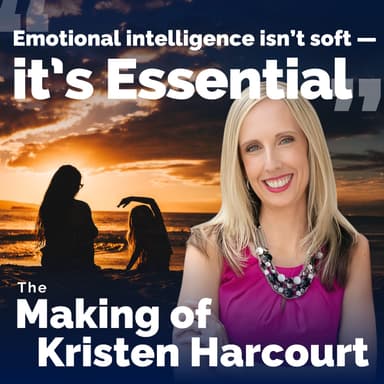
with the power of pictures. You can find the image that Kristen has chosen on the cover of this episode. And as I've already made it a small tradition at the Making of a Coach, I'm wondering, do you actually enjoy these small exercise interruptions, or should I rather cut them? Let me know in the comments.
Or text me at tobias@metafox.eu. Either way, you're welcome to try icebreaker online in one of your next sessions. And with that, back to the episode.
Back to interview
Tobi
Thank you for sharing. Can you take us with you into that space in time? How did your life look? What were you working on, where were you living?
Kristen Harcourt
It's interesting when you go back and connect the dots. I realize I've been coaching my entire life, but I didn't know that was called coaching. Even as a young girl I was coaching my mom and coaching my dad, and doing so many things, and I didn't realize it, because I didn't have the language, or even understand coaching as a job that existed.
I did definitely have the entrepreneurial itch, probably for a long time, since my twenties. But I didn't grow up with anyone who was an entrepreneur. So I was just surrounded by very risk averse people. They're like, you get a job, you need to make sure you do the same thing, you have a paycheck every two weeks, and all of the things.
So I followed that path. However, I started to become clear, like I was saying, becoming a mom 15 years ago. Around that time I started to work with my own coach. And so I got some exposure to what coaching was like. She actually reflects back to me now that back then, when I started coaching, she saw it.
But as I got further into my corporate career, and closer to when I did end up taking the leap for my entrepreneurial journey, I just had this deep desire to become a coach. So I did my coaching program, all of that while I was still in corporate, and just telling myself I was doing that to prepare for the future at some point. But then, as I got closer to the end, just realizing what this coaching was all about, and the changes that were going on within my organization, and my deep inner knowing.
I took a leap of faith. At one point in December 2016 there were going to be some changes to the way the organization was going to be run. And I remember having a conversation with my managing director and I said, I think this is it. I think this is the time. I think I'm ready to take the leap of faith.
There were no fears. My intuition and my whole body. My heart was on fire and goosebumps throughout.
And that's how I felt when I was doing it. I'm very glad I did it. It was one of the best decisions of my life. And I do have to say, after I made that decision and started going into it, it's still a lot, starting a business and learning all of that and figuring it out.
I did have enough people, luckily, in my network, in my community, who had told me it takes two to three years to grow a business. So that's what I had as my frame of reference, and that gave me a little bit of space and permission to know that it's going to take a bit of time and you have to grow it.
You have to plant a lot of seeds and do a lot of watering. But for me, I needed to see that it was continuously moving in the right direction every year, which it was. And that's what kept me. I had the faith and the trust that I would get to where I needed to get to.
Tobi
You were just describing this moment when you essentially told your manager that you would be leaving to go freelance as a coach. What led you to this point in time?
Kristen Harcourt
There was a very deep inner calling that this is the work that I'm meant to do. For me it wasn't just coaching, it was also speaking and training. I was very clear that I need to use my voice to make positive change in the world. And it was this deep inner calling that I couldn't ignore anymore.
It was like a little itch, and then finally it was like, come on. It was really getting my attention. I couldn't ignore it anymore. I do remember, it's funny as you're asking this question, it was December when this happened.
I was at a conference in the fall of 2016 and there was a big group meditation. I think there were about two or three hundred people all in this room meditating. And I closed my eyes, and in the meditation I heard, it's time, you need to go start your business. I did hear that very loud in my meditation.
Tobi
Wow. Okay. How else did you notice it, the calling?
Kristen Harcourt
I describe the calling as an inner knowing. And I was doing things, I know, Tobi, you're a planner too. There were things that I was doing in terms of planning, like I'd been having lots of dialogues with people.
Every time I would meet an entrepreneur I would talk to that person and ask all the questions, like, tell me about your business. What did you do? How did you do it? When did you know? What were the signs? So I was doing a lot of, when I'm about to do something, I realize this now, I start to get into research mode.
So I start to have dialogues and ask people a lot of questions. I would listen to podcasts and watch videos on YouTube and read books about entrepreneurship and starting your business and things like that. So I was also doing some researching to see, what would this look like? Could this be possible for me?
Tobi
That's super interesting. And I'm wondering, when was that point when you said, I'm ready now? You said you had this inner calling, you felt it. And tangibly, in terms of skill set and business setup point in your career, how did the world look tangibly, that you saw, okay, now is the time?
Kristen Harcourt
Those are some great questions. I was set up at the time so that my former husband had a full-time salary, so that makes me feel a little bit more comfortable. It's not all of a sudden that I'm leaving and I have no safety net.
I do have to say, when I was in that meeting and said I'm doing it and took the leap of faith, I hadn't told him I was going to be in that meeting. It happened in the moment.
Would I do things differently? I'm the type of person who would have liked to have a safety net, and to have it all planned, and to have started the business building. I hadn't done any of that. So I had that dialogue and next thing, it's January 1st, here we go, I'm going to start a business.
I definitely had the confidence in my skills. I had worked in the people and culture space for many years at that point. While I hadn't finished my formalized coaching program, I had been doing debriefs and coaching people informally, without having my formalized coach training, for many years as well.
I got lots of very positive feedback around it. So I know that I was good at it. I know that I got the results. I know that people came back to me and told me all of the things that they did because of those conversations that we had. So I definitely had done the miles, and I had the confidence that I knew I could do it.
And I didn't know all this building a business. I didn't have any of that framework yet. It didn't get created until I started.
Tobi
So in that sense this was an ad hoc decision. But maybe for context, if I understood right, you had worked before in sales and marketing in the manufacturing industry, and then afterwards for nine years as an HR consultant, which I imagine involved already a lot of coaching, or coaching as in people development, let's call it like that. What would you say were the key skills that you had picked up on this journey so far?
Kristen Harcourt
One of the things that is important to highlight, specifically for coaches: when I was working within that organization doing the consulting, I was an intrapreneur.
So I was the one being the practitioner and working with them. But I was also doing the business, I was bringing in clients and doing a lot of different things from a sales and marketing lens. And in previous roles as well.
What has made it much better, or easier, for me is that I love sales and marketing. With some people, I see some coaches who are incredible coaches, who love doing their work, but they don't want to go out there and build a business.
Whereas to me, I love the challenge of it. And I recognize I have strong trust in myself and a strong understanding that when it comes to new business development, sales and marketing, I'm going to do that in a way that energizes me. There are so many different versions of how you build a business and how you do sales and marketing.
And so what made it better for me those first two years is that I got to do the things that I'm naturally good at, which is building relationships, which is speaking and getting business through speaking, which is going on podcasts, going to networking events.
They energize me and they have a return on investment. They have an ROI, so it's a good use of my time. For me, I don't enjoy the whole online world where I have to create funnels and put people in funnels. That just doesn't speak to me, and I haven't done that. And for other people that does work.
But what has been great and beneficial for me is that I know what works for me. I continue to do what works for me. I do it consistently. That is something that comes naturally and is a skill set. I don't think I recognized at the time how lucky I am to have that skill set, because I find a lot of coaches, or people building their business, really struggle with that.
Tobi
So you were working in sales and marketing in that role. You were able to have the on the job training of being at trade fairs, building connections, closing deals. All of that you learned as an employee, actually, in the quote unquote safe environment of an employment.
And I think what Pam said also was that she identified, in her case, the one-on-one coffee meetings as her sweet spot, the kind of world where she really thrived and that she really enjoyed. And in the same way you say, for you it was the networking events, the bigger settings, that you then really leveraged.
And you said, okay, let me leave the whole funnel building online marketing bit aside, and let me focus on that craft that I learned as an employee, which you also used as a coach.
Kristen Harcourt
Yes. And you're right, I'm so grateful, because I got to be in a job for nine years where I was getting paid as an employee but practicing and learning all of those skills. We created a podcast then too, back in 2015, within that organization.
And I also saw how much I love that and how effective it was as well. Which made it easier when I got to the point where I started my own podcast, because it wasn't this brand new thing. I knew what it looked like and felt like, because I'd already been doing that.
Tobi
I'm still wondering, when you said you had that leap of faith conversation with your manager, that was during the time as an HR consultant. How was that time useful? I think that was also nine full years as a consultant. What did you learn during that time? ## [i=85]
Kristen Harcourt
It was huge, because working with organizations globally, across all industries and sizes. Sometimes we were working with companies who had five to 10 employees. Sometimes we were working with organizations who had 10,000 employees. It's amazing, because you get to learn about all these different industries, the challenges that are specific to industries, how they go about supporting them.
However, what was so interesting is that across all industries the themes and the challenges were always the same. Because it always comes down to the people. It's funny, because the organization would be like, we're very unique, we're not like other companies. With
us it's this stuff. And I'm like, no, I heard that with all the other companies. They're the same kinds of challenges that are showing up, no matter what. You hear a lot when you're starting a business that
you have to niche down. And what I realized, for me, is it's not so much about niching down. My expertise is emotional intelligence, and I can take that anywhere, because it's across industries. Because when it comes to challenges around emotional intelligence, it's not unique to one industry.
It happens in all industries. And I have the data to support that, in that I worked across organizations and industries and I was seeing the same themes and challenges every day. Different industry, different company, exactly the same. Sometimes I would hear the exact same challenge. In one industry I'm talking to a financial company with 10,000 employees. The next I'm talking to a small company with 10 employees in professional services. But the exact same problem.
Tobi
And the time as a consultant enabled you to see many organizations in a relatively short time span, and being able to build those internal patterns helps you to then identify problem areas.
When did you decide on emotional intelligence as your thing?
Kristen Harcourt
As soon as I left. I had been using those skills even while working there. I wasn't always labeling it as emotional intelligence. I would say the human skills, we need to humanize the workplace.
We need to have these human skills. Emotional intelligence was language that would be common for individuals and organizations to understand, and it helped them get there. So that was right from the beginning. I was doing training and keynotes. I didn't bring the assessments in as part of my practice until 2020.
So in the first part of my coaching and training I was talking a lot about this, but I wasn't bringing assessment tools into it. Then I had that complement my practice as of 2020.
Tobi
That's interesting. So you started calling it human skills, today you say emotional intelligence. How has that language evolved, and what do you see has worked? What works nowadays? How is your experience there?
Kristen Harcourt
As soon as I started in 2017 I was using the language of emotional intelligence. Before that, from 2010 on, I heard people saying all the time, soft skills, and I was getting tired of hearing the whole soft skills thing. Because whenever I heard soft skills, it was like it wasn't giving it enough credibility.
It wasn't valuing how important it is. It's, oh, we have these soft skills, like they're nice to have. And I was like, when you say it like that, you're not giving credence to how critical these are. These are the critical skills, these are the communication skills, these are the human skills.
So I would be talking a lot about that. Anytime I would hear soft skills, I'd say, can we please stop calling them soft skills, because I feel like it's undermining how important they are. I started to feel like there was a shared language in organizations and out in the culture around emotional intelligence, and they could wrap their heads around that.
So that's why I started to use that language. And I continue to use it, and I find that organizations get it. What I do find is that they sometimes think emotional intelligence is only some elements. Which is why I always like to highlight those five different buckets, because many people don't understand all that emotional intelligence entails.
They might know some elements, they might understand the self-awareness piece. They might understand empathy. Empathy has got a lot out there in the landscape, it's getting a lot of attention. But I don't know that they always realize that assertiveness is a big part of it.
I don't know that they know how much stress is connected to emotional intelligence and self-regulation. So I'm still continuing to educate in that part, because even when organizations or individuals are using that language of EQ, I don't think they know all it entails.
Tobi
And the EQ model in particular really gives you a nice presentation, where you can say, look, dear business customer, this is emotional intelligence. This is not only fluffy soft communication stuff, it is actually things like stress management and decision making as well.
Kristen Harcourt
Yes. It gives it more credibility.
Tobi
Do you see any evolution in the language being used when it comes to the race of AI, the changes of workplace? How has that been in the recent one, two years?
Kristen Harcourt
There's a lot of conversation. Every single conference I go to, there are many sessions on AI. It's very front and center right now. If anything, what I continue to hear emphasized is that with AI, EQ is even more important.
AI's Role in Efficiency and Relationships
Kristen Harcourt
There are going to be certain things that AI is going to be able to optimize and create efficiencies around.
And what it can't do is help to build relationships and communicate effectively, all those elements of what happens with interpersonal relationships. So if anything, I feel like that's being highlighted even more. Yes, let's give AI these things that don't require interpersonal relationships and connection and conversations and all of that kind of stuff.
It can be creating some wonderful efficiencies. I think, like anything with AI, we want to make sure it's in the right hands and used in the right way. And that can be incredibly beneficial. And I don't think EQ is going anywhere. If anything, it's going to be even more important.
Tobi
Great, thank you. With that I would like to zoom in a bit more on your current business. I think I heard on another podcast that you have a private practice on the one hand, and you do corporate coaching on the other. What does that mean, and how does that differentiation look?
Kristen Harcourt
At this point around 70 to 80 percent is my corporate practice, and then 20 to 30 percent is my private practice.
I just like to have some spots continuously available to individuals who are seeking coaching. I price it a little bit differently, of course, than I'm pricing to corporate, and I like to make it accessible for individuals who are paying for it out of pocket. The individuals who tend to seek out coaching through the private practice are individuals who might not be feeling very confident or happy in their current workplaces.
So it wouldn't make sense for them to go and ask their organization to support them and sponsor them, when part of what they might be discussing and coaching is an exit strategy. So that can be a big piece of it, the individuals who are seeking coaching on their own. And I find the people who tend to seek coaching from me on the private practice end are individuals who are
very clear around what success actually looks like for them. What's their definition of success, and then how are they creating a personal and professional life that actually reflects that? Because some of them are very ambitious, type A personalities, and realize they've sacrificed a lot of their life for their job and they no longer want to do that.
They want to work for a culture that creates more work-life integration, and want to make sure that they're prioritizing what really matters to them outside of work. I have individuals who seek out coaching who are other entrepreneurs, and who also want to figure out what it looks like to uplevel their personal and professional life and make sure they continue to have a lifestyle that is balanced.
I hate to use the word balanced. Integrated, because balance feels like you get to this perfect balance, but integrated in a way that is true for them as well. Because what can sometimes happen is, people leave corporate, become entrepreneurs, and now all of a sudden the same behaviors that happened in corporate, some of that hustle and spending a lot of hours working, some of that work addiction, now translate the same into entrepreneurship, but even more, because they love the work they do but they're still in this work addiction.
And so they're trying to figure out ways to integrate in a more effective way. Or just figuring out what do they actually want? What do they truly want? Are they in jobs and careers that are actually aligned with who they are and what they want to be doing? And sometimes they do a career pivot and realize that they want to go in a different direction and do work that's going to be more meaningful for them.
Balancing Private and Corporate Clients
Tobi
So the private practice means exploring more themes of change and career change, while the corporate practice is more on the classic leadership challenges that we also talked about.
Kristen Harcourt
Exactly.
Tobi
And in both cases the client persona is the same, leaders from English speaking countries.
Kristen Harcourt
Yes.
Tobi
And private practice simply means I come as an individual, I pay as an individual. And corporate coaching for you, which is 80 percent as you mentioned, is the company. You have a business customer and then there are several clients within that. What does it mean when you close a corporate coaching customer?
Managing Client Load and Scheduling
Kristen Harcourt
In my overall practice, the highest number of coaching clients I like to have is a max of 15 to 20 clients. 20 is actually getting even a little bit high for me.
I think my sweet spot is really having around 15 coaching clients at a time. And then of course I'm also doing some consulting. I do a lot of leadership development training, working with executive teams. I do a lot of work with the executive team, working really well from the top and then setting that culture.
And then I'm doing training, going and doing emotional intelligence training and keynoting. So it's that nice balance. And in terms of organizations, I work with many different companies, and with some I work with multiple people with coaching, and that just continues.
With another company I might have two or three. There have been times where the coaching practice is full and I've had to have a waiting list, because there are just too few spots. I have to make sure I don't say yes to too many coaching clients and then am not able to be available for some of the other work that I do as well.
Tobi
And when you say 15 clients in parallel, earlier you said you speak with them roughly every two weeks, so that's seven coaching conversations per week.
Kristen Harcourt
Yes. And we have cancellations, so if you looked at my calendar this week, I think I have maybe eight or nine coaching sessions, and the next week it might be four, and then it might be five.
It feels like each week there are at least 10 coaching sessions, I would say around that. Because with organizations I might also be doing EQ 360s with individuals who don't go into a full coaching program.
So I have those going on. You've got coaching clients at different stages. And then you have other work that you're doing separate from coaching, that is sometimes one-on-one work as well.
Tobi
You're saying you have a waiting list. Is that for the private practice, or the corporate, or both?
Kristen Harcourt
Right now I'm good. I'm at a perfect rhythm where I have space, I could maybe take on two more.
The Organic Growth of Clientele
Kristen Harcourt
It always balances out for me, I would say, over the last four or five years. Somebody wants to come in, and oh, it's perfect, one person just ended, I have your spot.
There's this equilibrium that happens. I don't do anything to create it, it just happens organically. There have been some times over the last three or four years where, once in a while, maybe I'm working with an organization and we've had five clients all start at once. So I'm very full, and I've had to say, there's a waiting list for right now, in about three months I should be fine, just because I know there's too much happening at once and maybe I'm doing a lot of training at the same time. But in general there tends to be this wonderful equilibrium that happens naturally.
Tobi
Sounds amazing. And I would love to explore that. How does that email magically arrive in your inbox? What is actually behind it? I would love to explore that a bit more. But to close that mental paragraph of your private and corporate practice: you mentioned earlier that there are two different pricings, the private practice is a bit cheaper. Would you like to share some ballpark numbers? Just orders of magnitude, what's the difference?
Kristen Harcourt
I won't say my pricing out loud, because there's a huge range, but I would just say my private practice is 50 percent less than what corporate would pay. Just knowing that person is paying out of pocket.
Tobi
And then I guess you sell the entire journey, not the hourly session. How does the packaging look?
Kristen Harcourt
I don't have any hourly pricing. I never had hourly pricing, from the beginning.
Because it's really not an hourly model. You're paying for a program, and that program is going to go on. This individual is going to go on that journey. So I don't even think of things from an hourly perspective. And I find organizations don't either, at least the organizations that I'm working with. It's very much that they're paying for an engagement, and this is what's going to happen as part of this engagement.
Tobi
Nice. For both of these practices you basically have one website, right? I think it's kristenharcourt.com. So for both of these practices they find you through the same website.
Kristen Harcourt
You got it. It's for a variety of reasons. They're still seeking coaching, but it's definitely also speaking, and that's why the kind of work that I'm doing with organizations has to resonate with them. If not, then they wouldn't seek it out, for sure.
Tobi
Let's go back to that email that magically arrives in your inbox whenever a client has finished.
Do you have a sense of how the person writing the email came across you? How did they know about you?
Kristen Harcourt
First, I do consistent actions every day, every week, that are business building, business development actions.
And I like to describe it as, I'm planting seeds, watering the seeds, but I'm not attached to when they're going to blossom. And so that's what tends to happen. I've had speaking engagements or coaching engagements come from people that I met back in
2019, but they're following along on LinkedIn. They're paying attention to what you're doing, and the timing is right, and you're the person that they think about. I think that's why it's important that you're staying front and center. You're going out there and making sure that you are promoting your business and what you're about, and people are getting a feel for who you are. One of the things I really love about the podcast is that some people will say, oh, I love what she's all about.
I love her energy. I resonate with her. And then someone else will be like, I don't like her energy. Great, I'm not your person. I'm not supposed to be out there supporting everyone. And the beautiful thing is there are lots of different coaches out there.
And that's why I think it's so important when it comes to chemistry and values and all of that kind of stuff. Because I know there are certain organizations that I'm going to work with and they resonate with me and the way that I approach things. And if they don't, then we're not going to have a very effective partnership, because we're not going to see things the same way.
So when I see that email, while it might feel like, oh my gosh, this came out of nowhere, it's random, it's not really. Because I know that I'm taking consistent actions every day, every week, every month, and you just don't know when it's going to lead to something. So when those things happen, where someone approaches me about a speaking engagement, or about training, or about coaching, I know it's because I've built trust with them and they've been following along and they know what I'm about.
A need showed up for them on their end, and they felt like I'd be the right person.
The Power of Podcasting
Tobi
And you mentioned that one of these ways that you build trust, and that you allow people to feel your energy and get to know you, is the podcast that you're running yourself. Can you tell us a bit about that?
Kristen Harcourt
The podcast is my passion project. The podcast started in 2019. I had thought it would be really interesting to start doing interviews with CEOs. So I would talk to CEOs of progressive organizations who really believe in emotional intelligence and humanizing the work.
And so I did a couple of interviews, not in a podcast, and then I did a blog post. Several people, after they saw the blog post, said, I love the blog post, you should create a podcast, you should be having conversations with these CEOs and HR leaders. So that's really where it came from.
It's people reflecting back to me. I started off not even doing a podcast, I started off doing video on YouTube. And then my audience again said, I really love it, but I tend to listen when I am at the gym or when I'm going on a walk. It should be podcast format, not just YouTube video format.
So that's where it emerged. The podcast emerged in October of 2019. I am so passionate about this message and what's possible when we create these human workplaces, and about the responsibility both the individual and the organization should have, and, with you Tobi, social responsibility.
I just feel so strongly about that, and I thought if I do a podcast it's a way that I can get more of this information out to people in a larger way, and to people who might not have the same accessibility, in terms of an organization that might not be investing in this way when it comes to training and coaching and keynoting and things like that. This is another way that they can get exposure to it.
And then HR leaders can hear from other HR leaders who are doing this very effectively, so that they can bring it to their organization and do it. CEOs who are not convinced yet might hear other CEOs who are talking about this and why it's so important, and they might be convinced to do some of it.
And leaders will also hear this and realize, oh, you know what, maybe I could be showing up a bit differently. Oh, I didn't realize that's part of emotional intelligence. And then they hear a story and they think, I just did that yesterday. Not to shame them, but more to invite them in, that there's another way of showing up that's a lot more effective, that's going to work better for you and for the organization.
And so it's been going really well. I love it. I love having the conversations. It feels very fulfilling, and from my perspective it's making that impact, because it's getting in front of people who might not have been able to hear these conversations.
Tobi
So we already mentioned that you do this to enable people to get to know you. But what I hear now is that it is also an educational resource. You mentioned the people from organizations who may not have the resources to book you. Then at least they can follow you and your practice on the podcast.
Then there's the CEO you mentioned, who hears from another CEO that this is useful. It enables them to maybe go on their own journey of organizational development. And at the same time they hear maybe a customer testimonial, because you might be interviewing clients that you have worked with.
Kristen Harcourt
I haven't had as many of my former clients on as guests. It's been more, because I also like meeting new people that I've never met. Or sometimes it's friends as well who are doing amazing work, like Pam Ross, who's a mutual connection of ours. She's been on the show.
You're absolutely right. This is why I love the podcast so much, because it's multifaceted. I get to have impact. It gets to do many things. It gets to be a form of education. It gets to be a form of influence. I also have a goal of being able to amplify marginalized voices on my podcast.
So when it comes to people doing incredible work in the DEI space, it's been very important to me that I have a platform, and I would like to give them an opportunity to use my platform to amplify their voice, because maybe they wouldn't have accessibility. So that's part of it. And it's people getting a feel for what I'm about and who I am.
Which also makes it harder to answer the question, what's your goal with the podcast, when people ask me that.
Tobi
You also do solo episodes, right, not only interviews. How do you approach those? What is your content strategy? What is the lifecycle of a solo episode?
Kristen Harcourt
The solo episodes have been very popular, and I've been noticing a lot of people are downloading them, because I think they're bite-size. They're usually under 25 minutes, so people consume them a bit faster. The goal with solo episodes is that I talk about topics and themes that I'm seeing in organizations, that I'm hearing in my coaching sessions.
The other thing that's so great is that then I'll do that topic, and then one of my coaching clients will come with something and I'll say, oh, it's so interesting, I just did an episode last week on that, let me send this over to you. So that's another way that they can get some quick education on a particular theme too, which they love.
So with the solo episodes, the topics come intuitively, or through me hearing themes, or just something I'm noticing that's bubbling up in me and I want to talk about it.
Tobi
Do you have some KPIs top of mind? What is it that you're looking at? Is that followers, or number of streams? How has that evolved and where is it right now?
Kristen Harcourt
If you asked me that question when I first started, I was very focused on vanity metrics, and I need to see the number of downloads and how many people. I don't really focus as much on that anymore.
I want to make sure it's continuing to go in the right direction. If I see certain episodes where I notice there are more downloads, I take note of it and think, okay, there's something about this topic that's more resonant for people. So how might I want to expand on this?
So I use it more for being conscious of what is resonating with people. If I'm seeing that it's resonating with them, how can I continue to have more information to share with them on that particular topic? And as long as I see it moving in the right direction. If all of a sudden I saw the numbers were going up and then all of a sudden they were going down, I would say, ooh, what's going on?
I was also conscious from the very beginning that I am not doing a weekly podcast. I just did not have the bandwidth to commit to that. And I knew it would start to become a should, and I would feel a bit frustrated if I was forcing myself to do it weekly. So from the very beginning it's always been a biweekly podcast.
For the first two and a half years I was pretty consistent with biweekly. And then after around two and a half years I gave myself permission to take a month of the summer off. And then it got to the point that if there's crazy travel happening it might be three weeks in between. I started to feel like I've created a bit of a community, and they don't have the expectation, because I'm not a weekly podcast and never have been.
So they're not like, oh, where's your podcast, it's supposed to be happening weekly. If you listen to people who talk about doing podcasts, people who are in this space and educating podcasters, they would all tell you, you have to do weekly, you have to do biweekly. I choose to listen to what feels right for me.
Tobi
It feels good to hear you say that. And I guess what makes the difference for you is also that you have been around for a long time. If I now discover you and I want to get you on the podcast, I have probably hundreds of episodes to choose from. So I guess you are now in a different space than somebody who's considering starting that business building practice.
Kristen Harcourt
You got it. Because at this point I think there are 123 episodes. So sometimes people go back and say, I love this episode, and then I have to remember it's one from 2020. But from their perspective it's brand new, they're hearing it for the first time.
I remember someone talking about that from a research perspective. Once you get to the hundredth episode there's a momentum that gets created. Because even when you're not releasing, people are still going back and listening to other episodes, and then that momentum continues.
So your goal is to get to a hundred episodes, and then you've made it.
Tobi
What would be your advice for a new coach starting out and maybe being a podcast enthusiast, as a listener, and now considering that as a strategy? Is it too late? Is it now exactly the right time? What is important to note? What was your most important takeaway that you would like to pass on?
Kristen Harcourt
It's a really good question. I would say it has to come from a place where you're super passionate, and this is very energizing. It can't be a should.
Oh, somebody has told me that if you want to build your business you should do a podcast. But if there isn't a strong drive and energy and enthusiasm and passion behind it, I would say don't do it. Because it does require consistency and commitment, and to be energized and wanting to do it, and you don't want something that's going to drain your energy.
If that does exist for you, and you feel like I have something I want to share, and I have maybe even a certain lens, a way you want to go about doing it, just the way you've done with your podcast. It's niched down in a way that there's a certain lens and a certain audience and a certain perspective, and a certain way that you want to approach your conversations.
Go and do that. Don't feel like, oh, there are so many podcasts out there, what's the point, why should I do a podcast, I'm just like everybody else. There was another stat that I saw around the number of podcasts that only do the first 10 episodes and leave.
So even though it might feel like there are a lot of podcasts out there, there aren't necessarily a lot of podcasts that went in and stayed and were consistent with it. So I wouldn't feel like it's too many people doing it. I would just say, are you super passionate about it?
What's the unique angle that you want to take? How are you going to differentiate yourself? Make sure that you're staying consistent. I would encourage you to do episodes with guests, but then, if you're coaching and wanting to build a business, also do solo episodes. Especially if you want to become a speaker too, which can be very helpful alongside coaching.
People get a feel for you and your expertise and how you approach things, which can definitely lead to more coaching and speaking business.
Tobi
So finding your sweet spot again, and approaching it as a marathon.
Social Media Strategies for Coaches
Tobi
Another topic that came up earlier, when you said there are these clients who have been following you since 2019, and I think you said they've been seeing you on LinkedIn.
So I hear this is another important channel. What is it that you do there?
Kristen Harcourt
I definitely feel like social media is important, if it feels good for you. Some people don't want to be on social media, so I'm not going to tell you that you have to go on social media.
I enjoy it. I'm very boundaried with it. I'm not on there all the time, I'm not scrolling. That doesn't feel very good for my mental health and wellbeing, because there can be a lot of divisiveness, and it can also feel like a lot of noise if you're constantly on there. So I use it in a very proactive, strategic, intentional way.
And I have definitely got lots of opportunities through the work that I've done on LinkedIn. And to go back to what you said with the podcast, it's a marathon. It's a proactive long-term strategy. It's not like you just create a post out there and, oh, I have all these clients now with this one post that I wrote.
You're out there, you're using your voice, you're giving people the opportunity to understand your voice and what you're speaking about and what your message is, and doing that consistently. And you'll resonate with the people who you're meant to resonate with.
LinkedIn gurus are teaching people to post every day, twice a day. I don't think that's how I would recommend you approach that platform. I think if you put out great content a couple of times a week, that's more than enough.
Tobi
And how do you approach it? Maybe on a scale from, I post once in a while when something comes to mind, to, okay, I really have this structured backlog with posts that are roughly drafted and once a week I sit down and schedule posts. How does that process look behind the scenes?
Kristen Harcourt
I'm not on that side of the spectrum, I'm on the other side. I would say my rough goal is a couple of posts a week, which usually always happens, because I have once a week as my podcast post.
If I'm ever doing a speaking engagement or things like that, I put posts out. I also go through phases where I notice I'm on there more often than not, just based on what's going on and bandwidth. I am not someone who has a content calendar and is saying, every week I need to have my two posts.
I'm definitely not as structured, more of a spontaneous style. I do find the people who have the content calendars are more structured like that. A lot of my community who are doing that as coaches, it tends to be that they're not the one doing their posts. They've hired someone who's doing the posts for them.
And having that structure and doing the content calendars. When you work with a company, they definitely want to have the content calendars and know what's going out. I don't think that's a bad thing, I think that's a great thing. I've even considered having somebody do that for me, having someone that's putting the posts out twice a week.
And of course with my voice, and me being part of contributing to it. It's something I've considered, but not seriously enough that I've actually spoken to anybody about doing it.
Tobi
And what have you learned works for you in terms of content? Which sort of content, which sort of posts, gives you engagement, or possibly even leads to business, if you can track that somehow?
Kristen Harcourt
Always storytelling. They want to hear stories. The more that you can bring either your story, or the stories of clients, or the stories of others, so that they can emotionally connect with what you're saying. Those are always my posts that get the most. Also, if I'm bringing in something that I'm teaching an organization around, an event, I will also talk about, here's where we went into, here are some of the themes that we talked about.
Those are definitely ones that really engage. And even just posts where I'm sharing parts of myself and being vulnerable, those tend to get a lot of engagement as well. Because they want to get to know who you are as a person.
Advice for Aspiring Coaches
Tobi
Is there any advice you would give to your younger self, either the very young person or also the one that's starting out as a coach?
Kristen Harcourt
I love that question.
I think it's such a powerful one. I think if I were to go back to talk to my younger self, I would say number one, you don't have to go at it alone. Go ask for help and get support, because there are so many loving people around you who would a hundred percent support you and help you through difficult situations.
I would say, trust yourself, for sure, and that you have so many answers. To be honest, there have been a lot of catalyst moments. I'm so grateful to my parents that they actually gave me a lot of autonomy and allowed me to make important decisions and trust myself.
So it was there. But I guess I would just reflect, you have it, trust it. And the last thing I would say is, surround yourself with loving and kind people as well. Because those are the kind of people who are going to inspire you to show up as your best self.
Tobi
Thanks so much. Is there any question that you would like to pass on to our next guest?
Kristen Harcourt
If I was going to pass on a question to your next guest, I would ask them, who were some of your role models that had the biggest impact on who you are today?
Tobi
Nice one. Thank you. I will take that into my next conversation next week. And for today I say thank you so much, Kristen Harcourt.
Outro
Tobi
And that's it with the making of Kristen Harcourt. After a few people had already asked me about social media strategies in the past, I was happy that Kristen shared her experience with us. What I took away was, number one, choose a medium or a channel that you enjoy. In Kristen's case I guess that was podcasting, and to some extent also LinkedIn and networking in general.
Number two, keep going either way, because it is a marathon. I think Kristen also made that one pretty clear. And number three, define your mission and your niche. Kristen didn't make that third one super explicit, but if you check her website and her social media, both linked in the show notes, you'll find that she's really all about emotional intelligence.
And this is also the topic we referred to a few times in this episode, but it will be the actual main topic of next week's episode, again with Kristen. Kristen ran a small coaching demo with me after I had filled in Kristen's go-to tool, the EQ-i emotional intelligence assessment. And I can already tell you, I learned that I still have quite some way to go with my EQ.
So if you're curious about Kristen's coaching, tune in next week. If you enjoyed this episode, share it with a friend and leave us a rating on your favorite podcast app. I'm Tobi from metaFox. All the best, and until next week.