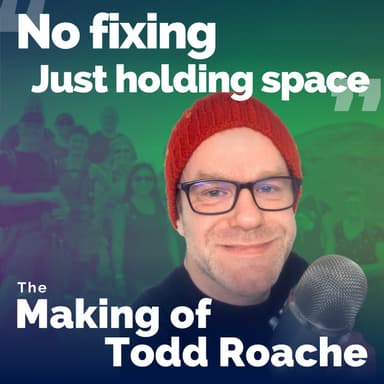
Becoming a Coach with Todd Roach: From Musician to Transformational Energy Work and Coaching
with Todd Roache, Executive Coach, Leadership Development Specialist
Transcript
Edited for readability: filler words removed, names checked. It may still contain errors. The audio is the source of truth.
Teaser
Todd Roache
I often describe to my clients that I'm 49 percent devil, 51 percent angel. And there's something in that they've often found a real relief. It's like, wow, this person is really forthcoming with their dark side, and they're not hiding it from me, and that makes me feel safe. As an energy worker I wasn't assuming. My experience as an energy worker was that those are values, those are your values, are they not?
And they are. And the reason I was right is because I wasn't guessing. I was literally reading your energy. I was going into the shelf of your being and seeing and feeling the values and reading them. That's why they were right. But as a coach, most coaches wouldn't be able to read energy at that level of detail.
Tobi
What enables you to do that?
Theme songIntroduction
Tobi
I am sure most of you will agree that coaching is a very soft science and art. We can't always measure or know why an intervention actually helps. I am a quite scientifically minded person, and yet I've also become more spiritual over the years. So with today's guest, Todd Roache from the UK, I was quite excited to explore his energy work as a practice. We discuss what he's doing, I'm sort of trying to translate that a bit into psychology language, and then we also run a small demo. We also talk about working on our own issues, our shadow as a coach, because right before we went on record Todd had shared with me that he had a very rough and dark night. So we become quite open and vulnerable right from the start. Let's go.
Start of interview: The Crossroads of Truth
Todd Roache
So straight away I'm at a crossroads in my mind: am I giving the raw, unfiltered truth, or am I tidying it up? So I'll just lay it out. Basically, I think the work of being a practitioner and being a human being is one of
facing yourself, actually. How do we support other people in being with themselves?
Navigating Inner Journeys
Todd Roache
And with the kind of clients I work with, it is around inner world journeys, spiritual journeys, existential journeys, dark night of the soul stuff. It's very much that kind of transformational, spiritual, existential work, more than it's performance. So those are the waters that I journey in with other people. And those are the waters that I journey in with myself.
Facing the Darkness Within
Todd Roache
And last night, I don't even know where it came from, but out of a seemingly very gentle day, by dinnertime I was like, I literally feel like my heart has been stabbed with knives. And what I noticed is that at that point I could have just had some kind of sedating chocolate and covered it up with Netflix. But in all honesty, I realized that I'd been doing that a bit too much recently. It was like there was something inside of me that had been doing that, and the sleeve of my heart was saying, you're going to have to listen to this and face this. And I just thought, okay, I can't cover this one up. To be fair, it was calling me. I could have repressed it, but I invited it in. I took myself to my quiet room that I'm in now, and I just put on some music, read some poetry, and just let the storm come. Let the storm come, feel it, feel it, feel it. And then the tears started to come, and it feels like peeling the onion of your soul, and there's just something black and caked at the bottom. Tears you haven't cried, whether that's from past lives, depending what your belief system is, but just something at the core of your being that is the next layer of work that is crying out to be worked on, the next layer of pain that's wanting to be felt, the next layer of transmutation. So I was just at that level, feeling it and feeling it. And then my Mrs came in and asked if
I was all right, and her presence and space holding, because she's a practitioner, took it to the next level. And then I was literally on my hands and knees just howling. Really working with, actually, my relationship with suffering and identity. It just went from fits of crying and real pain to hysterical, what I call cosmic laughter, as something became realized and unbound. Oh my God, I can't believe that this part of me was identifying itself with suffering. It needed to suffer in order to know who it was.
The Role of Suffering in Self-Discovery
Todd Roache
And it just made me reflect on how so many times we can become the victim, the sufferer, drama triangle style, or in just any situation. I'm the one that always does the washing up, I'm the one that always takes the bins out, and we position ourselves as the sufferer, and that's the badge we wear. This was that, but on a much deeper, darker level, where I'm suffering, in my belief system, in past life, traumatic, torturous ways, but I was still clinging to suffering as some kind of north star. And somehow in this
motion of really going into myself, that dissolved. And it was beautiful, but very painful. And I woke up again in the night at two o'clock in the morning, and just being in the darkness triggered this almost panic and more floods of tears and more feelings. And then I woke up this morning thinking, okay, something has been birthed through me, something has been healed, something has been revealed. And now I'm staggering into the day, or gently walking into the day, tender and raw. Like I've been in the emotional battlefields, which has kind of been my life for a couple of years now, and the life of lots of people I know. So that's how I'm arriving. And I'm arriving also really happy to be talking about this, because I think we show up to our work, we show up to our practice, with our game face on, and there's lots behind the scenes that we're doing to even have a face that can be game-like at all. To have a heart, to have empathy, to have intuition, to have any of those
things. And I notice, for myself anyway, there are lots of scenarios I might turn up in where people aren't comfortable to share that about themselves. I'm on the ICF board. I'll often turn up to meetings, how are you doing, and everyone goes, I'm fine. And I'll be like, I feel like a half drowned kitten that just got kicked around a football field. And then everyone else goes, oh, we're being honest, in which case I feel totally awful as well. So I think there's just something humanizing and normalizing about being able to lay it out. Yes, I got my ass kicked by my own heart and my past last night, and I'm happy to be here talking about it.
Tobi
Thanks for sharing.
The Practitioner's Path
Tobi
Can you describe a bit more this relationship to suffering that you mentioned? You say, okay, you face it, you also bring it into this conversation, also into your work as a practitioner. How did that evolve for yourself?
Todd Roache
Well, that relationship with suffering wasn't even one I realized I had until last night. So it's not something that I can speak about in generality with my work. Having said that, I suppose perhaps there's a background, and I really don't know what's about to come out of my mouth, so let's find out. There's a kind of background awareness in it. I say spiritual interest, but maybe more of a Zen interest, in how we create our own suffering needlessly in the mind. And perhaps that does come into my work, because as coaches we might have a lens on, what is the story that this person is telling themselves that might be creating suffering in this scenario? What are the filters that they're coming at this with? What's the position they're holding here that might be creating more suffering than is necessary? But at the same time, because of the kind of clients I work with, they're very into doing the work. So they're the kind of people who will head towards the suffering.
Tobi
I was coming from maybe this notion that I guess comes from Buddhist philosophy, that you need to choose your problems, and choose them in a way that avoids suffering, or maybe even choose your suffering. And in that, if I choose the suffering, I also realize this notion of acceptance.
And that comes with ownership and a strength, in a way.
The Balance of Light and Dark
Todd Roache
Well, if you really want to go into the Buddhist stuff, the way I feel about it is that it all comes back to a me. If there's a me at the center, then suffering can begin. If you're having the experience and you're just having the experience, then there's just a neutral experience. But if you make the experience about you, oh my God, this is my suffering, or this is my experience, or this is my problem, or this is my success, or this is my trophy to lose, then suddenly there's something at risk. The ivory tower of the ego is at risk. And I think that so much suffering comes from orientating everything to the me. Even as a coach, the more we grip around the me castle, our own empire, and make it about ourselves, the flimsier
the ground, I feel. It becomes harder to receive feedback. It becomes harder to open our hearts. It can be harder even to learn, because we're less willing to take risks, because there's this almost statue of me-ness that we've built at the core of our identity, that we're then having to sustain or defend.
Client Relationships and Resonance
Tobi
Let's take a step back and get to know Todd on a more tangible level. You prefer to call yourself a practitioner rather than a coach or trainer, and you also work with practitioners, artists and leaders. What challenge do you usually help them with?
Todd Roache
There's a little phrase that I've had banging around my mind for a while, and it's essentially, know thyself, grow thyself. And I'm trying to find the third rhyme that somehow goes with flow, but it doesn't quite work. Most of these people are on a mission to live in the world in a way that's unencumbered, and they're aware that often they're the ones in their own way. A lot of them, almost all of them, happen to be powerful women. And they refer their friends to me and always refer to their friends as powerful. I've got a lot of powerful women as friends. These people come to me and they're like, I wrote a LinkedIn post yesterday, it went viral, I got 500,000 likes. And there I am with my little 10 likes maximum, thinking, wow, we're doing very different things in the world. You're really out there on the front stage of it, absolutely kicking ass in your field. But something in your being is struggling to hold up the mission. It's that place where their own stuff starts to challenge the mission they're trying to bring into the world. So that might be, for example, somebody who's an entrepreneur, or somebody who's a leader and they're leading their own business, or somebody who's a practitioner and they're just trying to deliver
great work. It's like, what's the sweet spot between personal freedom and excellent work, and where are the challenges, where does the work distort or shrink or contract because our own stuff starts interfering with it and grabbing its heels and pulling it into the mud? Some of the clients I like working with the most are growing all of the time, and they have sessions every month, and have for years, because they're always growing and always peeling the onion of their being, learning and experiencing so much that they need sessions to keep them fresh and metabolize everything that's been going on before. There's no, oh, I've grown now, I'm done. They're just going and going and going. And the only reason we've managed to stay together as a partnership is that I'm growing and growing and growing.
Normally something quite heavy brings them. I've noticed that most people don't come, even though, the offer is there, you don't have to be on your knees to have sessions with me, you can come and work from things going great to even better. People tend to find me when the shit hits the fan, when something becomes unbearable. And that's kind of why I mentioned the dark night of the soul earlier. So that can be where maybe some kind of personal trauma just makes work too hard, where the interference of their own stuff becomes at a volume that it just becomes unpalatable and they're really not feeling great at all. Or they're feeling threatened in their ability to just keep going. Sometimes to the point where they might feel they're losing their way. Or sometimes they start a new business and they haven't found the way, so they're lost, or suffering, or having some kind of existential, spiritual awakening or meltdown that's leaving them extremely confused about what the
hell reality is. Something's gone awry, let's say. And just a caveat, I'm talking about my private practice. I also do wellbeing coaching in organizations and other things. That's a lot more corporate landscape, a little more, in inverted commas, vanilla, a little less deep and heavy. In my private practice, that tends to be the case.
Diverse Roles and Sanity
Tobi
I would suggest let's maybe unpack both of these parts later. But first let's learn a bit about how this grew over time, organically. And for that, I'd love to do the picture icebreaker exercise that I mentioned earlier.
And now this is my question: which image describes your becoming as a coach?
Nice. What is it that you see here? Can you describe the image?
Todd Roache
Well, this image is actually bringing back a very specific memory that is extremely relevant to my becoming a coach. So, this picture looks a little menacing. You've got this face that has neon colors on it. Slightly tribal, perhaps slightly war paint, but just neon colors of fluorescent pink and yellows, and also blacks and kind of whites. But the lips are black, the eyes are black. You can't see the eyes at all, they're just totally blacked out. And then the background is black, with some kind of shadowy murkiness, dappled light on the left hand side. So there's this very striking face that's sort of impersonal in its dark eyes, but yet lit up with the fluorescent light, surrounded by this darkness.
Tobi
What do you see there for you?
Todd Roache
I just feel relief. I feel relief about what I was saying before about the light and dark of all things. And the room that gives me in my being to be okay with the dark, in all that that can mean. I don't even mean good or bad. And the light. And it brings to mind that memory, and perhaps something that my clients value about the way I work with them, and perhaps something I've needed from the work myself.
Tobi
You noticed resistance when you selected it, and that's why you went for it. Where do you think that resistance came from?
Todd Roache
Where was that resistance? I feel like I just see myself in that photo. I don't feel resistance in this moment, I'm now more in relief and joy. But initially there was just something, I felt like I was looking at myself. And it reminds me again, having contracted for total transparent honesty as a way of working today, I often describe to my clients that I'm 49 percent devil,
51 percent angel. And there's something in that they've often found a real relief. It's like, wow, this person is really forthcoming with their shadow side, or the dark side, and they're not hiding it from me. In fact, they're telling me right to my face, and that makes me feel safe, because I don't have to worry that it's going to come unexpectedly into the space and bite me out of nowhere. And I've got these amazing stories coming to mind from certain clients, that they've been able to tell me things where they then said, I had therapy for 10 years and no one could hold that as nonjudgmentally as you did, and as unconditionally lovingly. And I've healed more in that 60 minutes than I have in 10 years of therapy, simply because there was something so unconditionally loving. But equally, what they told me was, for a lot of people, very shocking and dark. And I could see why others wouldn't have been able to hold it. That picture reminds me of that
journey I've been on in myself, to hold that range between real, beautiful love and that comfort with the darkness. To a large part, I'm aware of this darkness. I knew there was some dark for sure, but I didn't know the degree. And frankly, Tobi, it just came hammering on the door. I remember being with my partner in the house I'm in now. Her work is, or was at the time, sexual alchemy. And it was kind of through that world that I met several people who
made it possible for me to open doors in myself. What was behind those doors, though, was much more shocking than I expected. And to go back to what I was saying, I remember being with my partner and just howling in fear and terror. It was like I'd laid out the picnic blanket and everything was nice and sweet, and then these eerie dark spiders would crawl out of my being and back onto the picnic blanket. It was like, I just can't cut it out of me. And to be honest, there were times I thought the only way to get rid of this darkness in me is to kill myself. Not that I was serious about that, but it just felt that there was no way out of it. The only way out of it was in. The only way out of it was to love it. For whatever reason, the universe has just said, this is your little garden. Your little garden of being, or personality, or soul, however you want to say it, to take care of and cultivate. And for whatever reason your little garden has got a lot of darkness and rocks in it. And your little job as a human is to love it as it is. So
I just thought, if I don't love myself and love what's in me, I'm going to go mad. I can't live in such strong self denial and fear, downright fear of me, of what was in me. So that process just took so much meditation and time in the woods and being with myself, and just relaxing into what was inside me, till it just revealed itself as presence, actually. There was the possibility of violence, but I was never violent. There was the possibility of all kinds of things, but at the core of it, it was just energy. It was just divinity. It was just energy that was simmering away. The more I sat with it, the more my presence grew, the more my heart grew, and the more I could be a space in which that could be held. So it grew my being, so that I could be a big enough container to hold those kinds of energies, and any ambiguities or fears I might have had about them. And also,
therefore, hold them in other people. So when other people came to me, I wasn't judging them. Who am I to judge? There's so much in here that I had to learn to love. And I suppose it reminds me of a lot of the work of Carl Jung, that we can't really say we're unjudgmental towards other people until we've stopped judging ourselves. We can't really be comfortable in our own skin until we've faced all those inner demons. So it was a lot of inner demon work for many years. I did have this quest to know myself, and I did want to lift up every rock, as I say, and see what was under it. But I wasn't expecting it to be so horrific.
Tobi
Trying to zoom in a bit on the key elements of what you just shared, this journey of befriending your inner demon and self-acceptance. What were your key moments, or key experiences, that really made a difference for you in this journey? That unlocked the next level?
Todd Roache
Of acceptance.
Tobi
Self-acceptance.
Todd Roache
Just coming off the top of my head: time, surrender. And I remember reading a book called Owning Your Own Shadow, Understanding the Dark Side of the Psyche. I remember reading this on the plane, this would have been about 10 years ago, and thinking a lot of it didn't apply to me, but there was a particular word in there that really struck me, and it was paradox. It was the willingness and the ability to hold a state of zero-ness, in a way. If I made myself, or if I chose, right or wrong, or good or bad, then I would instantly become a villain. So I had to hover in the paradox, in the no man's land between, in this space of not choosing, in a way of not labeling. And tying to what we said earlier about Zen and those kinds of philosophies, not that I claim to be an expert, but just not labeling, I ceased to label or pick a side within my own soul. The stubborn hunger for truth, the truth of your true nature, even if it's horrific. And something in that, it's like I've always somehow thought, it doesn't really matter what it is, if it's ultimately true, there's something about truth. And I kind of mean that in an almost existential, spiritual sense, this idea that perhaps our true, true nature isn't me as Todd, the person sat in front of you. It's life itself. It's that kind of philosophy of oneness. Something in true nature knew that, at some level beyond the seeming dark person or the seeming light person, maybe I wasn't even this person at all. I was actually life itself appearing as a person, and this was just a temporary form. And there's something about that
that became a kind of candle, whispering to me and saying, there's something more here, let's say, that is another way of being. A transpersonal way of being is the truer answer.
Tobi
I'm going to try to translate it a bit into tangible and maybe also repeatable practice. So what I hear is, you read this book about shadow work, facing your own shadow, and that got you to this skill of doing less labeling of yourself. And that came also with less labeling, less judging, of others. And that then enabled you to become this practitioner, to hold a space that is nonjudgmental, where people can open up and bring also their own shadow.
Todd Roache
Beautifully summarized. He should be a coach.
Tobi
Thank you.
Also doing my fair share of work in many of these directions, coming more from a scientific, tangible viewpoint oftentimes. So I find it super interesting. And I think it's important to establish that you are a serious guy at a reputable coaching school. But I think what is possibly more interesting for me, and maybe also for some listeners, is the part that we discussed in the beginning: the darkness, energy work. And I would love to unpack that a bit with language. You said earlier you don't want to help people doing this sort of performance based coaching, but you do, and I think that's something I picked up when I was watching you on another interview, you don't do below shifts of being.
Todd Roache
Oh, is that what I said?
Tobi
That's what you said. So I'm wondering, what do you consider a shift of being?
Exploring Identity and Beliefs
Todd Roache
I need to go a bit deeper to find that. So I'll speak through my belief system, and the belief system and the experience of some of the people I work with. What comes to mind is a quote from a client who came on a retreat, and their words were, the work we did really opened my eyes and my soul. Nothing was added in. I didn't add anything into their eyes or their soul. The work we did opened their eyes and their soul. So to me it's like there are layers of human conditioning, like habits, or beliefs about myself, I'm this or I'm that, or patterns in the way we've existed, that might mask a deeper truth about who we are at a more fundamental level. For example, a young girl is ridiculed for being boyish and loud and a natural leader, and asked to be more quiet, and all of the things that we might imagine happen. So she creates this persona and exists in the world as that. But as she gets older she realizes, no, this is not me. There's something in me that
is stubborn and powerful and alpha, and I'm a leader, and I'm just not going to play this effing role that is some outdated princess thing I had to do to keep my parents happy, because my brothers were the ones who were going to do all the leadership stuff, for example. So something true in her was covered up by society and growing up and conditioning and maybe fear of not belonging, or whatever it was. So perhaps shift in being isn't as true as a revelation of the being that was there all along. But it can appear as a shift in being, because the person suddenly seems to become a different person. So you could say it's a shift in a way of being, but as I would feel it now, it's perhaps more a revelation, or a liberation, of who they already were all along at a more core level. That just feels true in an unfiltered way, almost a primal way. This is who I am without thinking about who I am.
This is what I am without considering if it's right or wrong. It's just who I am. So, going back to that quote, the work we did opened my eyes and my soul. It's those eyes opening to the nature of the person as they actually have been all along at those deeper levels, or the soul opening, however you want to think about that, to something that was always there but just caked up with all the things we've been talking about.
Tobi
And if I were to try translating it into conventional psychology language, it's like working on beliefs that were maybe established during childhood. Okay, you are the girl, there are your brothers, and you are the princess. And kind of breaking up with these beliefs and replacing them with more authentic ones.
Todd Roache
And through my lens of things, and we can play the lens game back and forth, I always wonder about, increasingly with the clients I work with, beliefs being replaced with other beliefs. At the rawest level, it's beliefs being replaced with no beliefs. A fox doesn't have to believe it's a fox to be a fox, it's just a fox. An eagle doesn't have to believe I'm an eagle. It has no self-referencing belief or mindset. So there's something about the level beyond that, where you are not thinking, oh, I'm not this, I'm that, I'm going to stick a new label on it. It's that unlabeled place where you just are that thing. That's why I said direct, it's more of a direct experience, without any labeling in the mind necessarily. Which can take quite a jump for people, because there has to be, in my experience anyway, a willingness to live without holding back. I can't be like this with you if I'm calculating who I'm being while I'm being it. It's like, well, now I have to dance to the puppet master of my own self-concept and
beliefs.
I'd rather just not have anything, and just come at you like a gust of wind.
Tobi
I love that. How I rationalize it for myself, actually, is that we get trained, especially when we work with self-awareness, we get trained a lot in looking at ourselves through the eyes of a third person. Which on the one hand is helpful with letting go of ego, or realizing there are these different personas. And at the same time, I think it also made me in the past self-conscious of how other people see me. So then I try to let go of that skill again and live my life through the first person's eye, living more within myself and just being, instead of thinking about these labels and beliefs, and, is that a useful belief, or is it rather that one.
Todd Roache
When I was a trainer at Animas, we did the paradigms module, and that whole idea that none of us are seeing the same reality. We have our own model of the world, built up of our own constellation of beliefs and values and assumptions and so on. So we look out at the world through that and we create our own filters, and therefore our own slightly colored version of existence. I look at you, I see through my beliefs of what a blonde haired person with glasses, who's younger than me and wears a jumper and has a piano in the background, who that is, based on my past potentially. So we know we are all carrying those filters into life. The more I trained at Animas, and the more I went on this journey for myself, the more I realized everyone in this room is making up a version of Todd. They're looking at me and just creating a Todd, their own version of Todd. There is no one ultimate definitive version of Todd, and I don't even need to carry around my own version, because everyone's going to make up their own version anyway. So, to your point around emptiness, it just reminds me, I'm off the hook. There's no point in me curating a version of Todd, because you're just going to make one up, good or bad or whatever, for yourself. So you do
you and your personal paradigm, and I think I'll shift my relationship with personal paradigms altogether.
Tobi
And as we're here, let's maybe also connect that now with energy work. Prompting you with something that I've picked up and found super useful, and that is this idea from a book called The Untethered Soul.
Todd Roache
Yep.
Tobi
Which I found very applicable, more than other books that I've read in that direction. And there was one metaphor that stuck with me, which is this idea of riding on a train, or in a car, and watching things just pass by. You see them, they pass through you, and then you let go of them. They are not further part of your concerns. And that's, in a way, how you want to go with life also. Letting life happen and pass through you, without clinging to it and without worrying. How does that reflect your understanding of energy work?
Todd Roache
Great question.
Awareness vs. Energy Work
Todd Roache
From my experience and perspective, I'd like to offer a difference between energy work and awareness.
To me, The Untethered Soul, having read it and similar books, is about awareness. Not even necessarily energy work, just the raw awareness that is life itself. That idea of, you're going on the train, you're not accumulating stuff behind you, you're not accumulating all of those trees that you've passed, and then looking out into the world through the journey that's behind you.
You are fresh in every second. There's just this freshness to your presence. It's an unlayered freshness. And there are terms like awakened and enlightened, for example, where you're just experiencing a very clean way of being. Does that make sense, as a kind of field of awareness? I could say a lot more on that.
So, Eckhart Tolle, a great example.
I think we've all heard of him, or a lot of listeners have, I'm guessing. He's all about the power of now, and he basically had that experience where his personal identity just got sucked down the plughole of a deep, dark depression and essentially evaporated, and all that's left there is a much clearer way of being, where there isn't everything I was talking about before. He's just experiencing the world new in every moment, to some degree. Obviously he can remember his own name and where the door handle is, but there's not that kind of accumulation of identity. There's a different way of existing in the world. So for example, Eckhart Tolle could sit down with somebody, he'd be very present and very in the moment, but that would be different from him tuning into somebody, sensing that they have some trauma in their left shoulder, and helping that trauma or contraction move out of their shoulder through energy work, or channeling an archangel, or doing reiki, or doing anything like that. So to me there's the field of
awareness and consciousness in which life is taking place. And that's the interest of things like Zen, and The Untethered Soul. And then energy work is more a manipulation of energy itself within the wider field of awareness. So I'm interested in awareness and presence, and have gone through, to a large degree, my own awakening journey, which has been totally horrific for the last couple of years, of really letting go of so much of who I think I am. Very separate. But they help each other, the journey of being able to read people's energy, feel their feelings, tap into their past lives, and lots of, inverted commas, crazy or awesome stuff besides. So that's how I see awareness and energy work. So what are you hearing in that?
Practical Applications of Energy Work
Tobi
I'm wondering how you get that into practice. Because on a rational level I also like these concepts, they make sense to me, this notion that letting go of clinging to that identity, letting things pass through me, that is useful and makes sense. And yet then I am awake at night and I have these thoughts and I can't seem to let go and let them pass through. So how would you approach that now, if we say you are having an energy work session now?
What seems useful here?
Todd Roache
So here we're going well off the coaching track. And you're up for that?
Tobi
Yes.
Todd Roache
Okay. Well, that isn't exactly the kind of thing I would help people with, what you've just said. There's a great author called Adyashanti who talks about Velcro, like a Velcro thought. And in my experience, if you're thinking something and you can't let it go, it's because it's sticking to something else inside you that makes it a concern
for you for some reason. For example, if I'm really concerned about, am I going to do this training right, and I've invested my ego as a trainer, it's a lot easier for that thought to stick inside me, to my idea of myself as a trainer. Whereas if I have no idea of myself as a trainer, then there's nothing for that thought to stick to. It can just float downstream. You see what I mean?
Tobi
So it would be useful to let go of that identity, because then I don't need to worry.
Todd Roache
Exactly. Then it's just a thought. It's just a leaf in a river floating downstream, that doesn't necessarily have anything to do with you. There's no reason for your mind to grab the thought and wrestle with it and interact with it and get stuck in it, because it's not relevant to you unless you identify in some way with the content of the thought. So the less personal identification you have as anything, the more transparent you become, and the less you can get attached to, because you've just let go that you are any of it. That you are a trainer, that you are a man, that you are a guitar player,
that you are something. Ultimately you are just life appearing as a Todd, or as a Tobi. And all those layers of conditioning we spoke about, when we were talking about opening the soul and opening the eyes, have somehow been resolved. They've somehow been released. Which is why I was up last night crying, because something in there had still to go. As much as my ego likes to think I'm an awakened being, all glorious, all knowing, there's clearly still bits of conditioning in me, although a lot less than there was, and less than a lot of people. That has yet to be seen, is how it feels to me, to be seen and be realized. Which is why oftentimes in those experiences, like last night, there's so much laughter when the thing is seen, when the illusion is seen. It's like, I can't believe I ever believed that was me, becomes this hilarious joke. So it becomes a transparency of being. And actually the transparency of being is something I'm increasingly finding super helpful in coaching, in any kind of session.
Combining Coaching and Energy Work
Tobi
And let's explore that bit of what you do to be able to do that. But first I would like to go back to this example. Because when I came with this example of, I can't let go of these thoughts and that holds me back from sleeping at night, we unpacked that a bit with the identity thing. And you said that we are going way off coaching now. What do you mean by that? If I come to you as a client with that sort of problem, would you say, okay, let's do coaching, or let's do energy work?
Todd Roache
I see.
I suppose I just had some ideas of what you might want to be talking about in this podcast about becoming a coach. So I meant it in that respect. I didn't necessarily mean talking about it in a coaching context. I think it is possible to coach around what you've just said. I haven't done a lot of it, to be honest. But if it was you, and you said to me, I can't let go of these thoughts, I would have said to you, who is the one holding the thought?
And then explored that and tracked you back into that, and then, what about that thought is worth holding? And just helped you explore who the holder is, and what is going on there. You'd just zoom in that coaching lens to start you reflecting on that, potentially.
Tobi
So I could be saying, let's say it's this thought of, how do I approach this podcast recording, how should we shape the episodes? And then saying, it's this identity. You're asking, and I'm saying, okay, there's this identity of wanting to be the podcast host, entrepreneur, leader, whatever. And realizing that it's that sort of identity that has that thought already kind of enables me to step out of the thought stream. Because it can now flow onward, because I'm aware, okay, it's just this persona inside me that is having that thought.
Todd Roache
Are you saying that it would in theory, or are you saying that it already has, just by talking about it?
Tobi
Maybe at least it's a super helpful image, to step out of the stream and be aware that this is this persona.
Todd Roache
If you want, we can try and have more of a conversation around it. We can have a little mini coaching conversation about it, if you think there's more to explore.
Tobi
I'm not sure if I have my issue straight, but yes, let's do it as an experiment.
Todd Roache
So, to give us a starting place, what I heard you say was that last night you were having a lot of thoughts, and as much as you know about letting go of thoughts in theory, somehow these thoughts weren't able to be let go of. Is that a recap that holds?
Tobi
And I think it's oftentimes that I'm not even particularly worrying about things, I'm just awake.
Thoughts. Thinking about work, thinking about how to approach things, thinking about a message that I'm going to write but then forget to write. And none of them is particularly urgent or scary, but it keeps me awake, basically, even though it's quote unquote not a big deal. And I've tried to approach that with, let's say, mindfulness, doing body scans. Maybe another strategy is writing things down, to say, okay, they're now on my little notepad here and I can let it go. And that sometimes works, but often enough it doesn't.
Todd Roache
So you're saying these thoughts are consuming more of your attention, and you're less able to let them go than you'd like.
Tobi
Yes. And they are holding me back from sleep. So with the result being that I'm less rested in the morning and the next day.
Todd Roache
Mind if we just sit with that for a moment?
Do you want me to go coaching, or coaching slash energy work here?
Tobi
Feel free to bring in the energy work.
Todd Roache
As I start to sit with you in this, I start to feel a little bit of fear and a little bit of tension in my solar plexus. I don't like failing. And if I really go into that, I feel my legs a little wobbly. I value excellence and I value clarity. And if I really go into that, I'll start crying again. And the last thing I want to do is disappoint people. Actually, I have a real value about being there for people. And I don't want to let people down, and I don't want to let my standards down.
And that's important to me. And that's me just tapping into something, feeling you. And I'd pass that back and see what that brings up for you. What do you recognize? What feels relevant?
Tobi
Wow. It feels very accurate. And I feel a bit of resistance in hearing these quote unquote assumptions.
At the same time, it's a very accurate analysis. And hearing you point out certain areas of your body also makes me aware of my own, which is useful.
Todd Roache
And, to clarify, when you hear it like that, it can sound, well, obviously that's why I said, do you want to go coaching or energy work? It's very not coachy, is it? In an ICF coaching session it would be fail, fail, fail. And it can sound like me telling you. But if we had more time I'd have framed it like, I'm basically going to tune into you and pick up as if I was you. I'm feeling this as if I was you. And then I would offer it, not asserting it as truth, but as data for you to look at. So I'm being an antenna, offering myself as an antenna for you, because I think sometimes it's a different way of mirroring for somebody. They can go, wow, yes, those things are true, they are accurate. And that helps me notice what is here actually, and start to get some traction on it. You see what I mean?
Tobi
And I'm thinking, okay, what I took from you was these values, in a way of, this need to be useful. That stuck with me now, and I'm wondering what can I do with that now, with that realization? That is, in a way, what is behind what's keeping me up, worrying about work.
And now what?
Todd Roache
So then we could, we've dipped into a little bit of energy work. If that was a proper energy work session I'd probably have been more accurate and gone deeper. But then we could be talking about, okay, what is the value that you feel is really sticking here, or resonating?
Tobi
Maybe it's this notion of, what's behind that need to be useful? What if I wasn't? What would I lose? What would it do? And I think that brings me back to this conversation we had about identity, because it is in a way also an identity that I'm clinging to. I am a person who is useful. And I guess there's potential of being even more useful by not trying so hard to be useful. Which again, then, I need to watch out. Do I try to not be useful in order to be more useful? I have to catch myself in these stairs of meta levels. But I think that's interesting.
Todd Roache
So, watching you thinking and feeling, it seems like you are figuring something out. What would you say that was?
Tobi
Looking at the problem through this identity lens, I think that is a finding here. I could say, okay, that is again beliefs. I have to be useful, or I have to be competent, whatever, that is at play here. What do I want to do with that realization? Now, looking at this in daylight, it seems useful on a cognitive level. I'm wondering what I can do with it when I'm unable to sleep. That mental image of stepping back and acknowledging, okay, it's just this identity, that's certainly something I can try. It's worth the experiment, or worth the reminder.
Todd Roache
I feel like there's something in this that is potentially fearful, because to lose an identity is scary. The mind is thinking and racing for a reason, it's trying to protect something, like that identity that's important to you, for example. So I think threats to identity are potentially threatening. So I'd try and really create a space that just allowed us to drop a little deeper. And sometimes, energetically, that can just almost be an invitation in the silence, that allows you to drop into your body and start feeling a little more, where is this in me? And maybe exploring any assumptions that this identity needs to not be there. But I imagine the way we could explore it would be spacious, slow, and, just to be honest, maybe letting you squirm in it a bit. Squirm in that there's something here, I'm not sure if I want it to be here but it's here, I don't know what to do with it. What's that? Why is this squirmy?
Tobi
And that again has this notion of acceptance, or letting things be, and by that becoming okay with it, and in that sense stepping out of it. Now, what I was trying to find out is also, what is the difference between energy work and coaching?
What I experienced now is that energy work, if that's what it was, could also very well be a quote unquote tool in coaching. Where we are in a coaching session, we are in a coaching setting, and then you use this sort of bodily mirroring, reflecting, making an offer, as a tool in a coaching session.
Todd Roache
Energy work wise, there's a lot. For starters, energy work can be a lot of things. The kind of energy work I do, what I was doing then, which was, inverted commas, reading you, is just one of the many things I could do in an energy work session, and a very brief toe in the water of it. But I agree that in a coaching session that's something that we can do as coaches, if it's offered. Because I didn't really offer it exactly, I was more in energy worker mode. In coach mode I might have said, I'm noticing in my body almost this kind of fear and tightness in my solar plexus, like something's at risk here. I'm not sure if there's anything in that that resonates for you, I'm just offering that for you. Like you say, you're not saying it's fact, you're just using your body as an antenna to pick up a feeling as data in the space. You are not asserting its truth. I said it more plainly than that. As a coach I might have phrased it
differently, and then offered it for consideration. It might land, it might not land. As a coach, I probably wouldn't have said the things on values, me reading your values. As an energy worker I wasn't assuming. My experience as an energy worker was that those are values, those are your values, are they not?
And they are. And the reason I was right is because I wasn't guessing. I was literally reading your energy. I was going into the shelf of your being and seeing and feeling the values and reading them. That's why they were right. But as a coach, most coaches wouldn't be able to read energy at that level of detail. They might be able to pick up fear or tightness, but I doubt they'd be able to pick up people's values. So some of that, I think, can be used in quote unquote pure coaching, if that's what you mean.
Tobi
And if we let go now of these labels, energy work versus coaching, and not make it a versus, but,
what enables you to do that? What are the underlying capacities that you have there?
Todd Roache
That enable me to read your system and read your values and your feelings.
I'm curious, just because I've never asked this. What do you imagine it is, if you think about it? How could it be possible?
Tobi
Listening. Listening a lot. And I'm not even sure how much of an aware process that is for you, but I guess you picked up many things in our interactions so far, and then, being in the moment when I was sharing my issue, kind of putting the pieces together.
And having a strong body awareness.
Which I'm also very aware of seeing in you, because that's, let's say, not my natural habitat.
The Art of Listening with Your Whole Body
Tobi
So I would say listening really, on the one hand with your ears, but also with your eyes, with everything. And then being able to use that to mirror it back to me.
Todd Roache
I would say that could lead to that result. In terms of how I did it, when I felt your values, I wasn't doing a Sherlock Holmes and adding up all the things we talked about. I was literally feeling the quality of them in you.
Tobi
Like energy all has a different quality. You can feel the difference between anger and sadness.
Todd Roache
Yes. But you can't pick up anger.
You can't pick up anger, can you? It's not solid. Is that true?
You can't pick up sadness. So what's it made of? It's made of energy, and yet it's so obvious that it's anger, and it's sadness, or it's anger, or it's joy. It's so obvious when you feel it in yourself, but not because you're looking at it or picking it up and going, it's a cup, it's a pen. Because you're feeling it. So when you really carry on that feeling journey, or that sensing journey, the same is true of other energies. The value exists in you somewhere, because you know it, you can feel it. So it exists in the
field of Tobi. Therefore, if I'm really sensitive, in the same way that you can feel your own anger, you are aware of your own values, I can be aware of them.
The Importance of Transparency in Coaching
Todd Roache
But to do that I have to be extremely transparent. If I'm really loud in here, I couldn't hear you. You see what I mean? I can't hear or feel you if my body is congested with its own feeling. I wouldn't be able to pick up any of that if I was too busy feeling my own stuff. So to do it I have to be super transparent and still and quiet. I imagine I'm white snow, and you are the one walking across the snow of my body and mind and soul and emotions. And then all of those footprints, I can then say, oh look, these are the footprints you left in my snow. These are the values, these are the beliefs, these are the things. Just by being an absolute blank canvas, as much as I can be. The things I can pick up from people are bonkers compared to what most people think you can pick up. But I think anyone can pick them up, coaches included, if
you just really trust the very fine quality of them. They're not always loud. And you are very still and quiet, you are that snow, or whatever metaphor works for you. Or, like you say, you've got that kind of relationship with your body. That's a nice exercise that somebody told me about, the Association for Coaching did a nice exercise where before you go into the session you do a scan of your body, you get totally aware of what is currently in your body. And then if anything changes, oh, someone's moved something, or something feels different in my body, you've got that data. Potentially it's your stuff, potentially it's the client's. If you're not sure, you can offer it either way. And if it's not right, it's not right, and that's fine too. But there are ways of cultivating that, I think. And there are just ways of being aware that it's an area in which you can listen. Full body listening, they sometimes call it. I'm just taking that to a more extreme example, by really listening, listening, listening down. I would say more the
other things, the values, and that can go further into beliefs, all kinds of things.
Tobi
And what do you do to cultivate that emptiness, making sure that your snow is settled so that you can really look out for the footprints that the client leaves in it?
Todd Roache
What I do now versus what I did might be different, but maybe I can give a few pointers based on some assumptions of where people are. Is that a useful way to go?
Tobi
Yes, please.
Todd Roache
Well, imagine you rush into a session with one minute to go, you've got all of this stuff churning in you. Oh my God, it's busy, I can't believe I've got a session now, oh, I've got to do this client. You are a snowstorm. You're not still snow. How are you going to hear the client and feel the client if you've got all of that moving around you?
Creating Space for Effective Coaching
Todd Roache
So for some people it's about creating space before a session, whatever their ritual is, 10, 15, 20 minutes. Some people like to just breathe, be still, literally let the snow or the dust settle, whatever metaphor we want to use. Sometimes people think about the muddy water in a pond, letting that go to the bottom so the water's clear. But sometimes it's just awareness. Wow, my pond is not at all clear, it's a snowstorm, I need to create some time to let this settle. So my secret sauce is space. I give myself so much space as a practitioner. Some of my friends do like eight sessions a day. When I do wellbeing coaching I do quite a lot of sessions, but generally in my life I need a lot of space. People, especially in energy work sessions, literally pay me to be able to tune in. So not only into them, but I can also tune into anything with that frequency that isn't even in the room, like their friends, or their book, or anything. And with such detail, without being told. All kinds of things. Very specific things that you just wouldn't guess. I had a client recently and it was like, why do I keep seeing a black panther? Because just before the session she had brought in her power animal, and it's a black panther. And so,
there's no guessing. I could have said anything, a duck, a glove. It's just very specific things that are absolutely the one exact thing that it was. But again, that just takes that real stillness and that real transparency. So, some time before the session, but maybe for me anyway, space in my life generally. Because I'm always doing the inner work on whatever has accumulated in me, so there's just less in me. There are fewer beliefs, there's less resistance, there's less conditioning, there's just less than there is in a lot of people. And that just takes willingness, or interest, in doing the inner work.
Balancing Coaching and Personal Wellbeing
Todd Roache
Not to make you a better version of yourself, but, to be honest, to me it's about true nature, in terms of what we spoke about, becoming the awareness of life and of spirit itself.
Outro
Tobi
Becoming awareness, and letting go of resistance and conditioning. With this advice from Todd we close today's episode. And if you're somewhat like me, you might react with a bit of skepticism hearing Todd speak about sensing energy and sensing frequencies. What helps me here is to ask, not, is this true from a scientific perspective, but, is this useful when looking at coaching and development? And my experience with Todd's energy and mirroring work, as I would call it, was definitely quite powerful. So if you are curious to work with Todd, he's also doing coach training and mentoring. Find him on LinkedIn or on his website, both linked in our show notes. If you want to hear more about how Todd makes a living from this line of work, just tune in next week, when we hear more on the making of Todd Roache.
This was a coaching demo edition of the Making of a Coach. I'm Tobi from metaFox. Thanks for your time and support. Bye bye.