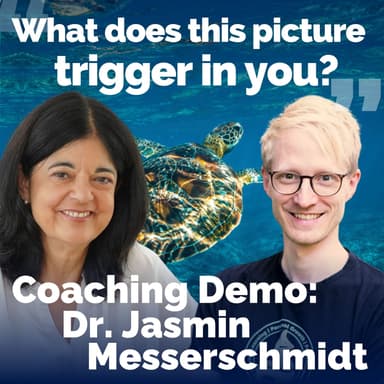
Coaching Demo with Dr. Jasmin Messerschmidt: Learn Coaching with Pictures and the Zurich-Resource-Model
with Jasmin Messerschmidt, Inhaberin/Owner, Management Consultant
Auch auf Deutsch: Coaching-Demo mit Dr. Jasmin Messerschmidt: Coaching mit Bildern & dem Zürcher Ressourcen Modell (ZRM)
Transcript
Edited for readability: filler words removed, names checked. It may still contain errors. The audio is the source of truth.
Teaser
Jasmin Messerschmidt
What does the image trigger in terms of feelings, in terms of physical sensations?
Tobi
Panic, I would almost say.
What I see in front of me is a person cutting a cucumber, who has placed their finger under the knife, so that at any moment they will not only cut the cucumber but also their finger. And I feel that directly. I would say, in my chest area, a tightening and an uncertainty, and in my stomach.
Jasmin Messerschmidt
Okay, good. So these are the negative somatic markers. They signal, help, get away from here, it's not comfortable here, it's not nice here. I'll show you another picture. What do you experience in this picture, or what does this picture trigger in you?
Intro
Jasmin Messerschmidt
So the Zurich Resource Model is a structured self-management approach designed to empower the client to achieve self-chosen goals through their own efforts. It was developed by Maja Storch and Frank Krause at the university in Zurich, and it is a mix of motivational psychology, neuroscience and embodiment.
It is a comprehensive self-management approach used in elite sports, in business, in the social sector, but also in the health sector. I also run some courses there, because it's often about, how can I control my behavior so that I feel good?
Tobi
For you, the ZRM and the training with Maja actually came after you had already spent years working intensely with images, in your doctoral thesis.
Jasmin Messerschmidt
Exactly. I dealt with that in the 1990s already. It was about, how can I get myself to live healthily, to have less stress? How can you incorporate the unconscious level? And that's when I came across images and the ZRM approach.
Tobi
Wonderful. So it sounds extremely well founded, psychologically, neuroscientifically, and that aligns very well with your doctoral thesis.
Yes, I would say at this point, let's go ahead and start our demo.
Jasmin Messerschmidt
How are you, and what topic have you brought with you? What topic should we work on here?
Tobi
I think the timing is actually very good for me, because I am currently in an exciting phase of life, I would say both professionally and personally.
Privately, we are expecting our first son at the beginning of October. That means a lot of change is coming, which makes me excited but also nervous. I'm getting many warnings from people about how much will change and how priorities will shift. And at the same time, they have already shifted in my professional setting anyway.
At metaFox, you, and perhaps many listeners, know us primarily for the picture cards and the classic educational publishing. That means we ultimately distribute printed paper. And of course we also want to grow beyond that, because as the coaching market and the coaching practice itself change,
when it comes to many processes also taking place online, we are both speaking online right now, then I think of course the coaching tools and materials must also adapt to that. That means my focus in my work has also shifted, from designing paper cards to developing online tools. And I say now it has shifted,
and at the same time that's only half the truth, because it actually often creates dissatisfaction in me at the moment, that I'm simply juggling too many things, that I'm still involved in very many projects. And at the same time, for over two years I've been saying, yes, we are now also building online tools, or I want to dedicate myself to building online tools.
And I only manage to do that halfway, because alongside it many projects with authors are also taking place. I do a lot of partner development work, and I just feel like I'm not doing justice to any of these roles a hundred percent. And that often leads to me ending the day thinking, ah, once again I didn't do what I actually wanted to do.
And how will it be when there's also a little baby in the house, to whom I naturally want to dedicate a lot of time? That means I need more clarity and more focus in my life.
Jasmin Messerschmidt
And what would be different if you had more clarity and more focus?
Tobi
I think I could end a day with the feeling, or maybe even the thought, of having achieved something, of having met my partners' expectations, of having delivered what I want, with the quality and also the commitment, the time input that I want. And I achieve that by having said no to other things.
Jasmin Messerschmidt
Okay. So your concern is clarity and focus. You want to gain clarity and focus. Is that your concern for now?
Tobi
Yes. And I believe what becomes possible then is that I am more centered. That I can also rest within myself when the outside is chaotic, when a baby cries, when the customers want something, when the colleagues want to pull me into this or that project, and yet I still manage to be present and calm in my center.
Jasmin Messerschmidt
So you need clarity, more focus, and you want to be centered, present, calm, and at peace within yourself, even when the outside is chaotic. Can we put it that way, or what else?
Tobi
Yes, that is very good.
Jasmin Messerschmidt
Very nice. Okay, then, Tobias, a wonderful method presents itself here: working with images. Normally I would go into the issue a bit more, but since it's a demo we'll do it with images, I'll jump directly into the method.
And for your information, we have two processing systems. You know that. We have the mind and intuition, head and gut, and they function very differently. The mind works slowly, with language, evaluation of right or wrong. And intuition is gut feeling, unconscious, fast, diffuse, and communicates through the body and through images.
Its evaluation is simply like or dislike. And images are capable of connecting these two systems, which work very differently, as you can see. And if I want to initiate successful change processes, then both systems must be equally involved.
So if I'm too much in the unconscious, then there is a lot of impulsivity. Let's take another example. I want to learn to do more sports. If I am too much in my head, then I force myself, I suppress the unconscious, then the whole thing is no fun and works at most until it rains, or the temperatures get cold, then I no longer feel like it and the unconscious takes the lead.
So this work with images, this Zurich Resource Model, is about involving both systems equally. This is done in the Rubicon process, where the first step is to see what your unconscious, your intuition, actually says about your desire to be clear and focused in the future, and to be calm inside,
even when the outside is chaotic. Maybe the unconscious is against it. Or maybe it wants something completely different. Or, at best, it also says, that's what you need, Tobi, to succeed in shaping your life clearly and focused. And I would now ask you to say what arises when you look at this image. What happens?
Where do you feel this image in your body? This is a kind of somatic marker check. It's about selecting the images later based on the feeling. That's why we're doing this now. What does the image trigger in terms of feelings, in terms of physical sensations?
Tobi
Panic, I would almost say.
What I see in front of me is a person cutting a cucumber, who has placed their finger under the knife, so that at any moment they will not only cut the cucumber but also their finger. And I feel that directly. I would say, in my chest area, a tightening and an uncertainty. Also in my stomach, exactly.
Jasmin Messerschmidt
Okay, good. So these are the negative somatic markers. They signal, help, get away from here, it's not comfortable here, it's not nice here. I'll show you another picture. What do you experience in this picture, or what does this picture trigger in you?
Tobi
The disappearance of the other image definitely makes me immediately open up, relax. And here I now see a beach image with palm trees on each side of the image, which form a kind of beautiful bridge or gate. And in the middle of this gate I see the view of the turquoise sea.
Over there a person is sitting on the beach. That could maybe be Johanna, my partner. And it actually evokes a feeling of security, because these palms form a kind of gate for me, and at the same time something open, because I really have the feeling that I can feel the wind blowing here at the sea, blowing against me a little. And that goes along with an open feeling in the chest.
Jasmin Messerschmidt
So it opens up more. And the way you describe this image, I can feel the wind directly. And yes, those are your positive somatic markers, Tobi. And it's about, when I present the pictures to you, you will then choose a picture that makes you feel good and supports you.
Your goal is to work clearly and focused and to stay calm. You choose what helps you with the feeling, with a positive feeling, with a feeling of moving towards, with a warm feeling. It can be very different.
Then I would like to bring you into a kind of relaxation before choosing the images, just briefly. If you want, you can keep your eyes open. You are standing in the room now, I believe, is that correct? Exactly. So that you feel how the ground feels under your feet, and that you focus on your breathing. You can close your eyes, you can keep them open, and just focus on your inhaling and exhaling. And now I will slowly guide you through your body, so you can look: how do your legs feel, how do your knees feel, your thighs, as you stand there and focus on your breath.
Notice your feet, and at the same time your legs, and how you stand there. How your bottom feels good here, and how your belly feels good, and how this relaxation then moves up towards your chest and back, and how your arms feel, your hands, your forearms, your upper arms, your shoulders. Now we move further up.
How your neck feels, your jaw, your face, your mouth, your tongue, your ears, the back of your head, your forehead, your eyes, your scalp. How everything is a bit relaxed and you are in good contact with yourself, how you stand there and breathe. And now just feel a little more how this feeling spreads within you and allows you to focus and concentrate on the picture cards.
And when you are ready, you can open your eyes again and come back here. Okay. And if you like, you can also move a little now, if you feel like it. In good contact with yourself, it's now about, I'll show you the deep pictures, the beautiful images. There are 52 images, you should know them. I ask you to choose one to a maximum of three images with the feeling that they want to come to you, that evoke a good feeling in relation to achieving your goal.
Focused and clear and calm, to be in your balance, to be centered, to work through things focused and clear, even when chaos reigns outside. Okay, now you see the pictures here, and it's important that you scan the pictures, so that you don't go into analysis, that you really choose the pictures that have a very strong
feeling, that trigger something, that want to come to you, that support you to work clearly and focused, to set priorities clearly and focused, to say no, to be centered, to do you good, to make you smile. You can simply take them and pull them out here. One to a maximum of three images. And it is important that you leave your mind out of it and let your feelings speak.
Tobi
I'll definitely take this turtle down here.
Jasmin Messerschmidt
Which image wants to be with you, does you good, when it comes to being clear and focused in your center?
Tobi
I think I will take the bird's eye view of the water here. I think that's already good.
Jasmin Messerschmidt
And would you like to say something about the choice of image?
Tobi
Yes. So I have two pictures here, both related to water. The first is the turtle, which is in the middle and yet at peace. That means the turtle just swims underwater and floats a bit, and that resonates a lot. I feel a bit of the coolness of the water. And at the same time it's calm, because it's underwater.
That means I have little noise in my ear.
Jasmin Messerschmidt
Before you continue, Tobi, it's about gathering your ideas, your positive associations, and you've already said quite a lot. I don't know if I can remember everything. I'll write down: underwater. What else?
Tobi
Floating underwater.
Jasmin Messerschmidt
I think you also said, in the middle.
Tobi
I see nicely here this being in my center. The turtle just does its thing, knows what is important to it, and is not affected by the hustle. Maybe some little creatures down there on the seabed, it doesn't touch her, she just floats along, and that's it. That's what really appeals to me, and this openness.
Jasmin Messerschmidt
At her own pace.
Tobi
That is very good.
Jasmin Messerschmidt
I will only write it down if you say yes, if you also feel or sense that in the image. Otherwise I would leave it out. So, not like that.
Tobi
I would say yes, that's good, but it doesn't necessarily trigger much.
Jasmin Messerschmidt
Calmness. Anything else? Any positive associations you connect with the image? Maybe she is wise, or in her element?
Tobi
That's good. I just said earlier, in her center, and I think the turtle carries a bit of that with her. She knows that much around her is perhaps rather new, as they say in modern German, and doesn't let herself get crazy, but simply floats through the vastness. That is also something I can actually see in both images.
This kind of overview. Somehow she floats here above the seabed and thus has a bit of a bird's eye view. In a certain way, the turtle is also the bird, or the drone, that made the other image. That means there is an overhead view, not losing sight of the big picture.
Jasmin Messerschmidt
If you take a look, what could be around the turtle? Is there anything else that comes to mind?
Tobi
Yes. I would say a lot and somehow also nothing. In the sense that around the turtle there is, first of all, just a lot of space, a lot of water, and a lot is happening on the seabed. There might be small crabs and small fish and such. But they don't really play a big role in where the turtle swims and where it moves.
I think that's the crucial point. A lot is happening, but it's not that important.
Jasmin Messerschmidt
So, I have written all that down, and then we come to the second picture, the bird's eye view here as well. What comes to mind with this picture?
Tobi
Yes, I have already drawn some parallels. I see the image of a beach from above. That means I can see both the sea and the vastness of the beach, and I just have a very broad overview. And then there is also a person walking along the beach, but they didn't play such a big role in my selection. So it's more about the feeling of vastness, weightlessness, and somehow the cool breeze that I can feel here when I'm hovering so far above the sea.
And that's also a bit of the parallel I see with the underwater image. It's a cool sea, and that also calms me down a bit. So when I look at it now, I have to say, I don't even know if I really need the second image.
Jasmin Messerschmidt
I was just about to ask.
Tobi
The turtle image already contains this bird's eye view that the turtle also has on the seabed, and that's actually what this image complements. But I actually think I could set this aside and focus more on the turtle here.
Jasmin Messerschmidt
Yes, that's great. Then I'll make this smaller. And this is the turtle. It's often the case that one image becomes particularly clear, that it's actually just that. Do you want anything else? Can you think of anything else that we don't have yet?
So, unknown world comes to mind. Vastness comes to mind, but it doesn't have to be. Those are your positive associations.
Tobi
Yes, I wrote that down. The limited view that the turtle also has in the ocean: it becomes dusty at some point and it can't see infinitely far, it doesn't really know what's there on the horizon. And that's still okay. It just swims there stoically, in the direction it thinks is right.
Jasmin Messerschmidt
So she doesn't quite know where she's drifting. Or how do you say it?
Tobi
She doesn't know what awaits on the horizon, but she trusts in swimming in the right direction.
Jasmin Messerschmidt
That's nice. Okay, good. If nothing else comes to mind about the image, maybe the colors, the turquoise, or light rays, sun rays. But those are your associations. Good. Then let's move on to the selection of your favorite ideas.
If you take a look, Tobi, which words are particularly important? I'll copy them and go to the favorite ideas board. And I do it like this: I have copied everything here again, and would simply look at which of these you take as your five to 10 favorite words, favorite associations.
Tobi
Yes, exactly. I'll just do it.
Jasmin Messerschmidt
And I also ask you to choose that with feeling. Not with the mind, but with feeling.
Tobi
Let me just connect again with this floating, open body sensation. Yes, I think that's fine as it is, this floating in my center. I would say that's actually the main headline. And not getting distracted. I'll make it calmly floating here.
Jasmin Messerschmidt
Yes, also very nice, calmly floating.
So why do you think your unconscious probably reacts so positively to these favorite ideas, to these words or associations?
Tobi
Yes. I feel this feeling of floating and calm, so actually calmly floating. If we just take that as a headline, that is something I long for very much, to end a day with this feeling of calm floating. And that's something I can really feel physically in my nervous system, that I just don't have that at the moment, that I'm often still on adrenaline. Now I'm trying to explain it cognitively again, but I know exactly how that feels.
Jasmin Messerschmidt
So what is here now is simply head-gut synchronization, right? That's what you are doing here. That's why the head can be involved, and the gut.
Tobi
I think my head would describe it as a rapid jumping of thoughts from one topic to another. And that is in stark contrast to this turtle, which simply floats stoically in one direction, in its center.
Jasmin Messerschmidt
Anything else about these words, these associations in connection with the image, why it is so important to you? Or would you say it has hit the nail on the head? Perhaps the aspect of trust?
Tobi
I would say a kind of basic trust that plays a big role here, and even more so a knowing, simply. I have Master Yoda from Star Wars in mind a bit. There is no try. Just an intuitive knowing about the right direction.
Jasmin Messerschmidt
And that's a nice image too. If you imagine Star Wars here, does he fit with the floating turtle somewhere in the image?
Tobi
He might be sitting somewhere on a rock, at the edge. And this quote, there is no try, that's what I have in mind here too.
Jasmin Messerschmidt
And this, there is no try, means, I trust that I am on the right path?
Tobi
That means a little bit, if you feel inside yourself, then you know what is important and what is right. So instead of going into mental gymnastics and trying to weigh it up, rather find an if-you're-in-a-hurry-go-slowly mode. To look at, not what do I think, but what do I know?
Jasmin Messerschmidt
So a lot of wisdom, right? Intuitive knowing, as you called it. If you base it on your favorite ideas, we might look here again: what is it now, from these favorite words, that is very important to you?
Tobi
I would say, calmly floating in my center. And a second one might be this, there is no try.
Jasmin Messerschmidt
I have goosebumps. Although it's not about the coach getting goosebumps.
Tobi
I think that's actually enough.
Jasmin Messerschmidt
If you look now, formulate your conscious desire based on your favorite ideas, with the result of the reflection, aligned with the unconscious. What do you want, and what do you need?
Tobi
I succeed. No, not I succeed, too many words, sorry. Instead, I would say, I am centered and have trust.
Jasmin Messerschmidt
Wow. You need that. What we are doing now is the next step. I think you are already very far along. It's about a motto goal, so it's about aiming towards something. You said at the beginning that you don't want to be confused anymore and sink into chaos and go from one thing to another and be exhausted in the evening, and so on and so forth.
But rather it's about developing a motto goal formed from your favorite words. So it's about having a motto goal that truly guides you internally and leads you to your goal, allowing you to act clearly and focused. It enables you to end your day in a way that you are satisfied in the evening.
Tobi
I would say, I actually thought during the previous exercise already, I know the method, that we are now at this point, and had already tried to formulate it like that. But I also thank you for the chance to refine it again. Yes, let's do it that way: I can float in my center. There is no try.
Jasmin Messerschmidt
Great. Tobi, is this now your motto goal? Let's go back here to pimp my motto goal. I'll ask you now: how many positive feelings does this motto goal evoke in you, on a scale from zero to 100?
Tobi
I am definitely in the eighties.
Jasmin Messerschmidt
In the eighties. And negative?
Tobi
Zero.
Jasmin Messerschmidt
Zero. Okay. And is that under your control?
Tobi
Yes, I would say so, because especially with this feeling of floating in my center and the attitude of there is no try, that is like a reminder for me to stay with myself and not fall into over-analysis. I think that's not the answer to everything. I think my cognition is also a strength that I can trust, but I don't think I need to worry about losing it. That's why it also feels right for me not to have it here now. And I would say, I can stay centered. There is no try.
Jasmin Messerschmidt
Or, I float in my center. Feel which one resonates the most.
Tobi
It's already the, I float in my center.
Jasmin Messerschmidt
So that is your motto goal. And in the next step, if we still have time, there will be a kind of systemic review of this motto goal. Now we have a motto goal aligned with the unconscious. Your body says, that's where I want to go. Your mind says, great, that will help me succeed.
And if you have time, we could go into it again. Is your goal even practical for everyday life? Does it need a bit of adjustment? Where do you apply it? What are the costs? What is the benefit? So that then goes into a normal, typical coaching conversation.
Tobi
Exactly. The eco check, right?
Jasmin Messerschmidt
So when, where, with whom, how often would you like to adopt the stance of your motto goal? Because a motto goal is an attitude that encompasses many concrete situations. So what would you say, Tobi? When would you like to implement this goal, adopt this attitude?
Tobi
Yes. I'm just wondering, are there moments when it's not useful? Because I would say almost always. I think for me, professionally that is, when it comes to project selection and dealing with my team members at metaFox, and privately in dealing with my emerging young family. It is actually this basic trust, this open floating, that I want to take with me.
Jasmin Messerschmidt
And how can you put yourself in that position? Because that's a feeling. Someone who thinks quickly and has many thoughts, how can you get there? How can you bring yourself to do it too?
Tobi
So I think I will definitely put the turtle on the wall here.
Jasmin Messerschmidt
If I may recommend something from my experience: if we were to continue the coaching, I would include the topic of embodiment, meaning bringing the goal into the body, and encourage you to find a body movement or a tai chi sequence that helps you get into this posture.
So you could do that afterwards, in addition to this coaching, by considering how you stand, how your feeling is, how your chest is, how the arms are, how the legs are. And then: I float, I float in my center, there is no try, or whatever. That you find a sequence of movements for yourself,
for the body, because in the morning, when you start, you can immediately bring the body into this embodiment, and then you are your goal. In my experience, this is the most effective method to succeed in focusing and bringing yourself into calmness. So basically the zero position, or calibration, in the morning.
Tobi
Yes, I think it would be a kind of standing on both feet, and an exhale, and maybe this movement with the hands, and then letting the hands, the arms dangle, and thus symbolizing this floating. I float in my center. There is no try.
Jasmin Messerschmidt
Now it is recorded. Wonderful. And then you could think of a mini embodiment, a small one that you do in social situations, a socially acceptable mini embodiment.
Tobi
Yes. I think it's more like a grounding movement somehow, feet on the ground and a downward stroke.
Jasmin Messerschmidt
Great. Remember it, and use it as often as possible in the coming days and weeks. Because the next step is to form and strengthen the neural network in the brain.
Okay. What happens when you implement your motto goal? What will change in your life?
Tobi
I think I can remain calmer even in hectic situations, and thus be more present for those around me.
Jasmin Messerschmidt
What do you need to let go of? What do you need to give up? What could be the disadvantages? After all, there is no change without disadvantages.
Tobi
I can't do so many things anymore. I also have to say no. I am finite. And at the moment I don't always say yes because I somehow can't say no, but because I really want to work with these and those people and on these and those projects. And I think that will be the challenge. That's why this benevolent attitude is so important to me. I am finite. That captures it very well.
Jasmin Messerschmidt
Then let's come to the conclusion. And the question is, will you cross the Rubicon with this and say, yes, I absolutely want that?
Tobi
So that means, is this motto goal attractive enough that I can also muster the activation energy if, in my case, it perhaps becomes hectic and many projects pull at me?
Jasmin Messerschmidt
That is the next step, right? Because there will be situations where you won't succeed. That is the relapse rate, it is always there. It is about working on it piece by piece, so that the neural network in the brain becomes strong enough to achieve the goal even in increasingly difficult situations.
So at the beginning there will be situations, these are A-situations, where it is very easy to float in your center. If you are having dinner at your girlfriend's, for example, then you're centered, there is no try, no problem. And then there are more difficult situations that are, however, predictable.
If I have a pitch, or there's the birth, where you can prepare yourself and develop action plans. We would do that in coaching now. We would develop action plans for difficult situations so that you succeed. And that's like an inner video, a kind of mental training, so that you manage to stay calm, to remain centered, even if the office is burning down around you.
It's about implementing this motto goal step by step and strengthening it in your brain, so that you develop such a strong neural network that you automatically stay with yourself, remain centered, and stay calm. This is work now.
Tobi
It's starting now, I have that feeling too. Then I say thank you very much for this process. And I would now be interested, in my role as your podcast host and interviewer: if we look at this process, how did it differ, or what would be something you might have done differently with a client in reality?
Jasmin Messerschmidt
I wouldn't have added so much at the end. That came from the impulse to give you a lot, how it continues, what you could use to make it work. Otherwise, that was a real process.
Tobi
In reality we would not have just one session, but several, and then one could say, okay, today I go home with my image and the motto goal, and next time we will talk about embodiment and work on the movement that lets me float in my center. I found the calibration exercise very nice and helpful.
I think that is, for me, from this session and also from our interview in the last session, the biggest takeaway. When I compare how I have worked with picture cards so far, it is this calibration. The picture with the cucumber, cutting into the finger: stress, how does that look in my body as a client, and how does relaxation, openness look in my body? And calibrating beforehand was really very helpful.
To then choose the image with the body feeling. It goes further than just saying, yes, let your intuition guide you and choose the image with your intuition. I often say that when I guide it. But through the calibration with the body feeling it naturally takes on a whole different dimension and becomes much more tangible.
Jasmin Messerschmidt
Great, nice, I'm glad. And that's also what I pass on to you for your goal: in the morning you need an inward calibration, for the body and not for the mind.
Tobi
What would you like to share as an image veteran, as a super experienced expert in working with images? What advice would you give to aspiring coaches to start with image work?
Jasmin Messerschmidt
So I have two points. One is, pay attention to the body language and less to the client's words. Stay connected with the client on an emotional level. And if you notice it doesn't feel right, your feeling, you sense there's no energy or something like that, possibly the image was then chosen too much with the head, or it doesn't have this effect because someone comes from marketing and works professionally with images.
So pay attention to body language and stay in contact with the client, but also stay connected with yourself. Be in resonance with yourself, that is important. And if one is not sure, then ask. And the other thing is, the image belongs to the client. I do not interpret for the client, but the client discovers for themselves what is right for them.
Tobi
What if I had said, oh, the thing with the images, that's somehow too esoteric for me? How would you have reacted then?
Jasmin Messerschmidt
I would have accepted that immediately. I might have asked again, really, and what about it could be esoteric? Maybe done another round of advertising: effectiveness, brain research of the third millennium, very important, and so on. But then I would certainly have left it at that. For me the client is always right. And what is important to me is that the client feels safe and well taken care of, also by the unconscious, so that this head-gut synchronization can occur in coaching. And for that they need to feel heard and appreciated.
I would certainly first move on to systemic questions, and then maybe at some point offer the topic of inner images or metaphors.
Tobi
That means the client can paint the picture in her mind herself. Beautiful.