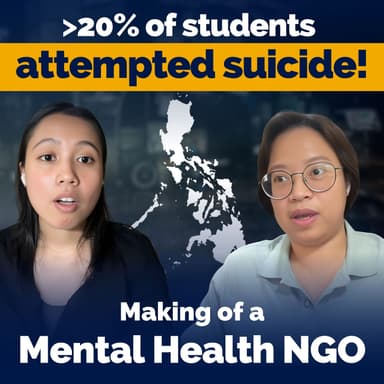
Making of a Mental Health NGO: How Phlourish Coaches Teenagers using Psychoeducation Workbooks & Effective Altruism
with Reynaly Shen Javier and Rochelle Bata, Founder & CEO at Phlourish
Transcript
Edited for readability: filler words removed, names checked. It may still contain errors. The audio is the source of truth.
Teaser
Rochelle Bata
And it said that in the Philippines around 18 percent of students age 13 to 15 said that they had attempted suicide at least once in the past 12 months. And that really blew my mind.
Reynaly Shen Javier
The worse I'm doing in the beginning of the program, the more useful the program will be to me. It's really starting with something small and then building it up as you understand the problem and the possible solutions more.
Intro
Tobi
Welcome to the Making of a Coach. I'm Tobi from metaFox, and today I'm sort of breaking the rules of podcasting by diverting from our regular focus of hearing the stories of experienced coaches. Instead, we go to the intersection of mental health, doing good and building organizations, because I'm sure these are all topics that both I and also you, as a coach or facilitator, are super excited and passionate about.
Mental health in the Philippines
Tobi
We go to the Philippines in Southeast Asia, a country with 7,600 islands, and unfortunately also a country with a very low supply of mental health practitioners, and a country that is very close to my heart, because at metaFox we've been collaborating with Filipinos since 2020 in the design and the delivery and all the things that go around our coaching cards. As we've come closer and closer, we also partnered with an NGO called
Phlourish. They deliver mental health interventions for teenagers, and I'm super fascinated by their approach to building an organization and to building their service. It is very focused on evidence and really has an impact.
Meet the founders of Phlourish
Tobi
So today I have the two founders here, to talk not about coaching and building a business, but about designing a program to remove stigma from mental health and to help young people to Phlourish. So, let's hear from the founders, Roc and Shen.
Phlourish's mission and approach
Rochelle Bata
Phlourish is a mental health nonprofit in the Philippines. The premise of Phlourish is that we believe every Filipino deserves to flourish in life. And we think that poor mental health is a barrier to that. And so we want to test and scale cost-effective and evidence-based mental health solutions, so that they become accessible.
Tobi
And maybe one cool thing that is not obvious to the listener right now. When I say Phlourish, that is, of course, on the one hand the word flourish with an F, but for the name of your charity, for your NGO, you put a PH in front of it. So it's flourish with PH, like the Philippines. That's where you are based as well, right?
Rochelle Bata
Yes.
Reynaly Shen Javier
I guess I would also add that right now, even if our goal is to test and scale cost-effective interventions, we are focusing on the younger population, so on adolescents. And we're reaching them through various partners such as government offices and other non-government organizations, and we are focusing on guided self help at the moment. And to give a background on myself: before I co-founded Phlourish, I also helped co-found another mental health charity in India called Kaya Guides. They also focus on the youth, but provide digital guided self help. I also led a mental health research project, which is about the top mental health charity ideas that can be started in the Philippines. And that's really how Roc and I started collaborating.
Tobi
Thanks. Would you also like to briefly share how you got to work on Phlourish, Roc?
Rochelle Bata
Yeah, well, I've been in the nonprofit space for most of my career, but mostly I was actually in climate change. And it was in early 2022 when I really started seriously thinking about working in this space. I had had the idea of working in the mental health space I think as early as 2015, although it was more in the space of flourishing and having agency, learning more about how to regulate and understand yourself. And in 2020 I actually stumbled on a study. It was a report, the Global School-based Student Health Survey. And it said that in the Philippines,
students age 13 to 15, around 18 percent of them, said that they had attempted suicide at least once in the past 12 months. And that really blew my mind. And while I was still working in climate change, it felt like an urgent problem. And I felt called, and I felt like, okay, this is the time for probably that idea I had in the past of helping young people learn all these skills, life skills and emotional regulation. Maybe it's about that. And so I started working on it, and Shen happened to be researching as well. And from conversations it became more and more concrete ideas, until it felt like it's time to start working on it.
Tobi
Thanks. So Shen was already looking into the space of mental health interventions and how that can be scaled. And you came in as basically a nonprofit veteran, coming originally from another sector, but then bringing in all that experience. Can you take us a bit into the work on the ground?
Reynaly Shen Javier
So our first program is guided self help, by providing the participants with a physical workbook. We deliver this workbook in an orientation, so that's an important part of the program. The first interaction that we have with the participants is the orientation, where we talk to them about what they can expect from the program. But aside from the program, we also introduce to them some basic mental health concepts. They attend this orientation with their parents, and it's important for us to inform them properly about what they're getting into, and also to increase the awareness of both the participants and their parents through these orientations. And after the orientation, if they're still interested, they sign up for the program, and a week after signing up they receive the toolkit. And then a week after that, the weekly check-ins with our lay mental health mentors start. So they meet with these mentors once a week, for eight weeks.
Challenges in mental health in the Philippines
Tobi
So most of our audience come from the global north, with many Germans, Europeans, also people from the UK and Americans listening in. Can you share a bit of the reality of your target group? How does daily life in the Philippines look?
Reynaly Shen Javier
I think the mental health burden, not just in the Philippines but in the global south, is that there is a high burden, but there are very low resources available. So the budget spent on mental health from the government doesn't even reach 2 percent of the overall government spending on health. And we only have about one third of the global average of mental health workers attending to the population. So in the Philippines, for example, there are only 28 children and adolescent psychiatrists in the country. And we have something like 30 million young children. So it's crazy just comparing those numbers. And there are just 357 other mental health workers, including psychiatrists. So it's just so hard to comprehend how these people are able to address the needs of the population that they serve.
Rochelle Bata
I mentioned earlier the 18 percent suicide rate among 13 to 15 year olds that urged me to work on this. But more recent data, which is 2019, shows that it has grown to almost 25 percent, one fourth of them saying that they had attempted at least once. But also on the reality, because we
did do focus group discussions with adolescents, with parents: the adolescents that we work with are really coming from low resource areas. So we have users coming from really remote islands, which is why it was also very intentional for us to deliver the service via a printed toolkit instead of a tech based service. Most of our users share mobile phones with their parents, or most families are actually sharing a phone across the members. We do have users who are still struggling with internet connection, even with mobile connection, that they would have some issues with calling our mentors because of data and signal network issues. And even the parents are somewhat struggling, and many of the
problems we learned about were related to relationships, but at the same time also to their conditions, poverty, not having the resources they need for school and stuff like that. So yeah, it's really quite complex, because it's not just physical and mental, it's really psychosocial and about the conditions. But yeah, we do work with adolescents from low resource areas who have very different realities, perhaps, from what's familiar to the podcast listeners.
Tobi
Yeah, so we have a country which is large in terms of population, it's really spread out over many remote islands. And then you're saying there are many adolescents, there's a very low supply of mental health workers, so access to these kinds of interventions is not great.
Target group and intervention strategy
Tobi
How did you then come to decide on exactly this target group and this type of intervention?
Rochelle Bata
For the adolescents, it's really the data showing the prevalence of the problem in this population, in this segment. But at the same time also considering that about half of mental health conditions start around this age, adolescence. And it's a very critical period where there's a lot of change and development happening in a person's life. And we thought it's kind of like the sweet spot to have this kind of intervention. Well, Shen did the research, so probably Shen would be the best person to talk about why it was the thing that we decided to test.
Reynaly Shen Javier
When it comes to this age group, in terms of mental health, it's also one of the most neglected populations in terms of research. So there's not a lot of things we know about this population. There are still a lot of mixed thoughts about the type of interventions for them. And I think it's really not easy to work with this population, compared to working with adults, because you have to go through partners who have access to the population, because they don't have the freedom that adults already have when it comes to accessing mental health services. So that is also part of the importance of working with this age group. And when it comes to choosing this specific intervention, we of course looked at the evidence base for this. Guided self help is considered one of the most effective mental health interventions. So that's from our research, but it's also from other meta-analyses done. And then we also thought about acceptability, of course, whether they really want this. And workbooks are a familiar format to adolescents, because they encounter it in their daily lives. So that was part of why it's also easy to scale.
Tobi
I can really hear that you have a very scientific approach. Even your language, it's a lot about getting the numbers right and using terms like scaling. And I'd love to unpack that a bit more in detail in a bit. Before that, however, let's make that more tangible, and maybe we can even look at the life of one user. Let's say we have John, he's 14, he's living on a remote island. And you said, okay, you chose a workbook for them to do this psychoeducation, because maybe John's smartphone doesn't really exist. In fact, he's sharing his smartphone with his parents, it's more like this family smartphone. And so that's why obviously he wouldn't want to write down very personal thoughts. So let's go a bit into the life of John and your intervention. Where does he get in touch with Phlourish firstly?
Reynaly Shen Javier
So, like I mentioned earlier, the first thing we do in preparation for the program is reach out to partners. Our partners have some form of access to the age group that we intend this intervention for. So examples for this are youth organizations who have services for children and adolescents. John is most likely already accessing some other type of service from this partner organization. So we talk and collaborate and prepare the program for them, and then the partners go around their community to ask John and others in the service age group to sign up for the program. And then, after a period of signups, we meet John and the other adolescents who signed up, through the orientation.
The orientation and the parents
Tobi
Let's say I'm a fly on the wall of this orientation. What would I see?
Reynaly Shen Javier
So in the orientation, a group of 12 to 18 year olds sitting down and facing a presentation. They will be sitting with their parents, and then we'll pass around some forms, after giving them a bit of time to answer, which is very important, because they're minors and we can't work with them without their parents' consent. That's when we introduce the program to them. So we usually start with a sensing of what they know about mental health. The answer that we usually get, and this is where stigma is still also apparent, is that they all usually refer to it in the form of illnesses. It's nice that they're familiar with depression and anxiety and stress, but that's what they automatically think about when they hear the word mental health. And then there are also those who really don't know anything about it. And that's the same with the parents.
Tobi
So basically the orientation helps John to understand what is depression, what is anxiety, these kinds of things. You want to normalize talking about this with others, with their parents. And then you said there is also this aspect of educating the parents on how they can actually talk to John about this. And I was wondering, do you talk to parents with the adolescents present and vice versa? Or do you work with groups there?
Rochelle Bata
In the first part of the orientation, which is more general, about the program and about mental health, everybody's there. And then we separate the parents while the adolescents are doing the pretest. Many of our orientations also happen in a basketball court, which is a typical venue for gathering people in the Philippines. So it's pretty spacious. If you move the adolescents to one side and the parents to the other side, there's a little bit of privacy and parents can start asking questions, giving comments. I forgot to mention, we also inform them about important signs: if they observe these in their children, that these are signs that the child might be needing help, and they could go to the health center or go to a hospital, try to check with the doctor, or, if our partner is the health office, they can reach out to them.
Tobi
Can you give an example of one or two of these important signs that I can see as a parent?
Rochelle Bata
Yes. So if there's prolonged low energy and not having the motivation or enjoyment in the things that the kid has been enjoying, and they observe that for at least two weeks the kid hasn't engaged with that same activity, hasn't had the interest, then that could be a sign. Another is if they are neglecting themselves, just basic hygiene, not being able to do the basic stuff, and it's affecting their performance at school, it's affecting other activities. I mean, it's pretty normal for adolescents to isolate, it's a period when that typically happens. But if they're finding clear changes in their behavior, then that's another sign.
Tobi
So if I see my child is losing interest in something that they previously were interested in, and there's this lack of drive, I would say those are probably similar to depressive symptoms that an adult would have, actually.
Rochelle Bata
Yes.
John's journey with Phlourish
Tobi
Let's go back to John and into the orientation. Shen, you were already telling us a bit about it. After the orientation, John goes home and then receives a simple WhatsApp, I assume, from their mentor, and goes through the program over the following weeks, which means they basically work with the workbook, read things in it, can write into it. What else is happening throughout the course of the program?
Reynaly Shen Javier
Yeah, so they do have assigned worksheets, that's what ideally they've done when they meet with the mentor. But during the first week that they meet with the mentor, they talk about their goals and commitments for the program, so that the mentor also has more of an idea about how to provide support to John.
Tobi
Can you tell us a bit more about the contents of the workbook and the chapters? How does the workbook help structure the entire program?
Reynaly Shen Javier
Yeah, so the workbook provides them the information, that's the first part. And then we have the second part, which is the worksheets, where they get to practice the techniques that were mentioned in the chapter. And there's also space for reflection, where they can just write down any thoughts that they have about what they learned.
Rochelle Bata
I guess I can share more about the actual content. So earlier Shen mentioned the modules. We do have five in the toolkit. First is fighting stigma, so that's general information about mental health. Then healthy habits and building self-compassion. The third module is on emotion regulation, so it has more skills and techniques that they can use. The fourth one is building healthy relationships. And the last chapter is around help seeking.
Reynaly Shen Javier
So it also has a buildup. If you've noticed, for example, we introduce healthy relationships before help seeking, because their support system is important when it comes to help seeking.
Rochelle Bata
And on those takeaways, we asked what kind of experience or model could deliver the knowledge, which is why we have in the toolkit the information, the introduction part. And then there's the experience of trying something, which is really the worksheets, prompting them to try something and have an experience. There's the level up, which is giving them tips and sort of a challenge to build on these things that they are learning and to integrate them into their routines, to build a habit out of them. And of course the reflections part as well. And we had several rounds back and forth. So we would have a first draft, and then have conversations with adolescents, have them look at the content, give suggestions. We kept trying to test and iterate before really coming up with the design. And of course we had help from metaFox for the design, for actually putting together all the ideas and putting them in this format that our users are finding to be attractive and appropriate for them.
Tobi
So what I hear is, on the one hand we have making sure the content is accurate and science based from a psychology perspective. Then there's making sure that you speak the language of the youth, so it can really be adopted by them. And then it's also about the design, using the metaFox designers who usually spend their days designing coaching cards, actually making this look good. So it's also fun to interact with, because you want people to interact with it. It's not only something to read, it's really worksheets where I reflect, where I write down my challenges, things that I'm grateful for, et cetera.
Rochelle Bata
Yes. And of course we also had experts check the toolkit before we started distributing it. And even with the design, at some point we presented different looks, different kinds of design, for testing, and they would suggest which ones they feel are more appropriate for them.
Tobi
The other building block that you mentioned now a couple of times, but which I would like to look at a bit more closely, is the lay mental health workers, as Shen called them earlier. What does that mean? Who is a lay mental health worker, and why do you need them?
The role of lay mental health workers
Rochelle Bata
I can start. Well, one problem that we mentioned is there's really a lack of mental health practitioners in the Philippines, and it's a gap that we also wanted to fill. But of course there's literature around the effectiveness of training lay people to provide some level of support. And so our lay health mentors are individuals who don't have to be psychologists or psychiatrists. We select them in terms of their fit for the role, which is being able to relate to adolescents. We have a concept here of Kuya, you know, big brother, big sister. So it's more of that, and not a super adult mentor, so that the relationship could have more rapport with our users. We have developed a training process for our mentors as well.
Tobi
So through these lay mental health workers, you also overcome the challenge that we talked about previously, that you have in the Philippines, and I guess in many countries across the global south and even beyond, and that is a lack of psychologists, of access to mental health treatments and interventions in general. And that's why you said, okay, we need to actually bring in people who do this voluntarily. Is that right?
Reynaly Shen Javier
Yes.
Tobi
So we need to bring in volunteers who actually take on this role, and through having the toolkit, the workbook, they can also do that, basically, because they have this blueprint to follow along. How else do you train them to take on this role?
Reynaly Shen Javier
So the training is in the form of online sessions. It's a mix of synchronous online sessions and asynchronous course materials. And then during the program they also have supervision from the team. So they have the option to meet one-on-one with a mentor supervisor if they have any concerns or if they need any guidance. And then we also hold general mentor check-ins. This is a group check-in with mentors where they can share their experiences, talk about reminders for the rest of the program.
Rochelle Bata
We also have a manual for our mentors, so they can have it while they're doing the mentoring, and a regular check-in with their team.
Tobi
So next to the workbook for the program participants, there is also sort of a cheat sheet for the mentors.
Reynaly Shen Javier
Yes.
Rochelle Bata
Yep.
Effective altruism and an evidence-based approach
Tobi
So I think what becomes quite apparent if one is listening to you, and what also fascinated me about Phlourish right in the beginning, is that you approach this like a startup of some sorts. You started with focus groups. I remember, from being part of the workbook development, that we had a first draft, then we tested that, then there was a second draft that we produced. And so you seem to be not just a regular association or NGO that is sort of, we feel like this was a good thing that the world needs, so let's do it. You take a very scientific and almost business driven approach to this entire venture. Can you talk a bit more about the principles that guide you in setting up and scaling Phlourish?
Rochelle Bata
Actually, Shen and Joseph, our other co-founder, we actually met through a local chapter of effective altruism. It's a movement that basically promotes rationality and evidence paired with wanting to do good. Even when we started working on mental health, we had this framework of scale and neglectedness: looking at the scale of the problem, then neglectedness, meaning that if we put more resources into this problem it could have a greater marginal impact, and also tractability, meaning that if you actually work on this problem, there's a chance of it being solved. And we try to have that always as a kind of guiding principle in our decision making. And as a practice also, whenever we make decisions, we try to be clear about what criteria we are setting, and to have sort of metrics or a weighted factor model in some of our decisions, to help us really make informed and evidence-based decisions.
Tobi
So there are these principles of the effective altruism movement, and all that you do is evidence-based. You want to focus on the big problem, and you also want to focus on the problem that is neglected, meaning there aren't many organizations actually working on that.
Rochelle Bata
Yes.
Measuring impact and outcomes
Tobi
Talking a lot about impact, I was wondering, how do you actually measure impact?
Reynaly Shen Javier
So for us, we look at various mental health outcomes, specifically life satisfaction and depression symptoms, and protective factors that are aligned with the lessons that we mentioned earlier. So there's mental health literacy, likelihood of help seeking, and contentment with relationships, for example. We assess our impact by comparing their pretest and post-test scores, and by understanding our costs. So we also want to make sure that it's cost effective, making the most use of the resources that we have.
Tobi
So, for example, there's a section about help seeking in the workbook and in the program. And then you ask a question like, how often did you talk about your state of mind with your friends? And you ask that at the beginning of the program and at the end of the program. How can I imagine that?
Reynaly Shen Javier
For help seeking, it asks how likely you are to ask help from people when you're having a personal or emotional problem, and when you're experiencing suicidal thoughts. So those are two different questions. Other questions are rating statements. So: I'm comfortable talking about mental health. I have people in my life to talk to about things that matter to me. I am confident in my ability to manage strong emotions.
Tobi
So it is asking questions from the subjective perspective of the program participants. You also mentioned measuring wellbeing, or happiness. How do you measure happiness?
Reynaly Shen Javier
So we're measuring life satisfaction. It's the Satisfaction With Life Scale, SWLS, and it's composed of five items. The items consist of general statements that they either disagree or agree with. And some items that I can remember are simply: I am satisfied with life. Or: if I could go back in time, I would change something in my life. Or: the conditions of my life are excellent.
Tobi
So asking, am I content with my life, do I have any regrets, et cetera. And what did you measure so far?
Reynaly Shen Javier
So during our pilot, and also in some initial evaluations for the programs that we ran during the first half of the year, we did see significant improvements in life satisfaction among our users. And this is more apparent with those who started with lower scores in life satisfaction. Recently we also started measuring depression symptoms using the Patient Health Questionnaire, the four-item version. And we're also seeing that trend, where users who have higher scores in anxiety and depression have reduced symptoms of anxiety and depression at the end of the program.
Tobi
So the worse I'm doing in the beginning of the program, the more useful the program will be to me.
Reynaly Shen Javier
Yes.
Rochelle Bata
Although, just a caveat, we're finding that the biggest outcome comes from those that start from slightly dissatisfied, not the extremely dissatisfied ones.
Tobi
Thanks. Let's look a bit at the aspects of building the organization. And there I'm wondering, how is Phlourish funded?
Rochelle Bata
Yeah, we are funded through grants. We've applied for grants from the Mental Health Funding Circle. We do have a grant from the Dory Foundation. Mostly from those sources currently.
Tobi
And how did you acquire this funding?
Rochelle Bata
It's really through application. I remember, when we were starting Phlourish, we actually got rejected. We started trying to raise funds as early as while we were still understanding and developing. Just continuing the work, even if we weren't funded yet at the time, until we had some traction that increased the confidence of the funders to support our work, and we were able to get a renewal of funding from them.
Tobi
So very practically, that meant applying for grants, writing long documents where you answer questions that are asked? Or how did that application process look? What was difficult, and what did you learn?
Rochelle Bata
Well, to be fair, the Mental Health Funding Circle has a very straightforward, simple application process. It's a couple of questions, and then you attach a one page document that captures the work of your organization. And if they're interested, you get a call with the funders, because it's a network. It's really different funders trying to contribute. If there are some who are interested in your work, you get to have conversations with them. They ask follow up questions, you send more stuff. So at least the investment in the beginning is not too much, but you just add a little bit more as you progress in the process. But I would say it was a simple, straightforward, easy process for us.
Tobi
How do you build trust with these kinds of donors and partners?
Rochelle Bata
Yeah, well, it's definitely very important to build trust. I think that even if we didn't get funded in the beginning, we were just doing it on the side, because we had our full-time work, and this is a thing that we were really passionate about and we were trying to build from the ground up with the resources that we had ourselves. So I think, after the rejection, continuing the work and having traction, progress in the work, built the trust that we're serious about this. And of course, once you have that relationship, it's important to continue nurturing it, which means we regularly send updates. Of course there's required reporting, which for the network is pretty doable. But at the same time, just having another layer of relationship with the funders, where even outside of those reporting schedules we still provide them updates, especially if there are exciting milestones. But at the same time, communicating openly our challenges and our difficulties, the things that we still need to figure out. That level of transparency builds trust. Because the reality is, when you start working on it, no matter how great your planning and how much you've thought about it, something is still going to be different when you're implementing. So being honest about those things as well.
Tobi
Yeah. And I think you are also very transparent with all these numbers that we talked about previously. I remember seeing this Google Data Studio, like a business intelligence dashboard, where basically I as a partner can really see the quantitative answers that people give to the surveys that they take throughout the program. What I also notice in your answers is that it doesn't sound like the network played a big role, and that may be encouraging for early stage NGO founders and social entrepreneurs. It really seems like it was more the craft of being able to write a good funding proposal than knowing important people. Is that right, or what would you say? What role did your network play?
Rochelle Bata
I would say network is very important. It's just that, I guess, when we were starting Phlourish, it's more of me personally just not having that network yet at the time. But at the same time, we know of the Mental Health Funding Circle because of our network, because of the effective altruism network. Some of them are aligned, and that's how we learned about them. And now I am seeing more and more the importance of network, building trust with people that could even expand that network.
Tobi
Let's say I'm a founder of an early stage NGO, and I'd like to learn more about this whole effective altruism thing and the networks you are in, that also bring you traveling around the world. Where would you say is a good place to start and to engage there?
Rochelle Bata
I guess I can answer for the effective altruism. There are a lot of resources online, and it's easy to find opportunities to engage. So there are some fellowships and there are local networks. There are events happening in different regions, in different countries. I guess for most of your listeners, it's possible that they could find local chapters, and that's how they can start engaging with effective altruism. At the same time, in terms of building a network in specific areas like mental health, it's really engaging with the space as well, participating in events, attending conferences.
Reynaly Shen Javier
For me, I think I would return to the agile and iterative approach. So we did start this, like Roc mentioned, the initial applications were rejected, but we still continued working on this. And we worked on this while having other full-time jobs. So it doesn't really have to start from something perfectly established already. It's really starting with something small and then building it up as you understand the problem and the possible solutions more.
Tobi
So build, measure, fail, possibly learn, and keep building, in a way.
Rochelle Bata
Yeah.
Tobi
To slowly approach the end of our nice session here: let's say I've now listened to the three of us talking, and now I'm super interested to engage, to learn more. How could I get involved with Phlourish?
Rochelle Bata
One way is to go to our site. It's phlourish.ph, Phlourish with the PH, dot PH. They can also reach out to us on LinkedIn. We'd be happy to connect and explore how we can collaborate.
Tobi
And how could that look concretely, especially if I'm not based in the Philippines?
Reynaly Shen Javier
We have plans to open an internship, but there's nothing concrete yet. But it'll definitely be an involvement in our monitoring and evaluation, our administrative and operational processes, and on-the-ground program implementation.
Rochelle Bata
We would be interested in working with researchers or institutions who want to work with us further into our impact or the effectiveness of the work that we do. Of course, for those with resources who would want to contribute, we'd be happy to accept that. Exploring partnerships, exploring work elsewhere that we could also test here, that would also be something we'd be happy to explore.
Tobi
So what I hear is NGOs in a similar field, researchers who want to get involved, money is always welcome. And what about if I am a trainer or a coach, and all of this sounds super exciting to me? How could I contribute there?
Rochelle Bata
Well, we would definitely be happy to welcome experienced coaches, mental health practitioners, to review our work, to see what improvements we can make. And perhaps more experienced practitioners, if they'd be willing, to help lead our lay health mentors, to provide mentoring to them, to further improve the work that they do. I think that would be an opportunity.
Tobi
Thanks so much.
Outro
Tobi
So that's it from Phlourish. And as you could hear from Shen and Roc talking about users and scale, you can really tell how driven they are by evidence and by iterative improvement. It's an approach I mostly experience in startups rather than in volunteer organizations. And at the same time they are of course also super excited to bring these principles into the mental health space. And that combination has really made me a big fan. If you want to learn more about their work or get in touch, you can go to phlourish.ph, and in the show notes we
also link the LinkedIn profiles of Shen and Roc, so that you can reach out to them directly. I'm also linking the books and resources that Shen and Roc mentioned, as well as the Happier Lives Institute, a research center that's also working on these themes on a more systemic level and that has really shaped my view when it comes to doing good better in the mental health space. That's it for today. I hope you enjoyed this small non-profit special. And we'll be back in two weeks with unpacking coaching practice and business building, with the Making of a Coach. I'm Tobi from metaFox. All the best and bye bye.