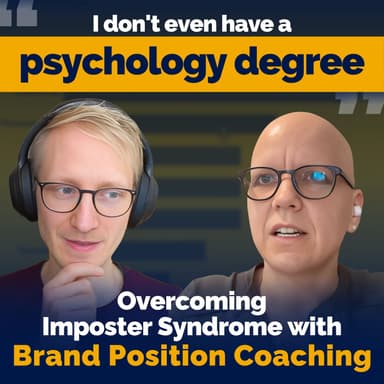
Demo Coaching: Overcoming Imposter Syndrome through Clear Brand Positioning with Julika Franke
with Julika Franke, Positioning & Offer Creation for Coaches
Transcript
Edited for readability: filler words removed, names checked. It may still contain errors. The audio is the source of truth.
Tobi
A world embracing emotional intelligence. That's the world we are working towards.
That's our vision. And then on Monday I would go to the coffee kitchen with a bunch of guys working in the energy sector, cool people, but they really couldn't make anything of what I was telling them from this coaching world.
I don't have an identity issue with being a coach or a trainer. I have an identity issue with throwing out this content and saying, oh look guys, I'm the guy.
Julika Franke
Where is the friction happening? What is the worst thing that the engineering world could think about you, that frightens you?
Intro
Tobi
How cool would it be if potential clients immediately got you? They know what you stand for and what value you can bring. This is the kind of challenge Julika Franke is helping coaches and experts with: picking the right target group, positioning your brand, communicating your value. And after a deep dive into Julika's value equation concept on the last episode, we are getting hands on today. Julika is coaching me on my new role as a co-trainer in the metaFox Inner Journey certification program. And, as it so often goes with coaching conversations, of course it didn't go as we planned. Instead of setting clear business objectives using Julika's business hub, Julika coached me on, yeah, my imposter syndrome. Questions like, how can I credibly train coaches without even having a psychology degree? Or, how can I resolve my fear of judgment from old colleagues? But interestingly, the answers to these questions for me actually lay in my clear positioning, in looking at what experience I can bring to this role, and connecting it with a clear
mission and mission statement. So if this kind of imposter syndrome sounds familiar, or if you're curious about your personal branding, I'm sure you can draw some parallels from listening to me and apply them to your own situation as a coach or trainer. Enjoy. So, how does it look if I'm a coach and now I start collaborating with you on reworking my business setup?
Julika Franke
I follow a business hub approach. That means that I provide one document and I call it the business hub. So in this case it's Tobi's business hub. And basically all the ideas that we are developing, all the frameworks, et cetera, they live in this one document. And for me that is very important, because in other coaching settings I saw either there is no document at all, or there are emails flying around, or different documents. So what we are really doing is, we create something that can be used for content creation, for website texts, for everything. There is really something that is created there. And the different stages that I am working through with my clients are built into this. I work with Google Docs, in tabs, and probably we'll see that in a minute. But this helps us structure the whole process. And at the beginning we always start with the expert profile and the goal and vision. So, where does the coach want to be in 3, 6, 12 months? We always need this vision first, in order to see, okay, how fast do we need to go, what are the right methods to bring him to this point? And we start from there.
Tobi
Really cool. And today we are going to hop into a small demo experiment, to work on my positioning. To what extent is that typical, or who would be a typical expert, a typical client of yours that you'd usually be working with?
Julika Franke
So, your situation is a little atypical, in the sense that you are a founder in a bigger company. Normally I'm working with solopreneurs, and we are readjusting or remodeling a little bit your role within that company. The normal type of client I'm working with is either right from the coaching institute, saying, well, okay, until now I was employed, now I took a break, I did this coaching certificate, and now I want to become self-employed. That is one possibility. Another possibility is that they are founding their own consultancy, for example after being employed before, for example in a big company, that is very often the case as well. Or they are in the coaching business since 20 years already and just want to readjust. But normally it's very small structures, so you are atypical in different ways. But I think we will still see a lot of how the work works, and people will take a lot out of it also for their own positioning and profile.
Tobi
Yeah, so basically your business hub is designed to help my positioning, my profile, in my work as a solopreneur expert, solopreneur coach of whatever kind. And I think we can also demo that today because, maybe transitioning into that now already, our situation at metaFox, and my situation as a co-founder of metaFox, is right now that we are mostly a product business. However, this product business originates, of course, also from our own practice as workshop facilitators. And in a way we are going back to the roots in that regard, because this year we have launched an Inner Journey program, which is basically a further education for coaches, all kinds of practitioners, sometimes also leaders or people working in the HR field, to work with our products and also more broadly with the frameworks we address in our products. At metaFox we have tons of different card sets that help you find the right words for emotions, describe your vision, describe resources, strengths, values. That's the sort of products that we make. And obviously these products are best experienced. It's hard to actually teach the work with our products without actually hopping into that experience, and then also going into the client's shoes and actually experiencing the journey that your client can go through, facilitated by this product. And in that sense I would say, me as a founder, as an entrepreneur, I'm also going back into trainer, coach, expert shoes. So I think we can work on my profile, my personal brand, as a co-founder, yes, but also as an expert in that field, training other coaches, which still feels weird to me to say, but that's, in a way, where I want to go here.
Julika Franke
Great. At the beginning I always ask a few questions, and I will do that with you as well. And I will write some things down, because this is how I think, so don't be surprised. So first of all, let me understand a little bit better. I mean, I know the products of metaFox, but what is your goal with all this Inner Journey program? So, do you want to just sell more cards, to put it simply, or is this more a kind of mission driven thing, this Inner Journey program? Why is that?
Tobi
I think there are two aspects to it. On the one hand, most people who buy our picture cards, for example, they simply use them as a warmup, at the beginning of a workshop or at the beginning of a coaching session. It's like this classic, you spread the cards and then you ask your client, your participants, which picture describes best how you're here today, how you're doing, how the last weeks were, et cetera. But you can do much more than that. You can go much deeper, working with one single card over a two hour session, basically. And I think, in order to really communicate that value and get that value out into the world, people need training, or we want to offer training, on how to do that. And then, the business aspect of it, the entrepreneurial side, I would say, is not so much selling more cards, but having an offer that is higher value. So we sell our cards between 30 and 50 euros, let's say, and by offering a further education we would also have a product that can be sold for, let's say, between 500 and 5,000 euros.
Julika Franke
Okay. So the training in itself is the new product launch, in a way,
Tobi
Yep.
Julika Franke
and the cards are the means, the basis, the foundation on which you build the training.
Tobi
Exactly, exactly.
Julika Franke
And now switching to your role. So you are the founder. At some point you decided, at some kitchen table, I don't know, I'm just fantasizing, that you wanted to create nice looking picture cards. Or how can I imagine that? How was your role at the early stages?
Tobi
I'm the co-founder, together with Max and also Max's wife Chrissy, and also my wife Johanna. And we've been working together already for a long time, also pre-metaFox, in a European student NGO, that's the context in which we met, that facilitates complementary education for engineering students. So basically everything that you don't learn as an engineering student: communication, leadership, group dynamics, these sorts of things. That's the stuff we've been dealing with in that NGO. And that was a super powerful experience, because it gave us this first sense of doing something together, setting up an organization which needs to acquire members, acquire partners who fund these events, et cetera. But also, of course, getting from engineering studies into this whole psychology field. And then it also organically evolved. Max said from right at the beginning, let's build a product and do e-commerce. I was a bit hesitant with just doing e-commerce, that's how I saw it back then. And one of the products that basically stuck, of all the things we tried, were picture cards, because that's something we had already worked with in this context of being a student NGO trainer. So it was kind of an obvious thing to do. And that's how, over the years, we evolved to be this picture card company.
Julika Franke
Yeah, great. So, I'll just make some remarks on a meta level so our listeners understand what is happening here right now. When I'm asking a question like this, asking, okay, so how have you become who you are today, then, for example, what you just mentioned to me, that you and Max worked together before that, tells me already that you are quite a team player and that you are able to do some team things together over a longer period of time. Something like that. Then what I also learned is, and I read your annotations before, and this is how I work normally as well, so I get some information from my client before, and then I get some add-on information in the conversation, as we are doing now. What I learned in the text that you sent me, and what you just said, is that you have a strong idealism. It was a student NGO, and ah, yeah, here we go.
Tobi
So basically I filled out two elements in your business hub, right? I filled in this vision and goal, a few paragraphs here, and then also an expert profile, where you had asked me about what my trainings and certifications are, my experience, et cetera.
Julika Franke
Exactly. And so I learned a lot about you, but now I try to ask a few more questions, and also just to get it verbally from you is very different. I can feel the energy, how you are talking, where you are hesitant, stuff like that. So for example, what is interesting as well, and I know that we are trying to remodel your new role in metaFox, what is interesting to me now is that you said, okay, from the very beginning on you were hesitant to only do e-commerce. And now the time has come. You are not only doing e-commerce, you are having another product, which is the Inner Journey, right?
Tobi
Yeah. I would say I also relatively quickly made my peace with doing e-commerce. I would say I'm always the innovation guy, and back then I wanted to build software and to create something the world hasn't seen before. And just doing picture cards, which is a thing that we renewed, that we brought into the 21st century, that seemed innovative enough back then. And secondly, what was also always very important for me is this mission-driven aspect. I'm not sure I like the word idealism. It just seems to me that as an entrepreneur you have a certain responsibility to make your contribution, in a way. And for me that has always been the mental health space, broadly education. But I think basically helping people to have a strong foundation to then solve the problems of life, in a way. And that foundation, to me, is mental health.
Julika Franke
Yeah, that is very interesting. And this is also why you started your coaching trainings. I think you already started in 2014, something like that.
Tobi
Yep. My first education as a trainer was, as part of this student NGO, a 14 day train-the-trainer program, where you learn the hard craft of training session design, but of course we also did lots of work on ourselves, going through an MBTI two day session, working on your own personality, realizing, oh, other people have different preferences than me.
Julika Franke
Mind blowing.
Tobi
Yeah, exactly.
Julika Franke
And it's interesting that your first seminar was a train-the-trainer seminar, and now again we are getting there, that we are training trainers. So basically what I'm doing is, I try to fit the different pieces together. Sometimes that works very well, sometimes it doesn't. In this case, at least we have some clues. It's only clues yet. But what I'm hearing is that you have this strong wish to explore and to innovate. I will have a question about that later, about how that corresponds to how your new role is designed. Just transferring knowledge, thinking about it from a didactic point of view, how you could design sessions to bring messages across, I think that is something that you worked on since 2014, if I got you right.
Tobi
Yeah, exactly. Back then, facilitating lots of training sessions, so this classic semicircle with 16 people in the room, talking group dynamics, leadership, et cetera.
Julika Franke
Okay, great. And so, if you describe your role today in metaFox, what is your role today and how should it shift? Because this is what I understood, right, there is some tension around this new role, there is a certain hesitancy to call yourself trainer or to call yourself coach. So please let me know, where are you now and where are you heading in your role?
Tobi
Yeah. It's funny, last night you made me reflect on what I actually did in this space. And I was able to actually write down quite a list of coach training that I did throughout the years. And at the same time, if you would ask me today, I wouldn't consider myself primarily a coach. Of course, I did lots of certifications, but I'm not earning my money with coaching. I consider myself a product developer, if you want to put it down on a craft level. And I think that's, in a way, this shift, actually throughout the last two years already. In early 2024 we started designing training programs, first online, and now more recently also the three day certification program that we ran in Singapore with Max as a facilitator. But that process also enabled me to go back and think, actually, do you know what we could do here, combining the strengths cards and the picture cards and then timeline work from NLP? We could come up with this in that format. So that brought me back, in a way. And of course I also try to live coaching skills in my day-to-day work as a leader, or also here and there in informal coaching sessions. But my identity is not the one of a coach. And that is also a bit where this imposter syndrome comes from, that I said I want to work on with you. Now positioning myself as a coach trainer: can I do that, actually? Am I allowed to do that? In a way, that's the question.
Julika Franke
We are getting into your inner world in a second. Before that, I want to understand a little bit more: what is really your role in the outside world? So, is the idea that you are actually going from being a product guy to being a trainer? How much of your time should that entail? What is visible for the outside world, how your role shifts? Do you know what I mean?
Tobi
Yeah, I am thinking, there are two parts in my chest, because on the one hand I wouldn't say I want to become this coach, coach, like Julika. But I still want to be a founder who sets up the infrastructure to make that happen, and who develops products, who now builds software, who comes up with these training programs, who also facilitates these training programs, who occasionally does coaching, all these different things. And of course I would love to get that across and have that nuance. I also know that it's overwhelming for people, and they won't trust me with any of these roles if I just throw all of them at once at them. So I think, to really make that shift stick, it's probably time to actually emphasize this coach trainer role, or expert in working on emotions, strengths, values, the products of metaFox. And I'm the guy who can help you to master that for your own coaching practice.
Julika Franke
And metaFox's mission is somehow supporting the mental health market?
Tobi
Yeah.
Julika Franke
Embracing emotional intelligence.
Tobi
A world embracing emotional intelligence. That's the world we are working towards, that's our vision.
Julika Franke
Okay.
Tobi
And we want to achieve that vision by empowering coaches through easy to use and beautifully designed tools and experiences. And when we say experiences, what we have in mind is these training programs that are very heavy on actually experiencing the work with these tools.
Julika Franke
Which enables the coaches then themselves to create the same experiences for their coachees, right? So first of all, congrats to this mission and vision statement. Well done.
Tobi
Thanks.
Julika Franke
Okay. And so, please tell me again why you think that the different roles that you just mentioned are confusing for people, because they all match this vision and mission very well, don't they?
Tobi
Yeah, I would say that they're all derived from this vision and mission. A coach works in person, so they need these cards. A coach sometimes works online, so they need also an online environment where they can use these products. And in order to do that, we believe they can benefit from our training offer.
Julika Franke
And tell me again, please, what roles do you see in yourself there? There's this product development guy, probably the founder, business data guy. Who else is within you?
Tobi
Yeah. So we work internally with this traction model, which is a kind of company role model, and there my role is the one of the visionary. So I'm the one who is close to our customers, who talks a lot with our customers and keeps us focused on this people development, mental health mission. And when it comes to craft, on the one hand the product guy, maybe the ambassador, the podcast host, the trainer. And that last part, the coach trainer, that is where, for example, Max has much less inner blockage than me, when it comes to just saying, okay, I'm the guy who now teaches you how to do this. And is there also some identity question attached to it? Like, I don't want to be the one having a thousand coaching certificates but not being able to coach, or leaving that field completely to Max. Already starting this podcast a year ago was overcoming some sort of identity question. What I really enjoy about the podcast, and what I don't enjoy, for example, about shorts, giving small knowledge nuggets, value nuggets, on how to use our products, is that I really enjoy the depth in relationships, the depth when it comes to conveying concepts, theories. A podcast format is where you also have this stretch of a half hour, an hour, a two hour conversation, and you have that less when it comes to recording shorts and posting them on YouTube or something, you know?
Julika Franke
Totally get it.
Tobi
I don't have an identity issue with being a coach or a trainer. I have an identity issue with throwing out this content and saying, oh look guys, I'm the guy.
That's sort of where my mental obstacle is.
Julika Franke
So the coaching and training could be somewhat of a counterbalance to the slightly less deep things that you need to do to market your product. Is that also what I'm hearing, that there needs to be a counterbalance?
Tobi
Yeah. Now that we speak about it, it becomes quite clear to me that it is not a problem or an issue that I have with our offering and with delivering that offering. It's a marketing problem. It's about being the guy who goes in front of the camera and says, look guys, you do this, step one, step two, step three.
Julika Franke
Okay. That is now very important, and I think I want to pick up that topic, because I feel like there is some tension. Is that okay, that we dig into that? Okay. What does it do to you when you're imagining yourself being on camera doing this one, two, three thing? What images, feelings, what comes up for you?
Tobi
Yeah, it doesn't feel authentic, in a way. Because I'm happy to do the step one, step two, step three, and I've always been doing that actually, starting at school when helping other people with their math homework or whatever. But still, I have this sort of inadequacy, especially in the coaching world, of, I don't know, not having a psychology degree, for example. So what would a psychologist who's been doing that sort of work for 20 years think when I come now and say, look, this is how you work with picture cards? That is the fear of being seen as a fraud, or as, I don't know,
Julika Franke
Interesting, interesting. And what picture do you have of yourself when you are thinking of the value that your picture cards bring to the actual coaching business? I can imagine that you are quite convinced of what it can do, aren't you?
Tobi
Yeah, it's quite amazing. Whenever we hear from people, and also when we use it ourselves, when we basically step into our customers' shoes and use the products, the closeness you can create, and also the revelations, the new perspective that you can bring to an issue of a client, is really amazing. So yeah, I don't have an issue there, actually.
Julika Franke
So what is it? Is it the other people in the market seeing you doing your one, two, three thing? When I'm hearing you speaking about this lack of authenticity, I'm wondering whether there is something in it. You know, oftentimes coaches think that in selling there is something dirty. Something dirty like narrowing it down, or making it seem, oh, it's so easy, and, you know, it's not easy, it needs a whole story around it, so it feels like lying to people. Is that something that is in it too?
Tobi
Which is odd, because I worked a lot in sales, business development, pre-metaFox. I'm not naive, but still, putting my face on it, I have some issues apparently.
Julika Franke
Yeah. So, the way I work with that, because I am not a mindset coach in itself, but what I'm doing then normally is really try to pinpoint, where is the friction? So, between, you're happy with your product, you are proud of what you created, and, I do a ten second short and it feels like lying or doing odd stuff. Where is the friction happening?
Tobi
I think the difference comes from who I believe is listening to me. And that's a new realization that you prompted there, because, you know, I worked in the energy sector, where I was the somewhat engineering guy, always bridging between engineering and sales, the business world and the technical world. But I was in this environment where basically I would do my NLP coach training at the weekend, and then on Monday I would go to the coffee kitchen with a bunch of guys working in the energy sector, cool people who are committed to the renewable energy transition, la la la, but they really couldn't make anything of what I was telling them from this coaching world. And I can feel authentic in both of these environments, but the idea of my engineering network seeing me talking about psychology, I think that's where this cringe, odd feeling comes from. I feel very comfortable in a coaching setting, I feel very comfortable in this training setting, facilitating these experiences. But I think it's the idea of posting a short that is then seen by both the psychology world and the engineering world, that somehow I have an issue with.
Julika Franke
Interesting. And is there something in it like, what is the worst thing that the engineering world could think about you, that frightens you?
Tobi
I think I'm afraid they wouldn't get it. They would find it weird, but maybe also this aspect of, why is he doing it? They wouldn't get me. That is, in a way, what I'm afraid of.
Julika Franke
Let me make a suggestion, okay? It can resonate or it cannot. Because I think, okay, they don't get why I'm doing this, for me that doesn't have much power, for me personally that is not yet very much anxiety inducing. But if I think they might think, how on earth, you know, you switched topics a bit, right, you switched from being the engineering guy to being the coaching guy, and now they see you in a completely different scenario, and thinking that they might think that you are pretending, or that you are not able to do what you are doing, because how on earth can he be a good engineer and then also a coach, something like that. Is that it?
Tobi
I think it's this fear of being perceived as not competent, in a way.
Julika Franke
But interestingly, you are more afraid of the engineering guys who are not able to understand what you're doing. You are not so much afraid of the coaches and psychologists. Or both of them?
Tobi
Oh yeah. I would say, interestingly, I feel very at home in both worlds when they don't collide, you know.
Julika Franke
Yeah. Okay. But that means you are afraid of both judgments, or are you more afraid of the engineering judgment?
Tobi
Yeah, so with the engineers it's sort of our engineers, the energy industry, let's say. And with the coaches, I would say it's like this classic imposter syndrome: okay, this guy didn't even study psychology, how can he know anything about it?
Julika Franke
So what I'm hearing is that you are like a third party thing. You are not belonging to either the one world or the other. And you especially are not allowed to say that you have some sort of expertise. So the question is, why am I allowed to speak in this domain when, one, I am actually a product guy, so perhaps I should have never walked into the other room, and two, now that I'm in the other room with the coaches and psychologists, they will understand that I'm a fraud and that I'm not as good as I need to be in order to be able to sell them stuff.
Tobi
Yeah.
Julika Franke
Is that what I'm hearing?
Tobi
Yeah. And not all of this is entirely new, and I already did some steps. My current LinkedIn headline is, turning emotional education into tools that coaches use to change lives, which for me encompasses both of these bits: this engineering skill of structuring a concept, a process, turning it into something repeatable, turning it into a tool, and bringing that out into the psychology world. So I think that's where this feels very authentic to me, because that's also where I believe I can bring in value from both worlds. And then I think the next step, and that's sort of the challenge that we started out with, is seeing myself, and being seen, more as a practitioner, also as a coach.
Julika Franke
Yeah, that is interesting. And I can see now, after this discussion, how, if this house is built on two pillars, the quote unquote product engineering pillar and the coaching pillar, maybe the coaching pillar is still a little weak. It's not completely missing, because obviously you have tons of experience in getting certificates and also in just working with these topics. But that you're lacking a little bit of practice in this field at least lets you feel like there is something missing, and that decreases your loudness in speaking about that.
Tobi
Yeah, exactly. And I think you're touching on an interesting point: it's not another certificate that I need. And that's where I say, these coaches always think they need another education. Where I also realized, a few days ago I talked with Kirsten, a previous guest here on the podcast, and basically asked her, which program of yours would you recommend to me in that situation? And we ended up with her saying, how about you just record a coaching conversation and we do a supervision session, rather than you doing another education? Because I think we also got to this point where it's, okay, my felt inadequacy doesn't come from lacking education, but comes from lacking practice.
Julika Franke
And is there a way for you to get this practice?
Tobi
Yeah, for sure. Just yesterday a business contact, let's say, texted me that he's struggling, and we met for a spontaneous, quite formal coaching session, I would say, where I really used the solution focused coaching approach that I learned from Kirsten. So there are occasions here and there. And I think the question she also raised was, does it make sense to start another chapter in my life, of now being a practicing coach and actually asking for money for that? I think that's maybe a question I need to fiddle with, like, to what extent to go into that. And then, do I go into that for the coaching business's sake, or rather for this, okay, to make me more competent in the coach trainer role and to make me more confident in the coach product developer role? This simply is a learning area. I think that's how I would phrase it right now.
Julika Franke
Yeah, yeah.
Yeah. If I look at it, I would even put a number on it. Like, how many sessions do you think you need until you feel sufficiently confident? And this can be five, this can be 10, this can be 20, 25. But then there is a full stop. And then you take out of these sessions what you need, and then you're done with that pillar. And I think we went a little bit sideways in this conversation, and we'll bring this demo to a close in a second, but what I would recommend now is really looking at what you have written down. Because this practice is something that you need to get, this is nothing that any certificate can give you. But at the same time, I saw how many certificates you have, and how much your professional journey really supports also this new role. With all the things that you did with the NGO and other steps on your journey, for me it really felt like this can all very well add up to this new role. And I would also conceptualize the role really only as part of your founder role, because I feel your mission statement is really, really strong. And I wouldn't try to go further down and say, okay, now I'm the trainer. No, you are the founder. And the founder supports the mission statement, and you have different sub-roles. And one is, you're doing the business analysis. One is, you are doing the product development. And one is also facilitating trainings, in order to
fulfil your mission. And then somewhat draw a picture of yourself in this trainer, facilitator role, with all the things that you just wrote down yesterday. I think that would be the next step.
Tobi
Yeah, thank you. That's also reassuring to hear, in a way, that even from your marketing consultant perspective I don't have to give up any of these hats, because that would also feel inauthentic.
Julika Franke
Absolutely. And so, for me, normally I'm thinking visually, and if we worked together in a room then I would draw on a flip chart. So for me, just to tell you, I have this bubble on top and this is the founder role. And then, besides the founder role, I would write your mission statement, which is amazing. This is the founder's role, mission statement. And then you have, mind map wise, this: okay, business, product, ambassador, trainer, facilitator. And the ambassador does the podcast, and the trainer, facilitator flies to Singapore every six months or so. And then you can fill this all up. And roadmap wise, I always try to give my coachees a roadmap. In the end I would say, okay, do the practice, the coaching practice, set your number of sessions that you want to do. Maybe do some supervision with it. What do you need in order to take the most out of it, in order to boost your confidence? And then really try to see what steps you need to take in order to also get more practice in the trainer, facilitator field, because this is the actual goal, where you are trying to build your pillar strongly.
Tobi
Yeah, thanks. This totally didn't go as I expected it to go, but it was still quite valuable.
Julika Franke
Me neither.
Tobi
And maybe, to give me and also the audience a glimpse of how it would look now if we continued on this path: you provided me with my business hub, which is this set of Google Docs, and yesterday you prompted me basically with a set of questions to think about my vision and goal. And you also asked me to think about who I am, what makes me unique, to list my certifications, experience, et cetera, what other people say about me. And that's what we didn't discuss today, but that was the foundation of our conversation today, I felt. And how would we continue
Julika Franke
Yeah, exactly.
Tobi
if we said, okay, now I join you on this journey from Hell Island to Heaven Island? How would we further continue?
Julika Franke
Yeah. As we said, it was a little bit more atypical than probably we both expected. But let's say you really want to build your coaching business as a side hustle, and we want to know, how do you position yourself as a coach, and how do you make money with that? Then I would really go through this vision and goal sheet with you. I put some comments in yesterday, so perhaps you can go there again.
And normally I would go more into detail with my questions, with what you tell me. And we create really define goals for the six, 12 month period, or even three years. Normally we have things there like, I want my website to be ready, and I want to have my first five to 10 paying clients in the next six months. Something like that could be a goal. And then we move on to the expert profile, the things that are in bold here basically. And we go through this, and normally when I'm reading this I already have some questions, some clues, where I think, oh, okay, that is an interesting combination. I have ideas of where we are heading, and I check them with my coachee: am I going in the right direction with my ideas of where we are heading, in terms of target group, in terms of problem that we're solving, et cetera.
Tobi
And then you create something that you see in the output here.
Julika Franke
Exactly. This is empty now, because I didn't do it yet. The expert profile. And normally, after the first or second session already, I have something like a claim in mind, that is nothing that needs to be on the website, but it helps like a north star to know, okay, this is where we are going. I describe a little bit of context and identity. What is the vision? But also the intention and the problem understanding. So, what is actually the thing that the coach wants to change? What is the inner drive to change something? And I fill this out. These are, in the end, three to five pages.
Tobi
And this is the basis for everything else that we are doing.
Julika Franke
We have an understanding of why this person is great and why the world needs their services, a very empowering situation for them. And then we're doing the positioning, with the target group, the problem. Then we are doing the offer creation, what we just explained in depth in the last episode. And the visibility is about,
Tobi
what channels do I want to be visible in? What is my tonality? What doesn't feel salesy?
Julika Franke
What does feel salesy? So it's really about becoming visible in an authentic and aligned way. And then also creating a funnel structure. It can be a very simple funnel structure, but what is the process for people who don't know me today to buy from me, maybe also a very pricey product? There are certain steps that we need to go through before somebody is ready to buy, for example, a 3,000 euro coaching package from you. And that is what we are creating, all in this business hub.
Tobi
Okay. So we work on becoming clear about the transformation that my client would be going through. How does their journey look? Then, how can I be visible? And what are the concrete milestones on my journey as a coach, working on my offer and positioning?
Julika Franke
Yep, absolutely. And this is, for me, very important: I don't let my coachees just stand there alone. So we create this roadmap, that really helps them bring the things into reality. And also something like a test client strategy, that I mentioned in the previous episode as well. So my clients, when we're finished with the work together, oftentimes have their first paying clients and are very confident about the path forward.
Tobi
Yeah, they have resolved all that inner jungle and blockage, that we gave you an insight into today for me personally. And then they also have clarity about what it now concretely means. Like, what's the copy for my website, and how do I price that package, et cetera.
Julika Franke
Yeah, exactly. And also, what services do I maybe need? What should I do? They can ask me all that.
Tobi
Yeah, really cool. I like how your program is, in a way, directive, and the different tabs of this business hub basically guide me through my own journey as a coach, from Hell Island, I don't know how to talk about myself, to Heaven Island, I'm super clear and clients immediately get me. And I like it because it's so simple in terms of infrastructure. At the same time, it looks nice, having the emojis, and it has a bit of this self-guided element. I'm even thinking, couldn't you now take that and build a self-guided online course where I as a coach can go through this without booking the 3,000 euro coaching package with Julika, but rather the hundred euro online program? How do you see that?
Julika Franke
Interesting. So this is for the next episode, when you are coaching me again on how to build a product around what I created.
Tobi
Yeah, okay. Curious how that also evolves then. And I have a small question that I think we can use to close, that my previous guest, Lucy Higgins, left for you, without knowing that it would be you. Her question was, what would you change about the coaching industry?
Julika Franke
You know, obviously there is this discussion about whether coaching should not be free for everybody, you know, in the sense that you need certain certificates in order to do coaching. I'm not sure if that's a good way to go forward, because I know many coaches who perhaps would not have that certificate and are still bringing immense value to people. Perhaps one thing, and maybe it's not so much the industry but for every coach themselves, I would really bring the question to the center: what is the value that I'm creating for my clients? So going away from, I'm selling only sessions, to really being more aware of, what is the value, what clients do I serve, and how can I really help them move forward?
Tobi
So bringing us back to the question that I also asked you in our last session, does this value equation also apply to non-directive coaching? And your answer is yes, it should, actually. And that's one thing you would change.
Julika Franke
Yeah. And me personally, also, this is my answer from a coachee perspective: I felt that there are many coaches who start with a very good analysis in the beginning, but then they lose track of it over time, and nobody remembers anymore what was the actual reason why I started the coaching in the first place. And that is something that I really would want to change.
Tobi
Yeah. So in a way that's also the question I hear you would leave our audience with. In my role as a coach, what value do I bring to my clients?
Julika Franke
Which clients do I serve, and what value do I bring to them?
Tobi
Yeah.
Julika Franke
And is that value relevant to my client? Because sometimes coaches think, oh, that is really great for him, he needs that. And probably he does. But the question is, does he realize it, and is he willing to pay for it?
Tobi
Cool. Thank you so much, amazing. Then I say thank you so much, Julika. Maybe one question I still have for you: if I am a coach and now I say, ah, this business hub looked really cool, how can I find you and get started working with you?
Julika Franke
Yeah. So you find me on LinkedIn and on my website. My website is julika-franke.de. But I am sure we will link that in the show notes as well. And so people can find me there, just shoot me a text and we'll find a date for a first conversation, completely non-binding, just to get to know each other, and then we will see if I can help.
Tobi
Awesome. Thank you so much.
Julika Franke
Thank you.
Tobi
This is it. So cool, you made it to the end of this somewhat unusual episode. And if you are actually curious now about Julika's business hub, then get your own by simply getting in touch with Julika. You can follow her work on LinkedIn, or of course learn more about her on her website, both linked in the show notes. And if you are curious about this new metaFox certification program that I've been talking about on the episode, you can also get in touch. Of course you can participate next year, or this year. We are planning events in Singapore, Germany and in the UK. But you can also co-host the program, help recruit participants, or be there for the community as a business partner. If any of this sounds interesting, email me at tobias@metafox.eu, or join our community on metafox.eu/community. That's it for today. We will be back here as usual in two weeks. I'm Tobi from metaFox, and I say all the best with your own brand positioning, your own making of a coach. Cheers.