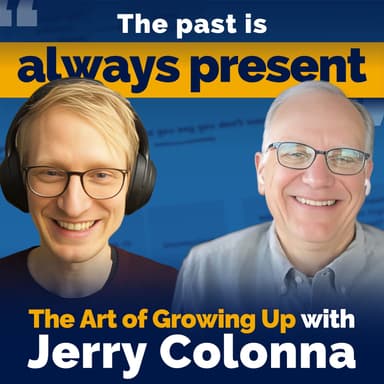
The Art of Growing Up with Jerry Colonna: Coaching Queries, Ancestral Beliefs & Coaching vs Therapy
with Jerry Colonna, CEO & Co-Founder of Reboot.io; Executive Coach
Transcript
Edited for readability: filler words removed, names checked. It may still contain errors. The audio is the source of truth.
Jerry Colonna
Sometimes our job as a coach is to continue to work and bring in reinforcement. I bring in a psychotherapist, I will say I am no longer the boss of the treatment plan, the boss in the treatment plan is the psychotherapist. And if the psychotherapist says, stop coaching, then you stop coaching. But if I say, there's a pathology here and I can't do anything about it, I'm in danger of making the client feel dropped. So this is why it's really important, when you take on a client, you have a moral obligation to that client. Are you well-resourced to do that? Do you have a network of therapists? Do you have a network of people that you can call? Do you have a peer group that you can talk to and say, holy shit, this thing is happening here?
Intro
Tobi
Jerry Colonna is an executive coach rooted in the business and venture capital world, and yet his coaching practice is deeply informed by psychoanalysis. He says the past is always present, and also in coaching, not only in therapy but also in coaching, we can't ignore it. We demoed this idea very drastically on the last episode, where Jerry and I explored how the history of my father and even my grandparents influenced my unconscious patterns. On today's episode we look further into this kind of craft, unpacking Jerry's infamous questions for self-inquiry, why we can call a client complicit in creating the circumstances they say they don't want, but why it might not be helpful to call them responsible. We also look at in what ways my quest to deconstruct Jerry's methodology, for myself but also for you, might not be the way after all to become impactful
coaches, if we listen to Jerry. But if all of that sounds a bit cryptic, let's hear from Jerry himself.
Interview
Tobi
So, Reboot, your first book, has a subtitle that says, the art of growing up. What does it mean to grow up?
Jerry Colonna
Well, one of the first conclusions I came to when writing the book, and I wrote of this in the introduction, was that better humans make better leaders. And there's a corollary here. What I mean by growing up is really more fully understanding who we are and how we are, and really connecting to the unconscious motivations that have shaped our lives, so that we are more in the driver's seat. There's a useful phrase, I use radical self-inquiry, and what I mean by that phrase is, it's the process by which the
masks that we wear are slowly and compassionately taken off, so that we've got no place left to hide, and most importantly, from ourselves. So a grownup, if you will, in my language, is someone who is willing to look deeply in the mirror with curiosity and compassion, so that they can really realize their full potential and not harm other people. We live in a world right now where people with terrible, terrible characterological faults hold enormous power, and the result is, people are hurt, people die. We have a bunch of people who are in power who are not grownups. That's what I mean. And I'll say one other thing. The last line of Reboot is, and with that I mastered the art of growing up. And the reason I said that is because it is very much an art, not a
science. And it is very much a process of growing that actually never ends. You're always becoming, you're never done.
Tobi
And what helps to facilitate this process? If I paraphrase it in my language, I would say it's a lot about understanding these subroutines that you mentioned in our previous conversation, understanding the inner beliefs that shape me, that maybe are not even my own originally but that I sort of inherited from previous generations. How do you, in your programs and coaching sessions, unearth these, dig into these, and help clients to understand these patterns and beliefs?
Jerry Colonna
Well, first of all, let me affirm what you observed. Yes, it's the process of using radical self-inquiry and deep, powerful questions to unearth things. As I've mentioned, my infamous question of, how have I been complicit in creating the conditions I say I don't want, is a perfect example of the kind of radical self-inquiry that is necessary to unearth the unconscious motivations. And to unpack that question just for a little bit, because this is part of the process here: complicit is different from responsible. I always point out that the word complicit is related to the word accomplice, and the accomplice in the bank robbery is the one who drives the getaway car, not the one who sticks up the bank teller. And this is important, because as we start to unpack things, one of the impulses is to become self-critical. I cannot believe that I do this stupid thing that I do. Self-criticism, just like guilt, shuts down the inquiry process and actually leaves us trapped in the subroutine. It's only by being compassionate and curious that we can understand that we are not responsible. Your obsession with being safe, for example,
is not necessarily rooted in your DNA, your genetic structure. It's in your emotional DNA. It's something that you inherited, and it wasn't done maliciously. It was done to keep you safe, it was done out of love. So as a coach, my job is to listen closely, pay attention to what is happening at the sub level, and then ask the question that is designed to help the client surface their own answer. There's one thing that I do appreciate about all coaching programs: they all start with the basic supposition that the client is healthy and whole, and that, more often than not, what they're dealing with is a blockage from understanding that wholeness. That speaks to its roots in Carl Rogers's work, or Martin Seligman's positive psychology work. It's rooted in the belief
that we are not working with pathologies, we're working with healthy people who are stuck in patterns and routines and that kind of thing. So our job is to ask questions, make observations, pay close attention, listen to repeated words, listen to patterns, pay attention when a man's Adam's apple bobs up and down as he mentions his mother. Oh, something's up there. Yeah, see, it just happened to you, just mentioning her brings that up. And so you pay attention. You said before that you were trained in NLP. You know that's one of the things NLP does really well, is to pay attention to the body. Where are the eyes tracking? Where does that take us? Is that in the past or is that in the future? And we pull all this together, and then we ask the zinger of a question. Tell me about your mother.
Just kidding.
Tobi
Yeah. So in the end, what you are saying is that one of your main tools in unearthing these beliefs is questions. And I think you are quite well known for a few of these questions. I just pulled it up here on a board. I think this is one of the most famous ones: how are you complicit in creating the conditions you say you don't want?
Jerry Colonna
Right.
Tobi
And I would love to unpack that a bit. You just pointed out it's a very conscious choice to not say responsible here, but to make it an accomplice, because that helps the client to not take the blame, and then not make this a conversation about blame.
Jerry Colonna
That's right. Blame, shame and guilt block the client from the inquiry process that is necessary to create the conditions for transformation. I'll say that again: blame, shame and guilt block the client from the inquiry process necessary to complete the transformation. All right, so you're right to focus on that word complicit. It drives me crazy, because this question bounces around the internet every day a billion times, and I wish I had trademarked it so that people would give me the credit. God dammit. No, just kidding. And almost every time I encounter it I almost have to explain yet again: complicit, not responsible. And the reason that goes on, Tobi, is that so much of the self-help literature and the self-help mindset is so focused on helping people see how they're responsible for things. It's misguided. It's well-intentioned, but it's misguided. The focus on responsibility is intended to give people a sense of agency: if I'm responsible, then therefore I have the power to change it. And that is true, but the problem is it directs the client in the wrong
place. Because, how have I been responsible in creating the conditions I say I don't want? I say I don't want to be overweight, so I'm going to be responsible and diet, and then I fail. And what happens? I just feel guilt. I feel like shit. I feel like the piece of shit that I always tell myself I am. Okay, great, mazel tov, we've just made the client feel terrible. That's not what this is about. This is about evoking curiosity, as I said before. How do we surface the benefit that this pattern of behavior has created in our lives? Okay, now that flips to the second half of the question. The question is not, how have I been complicit in creating the conditions in my life, which is, again, sometimes how people have interpreted it. The question is, how have I been complicit in creating the conditions I say I don't want. Now, what am I getting at there? What I'm getting at is that what we
consciously talk about wanting in our lives is very often not the thing that we want. You mean we can be our own worst enemy? Yeah, but more importantly, there is some sort of benefit in the maintenance of it. I'll give you a simplistic example. How many clients do we all have who say, I am just so busy. I am so busy. Tobi, you have no idea how busy I am. I am exhausted. And so a good coaching question is, what is the positive feeling you get from being busy? Oh, I feel useful. I feel productive. Oh, my father, who always told me that you have to be productive, is satisfied, because I'm busy, because I'm productive. Oh, okay. So now we know: you say you don't want to be busy, but if you stop being busy you're going to feel anxious, you're going to worry about whether or not you're enough. So we need to unpack, we need to solve the other challenge, which is that
I get a sense of self-worth from the things that I do, not from my inherent humanity. That's why that question is so powerful and why so many people connect to that question.
Tobi
Yeah, so that's again about looking for the positive intention behind the behavior, and acknowledging that intention with empathy, and bringing us back to self-compassion.
Jerry Colonna
That's right. I think it's one of the people who developed NLP that I heard it first from. He used to call it the IPO, not initial public offering, but the intended positive outcome. There's almost always an intended positive outcome, even from our worst behaviors. In nonviolent communication training, which is also a very useful training, the focus is on the needs. What need are we trying to meet? We're almost always focused on a
need we're trying to get met. In my parlance, we're trying to feel loved, or to love. We're trying to feel safe. We're trying to feel like we belong. And what's crazy-making is, sometimes our worst behaviors have an IPO, an intended positive outcome, that's so removed from how we actually feel. I will work myself to the bone so that I can finally feel loved. Okay, that's nutty. Or, more specifically, it's kind of the logic of an 8-year-old.
Tobi
How do you bring up these questions in an actual coaching? You've written about them in your book, you say they float around on the internet. How do they find their way into the actual coaching journey, let's say, if not even the conversation?
Jerry Colonna
So you've already experienced some of my coaching, if you will. Notice how natural it is. I don't go in and say, what are the five questions that I have to ask here? The questions that I have written, that I write about, grew out retrospectively from examining what it was that I was doing in a coaching session. So, you asked, how does this come up? And, again, the coach's job, the coach's tool, if you will, is a well asked question. And behind the tool, the stance we take is one eye on the client and one eye inward, paying attention to what's going on. We're listening with empathy that is deep and profound, and then we ask the question that simply, intuitively arises from inside of us, not from the methodology. Ooh, I listened to Jerry, so I have to ask five times a day, how have you been complicit in creating? Stop. Do not turn Jerry's work into a methodology, please, for God's sake. Do not emulate
Jerry. Be Tobi. Trust Tobi.
Tobi
Earlier you said you have a team of 10 coaches at Reboot. How have they been trained?
Jerry Colonna
In lots of different methodologies. One of the things I like about our happy little band of warriors is that there's a wide diversity of experience. There is some similarity in everybody, in that one way to think about it is, there's a Venn diagram that I think every good coach lives in, and the various components of the Venn diagram include some sort of spirituality, some sort of spiritual awareness. A deep and profound understanding of psychology. An awareness of business issues, because we are an executive coaching firm, and so being able to speak fluently the language of leadership and business is extremely important. And then the final piece of that Venn diagram, I would add, is a profound commitment to self-growth and self-awareness. And in that overlapping
center of that Venn diagram is a Reboot coach. As a coaching company, many years ago, I'm a former VC, the impulse was, at one point, let's raise 50 million dollars and build a worldwide global coaching platform, blah. Oh, a billion dollar IPO, blah. I don't fucking give a shit. I don't really care. At times when I get afraid of money, sometimes I'm like, what an idiot, I could have done this. But really, all that would take me away from the work. I did not go through everything I went through in my life to end up living a life shallow and hollow and in pursuit of quieting my worst fears. That's not how I want to live. So our commitment is to live through that Venn diagram, to do the exploration. And some of the coaches are more somatically aware than I am. I come at it from a psychoanalytic perspective, some of the coaches come
at it from a more mindfulness based experience, some of the coaches come at it from a more direct experience. We have one coach who's both a world class trained guitarist and a former CEO of a music production company, who's in his early seventies, and he's just a badass kind of guy. Ray, yeah, I'm talking about you, Ray. So it's a mix of things. My co-founder, Ali, has a master's degree in religious studies, and brings a spirituality sensibility, not necessarily a traditional approach, a kind of badassery around that kind of spirituality, the deeper meanings there.
Tobi
So, just recapping that Venn diagram you mentioned. You said business acumen, speaking the language of your clients, simply because you navigate in that industry. Then this deep commitment towards the art of growing up, for my own sake, doing my own work, and actually the awareness that this work is continuous and not completed.
Jerry Colonna
And the psychological sophistication, the fluidity around that. The coaching training, which is different. And the sensibility, whether it's mindfulness or a body centered approach, this notion that we are not always what we say, we're more often than not what we feel and what we do.
Tobi
Another question that I caught, I think it was in one of your email journeys, you have the self-inquiry email journey, that resonated was,
Jerry Colonna
You've been taking one of our courses.
Tobi
Yeah, if you want to call it that, at least I received
Jerry Colonna
Yeah.
Tobi
them. Taking and receiving is, yeah, you have to do the work.
Jerry Colonna
Yes, you do.
Tobi
Yeah. But another one that I actually did reflect on, and that I noted down for today, was also this: who are you really serving right now? And I think the resonance that I felt there is also going back to our previous conversation, in a way, becoming aware of what beliefs did I inherit. Can you take us into the origin and motivation behind this question?
Jerry Colonna
Well, if you unpack it a little bit, the operative word there is the word really. If you think about it for a moment, if I just say the phrase, who are you serving right now? We started our first conversation, you asked me about what my mission was, and I made the point that I could just spout off something that had no meaning and no authenticity. I could just say shit that sounds good. And the more practice you get at doing podcasts and writing essays for LinkedIn and blah, blah, blah, the more capable you are of saying something that goes viral. Oh my
God, it gets a thousand likes, isn't that great? But who are you really serving? It reminds me of, one of my most infamous questions is not the complicity question. Decades ago I got tagged with this notion that this man makes founders cry. This man makes people cry. And I used to answer that with, you know how I make people cry? I ask them a question: how are you, really? No, no bullshit, how are you really? Because we have been socialized to answer the question, I'm fine, how are you? It's bullshit. There's a land war in Europe right now. I'm both. I'm blessed, I have brilliant children, I have a loving wife, I'm about to have a second grandchild, I get to do the most meaningful work of my life. And I live under the shadow of terror. Both is true. Both are true, and therefore it's hard. So the operative piece of that question is, who are you
really serving? Not, what's the story you're telling yourself? And, I'm really serving the ghost of my grandfather. I'm really serving my grandmother, who had to escape a pogrom and so, as a result, grew up in her own shadow of terror.
Tobi
How has the awareness of this, who are you really serving, changed you?
Jerry Colonna
James Baldwin, the writer, said, not everything that is faced can be transformed, but nothing can be transformed until it's faced. Who are you really serving is the kind of question that forces one to face the things that caused the conditions in the first place. We cannot become the people we were born to be until we are willing to consciously create our own story, our own life. And so, by acknowledging that, like everybody else, I carry these ghosts, the ghosts of my ancestors,
both biological and adopted, in me. I have ancestry that goes back to southern Italy, with deep poverty that my ancestors had to escape from, and biological ancestors that go all the way back to Ireland. I have an ancestor who may have been transported to Australia for the crime of stealing back from the baron who took it the cow that provided milk for his family. I have ancestors who knew famine. So my fear of not having enough is deeply rooted. So when that fear makes itself known and causes distress, say in my marriage, or causes me to fight, or causes me to grasp, by understanding the roots of that, and understanding my ancestors' fears, notwithstanding that I am safe, I can then transform that fear into service to other people.
Tobi
And that's exactly the point where I would like to dig in, because this kind of work, these kinds of questions, you worked on this a lot for yourself, and I assume now at Reboot, and in the bootcamps that you do and the coaching practice that you do, you also translate this into the transformation that the leaders that you mentioned would need. And certainly the business leaders that actually book a bootcamp with you. How does this process look for them? Do they get homework before they attend the bootcamp, to actually talk to their parents about family history? Or how do you make that very hands on and practical, this getting into this kind of work?
Jerry Colonna
So, before I answer your question, notice again the engineering mindset that you have, where you want to know all the steps. And we're going to blow it a kiss, because it's an important part of who you are, and it helped you get to where you are. And yes, there are, we do lay out pre-work. Right now we've got a bootcamp that will be running in March, and all of the attendees are doing something we've never done before: all of the attendees have been in a peer group since November. And so when they arrive there's already cohesion among the group. And some of the content of the camp is going to be classic Reboot book content, but some of the content will be Reunion work, which is all about relating to our ancestors. But I want to take a step back, because the first half of your observation and question, the jumping off point, was really about doing this work in service of others, of creating the conditions for others. And I want to bring your attention back to the first thing that you were asking me about in our first conversation, which is about my mission, and I referenced the importance of the Bodhisattva vow. Now, as long as space endures,
as long as there are beings to be found, may I likewise continue to remain, to drive away the sorrows of the world. That comes from Shantideva, who is one of the most important Buddhist teachers in the Tibetan tradition. Every day I make the vow to drive away the sorrows of the world, and every day I will fail, because there are always more sorrows than there are Bodhisattvas. But I'm going to keep trying. So it's this combination of the why and the how that I was getting to in that regard. People are fascinated by our bootcamps, we've been doing them since 2013. But what they are is an extraordinary platform for personal transformation, and that's what's really interesting to me. It's part of my Bodhisattva vow.
Tobi
Can you walk us through, on a high level, how the flow of a bootcamp looks?
Jerry Colonna
No. No, just kidding. Every camp unfolds slightly differently. I am a big fan, and it drives my colleagues a little crazy at times, of what I call emergent experience. If you listen carefully to retreat participants, just like you listen carefully to clients in a coaching session, you have to give them what they need in the moment. Now, that said, there is a sort of broad structure, and the broad structure begins with setting the conditions of the container. Nothing like this will work unless the container itself is safe. So you're establishing safety very early on. You are also establishing, there's a great line in The Wizard of Oz, the original movie, in which Dorothy turns to Toto, her dog, and says, Toto, I don't think we're in Kansas anymore. There's this moment where people realize they're not in Kansas anymore. And usually I say something like, welcome to bootcamp. Bootcamp is not, I call it bootcamp, we started calling it
bootcamp, it's not about sleeping on the ground in the middle of the rain, like a military bootcamp. It's an emotional bootcamp. And, as I always say to the coaches and the facilitators, it's not bootcamp unless it also kicks the ass of the coaches and facilitators. It's a joint experience of depth. There is a tremendous amount of poetry. There's a tremendous amount of connection to nature. A tremendous amount of dyad work and triad work. There's a tremendous amount of journaling, and there's a tremendous amount of work in circle. There's a phrase that Parker Palmer, who is one of my teachers and dearest friends, uses in a book called A Hidden Wholeness, and he says, it's individual work that can only be done in a group. And that's a guiding principle for what we do.
Tobi
Yes. And of course I will dig in a bit more. So what I hear is, it's a lot about contracting, in a way, that also sets up participants to be ready to go deep, to be vulnerable.
Jerry Colonna
Yeah. So, understand that people apply to the bootcamp. There are a lot of people who want to treat it as a performative experience. We don't do that, we're skilled at this point at assessing that. And, I'll be honest, we get a lot of coaches who want to come to our bootcamps because they want to learn things. When I said before that it's not bootcamp unless the facilitators have their asses kicked: if we approach it from an intellectual stance, oh, let me see what Jerry does in a bootcamp, then you're remaining apart, and that's not acceptable.
Tobi
So the magic happens if also facilitators go beyond their comfort zone.
Jerry Colonna
That's right, that's exactly right. The minute it becomes routine or rote, I change the content.
Tobi
You mentioned the dyad and triad work. How does that look?
Jerry Colonna
Well, a dyad is two people doing work together, and they may do it in a partnership walk, or they may do it one-on-one facing each other. Triad means three people doing it. But the point is that we use each other as mirrors to create deeper exploration. To come to our bootcamp, you are committed not only to your work, but also to being there for others, to create safety. Again, borrowing language from Parker Palmer in A Hidden Wholeness, we have adopted a notion of what he calls double confidentiality. And double confidentiality works this way. There's the obvious confidentiality that every retreat does, which is, what happens in this retreat stays in this retreat, you are not allowed to reveal it. That's easy. More difficult is, if you and I are
in a retreat together and you say something that's really triggering for me, you talk about, say, your father, and all of a sudden it brings up my father, I actually have to respect the fact that you are having your own experience, and I cannot come up to you and say, hey, Tobi, remember that thing that you said about your father, can we talk about that more? No. Whereas you can come to me and say, would you mind if we went for a walk, and I shared with you some more about what I shared? See, my job as holder of the container is to keep every soul safe, because if the spirit is not safe, then the individual cannot do their work. I was so adamant about this in the early days. You know how, like, you sit in circle, I'm sure you've done this, and somebody says something and they start to cry, and everybody rushes to give them a tissue? I was so adamant about this, I was like, you're not even allowed to run across the room and give somebody a tissue.
I don't want the emotional experience to be interrupted. Now, I'm not so rigid about that anymore, but when we first started you weren't even allowed to share last names, because I wanted to create this ultra intensity. We've relaxed that a bit. It still remains safe.
Tobi
Yeah. Maybe coming back to what we talked about earlier, about coaches sticking to their safe space, the methodology they learned. What I also noticed about your work, and this looking back at family heritage, the beliefs we inherited: for me it goes beyond what I learned coaching is, in the sense that it looks into the past, in a way where you sort of enter therapy space. What would you respond there? Where do you draw the line between therapy and coaching, and what we as coaches are supposed to do?
Jerry Colonna
Yeah. So, notice the supposed to. There's a right way, there's a wrong way, and there's a way that works. Notice how scared coach training programs, and the coaches who train in the coach training programs, get when we start to approach this. But I want you to know something. Why are you drawn to my work? You, as a coach, why are you drawn to my work?
Tobi
Your story resonated. The family, the parallels I see in our family history, maybe.
Jerry Colonna
Yeah. But as a coach, what makes it fascinating, the way I coach?
Tobi
And I think, for me personally, also the overlap between entrepreneurship, tech and coaching, personal development, therapy.
Jerry Colonna
I was asking, and I don't know if this is true for you, I thought it might be, but we'll see. I was asking because what my experience has been is, the more I've spoken about the way I coach, the more I encounter coaches who say, yeah, I want to do that. So you're right, there are a lot of training programs that say, don't go there. They create this false dichotomy that you yourself used, which is the past. Well, that's the realm of therapy. And I believe it's a misunderstanding of Carl Rogers, it's a misunderstanding of Martin Seligman, the roots of modern coaching. It misunderstands, because the fear of the coach training programs is, we're going to break the client. And so what happens is, the client is dropped, the client is left in this zone. A really brilliant coach who best epitomizes what I'm talking about is Manfred Kets de Vries, who was the original CEO whisperer, who is a psychoanalyst and executive coach. Read his book, The Leader on the Couch. Read his book, Coach and Couch. What are we in this business to do? We're in this business to effectuate transformation by any
means necessary. Now, does it require that I, as the coach, have to do supervision, have to be mindful of my own shit, have to be mindful of the fact that I can delude myself that something I'm doing is working? Yeah, of course. And the real question, the coaching versus therapy question, you know what it turns on? It's not turning on the past and the present, that's bullshit. It turns on pathology or non-pathology. If you do this work, you are going to encounter depression. If you do this work, you're going to encounter anxiety. If you do this work, you may even encounter mental illness. I would argue that all Silicon Valley CEOs experience some form of narcissistic personality. I'm kidding. Not really. It is a very common phenomenon. Read The Productive Narcissist, it's a great book by a Harvard psychologist who talks about the predominance of narcissism in business leadership. Because the narcissist
promises the sun, the moon and the stars: believe in me and I will transform your life. Sometimes they end up in politics, by the way. So the split between therapy and coaching should be focused on pathology and illness, not focused on past and present. The truth is, the past is always present. Always, always, always present. And it does a disservice to the client to deny that reality.
Tobi
And how do I recognize this pathology?
Jerry Colonna
Ah, that's a great question. That's a really great question. It's a good thing you have a supervisor to talk to about what's going on. I'll give you a quick story. Years and years ago a very famous founder of a really important internet company came to my office with his number two, and they wanted coaching. This is an office I had in New York. And I sit in a chair, and there's a little couch and the couch can seat two people, a little sofa, and then there's another chair on the left hand side. And the founder in question comes in, sits right in the middle of the couch and sticks his arms out, preventing his co-founder from having a seat. Session ends. I call my analyst, to act as supervisor, and I was like, holy shit, this experience. And she said, how did it feel, being annihilated by a narcissist? Because that's what was going on. There are certain aspects of it, I could work with that client. Unpleasant, but I could work with that client. But when that client's narcissism also morphed into bipolarity, and he was a high functioning, fast cycling, up down up down bipolar, I called a friend who was a psychoanalyst and I said, I need your help. And then we got him a psychiatrist, got him on medication, created some stability, and I
continued working. Sometimes our job as a coach is to continue to work and bring in reinforcement. I bring in a psychotherapist, I will say I am no longer the boss of the treatment plan, the boss in the treatment plan is the psychotherapist. And if the psychotherapist says, stop coaching, then you stop coaching. But if I say, there's a pathology here and I can't do anything about it, I'm in danger of making the client feel dropped. So this is why it's really important, when you take on a client, you have a moral obligation to that client. Are you well-resourced to do that? Do you have a network of therapists? Do you have a network of people that you can call? Do you have a peer group that you can talk to and say, holy shit, this thing is happening here? If not, stop, build those networks, and then you can be a coach.
Tobi
So in a way it comes back to reflecting a lot about what is happening in your sessions, by yourself, with a supervisor.
Jerry Colonna
That's right.
Tobi
And making sure you have that network.
Jerry Colonna
The work is not about saying the right thing. It's about presence. It's about how you hold yourself as a coach. Irvin Yalom, the psychotherapist, has this great quote in one of his books, The Art of Psychotherapy, in which he says, the healing is in the presence. The healing is in the presence. The healing is in the presence. He repeats the line three times. The same thing is true in coaching.
Tobi
Thank you. Maybe to close off, as we talked a lot about questions: what is a question that you, from today's perspective, would ask Jerry the young coach from 20 years ago?
Jerry Colonna
That's a good question. I don't know, let me think about it for a second. Why is it so important to you to heal people? Now, in hindsight I know the answer, but I think 25, 30 years ago, if I'd spent a little bit more time with that question, it might have been helpful for me. That said, I have thoroughly enjoyed my journey, even if it's kicked my ass at times. It's one of the many ways in which I feel blessed, to have had this journey all these years.
Tobi
Thank you.
Jerry Colonna
You are welcome.
Tobi
That's it with Jerry Colonna. If you want to go further with Jerry's work, I guess the best starting point is his books, Reboot and Reunion. And you can also go to reboot.io, where you can find the self-inquiry email course that I also took in preparation for today, and where you can find some of the questions we unpacked. If you missed the first episode with Jerry, then I can highly recommend checking out the live coaching demo there, it really makes some of the themes of today much more practical. And if there's one thing I've taken away for my practice as a coach from the conversation with Jerry, then it is the importance of self-reflection and of supervision for us as coaches. So, how fitting that my guest in two weeks is exactly an expert in this. We are doing an actual supervision demo, leveraging the power of pictures for us as coaches to reflect on our coaching. If you want to check out the online coaching and visualization platform that we also used on today's episode, go to metaFox Online; with the code IMPACTFUL you can even get three months of entirely free pro access. That's it for today. If this conversation made you think, share it with a coach in your life, or drop me a message on LinkedIn or at tobias@metafox.eu if you have any feedback. You can of course also leave comments on your favorite podcast platform. And with that I finally close off. I'm Tobi, co-founder of metaFox. All the best
on your journey towards becoming an impactful coach. And see you back here in two weeks. Bye bye.