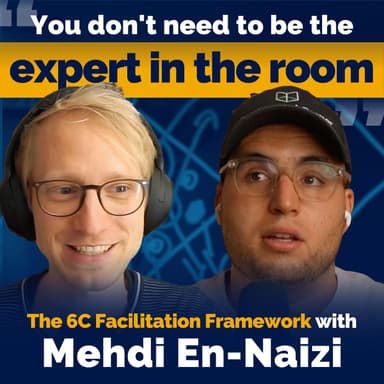
Why Facilitation Skills are Not Optional For You as a Coach with Mehdi El-Naizi
with Mehdi En-Naizi, Facilitation Training
Transcript
Edited for readability: filler words removed, names checked. It may still contain errors. The audio is the source of truth.
Mehdi En-Naizi
Look, you don't need to be creative. Creativity is in you, because we all are creative, but it depends on the way I'm going to guide you. You see, with a bad explanation, everyone had the same sunset. But when you give a specific prompt, this is where creativity comes. So in this session, you won't need to be creative, because you already are, and I'm going to guide you to your best creative space. And here I've created connection between people, because they know each other better thanks to this nice moment. I teach them something about creativity, and I give them the confidence that today is going to be okay, because I'm going to make sure they will be able to come up with those ideas.
Tobi
Have you ever participated in a workshop and gotten the icebreaker "share an embarrassing moment"? For years, I found this kind of icebreaker super awkward. It rarely made me feel safe and vulnerable; more often I just wanted to leave the room. But building psychological safety is a real skill, no matter if you are coaching one-on-one or facilitating a group process.
And this is exactly the kind of skill that I'm going to discuss with today's guest. Mehdi En-Naizi is a workshop facilitator from Brussels and a former stand-up comedian, which apparently can be quite useful. He's not a one-on-one coach, but that is exactly the kind of parallel we want to draw today: what can coaches learn from a facilitator like Mehdi, and maybe also vice versa?
We cover how you can warm up a group without that kind of cringe, how to manage your own state before the session and also during the session when things don't go according to plan, and we will unpack a model that sits underneath both these kinds of group processes and, I believe, also underneath great coaching. So if you ever work with more than one person in a room, this conversation is for you. Let's go.
It's great to have you here, Mehdi. Today you guide group processes and facilitate workshops at companies like Volvo and Audi, but you also have a history as a stand-up comedian, I learned. So I was wondering, how did this history shape your facilitation practice?
Mehdi En-Naizi
First, thanks for having me on the podcast. A history in stand-up, I think that's a big word. It was my dream since I was a kid, and unfortunately for me, I tried it a bit too late. It's very difficult to do both when you're a parent and working for yourself.
But I hit the stage enough to see a lot of things that I can actually use in my own facilitation. I would say the most important skill I've learned from there is the capacity of reading the room. When you go to stand-up, your way to the scene, going on stage, the first joke is going to be critical, because this is the moment where people are going to judge you: is this guy funny or not? If your first joke bombs, it's going to be difficult. Not impossible, but you're already starting on the wrong foot, because people are going to say, "Okay, this guy is not funny." It's the same in facilitation. When you kick off your workshop, people may have feelings or thoughts about workshops: we tried this in the past, it didn't work. Oh, it's going to be cringe again. He's going to use an icebreaker, I don't know what.
So this is the moment where you need to show people if they can trust you, if you're going to guide them towards the outcome they want to achieve. And most of those people don't want to be in the room, contrary to a stand-up, where they decided to go and have a good time. Maybe the boss hired you, maybe two or three people are convinced about this way of working. So the first interaction, I would say your first five minutes, but really your first 30 seconds and then the first five minutes, will have a big impact on your session and on whether people are going to contribute or not.
Tobi
So you say, firstly, there is no second chance for a first impression. Then in facilitation you have this additional obstacle that maybe not all participants in the room are as open to you as a facilitator as they would be to you as a stand-up comedian.
And you also said the most important skill you took from there is reading the room. What does it mean to read the room?
Mehdi En-Naizi
It's really looking at people and seeing how they behave based on what you're saying. If I'm saying something that you like, you will nod: "Oh, actually, I relate to this." It's like in stand-up: if people smile, if people are laughing, this gives you a good feeling. If they are like, "Make me laugh," okay, it's going to be a harder fight. So you want to see how the room is behaving. Of course, if you're hearing the laughs, it's already a good sign. But imagine a certain type of joke hits harder than another one. Then it's like, okay, this group is more into this type of humor or this topic. So I can change my stand-up routine, if of course I have enough material, to please this audience more. In facilitation, it's a bit the same.
This is why, among the many reasons I want to start with a warm-up activity, aka the icebreaker, though I hate this word, is because it helps me read the room. It helps me see: okay, this group is going to be more fun. This group is going to be more strict. This group is reserved, it's not going to speak a lot, so I will have to fight to get the insights I'm looking for. And then it's adapting your skills, your style of facilitation, based on what is in the room. Of course, each one of us has a certain style, but you can stretch it. I believe you have two opposites: I can be way more fun, and I can be a bit more serious and to the plan. Based on what I have, I will assess where I need to push more. Also, the first time you do something with a group, you're taking a risk, so you don't want to take a big risk right from the start. If you have a political joke, you don't want to throw it right away. You first want to create the trust, do the warm-up, make sure people are ready, and when they are, you hit them with a bigger risk.
It's the same in facilitation and in stand-up. You want to find where your group is, and then assess if it makes more sense to take a bigger risk later in the gig.
Tobi
I would like to acknowledge where we are and who might be our audience today, because we are on the Impactful Coach podcast, and from many of the coaches I've spoken to, I believe many people work both one-on-one and with groups. Even if you don't, I believe there's a lot that I as a one-on-one coach can learn from what you are going to share from your background and from actual facilitation. So why do you think I, as a coach, should also learn about facilitation?
Mehdi En-Naizi
First, I think it's important to say on the podcast that I'm not a coach. But what happened is that more people are interested in becoming a coach.
So you saw more and more coaches on the market. And like everything in the market, what happens when you have more offer than demand? The skill becomes a commodity. So you need to find a way to differentiate yourself. The people engaging in my course see it like: okay, I can be a stronger coach if I can also offer facilitation, the coaching of the group. Because yes, you can do a lot of things with your clients. Imagine you're coaching the boss of a team. You can do a lot, but there are also things you're limited with, because they will depend on the group, on the people executing what is right for the team or how to solve the problem they are facing. And this is where I think facilitation can help. When you're coaching, it's one person, one mindset, one perspective, one background. And you have enough time to get to know the person and to understand what could be improved, changed or optimized.
But when you have a group of people, it's different people, different mindsets, different backgrounds, different perspectives. It's not one human being. So you need the skills to deal with all of that in a very short amount of time, because you won't have a lot of time to work with the group, except if your client has a very big budget, which I totally wish you. Then it's going to be tricky. And this is where I think facilitation can help coaches: okay, now I can deal with a group. I can deal with the complexity of having different voices, of aligning on where the group should go, on how to solve a problem, on how to define a strategy, et cetera.
Tobi
A few episodes ago I had a guest, Niels, who's an organizational change consultant, and I had the plan to talk with him about group coaching.
But in the end, what I learned is that he always talks to the leader of the group first and starts with changing their mindset, or rather helping them reflect on what he or she actually wants to change. Only then does he face the whole group. But of course, you're totally right that eventually your client, if he or she is a leader, will face the whole group. So there's a lot of value in also facilitating that process if you actually want to help make an impact in the organization. And that's where group facilitation comes in.
Mehdi En-Naizi
Yeah. His name was Niels, right?
So I think Niels is totally right. I would also start with the leader. Actually, every good workshop starts with a good discussion with the leader, because this person will drive the ship. So first you need to know where the ship is going to go. Is the ship capable of going there? What are the problems you have?
It's also having the manpower, the budget, all the things you need to work with the group. So you want to start from that. When you have clarity on what needs to happen, what the problems are, what the goals are, what the ambition is, and you help him also as a human to get there, then you can work on the group. And something I didn't say is that I've worked 10 years in consulting. My consultancy was expensive; we were paid a lot to define strategy for our clients. And I was frustrated a lot by doing awesome work, at least I believe it was awesome work, giving it to the client, seeing happy clients, but then nothing was done with it. This created frustration, and the moment we tried facilitation, this is where I saw the shift. Because when you build a strategy with the group, with the team, the magic happens: people feel ownership over it, and they're willing to implement, to change, to do the actions that are required.
So this is why I believe in bringing this facilitation. Of course, the leader will take the final shots. Of course, the leader will have a big impact on part of the strategy, the plan, the solution. But everyone will contribute, and this is a very important ingredient if you want real change to happen.
Tobi
You need to get everyone on board. But you also mentioned another interesting parallel between coaching and facilitation, and that is the step of finding out where the client wants to go. This contracting phase, where we see: what's not working? Where do you want to get? What is already working? How does that conversation usually look for you?
Mehdi En-Naizi
I would say, from what I've learned, and I used to be in sales at the beginning of my career, most of the time people don't really know where they want to go, what they want to do, what they want to achieve. So it's asking a lot of questions.
Questions that are outcome-oriented, purpose-oriented and goal-oriented. What I mean by goal-oriented is: what do you want to get out of this session? What is the most important problem you want to solve? When it comes to purpose, it's: why do you want to solve this? Especially if you want change to happen, you want to understand the why. You ask questions as simple as: why are we doing this? Why now? The momentum is usually important to understand in terms of context. And the final one is the results. What does the result look like? If I tell you, "I want to improve the collaboration in my team," wow, this is huge. What does it really mean for this person? So you ask: "Imagine this workshop is a success and we improve collaboration. How do you see that?" I'm talking about success metrics, final outcome, final deliverable.
How can we assess if we actually achieved the ambition? This will help you make the result you want to achieve more tangible. And the secret is asking those questions multiple times in different ways, so that you're sure you fully understand this person.
Because it's a conversation: what would you add to my answer? What is important when you're having a conversation with this leader?
Tobi
I think you nailed it pretty much. One aspect you mentioned that I really like is: imagine this goes really well. This is a bit like the wonder question, as it's often called in coaching. Let's imagine a miracle happens and everything is awesome. You get up, and all problems are solved. How does the world look then? And then you have them describe: how will the team behave? How will I behave? How will I feel when I come to work?
Mehdi En-Naizi
Yeah, definitely. First, you nailed it. And what I also like is that they can already see themselves succeeding because you're asking this question. So it does two things: they are seeing their success, and it also clarifies what success really looks like. Because as I said, most of the time they don't really know. And when you want to design a workshop to get there, a workshop is basically the small sequence of steps they will take to achieve the outcome. If you have the final outcome you want to achieve, it's super easy, because then you just need to reverse-engineer the process and define the activities that will give you what you need to get there. This is why a good workshop always starts with clarity on the outcome, and then putting a session together is less difficult.
Tobi
And maybe another thing that is worth unpacking during this contracting phase with the client is: where do we already have traction? What is already working?
So you tell me you want to get to ABC. Do you already have small, subtle signs that you are going towards ABC? Is there a behavior that is already useful? On the one hand, I think that helps the client to see what's already there, so it's just as important for the client to become aware. And then you can possibly work with that in the further group process.
Mehdi En-Naizi
So starting from a positive mindset. When it comes to, say, improving a recruitment process: what is working well today? This is what you want to start with, and it's going to do two things. First, we're already doing a couple of great things, so we can maybe reuse some of that. On top of that, it's going to stimulate their creativity to find afterwards what could be improved. So I definitely want to ask this question, but I want to ask it during the session, so that it's not just asked to the leader but to the entire group.
The way I see it, leaders' time is very expensive, really precious. So I'd rather focus on the information I really need, and this one can wait, because it's going to be more powerful linked to other voices. Something I could ask is, "What did you try in the past to achieve this outcome?" That is also more interesting in the conversation with the client to assess the situation, because it shows you things they've done. Maybe they had a good idea, but why didn't it work? Then you have a lot of context on what could be the best thing for this team. They had a good solution, but what didn't work? Oh, they had a problem with execution. They had a problem with clarity on roles and responsibilities, because it was not clear who should do what.
Tobi
Awesome. So we had a contracting phase. We talked with our actual contractor, the leader of the team we are working with.
We also said maybe some of this contracting exploration is worth redoing together with the team during the workshop. But let's say it is now before the workshop, or the morning before going into the workshop. What are you doing to prepare yourself? I don't mean your schedule or your draft, but how do you prepare your own state going into the workshop?
Mehdi En-Naizi
For context, I'm a parent of two kids who don't sleep, so usually I'm quite late in my preparation and still fine-tuning details the night before. But what I've learned, and I've made the mistake of becoming cocky, thinking I've done this hundreds of times, I don't need to prepare anymore, and then you start your session and you're not happy with the way it goes. I think it's more a mental thing.
This is why in the beginning I was talking about stand-up: when you hit the stage, you have to have this energy: "I'm going to kill them. They're going to laugh so much. I know my gig is really strong. I've done it before." You need to go in with this winning mindset, and I believe preparation gives you that. And when I say preparation, it's going to sound a bit scholarly, but it's really repeating what you're going to say. Imagine this is the first time you put a workshop together; then it's being able to explain the activity. So rehearse the way you're going to explain a certain activity. I'm not going to lie, I'm not rehearsing explaining activities anymore, because I know my stuff. But what I'm always rehearsing is my first five, ten minutes. Basically, it's the way I set up the scene: "Hey guys, welcome. My name is Mehdi," and so on. I believe this powerful start can only happen if you're mentally prepared for it. So it's about rehearsing those five, ten minutes.
Usually I'm doing that sitting in my car, then I put on my favorite song, and then I just go.
What do you do?
Tobi
What I hear is: even though I asked whether you prepare yourself emotionally, you say it helps you emotionally to be ready and feel strong when you have your content straight. Especially the first part: how you enter the room, what your warm-up exercise is. This is basically what you want to have prepared and be aware you have it prepared. Music. Anything else? Any breathing exercises or anything where you say, "This also helps me to ground myself, to be present"?
Mehdi En-Naizi
I wish I could say yes, but actually no. And it probably would help. I know other facilitators do pronunciation exercises, breathing to calm the nerves. I will feel sick, of course, three to five minutes before hitting the stage, especially if it's a big crowd or a really important person.
But for me, the confidence comes from the preparation, from rehearsing. If I start my session by saying, "The goal of the workshop is..." and then, what is the goal again? It's to remove... no, it's to... Even if people don't care, because most of the time nothing is prepared, I myself am like, "Oh shit, I'm not doing the right job and I'm losing them." So this is why I was talking more about my mental routine. I don't have anything physical.
When I had a team, we were doing high fives, small physical contact so that we have more energy. But that's it. I'm not doing high fives myself anymore. Well, except if I have a really cool connection with the client, we've been working together for a while and he's like, "Let's go." Because I'm giving a lot of room to the decider; that's what I call the manager.
He's going to help me set the stage, because he's the person behind why this is happening. And hearing the boss explain what the goal is and why we are here helps a lot with engagement.
Tobi
It gives you the authority. And as you asked: one thing that often helps me to arrive in my body, to get out of my mind and into my body, is an exercise I learned singing in the choir. It helps with your voice on the one hand, but it also really helps me to de-stress. It's like yawning from top to bottom, and doing this sigh. It really grounds me. It reminds me I have a body, not only a mind.
Mehdi En-Naizi
That's a great one. I've also heard of people smiling, a forced big smile for a couple of minutes, and then you go in with this positive energy. Because if I'm smiling at a person, big chances this person will smile back at me.
So those are great things. It's like when you ask a professional athlete, "What do you do?" Each one of them has their own thing. What is important is to experiment and see what works best for you, and then you do that again, so that you enter the room with confidence, ready mentally but also physically.
Tobi
Awesome. Now we've prepared ourselves and we get to the session. And you mentioned one very important aspect, which I think again is true for both coaching and facilitation: how do you help the client or the group to warm up? How do you establish psychological safety? You said you don't like the term icebreaker, and I can very much relate to that.
In my very early days of workshop participation, I always found it a bit cringe and difficult, and it rather tensed me up if I had to come up with, I don't know, the most embarrassing moment of my life. I get the intention: revealing something about ourselves helps to create vulnerability, to create trust. But I often found it difficult and rather achieving the opposite. So what's your take and your experience?
Mehdi En-Naizi
The first thing is that I need to react to the question you asked. If you ask this question to a group, what's going to happen? First, people are going to roll their eyes; they are not going to be happy and excited. On top of that, they will try to think about an embarrassing moment. So it will just bring negative thoughts into the session, and this is not how you want to start. As you said, I believe a good warm-up is about creating connection between people, between you and the participants.
Between the participants themselves, and bonus points if you can create a connection with the topic of the session. So how can you design an activity that is going to do that? Usually I like to have an activity that does both: create a connection between people, but also a connection to the topic. Let me give you an example. If I do a creative or innovation type of workshop, where people will need to come up with ideas and draw stuff, an activity that I love is called the sunset activity, where you ask people to draw a sunset. You tell them, "Hey guys, you have 30 seconds to draw a sunset on this blank page. Don't overthink it. You only have 30 seconds."
What's going to happen is that most people are going to draw the classic horizontal line, some birds, and palm trees, like this.
Tobi
Audience, if you're just listening until now, it's worth checking the screen. Mehdi is actually drawing.
Mehdi En-Naizi
I'm actually a good drawer, but here you cannot tell. This is what you're going to have. Then you ask people to show it to the group, and everyone is going to have the same sunset. But then you want to change that. You say, "Okay guys, now I want you to take another blank page, and you're going to think about the best sunset you watched in your life. Think about the person you were with, think about the location, think about why this is the happiest moment." And that is going to do a couple of things. First, what is really interesting is that each of the sunsets is going to be different, because it depends on the memory. On top of that, I will invite people to explain the story behind the sunset. So people are sharing a nice moment with each other.
"Ah, you know, I was in Bali with my wife. It was before the kids. We were sleeping. We were free."
So basically, you're just going to bring those good vibes, and people are going to learn about each other: ah, you've been to Bali, where did you go? It's going to create all those context situations that people can refer to during the break, during lunch. And after this activity, I'm just going to tell them: Look, you don't need to be creative. Creativity is in you, because we all are creative, but it depends on the way I'm going to guide you. You see, with a bad explanation, everyone had the same sunset. But when you give a specific prompt, this is where creativity comes. So in this session, you won't need to be creative, because you already are, and I'm going to guide you to your best creative space. And here I've created connection between people, because they know each other better thanks to this nice moment.
I teach them something about creativity, and I give them the confidence that today is going to be okay, because I'm going to make sure they will be able to come up with those ideas.
So a good connection activity will do that. But people think about, as you said, icebreakers, embarrassing moments, the shaking stuff like dancing. No. And even if you want to do that, which is not my style, think about this risk-taking perspective: you're asking people to take a risk. You want to start with a small risk. So I invite you to check out the work of Jan Keck. He's German, and he wrote a book about the campfire method, which is all about that. He calls this ice melters. It's not about breaking the ice, it's about melting the ice with the fire. He's gone very deep into this risk-taking metaphor that I took from him, to give him credit, of course.
Tobi
Nice. So we heard how we can prepare ourselves, how we help the group to get started, to connect with themselves, with the other participants, with the topic. Now we are a bit into the workshop. We've prepared some sort of flow, some exercises, some things to work on, and we see this is not working somehow. Somehow I have to pivot the schedule that I prepared. Does that happen to you? And if so, how do you recognize it? What do you see going on in the room that tells you maybe you need to change course?
Maybe you realize the thing I thought was the problem we should be working on is not actually the problem. There's something else. How do you spot that kind of scenario?
Mehdi En-Naizi
Okay, this is the classical one. People always think they know what the problem is. They will tell you, or even the boss will tell you, "We have this issue, I need you to solve it."
Most of the time, coming from design thinking, you always have this space where you first want to take a step back. I don't know if you're familiar with the double diamond. The first part is to diverge on the problem space. When it comes to this topic, what is not working? Why is it a problem? This is where you want to take your step back in your workshop and spend a bit of time on it, so that you're sure you're going to work on the right challenge and that the team's time is well spent. Then, of course, because your time in a session is limited, you want to define which ones are worth spending more time on.
Taking my example of improving the recruitment process: there are so many things you could do. Maybe it's your conversion, the way you present the package. Maybe it's the package itself. Maybe it's how many people are involved in the process. So instead of throwing out this big question and already trying to brainstorm on "we need to improve the package because the package is not converting," take a step back. What is going wrong in the recruitment process? Then you're going to have: there are too many interviews. We are not paying enough. The recruiters are not able to explain the jobs properly. Doing that first does a lot of things. It's more like coaching: people love to complain, to empty themselves, if you can say this in English. They want to brain-dump everything they have.
That will feel good, and then you can choose. And it's easier to choose when everything is in front of you than when you assume that everyone knows what the biggest part of the challenge is. Now imagine a scenario where you don't have this luxury, you have less time, and you're going more into decision-making. There are two things you can do. First, you can have small interviews with the people before your workshop and ask them, "According to you, what is wrong with this? What is the problem? What are the three main reasons behind this issue?" Then you'll see if the group is aligned, if they really think like the boss. An activity I didn't mention for connection is called hopes and fears. It's asking people, "What do you want to get out of the session? Imagine it's a success. What do we have at the end?" Those are the hopes. And imagine it doesn't work and you're scared that... scared is a big word, so you don't use scared.
But: "What would make you not happy at the end of the session? What are the topics we didn't solve or the results we didn't achieve?" By doing that, you get a feeling of what the group thinks. Then what you could do is have a discussion with the boss: "Listen, your team thinks this should be the priority. Do you agree?" And you do that during a small break: "Hey guys, let's have a coffee break." If you see that people are really pushing back, not contributing, ask them the question, take breaks. If it's one or two people specifically, have a conversation with them during the break: "Can I talk with you for five minutes? Why are you not participating? Why are you challenging this?" And then you get the behind-the-scenes.
Tobi
I again see a parallel between facilitation and coaching here. If we can bring back that double diamond shape, I think that's a really interesting one to always have in mind.
Because what you said basically is: in the first part of the session, you want to explore the problem. You first want to go broad. You want to explore all the different problems we're having. And at the point where the first diamond is big, that's when you decide. You said maybe it's nice to take a coffee break at that point, pull in the boss, who is kind of the co-facilitator in some way, or at least the person you should be aligned with, and then decide: let's say this is the problem we are going to work on, and then we narrow in. And at some point we come to the solution space, where we again go broad first, collect ideas, and then we narrow.
And this is exactly how you can define both group and individual processes. I asked a very experienced coach, Kirsten Dierolf.
In one of our very early episodes of this podcast: "After all these years of coaching, do you still follow any method, process or model?" And she also said, "Well, no, not really, but if anything, then the double diamond." That's her mental model for structuring the conversation.
Mehdi En-Naizi
Even myself, I used to be very opinionated when I was working on problems. I was like, "You know what? We are problem solvers as humans. I don't have time. I know what the issue is. I just want to jump in and craft solutions, because this is the fun part." But a lot of the time, I just didn't frame the problem correctly. I didn't look at it from the right angle. So you want to do that in your session. And this is how I created my workshop design, my framework, the 6C framework. It's based on the double diamond. It's the same logic. People want to start by brainstorming right away, with the creation of the ideas.
But first, creativity will also depend on having people spend time on the problem. The more time they spend on the problem, the better they will understand it, and this will start connecting the dots to stimulate creativity. I believe one of the strengths of a workshop is that everyone will share their opinion, which never happens in a group conversation. I don't know what Tobi, what Matthias, what all the guys think. Maybe I have two voices that said it to the group, but most others didn't. So you want to give everyone the possibility to share their opinion, and there are techniques to do that in a psychologically safe way, because sometimes it can be overwhelming and scary to share your opinion on stuff like that. And then you want to invite the decider, the client, to take the final shots. The power of that is that when he makes the decision, he will know what his entire team thinks.
That helps him make a better decision and also manage the explanation of why he took a certain direction instead of what the group advised.
Tobi
Nice. Thanks. As our last topic for today, let me ask you: what is the 6C framework?
Mehdi En-Naizi
There is this great guy called Chad Littlefield. He calls this connection before content.
So this is what you want to do first: have this warm-up, not the cringey one, the one we explained how to do, so that it helps people connect with the topic, but also with each other. Then we want to explore the problem space. I call this the collection phase: you're going to collect information. The third C: you want to choose what to focus on. I only have two hours in this workshop; I'm not going to try to do everything.
If I try to do everything, what's going to happen is that you're going to have surface-level thinking, very small ideas that are not going to help anyone. So you want to spend enough time on the problem you decided to prioritize. Because one of the biggest problems in collaboration is that people are not on the same page. How can they contribute to coming up with ideas if they don't understand the situation well? If I invited them to my workshop, I want them to contribute. I want their smart ideas. So I want to give them the space to be able to come up with those right ideas, which is having this moment. I'm sure most people, when they have a brainstorm, skip this. "Hey guys, we have this problem. We're going to spend one hour finding ideas." And right away you've lost half of the group. Okay, now we have done that. You're going to go to creation. This is the fun part.
This is the part people enjoy. This is where we come up with solutions. And then, as the double diamond suggests, you want to choose again, but this time you want to commit to what you're going to do. This is another step that is often skipped. We have cool ideas, the meeting can be done, the workshop can end. No. If you do that, what's going to happen is that you're going to be this facilitator: it was fun, it was nice, but then nothing happened. And this is not what you want to give to your clients. You want to create real change. So the real change is: "Okay guys, we have all those ideas. Let's see which ones are the best. Let's commit to a certain number of them. We're going to do these three." And then you want to create a commitment plan. It can be a roadmap: okay, this idea will be delivered by Tobi in two weeks. But the last part, which people never forget, is the celebration phase.
So the celebration phase. First, it brings a smile to your face. But it's this moment: how can I close my session the right way, so that people have clarity on what needs to happen, but also remember that it was a very fun, engaging experience? People remember the beginning and the end of an experience. This is why you want to design the connection, the kickoff, the setup well, but also the ending. And then it's summarizing everything that happened, because you, Tobi, just remember, "Oh, this brainstorm activity was really difficult. I cannot remember what happened before." So you want to tell the story: "Hey guys, three hours ago we had no clue how to improve the recruitment process. Now we have a full diagnosis of the situation. We've mapped the five top issues. We decided to focus on the first two."
"We came up with a bunch of ideas that we smartly prioritized." Because when you have creativity, you have a lot of biases. What sounds cool, what sounds innovative, tends to win.
Tobi
Awesome. Wow. Thanks, Mehdi. I've spent a lot of time facilitating and planning workshops, but this is really an awesome model. Let me try to recap, even without the illustration. First, we want to connect with each other, but also with the topic. Then we collect ideas about the problem: what is actually the problem behind the problem? We ask why a few times, and we just collect. Then we choose what is the actual problem, or the group of problems, we need to work on. Then we go into the solution space, the second part of the diamond, and we create solutions. Then we want to commit to one or a few of the solutions. And when we say, "Okay, this is the shit we're going to do, this is what's going to change our world," we celebrate, and we go back to real life. Super.
Mehdi En-Naizi
You don't have the blank page syndrome: where do I need to start? You put down the six Cs and think about it. But today, I'm not going to lie, I'm not using it anymore. I'm just using it when I'm stuck: does my plan make sense? Where are the holes? Then I can see. And sometimes I'm not afraid to break the framework, because I think the flow makes more sense another way. I'm always coming back to this reverse-engineering of design: what is my final outcome? How do I want to get there? And then I will do it, even if I'm not respecting the six Cs.
Tobi
I think this is a great model. All models are wrong, some are useful, but this seems to be a really useful one.
Mehdi En-Naizi
Again, it was not invented by me alone. There was an original one from AJ&Smart, a company in Berlin, who came up with this framework originally.
Together with two or three people from the community, we improved it with the connection and the celebration. But this framework has been used by hundreds, I would say thousands, of facilitators, and I know it works.
It's a framework, so it should help you, not the other way around. Don't try to push it for the sake of pushing it. In the end, all of those frameworks are based on common sense and logic.
Tobi
And if you had one minute with the Mehdi from five years ago, not knowing this framework maybe, what would you tell him?
Mehdi En-Naizi
Always challenge clients. This is why I was saying in the beginning that you want to ask a lot of questions to really understand the situation. It's not because the client tells you, "We need to work on that because this is the problem," that you're just going to listen and execute. I believe we should be a strategic partner to the client, and I can only do that if I'm helping him beyond just execution. Because if I believe it's not the right problem, what's going to happen? We're going to build solutions, but the solutions are not going to help, because it was not the right problem in the first place. So I'm going to challenge my clients: "Are you sure it's this? Why not work on that? Why do you think this is the most important thing?" So that we create this more collaborative mindset. I'm only here to help him; that's my goal. So why would I want to work on something else that he has in mind? Challenge your client, because if you just say yes, you're going to work in horrible conditions, impossible workshop designs. Dare to say no to your client. It's not because you say no that you're going to lose clients, and I believe they will even see you as a more professional facilitator.
Tobi
Challenge your clients, be a thinking partner. Thanks so much, Mehdi. This was fun and insightful.
Mehdi En-Naizi
Thank you, Tobi. Maybe you already answered this, but I want to ask you the same question. As a coach, you meet Tobi from five years ago. What would you say to him?
And then you would tell me a good coach doesn't give advice.
Tobi
Maybe I can phrase it as a question. I would ask: do you really need to be the expert? I think that has two elements. On the one hand, as a coach and also as a facilitator, I don't need to be the biggest expert in the room.
And trust that the client has the competency. I think this is very much true in coaching and also in facilitation. In the end, it's their problem, they are capable of solving it; you are just making the process smoother.
Mehdi En-Naizi
And as I said in the beginning, by letting them solve their problems, whatever they create is going to be better than your solution. Even if your solution, I don't know, worked with competitors, you've tried it in the past, if it's not coming from them, it will always be a difficult moment to implement. It will depend on very smart people who are really resilient if you want this idea to see the light of day. But if it's really the team coming up with everything from the start, this will be implemented, and it will be way better than anything perfect on paper that never sees the light of day. And I have one last question for you, Tobi, because I want you to really improve your sessions. We've covered a lot.
Tobi
Coached by a facilitator on a podcast.
Mehdi En-Naizi
I have to, right? Practice what you preach. We've said a lot about how you can improve your workshop design, from the conversation with the client to designing it and choosing the right activities. What is one thing you are willing to try in your next workshop? You told me you have a team retreat coming up with your team soon. What is one thing you would like to try there?
Tobi
After today, definitely use the 6C framework to think through my workshop. And I think what comes with that for me specifically is also to dare to prepare less, in a way. Earlier you said to prepare a lot, but I'm the kind of guy who tends to over-prepare, who gets too rigid in his mind because he has invested so much in this nice plan that it now prevents me from being flexible. What's awesome about the double diamond is that it helps me as a facilitator, as a coach, to stay flexible and really explore the problem properly, and only then commit, together with the group, on what we want to work on.
Mehdi En-Naizi
Man, that was perfectly said. It's the same in stand-up: the more you work on a joke before you try it, the more you're going to fall in love with it, and the harder it will be to remove it when it didn't work. This is why when you have an idea, in general, you want to go very fast into testing it, so that you don't have time to create a whole fantasy and build up on it. Imagine you worked on this perfect preparation and already imagined what the options could be. When no one mentions one of the options you had in mind, it's going to be hard for you. You're going to be biased. Maybe you're going to try to change their mind, and that can be very dangerous. So you want to be careful with that. Another myth I want to break: as you said, you don't need to be an expert on the topic. Just by bringing the process, you will bring a lot of benefit to a group.
But I think if you have a bit of knowledge about the topic, this is where you can have an even bigger impact, because you will know which options make sense for the group, which conversations should be stopped, which ones should be carried on. Even if you don't have that, what I do now is, in the car, I'm talking with Claude: "I have a workshop on this topic. Can you tell me the most common problems when it comes to that?" I'm just building context information that I may be missing, so when I hear it the first time, I'm not surprised. It helps me better visualize all the different ways it can go in the room. Then it's easier for my brain to say, "Okay, we're going to go this way," instead of, "Fuck this. I have this plan. I'm just going to execute my plan."
Tobi
So in a way, do the collect phase really elaborately, so that you have so many ideas that you can actually stay flexible.
Mehdi En-Naizi
I would say yeah. Makes sense.
Tobi
Good. Thanks so much. With this, I'll click stop now and say thanks so much, Mehdi.
Mehdi En-Naizi
Thank you, Tobi. It was a great conversation. Love your questions.
Tobi
This was Mehdi En-Naizi. If you want to go deeper into his work, you will find all you need in the show notes: his Substack newsletter, Facilitator's Corner, his own podcast, Another Day, Another Workshop, and the deck he shared with go-to workshop activities. If the warm-up part was the section that stuck with you, the idea that the right prompt helps people to open up, then you can also check out the card sets we built at metaFox. They are all about helping people build this closeness: human connection made easy.
You can also try working with these kinds of cards digitally on metaFox Online, or you can get a physical card set on metafox.eu. If this was useful, share the episode with a person who runs workshops or meetings, and feel free to subscribe to this podcast wherever you are listening. I'm Tobi, co-founder of metaFox, and I wish you all the best on your journey towards becoming an impactful coach. See you back here in two weeks. All the best, and bye-bye.