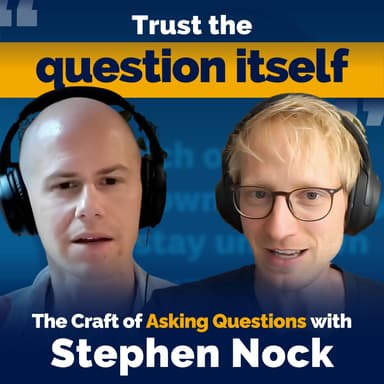
The Craft of Asking Questions with Stephen Nock
with Stephen Nock
Transcript
Edited for readability: filler words removed, names checked. It may still contain errors. The audio is the source of truth.
Stephen Nock
I also think that the question "What do you want?" is a really difficult one. Sometimes a whole coaching process can revolve around this topic of the client not being able to figure out what they want, and that alone can be an incredible journey, to support someone to figure out what's important to them. That's a question a coach can also hold, that I can hold with deep curiosity. I can just be asking myself as I'm engaging with a client, "What does this person really want?" We don't ask the client why. We don't ask them this question, but we sit with this curiosity ourselves. And I think that "What do you want?" question is worth keeping as a foundation.
Tobi
What makes a good coaching question? This question seems somewhat basic, but I think it's still super worth exploring on this show because, of course, the most fundamental tool of all coaching is the question. And this question about questions is what I explore with Stephen Nock. He's an American coach living in Berlin, the founder of &joy Coaching, and he's also, in my words at least, the question guy. He's the author of the "And What Else?" Coaching Cards, and since we met at an ICF coaching lab last year, questions have been the ongoing thread that kept us together. So today we dive in, and we get practical: why "what" often works better than "why" or "how" in coaching. We unpack the seven questions from the book The Coaching Habit and how Stephen uses them in coaching and also outside. We also look into Stephen's method for crafting questions, journaling, and of course we also do something that we do often on the show, but that still somehow came unplanned: Stephen coaches me a bit on what is the question that I need today. This took me somewhere unexpected, and of course we debriefed the process, looked into how Stephen came up with questions, and also why maybe what's underneath those questions matters much more than the question itself. So let's get going.
I would say let's hop right into it. I'm asking you: in the context of coaching, what makes a good question?
Stephen Nock
What makes a good question? I guess there are some basic things we could jump into. It's an open question, I think we've all learned that, and it invokes curiosity. Oftentimes they start with "what", so that was a good question. And it's probably on the shorter side. But beyond those things that we could put on paper in a bulleted list, a lot has to do with how a question is asked. Does it reflect listening and awareness? What is the intonation of the question? And above all, let's just drop the word "good". There's an assumption there that there are good questions and bad questions. Even if we want to ask better questions, maybe we need to drop the idea of having a better question. It reminds me of a saying from Dr. Ellen Langer, I think she's the mother of mindfulness, a psychologist from Harvard. She said, "Rather than focusing on making the right decision, focus on making the decision right." I would think about the same thing with questions. Rather than focusing on asking the right question, we can focus on just letting the question be right, trusting the client to tell me as the coach: is that a quality question?
Trust the question itself to tell us the quality of the answer. If we're focused on good questions, bad questions, better questions, we very quickly fall into what I would deem analysis paralysis, and that's connected to "what's the right decision?" I have to look at all the data points, all the options, all the possibilities for what a question could be, in order to figure out what's the single right one, the best one. But in the moment, it's not really the time for that. We can reflect on the client interactions and the coaching experience later, but in the moment, I think the right question is the one that comes up. And I have so many really special moments when I ask a question to a client, and they come back with, "Oh, are you asking something slightly different?" And I think, "Yes. You've just told me the question that is actually more resonant with you and what you want to speak to."
Tobi
Cool. So what I'm hearing is that it is not so much about the question itself, but about how we ask it. The tone, and I guess also the attitude underneath that shapes that tone.
Stephen Nock
Yeah. I heard your question, "What is a good coaching question?", in a very curious way. But we could also ask, "Tobi, what makes a good coaching question?" That comes across with more judgment.
Tobi
I think we can dig quite a bit deeper, but let's first look at another thing you said: it's an open question, not one that can be answered straight with yes or no. And you also mentioned it starts with "what". How about that?
Stephen Nock
You used the word "how". How questions often point to a method.
If we ask why questions, we would all love to know why, or why not. But such questions generally tend to elicit a defensive response, which might point toward blaming or shifting responsibility. So I think "what" tends to be a more neutral and also expansive form of opening the client's thinking and understanding their perspective.
Tobi
It's an interesting one, because I have never thought about that in the last 10 years. But now that we talk about it, I'm reminded of my first train-the-trainer education in 2014. It was a two-week education, and one of the many sessions was called Powerful Questions, I think. The main chart that I still remember was a pyramid. At the bottom it said things like when, who. Then it said what, a bit further up the pyramid, then how, and at the top of the pyramid it said why. Basically implying that why would be the most powerful question. And I think we also hear a lot about the question why, like the five whys and these kinds of methods. And yet you are saying that in a coaching context, we sometimes don't want to get out the most powerful tool, because why also evokes, I guess especially "why not", this sense of blame. Why haven't you done this? Why haven't you tried this? How do you see that?
Stephen Nock
I don't think any of it is black and white, all or nothing. Why can also be a great question. You point to the five whys, which, for those who maybe don't know, is the idea of asking, "Why is that your answer?" Then the person explains their answer, and you ask why again: "And why would you explain it in that way?" When it's used as that sort of tool, I think it does evoke a lot of curiosity and becomes a powerful tool. But if a client says, "Yeah, I want to talk about this topic," and we say, "Why is that important to you?", it could come across that they need to defend their reasoning. Whereas a very similar question might be, "What makes this topic important to you?" Same question, there's just no need to defend it.
Tobi
And how about how?
Stephen Nock
I think how often points to a method. Maybe we can think of an example: how would you like to achieve the result you're looking for? Then they immediately need to come up with an answer that suggests, "I have a method, an approach, and I know the way." Oftentimes, if people had those things, they probably wouldn't be in conversation with us.
Tobi
So if we wanted to put it in some sort of order or structure, and I heard you say, "Let's not do that," but I will do it anyway. Maybe in the early stages of a conversation, we want to figure out the what: what is the goal? Where do we want to go? Along that, before or after, I guess that really depends on the context, we could go into why: what is the reasoning, the purpose behind it? So why is the digging-deeper one. And then how is more about the execution. How can we do that? How can we get there? So that is already more in the planning, making-things-happen stage.
Stephen Nock
Yeah. We could put those labels on that structure, and we could ask all of those questions also with "what". "How would we get there?" We could also ask, "What steps might we take?"
That also gets a bit more granular and specific, whereas how can be very vague. So we can think of it as what, why, and how, but we can still ask the questions in a different way. And I think this type of thinking is worth our time, to pay attention to the language we use in our questions.
And I guess the saying goes that with great power comes great responsibility. So if we have really powerful questions, we need to use them responsibly.
Tobi
Cool. So for me, you are the question guy. How did you become the question guy, and who are you besides all that?
Stephen Nock
It makes me wonder when I became the question guy. I think I've had a life where questions and curiosity were encouraged or rewarded. There was a lot of curiosity in me as a child, which also makes me think: how often do kids ask why and why not? And the parents get exhausted by it, and maybe that's why we have this defensive inclination. But I had a lot of curiosity as a child. I remember in particular, I asked my mom, "What is the name for this little valley, this skin between our nose and our upper lip?" And she was like, "I have no idea." We had a neighbor who was a doctor, and she went off and asked him. I just had a lot of questions about the world. That's also how I showed up in grade school, not afraid to sit in front of the classroom and engage with the teacher. So I think that was fostered from a very young age. It was my childhood, also my educational experiences. Going into university, I studied engineering, and I think you did too. There was a certain type of problem-solving that was encouraged, a solution that we were expected to have. But I sometimes thought creatively, out of the box, and I wasn't afraid to question or challenge the norm. One of my professors, who became a very beloved mentor of mine, Burt Swersey, taught us to really question the question.
This was the final, thesis year of my bachelor's study. He showed me that something different happens in the brain when we start asking questions just to ask questions, and one leads to another: "Oh, if we ask this, then what about that?" I think the original exercise was to ask questions about trees or paperclips and write three pages of questions. What I learned from that exercise is that the first question, or the tenth question, is not always the one I'm most curious about. I can keep purely questioning, purely stepping into curiosity, until I figure out, "Ah, this is something I'm really curious about." So my education, and I think also my professional journey. I worked for twelve years in technology startups. To be successful in entrepreneurship, in doing something different, in starting, you have to be willing to question, sometimes go against the norm, and also face hard questions. The best companies I've worked for are the ones willing to face the challenging topics head-on and not try to conceal things or sneak past obvious challenges. And in those various working experiences I also learned about the importance of psychological safety, which reflects environments where it is safe for people to ask questions. I learned that places where it's not safe to ask questions are a no-go for me. I have a lot of questions, and I want to ask them.
Tobi
Nice. And maybe the most important question first: what is the bump on my upper lip called?
Stephen Nock
True. I don't know the German name for it, but in English it's called philtrum, P-H-I-L-T-R-U-M.
Tobi
Okay. Wow. So this was already worth it, I guess. Nice. And how did all these influences shape the approach to coaching that you follow today?
Stephen Nock
I think it supports me first and foremost, and above all, to maintain curiosity. To not necessarily trust the client's first answer as the right answer, to stay with them, to stay curious and really say, "Okay, I'm never really going to fully get this person, so let me keep wondering and keep asking."
Tobi
So we're kind of back at the attitude, the foundation of curiosity.
Stephen Nock
Yeah, I think so.
Tobi
Okay, to make that a bit more practical: one experience that we also share, and that has definitely shaped my view on questions, was reading a book by, I think it's also Stephen, right? Stephen...
Stephen Nock
Yeah, Bungay Stanier.
Tobi
Ah, Michael Bungay Stanier. Okay. The Coaching Habit and The Advice Trap. Right now in the ICF Book Club, we are reading The Advice Trap, which I think is the sequel to The Coaching Habit. The Coaching Habit is this relatively thin book, and what I loved about it is how it brings coaching, the attitude and also very practical questions, into everyday life, into leadership life. In the end, the book is merely a collection of seven questions. He talks about them, what makes them powerful, and how to use them. I would love to unpack that a bit and see what that means in everyday life and in the coaching practice.
Stephen Nock
Truth be told, I haven't read The Coaching Habit. I've only read The Advice Trap, but he includes the same seven questions. I think he explains there were originally 100, then 20, then five, and then seven. So I've only seen the list of seven. But they are quite provocative questions.
Tobi
I think he also has an order to them. Maybe I just quickly read them out, as I have them in front of me. He says there's the kickstart question: what is on your mind? Then there's the focus question: what's the real challenge here for you? And I think the "for you" is an important part he often stresses.
There's the foundation question: what do you want? There's the lazy question: how can I help? The strategic question: if you're saying yes to this, what are you saying no to? There's the learning question: what was most useful for you? And then there's the "or" question, I think he calls it, I'm not sure, which is: and what else? I guess that's both our favorites. When I read the book a few years ago, that's the one thing I took away from it, really the power of asking, "And what else?" We have never talked about this, but I guess you also found it quite powerful, because it is also the name of your business, or no?
Stephen Nock
Not my business, but yeah. I named my business &joy Coaching, which I guess has similar origins. To be honest, my ego was a little hurt when I read the book and saw he landed on "what else", because I thought I had discovered the power of this question. But I think many coaches see the value of asking a client, "What else? What else? What else?"
One client told me recently that the second wave of ideas we came up with was the best set, and that was because I kept saying, "Okay, what else?"
And the client will tell you when there's no more, when they're done.
Tobi
So in a way, this is the idea generation question, because you always say, "Okay, and what else?"
Stephen Nock
Yeah. He also has some combinations, some ways of pairing them: "What's on your mind? And what else?", if you feel like you haven't gotten the client's full story of the present moment. He has several different pairings and combinations. What I think is also noteworthy, you pointed it out with the focus question, "What's the real challenge here for you?" He has a line in the book that I don't think comes across so well, because it's in writing. He talks about the English expression of putting the emphasis on the wrong syllable, which is a play on putting the emphasis on the wrong syllable. With each of the questions, you can play with the intonation. "What's the real challenge here for you?" Or "What's the real challenge for you?" There are different ways to play with it, and I think we could do the same with "What do you want?" "What do you want?" Or "What do you want?" You've told me what you think is important to other people, but what do you want?
Or we could emphasize "want". What do you want? Maybe you're not sensing what the client is really hungering for. But altogether, what makes the questions work is that they're concise, so we don't need to elaborate on that.
Six out of seven of them are "what" questions.
Five out of seven use "you", and only one of them uses "I". They're really client-centric. And the "I" question, "How can I help?", is focused on the client acknowledging the coach's presence. The rest are really encouraging the client to think out loud, and the coach is not there as an entity.
So I think those are some of the strengths of his questions, and they're really versatile. He has these different combinations and pairings, and I almost think of it like the standard IKEA toolbox we all need in our households. You need a wrench, a hammer, a screwdriver with some different bits, and if you have those basics, you can probably take care of 80% of your needs.
Tobi
Yeah. Let me cross-reference it to other questions, other phases of coaching that we have. For example, if we look at "What's on your mind?", I guess this is sort of "What did you bring today?", the contracting phase. What should we tackle? And if we look at the lazy question, "How can I help?", I was almost inclined to say, well, this is not a question for coaching, this is more for the leadership context. But actually, this can also be the partnering question: who can I be for you? How can we make those next 60, 90 minutes useful for you? So in a way, those would run really nicely together in this early contracting, partnering phase.
Stephen Nock
Yeah. I think "How can I help?" is very much a contracting question, so that the coach is not the one guiding, and the client holds the responsibility of guiding the direction, explaining what it is they feel they're needing, lacking. It's connected to "Okay, what's the real challenge for you?" Now that we've acknowledged the challenge, how can this conversation be helpful?
Tobi
Yeah. While "What do you want?" is sort of, you just mentioned it, if we have a client that talks a lot about what is expected of them or what they, quote-unquote, "must do", I think this could nicely shift the focus. Or we put the emphasis on the "you", and then it's again zooming in on what's in your control, what do you want to bring? Nice. What else do you see there? How did you experience those in your own practice?
Stephen Nock
I like them so much that I put them on a Post-it. Sometimes I reflect on that, just glance at it to see where I am, both inside and outside of coaching. I also think that the question "What do you want?" is a really difficult one. Sometimes a whole coaching process can revolve around this topic of the client not being able to figure out what they want, and that alone can be an incredible journey, to support someone to figure out what's important to them. That's a question a coach can also hold, that I can hold with deep curiosity. I can just be asking myself as I'm engaging with a client, "What does this person really want?" Last year in the book club, we read Marion Franklin, The Heart of Laser-Focused Coaching. She encourages coaches to ask, "Why is this person telling me this?" We don't ask the client why. We don't ask them this question, but we sit with this curiosity ourselves. And I think that "What do you want?" question is worth keeping underneath as a foundation.
Tobi
So if you're saying we as coaches have in our mind, "Why is the client telling me this?", then it's because it might give away an answer to the "What do you want?" It is sort of looking for this underlying motivation.
Stephen Nock
Yeah. The underlying motivation, the end goal. What are we working toward? What is this person aspiring towards, that they presumably want to have or obtain as an end result, and that for whatever reason doesn't seem to be within their reach at the moment?
Tobi
How about "What's the real challenge here for you?"
Stephen Nock
What about it?
Tobi
How do you use it?
Stephen Nock
I think that question helps me to not assume that I know what the problem is that they're experiencing. They've told me their story, they've told me what's on their mind, they've checked in to the coaching session. I don't want to assume that I know the problem or the solution. So that's a question where breaking down the emphasis can be really valuable. They might give us five problems, and we want to say, "Okay, what's the real challenge? Where do we need to prioritize? What do we need to focus on today that's going to make a difference for you?" Or maybe they try to distract us with some topic, and we say, "Hey, I'm hearing that you're talking about this, but are you sure that's the real challenge?" So we can challenge them with this focus question. That's why he calls it the focus question: to really hone in on what we need to focus on. We can also emphasize the word "challenge" and say, "Okay, we're hearing about topics, problems, opportunities, but which of these presents the challenge?" Because maybe a client has explained something to us and we don't see the challenge in it, or we don't want to assume that the challenge we see is what they're experiencing. Which is where the words "here" and "for you" can be really relevant to emphasize: in this particular situation, what's challenging for you? Maybe the client is showing us a bit of a pattern that we've seen over our time with them, between sessions, but we don't want to assume that pattern is the challenge they're experiencing here, in this moment, and for you. What's your experience of this situation?
Tobi
Yeah. Looking for the problem. If we think of the coaching session in a double diamond shape, this is still where we're trying to figure out what it is that we're actually here for. What's the challenge?
Stephen Nock
Yeah. And you know as well as I do that sometimes that's half the work, or even 80% of the work. There are cases where once we figure out what that challenge is, the client says, "Oh, we're done. Now we've named the problem. Finished."
Tobi
The rest is easy. Cool. But maybe one that comes after that, more in the solution phase, is this strategic question: if you're saying yes to this, what are you saying no to? That is, I would say, the longest one, the most complex one. Are you using that at all?
Stephen Nock
No. I have yet to find a situation where that really resonates with me. Also because it assumes we've identified the decision, the opportunity that the client wants to work with. And it feels a little bit closed-minded to me to say, "Okay, you've decided what you're saying yes to. What are you saying no to?" I haven't worked with that question too much, but I see that it potentially reopens the door and the conversation to second-guess and reconsider the yes that I've found.
Tobi
So if you want to wrap up, or if you're happy and you have the feeling the client is happy with the result that has been achieved, maybe that's not the way to go. In its defense though, how I can see it being useful is this question of priorities and the awareness that you cannot get everything all at once. I'm a person who tends to say yes a lot, not being aware that saying yes to A also means other things will inevitably suffer.
Stephen Nock
Yeah. I guess what I also don't quite like about this question is that it's yes or no, so it feels binary. If you're saying yes to this, what are you saying no to? You could say maybe, or I don't know, or many other answers. But another question that I like to explore is: what are the costs and benefits of action or inaction?
Tobi
Yep. What's the cost of this path? And maybe that's a nice transition, because now you said, "Okay, I'm not using that one, but I have this bunch of other questions." And I know that you do have a big bunch of other questions, because you are also the author of the "And What Else?" Coaching Cards, which is a deck of questions. Can you tell us a bit about that?
Stephen Nock
Yeah, I created this deck of questions. Each card has four questions as well as a prompt, and they're sorted into six categories. I created it initially as a tool for myself. First, in my own coaching experience many years ago, every time the coach asked me a powerful question, something that I loved, I wrote it down. At the end of the coaching journey, I was like, "What can I do to keep all of these questions?" I have it here: I made this set of basically business cards with some of my favorite questions and statements that came up.
Tobi
So cool.
Stephen Nock
They were all random colors. This one says, "How can I position my goals in other people's interest?" "What is a dream I've always wanted to start?" I just collected all my favorite questions, put them on cards, and periodically I would come back to them and reflect on them. Later I started journaling, and I started answering one question in particular every day. I would look at the answers I wrote and reflect on what other questions are behind what I've written down, the answer that I've given myself. What is the question that I'm ultimately striving for? That's what led me to create the "And What Else?" card deck, which is the prototype I have here. It's called "And What Else?" because the idea, and my experience of the journaling, was to not assume that my first answer was the best answer, to keep going, to assume that I might have even richer insights to explore, and to push myself to answer, "Okay, what else?"
Tobi
Yeah. Which is also the concept of the card set, right? Because it's not only one card, one question, as with many other question card sets, but there is sort of a process on every card.
Stephen Nock
Yeah, four questions. The first one invites the user to explore the topic through a big-picture lens. The second question asks for a really simple answer, which sometimes is really good to do. What's your first instinct? So it's to center: a very simple one-word answer, without overthinking it. The third question invites them to shift their thinking: "What's maybe an answer that you haven't thought of yet?" Or, "If you would look at this from a different perspective, what might you see?" And the fourth question is always, more or less, some variation of "What else?" What else could you come up with? They're each a different question, so someone could do all four or just choose the card and say, "Okay, there's one question here that particularly resonates with me."
Tobi
So basically, first question: opening up the diamond shape. Second question: giving us an easy win, first instinct. Third question: help me...
Stephen Nock
Shifting.
Tobi
Ah, shifting. So I look at this from a different angle. And the last question, a variation of the "what else".
Stephen Nock
Yeah. We might call that evolving, similarly to how coaching often works. Okay, we've come to the end of the process, what's going to be the evolution here for you? How can you wrap this up?
Tobi
Can we do an example?
Stephen Nock
Yes, we can, but I think we're going to do it in a backward order, if that's okay with you. Or do you...
Tobi
Interesting.
Stephen Nock
...want a real example card?
Tobi
As you like.
Stephen Nock
If you want me to, you're going to answer the question.
Tobi
Yeah, maybe.
Stephen Nock
Okay. It's good to just exhale for a moment. And also inhale. When you're ready, you can release your breath. Take a moment to yourself and just consider: if you would ask some higher version of yourself, what does Tobi need to know today? What does your higher self respond with?
Tobi
Actually, what comes to mind is sort of a question.
Stephen Nock
Okay.
Tobi
It is this notion of what is it that I need? Need in a needs-based sense.
Stephen Nock
So what would be your first answer to that question? What does Tobi need right now?
Tobi
The sense of enough, maybe?
Stephen Nock
Tobi needs to be enough. What does enough mean to Tobi?
Tobi
Enough means being okay without having to worry what others expect or what needs to happen when. And having this sense of trust that the other people accept me no matter what.
Stephen Nock
So there's a connection here between what Tobi needs and your external relationships with other people and their expectations.
Tobi
Yeah. I didn't have that on my mind when we went into this conversation. I could give a big background story now, but I'm not sure that's needed. Even though I feel like I worked on this quite a bit, that still seems to be a big theme. At the moment I'm on parental leave for the most part, so that means I'm also less in touch with the team. But still, I feel there's this need to prove myself, to show presence. And also a rigidness to my interactions that comes from this fear of losing control, maybe. The classics, right? The sense of "I know how things should be going best," and I have this fear of things not going that way. When I say it, it even sounds so stereotypical, boring. So it's a bit frustrating, actually, to not be further.
Stephen Nock
And when that frustration comes up, what do you need to hear?
Tobi
Maybe some version of "it will be fine, you are loved," or something like that. And I'm not sure if hearing even would be sufficient. It's deeper. It is more about this feeling. I need to feel it, not hear it.
Stephen Nock
Yeah. You used the word "enough" a moment ago, and it often makes me reflect on the question of: is the glass half empty or half full? And how rarely do we even consider how full is full enough?
Tobi
Yeah, I guess in my context, I could answer that by defining some level of contribution, but I'm not sure that really solves the problem. I think it's not really about the amount but more about the feeling behind it.
Stephen Nock
There's almost a version of "If you're saying yes to this, what are you saying no to?" But I guess: if you're saying no to measuring enough, what are you saying yes to?
Tobi
Trust. Whatever it is, it is enough. And I think that's in a way the solution, not defining that X amount of contribution is enough. Cool. Thank you.
Stephen Nock
What question sticks out to you now?
Tobi
Maybe it's still this: what do I want? What do I need? And actually, I just refused or rejected it, but "If I'm saying yes to this, what am I saying no to?" is actually also really applicable in my context, this parental leave and still being on, thinking about things going on at metaFox and what I still need to get done tonight. With that, I'm also saying no, maybe, to spending time with the little one, this unique period, et cetera. Again, listening to myself, I found it too stereotypical to even say. But in the end, it's true. So that is maybe the one that sticks.
Stephen Nock
Yeah. I hear a depth of acknowledging what you want and what you need, while acknowledging there are externalities.
Tobi
Thank you. I didn't expect this to go this way, but maybe it's interesting now to explore how this was for you. How did you choose to go about this, to ask this or that question?
Stephen Nock
If you remember, I asked you the question to start with: what does Tobi need to know today? And you reflected back, "Yeah, I just need to ask myself, what do I need?" I could sense this acknowledgement of, okay, Tobi needs to acknowledge some things that he hasn't yet acknowledged. I don't think I said or asked too much. It was really just letting you think. And there was also a moment, I think, when you said, "I don't know," and you kept elaborating, which I think is a super strong signal to create the space for the client to not know and to figure it out.
Tobi
So when the client, in this case me, says, "I don't know," but then goes on trying to know, hypothesizing, then you say, "Okay, let that run."
Stephen Nock
Yeah. "I don't know", for me, is the best signal that we are arriving, that we are in coaching. Especially in an AI world, there are tons of things we don't know, and everyone is grasping for the answers. But the world would be extremely boring if we all walked around and talked only about things that we know, and worked in a context where we truly have all the answers all the time. The human mind and psyche feeds on solving the unknown, figuring out things that we have not yet understood. That is an excellent context for coaching: to work on the things that we haven't figured out yet. It would be extremely boring, I think, if we only spent time talking about what we do know.
Tobi
It's funny that you are talking now about this not knowing on the client's end, me as a client acknowledging, "Okay, I don't know, let me think about it." At the same time, I would also expect that for you as a coach, this is the foundation of everything, this attitude of "I don't know, and maybe I don't need to know." How do you deal with that? What is the fundamental narrative in your mind in this mini coaching conversation?
Stephen Nock
In our context, I think it was extremely important that I didn't necessarily have a plan or an agenda. I had no clue what you were going to bring up as a topic. You said, "Hey, can we try this out?", this sort of multi-layered questions. I was like, "Okay, I don't know where this is going. I don't need to know."
Tobi
The funny thing is, what I had in mind back then was, okay, let's actually look at a card. Can we go through the questions on a card to showcase that? And then this process unfolded. Sorry to interrupt.
Stephen Nock
No, if we looked back at a transcript of our conversation, we could create your card. It started with "What does Tobi need to know today?" Then it jumped to "What do I need?", a very simple question. And then there were at least two more under there that helped you to shift and evolve your thinking. So I think that reflects the arc, this explore, center, shift, evolve, that I'm trying to facilitate in every coaching conversation, and we just created that on the spot. But we can also go through a normal card if you want.
Tobi
Center, shift, evolve. Nice. Yeah, let's do that. Let's do one for closing, to look at how this can look like with a card.
Stephen Nock
Do you want to choose a category first? Explore curiously. Foster trust. Empower...
Tobi
Trust.
Stephen Nock
Oh, we have an answer already. So I'll take out just the Foster Trust cards. I think I have your question. This one says, "Not knowing is an indicator that we have an opportunity to learn and grow." The first question: which of today's unknowns are okay to stay unknown or uncertain?
Tobi
Do I answer in my context?
Stephen Nock
You can choose. We can also keep reading and just reflect.
Tobi
Reflecting back on our conversation, it's this idea of: I don't have to know how much is enough.
Stephen Nock
And if you would center and pinpoint one answer, what is an unknown that you feel deeply curious about?
Tobi
That's a question on the card?
Stephen Nock
Yes.
Tobi
What do I need?
Stephen Nock
What do I need? Deep curiosity. How does not knowing the answer help you?
Tobi
Giving up, letting go, accepting. How do the Buddhists say it? Surrender.
Stephen Nock
This is not the next question, but I want to ask you: how else does not knowing what you need help you?
Tobi
Ah, not knowing what I need. I think what I need, I should know. It was more: how does not knowing how much is enough help me?
Stephen Nock
Enough? Yeah. How does not knowing how much is enough help you?
Tobi
Well, it makes it easier to not run after a certain bar, to not jump through the hoop.
Stephen Nock
Yeah. If I could suggest a perspective: I often like to think, what is the survival instinct here? Psychologically, what about your way of operating right now is in the interest of your survival? When you don't know how much is enough, your brain, especially when you have a little one at home, is on the lookout: "Could more help me survive?"
Tobi
Yeah, I think that's it. I often say that it's also in the Franconian DNA, where I'm from: your self-worth is defined by your work. It's that sort of underlying belief that's driving me there. How did you come up with this question now?
Stephen Nock
Which one?
Tobi
The survival aspect.
Stephen Nock
Oh, that's just my thinking. Not wired, but I like to consider that. That's where my curiosity often enters. We often assume our behaviors and our thoughts are maladaptive, that there's something wrong with me for thinking this. But almost every behavior and every thought we have is somehow our brain and our body wanting to support our survival. So where could we find an explanation that this line of thinking is some part of you thinking it's going to help you survive?
Tobi
In a way, that's almost a therapeutic approach, I would say. Because it looks back at where that pattern is coming from. How did it help you survive as a child, or in your evolutionary past? How did this behavior help you survive?
Stephen Nock
Yeah. I don't think about it so much in the past tense as in the present moment. And I'm not saying that because coaching is supposed to be present-focused. I'm just like, "Okay, what about this person's thinking?" That was my thought: "Okay, you're focused on enough. Your brain probably wants you to constantly have an eye half open: could there be a little bit more here that's in the interest of my survival?" And I love the work of, I think his name is Mo Gawdat, who has a fascinating life story with losing his son, and he developed this philosophy of talking back to his brain. He named his brain Becky. And he's like, "Okay, Becky, I know you're telling me that right now I need to do more in order to be enough, but I'm busy right now. We can have a conversation later today at five o'clock. So, you and your 'enough' chatter going on here, I know you want to help me out, but I don't need your help right now."
Tobi
Awesome.
Stephen Nock
So the fourth question, just to close it out: what else would you like to learn in the future, but not necessarily soon?
Tobi
That's unexpected. Or to pass this on, maybe. The letting go of enough. The immediate thing is learning it for myself, but in the end, I think the purpose of it all is also to bring the sense of enoughness into the room, into the team, the family. Okay. Thank you.
Stephen Nock
Thank you for playing along.
Tobi
Do you want to say a few more words about the attitude? Because when I asked you what happened in our conversation, you said you didn't do much. You didn't even ask many questions, but you showed this presence. How do you nurture this mindset of curiosity, this presence, the not knowing, all of these things, and how can one learn this?
Stephen Nock
Oh, I guess it's just a life journey, and it's a journey that I maybe accidentally set out on. I meditate every day, I would say for at least six minutes. I also share my meditation journey on Insight Timer and try to reflect a little on what meditation means to me. I like to sit with the unknown. I like to acknowledge that the unknown is present. That's what's reflected in this question too: there are tons of things we don't know. What are the ones we want to play with today, and what are the ones we want to set aside and leave as unknowns? I have experienced similar challenges with what it means to be enough. I have some similar life stories of being dictated by my work output. But I reconsider that question of what does enough look like today? Because I know I can make myself a to-do list with plenty of things, more than I can possibly complete in a day. I know there's the human planning fallacy, that humans consistently overestimate time, money, what we can do in a day. But at any given moment: what's important? What do I need to know or not know right now to keep myself moving one step forward, or to be a little more present with myself?
Tobi
And how does that relate to nurturing and bringing that sense to the coaching session?
Stephen Nock
Whatever has happened, whatever has evolved in me, a lot of what my clients reflect to me without prompting is that they feel extremely calm in my presence. They feel calmed, they feel safe, it's a space where they can think out loud. Initially, it really threw me off, because people would tell me I was calm in moments where I didn't feel calm whatsoever. So I think that's something it brings to my coaching presence: this welcoming of the "I don't know", the idea that I don't need to know. I think if I do know in coaching, then I'm on the wrong path.
That's when the advice monster, or the advice trap, as Michael Bungay Stanier calls it, really gets triggered and activated. So it encourages me to show up in a way that I get resonance for, and that clients reflect is positive for their experience.
Tobi
So that's where the sense of curiosity that we started the conversation with is meeting the enoughness. And you're saying, having walked that path of figuring out your own enoughness helps with bearing the vulnerability of not knowing, of being curious and being okay with that.
Stephen Nock
Yeah, I think so. And often this enoughness, the way I hear it asked, is focused on what I would call the debt, the amount by which we haven't reached the level of enoughness. We operate in a mind, in a world, that has a lot of scarcity, a lot of emphasis on abundance. We need more. But that's where the glass being half full or half empty analogy is really interesting to me, because I think what's in the middle of scarcity and abundance is enoughness. Then we're not trying to fill the glass up to the top, constantly looking at the gap, but we're giving credit for what is present, what has shown up. When I think about what I need to be enough today, all of my needs are met. Ah, okay. So this reptilian mind of mine that wants to think about all the scarcity and the things I haven't done, it can quiet down. I can show up in that way to my client as well, when they're thinking, "Well, I haven't done this, and if I don't get that promotion, and this person is mad at me for this." Instead of just paying attention to the debt, the amount that supposedly we need to pour into the glass for it to be full enough, what about giving ourselves credit for how full we are, how much enoughness we are already bringing into the picture?
Tobi
Cool. An unexpected turn, I have to say, coming from questions and curiosity to being enough. Thanks, Stephen. Where can we find you and get to know your work a bit more?
Stephen Nock
You can look at my website, which I don't update too often, but it's there: andjoy.coach, A-N-D-J-O-Y dot coach. I'm also on Instagram with the same handle, and fairly active on LinkedIn. You can find me there, you can follow me. I also have a newsletter that I put out, quite proud to say, just once a month. I'm not going to spam people's inboxes. For whatever reason, it's called "And Now What?" That's the name of my newsletter, and you can find it through my website.
Tobi
Cool. And then there are the "And What Else?" cards on top of all of that. We'll also put that in the show notes. What you inspired me to here, because this is something I've wanted to do for a while, is to intensify my journaling practice again. I think today's experience has inspired me to actually go with the random question journaling, which I think I've tried in the past, and it seemed random, or I have to give up control. But maybe that's exactly what I need.
Stephen Nock
Yeah. If you like the question, you can answer it. If not, you can start journaling and then figure out what the question is that you're answering.
Tobi
Cool. Thank you.
Stephen Nock
Thank you for inspiring me to unpack where my curiosity comes from. Happy to be known as the question guy.
Tobi
This was Stephen Nock, and as you heard, all links are in the show notes. If you enjoyed this, if this was useful, share the episode with a person who loves a good question, and of course, subscribe wherever you're listening. This helps us out quite a bit. I'm also happy to get your feedback on LinkedIn or at tobias@metafox.eu. I'm Tobi, co-founder of metaFox, and I wish you all the best on your journey of asking better questions inside and outside of coaching. See you back here in two weeks. All the best and bye-bye.