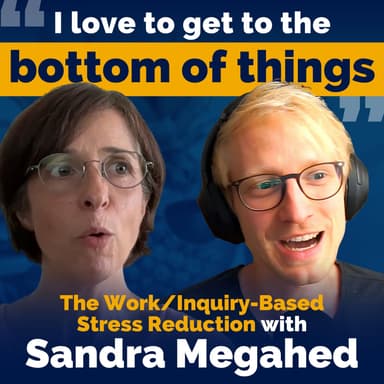
The Work / Inquiry-Based Stress Reduction with Sandra Megahed
with Sandra Megahed, Coach and facilitator for entrepreneurs and leaders
Transcript
Edited for readability: filler words removed, names checked. It may still contain errors. The audio is the source of truth.
Sandra Megahed
Like in any other coaching situation, I always say presence comes first. It's a method, but especially with The Work, my experience is: presence stands over the method. Really stay very connected in this process and don't go into giving advice or trying to push someone in a certain direction. Really trust the answers, the feelings or whatever is coming up. I think this is the most important thing. And I think the questions themselves also work in another coaching setting. But more and more I experience that the more we include the body and the breath, the more effective it is for reframing, for finding new ways and for letting go with time, to watch what is really bothering us or stressing us. And, as you also experienced, to even look at it with a sense of humor.
Tobi
Is this true? And can you absolutely know that this is true? These two questions may almost sound insulting if somebody asks them to you about a problem you have. And they are also the start of a method that I have been curious about for years. The method is called The Work by Byron Katie, and it's also known as Inquiry-Based Stress Reduction, or for short, IBSR. And today, I learn and also experience The Work with Sandra Megahed, a coach and facilitator working with entrepreneurs and leaders, and the creator and founder of changeyourbrain.de. On today's episode, we unpack The Work, the four seemingly simple questions that form the foundation of the method. Sandra walks us through these questions and also the three so-called turnarounds. She shows us how she finds a thought that's suitable for working on with this method, and then she actually coaches me using The Work. We go into one of my long-term themes of belonging, of feeling included, and she helps me defuse my thoughts and understand who I am without that thought. So let's get to work with The Work, AKA IBSR.
I'm quite excited for this conversation, and to dive into one of your working methods today, which I've been interested in for a long time. In fact, when I discovered you, or when we met, I found all three methods that you work with super interesting. Those are positive neuroplasticity, and The Work of Byron Katie, or, as you call it, I think, Inquiry-Based Stress Reduction.
Sandra Megahed
Correct.
Tobi
In your experience, if you work with clients, what does The Work or IBSR do for a client that these other methods in your toolbox cannot?
Sandra Megahed
I love this question, and I love The Work, also called IBSR, as you said. I love it for different reasons. One reason is that I can use it very easily for myself to reduce stress: stress caused by thoughts or by limiting beliefs coming up again. And I can use it in one-on-one coaching. This is the more intense way to work with people. I can do The Work for 20 minutes, or in a very extended version of up to two hours maybe. And also in a group, in what we facilitators or coaches call popcorn work, for softer topics. We can choose a shared belief we have, for example about the world: the world is not good. Or we find a common belief which we all share and which stresses us. Then we just pop in what comes up, without sharing, "Oh, my situation with this person," or, "This is happening." But what makes it so special for me is that I can really inquire, investigate a specific moment, as little as it seems, really a nanosecond of a moment, which causes all these feelings and frustration or anger. This is like an anatomy of a problem, or of a stress-causing problem. And I can do this for the past, something which is long, long ago. I did this also with things from my childhood. I can do this with something that happened five minutes ago, and also related to the future. For example, I did it with people before job interviews or exams, where they have such a fear of failing. So this makes it flexible, but also very specific. Going through that process in the moment where the cause of suffering is, is fascinating, and it always brings a kind of release at the end.
Tobi
So what I hear is that it's usually about beliefs, and that it's super versatile. I can work on beliefs that cause me fear, maybe before a certain event, but I can even go back and reflect on, or work on, long-held beliefs from childhood. It sounds super versatile, because you also mentioned applying it in a group, in one-on-one coaching or even, I guess, in a therapy situation, and also on yourself. Today I want to really unpack that, and maybe also hop into a small demo of IBSR. But before we do that, let's get to know you a bit. I believe you started out as a literature scholar, you had a career as a journalist, and today you work with entrepreneurs, self-employed people and leaders. And your website, and also your promise, is "change your brain", right?
Sandra Megahed
Yes.
As preparation for today's conversation, I was also thinking: what is the common thread, as I think you call it in English? What connects everything with each other? It's fascinating every time: we do things, and then we think, why have I done this job? And later, after a while, you understand, okay, there is a connection. So I think my passion is really research. I love to get to the bottom of things. And I think The Work also goes very deep in investigating. On the other hand, it's a very easy method to apply. And this is also what fascinates me about positive neuroplasticity training, where we can use our experiences, our daily experience, in a very beneficial and a very conscious way to grow strength. But what really connects everything, as I told you, is my passion for learning and understanding things. I think we also have something in common there. As a journalist I had the chance to try out different methods, holistic methods. Many of them were connected more to the body, but also to the mind and to mental things. I tried out as much as I could, and then I wrote about it. In the last years I did the same in my podcast, which is in German: I tried out methods from books, and then, like you today, I invited guests to talk about it. And then there is my own journey, because we also have a life journey, which now brings me to storytelling, which for me means The Hero's Journey by Joseph Campbell. I don't want to go too deep, but it means to live, to experience, or just to see life or challenges as a kind of journey we can master. For me the tool is also very helpful in coaching, to see where you stand right now, and whether maybe the next journey has already started and you were not aware of it. So this is the framework I use for myself and in coaching. And the story always plays a major role, which I also bring into this tool. And I also had a challenge, a health challenge, and I spent some time in a rehabilitation center. When I was there I was reading a lot, and I decided to find a tool for myself which helps me, when I come back into my normal life, to really get clarity, to stay calm and to make conscious decisions. And this was, in the first place, The Work for the specific moments, and also positive neuroplasticity training as a kind of relaxation and calming down. That's why these are the two main methods and tools in my toolbox, which I use on a regular, daily basis.
Tobi
So basically, when you went through your own hero's journey, one could say, and faced difficult times, you took The Work as a method for going deep and questioning what's going on.
Sandra Megahed
Yes. Even these days, when I have a thought or a feeling which disturbs me, I can use it with my smartphone. I record myself, or I fill out the worksheet, which I just do on paper, and sit with that, sit with the thought. In the first place, The Work is being with the thought and the feelings and everything that connects or is related to the initial thought. The Work is a meditation, I think. In coaching we can use it in another way, but for myself I practice it as a kind of meditation, or as a meditation.
Tobi
Okay, so how does The Work work?
Sandra Megahed
How does it work? As I said, it's an inquiry, a self-inquiry. There are also other self-inquiry approaches. This means I take the thought, and I see: where is the situation where I really feel stress, or where there's a lot of mental or physical load when I think about it? Let's take something in the past, for example. I think about it again and again. And my brain will also make predictions: what does this mean for the future? This causes stress, because I cannot control the future. With The Work I have the opportunity, really a tool, to sort things out, and first to bring myself into the situation, when I do it in a very meditative state, in the beginning. In coaching, which is maybe more interesting for your listeners here, you can just ask the questions, because The Work always works, even if a person who doesn't know the method is just asking you the questions. I experienced that when my son was younger, still in school, and I was stressed: "Now please just read the questions." And we were both very surprised about the result. Then I first go into this room, into the initial situation. The first two questions are: Is this thought true? And: Can you absolutely know that this thought is true, in this moment? This is just a check-in, to see how it feels. And sometimes I say no, and then I go on and describe why I'm in the situation again: How do you react when you believe this thought? As a coach we also have some sub-questions we can use. But mainly we focus on the four questions, and then we turn, or go over, to: Who would you be, or what would you be, without the thought? To see how that would be, as a kind of experiment, to create this space of: oh, just look around, what is different? And there's always something different. And then we turn the thought around. It's like you are in a room, and maybe you have also changed the furniture in your room. You put the chair in another corner. And this is what we are doing: we sit in the other corner of the room now and see, okay, there we have the turnaround to the thought. Maybe the thought is "He doesn't respect me", for example, or "He doesn't like me in this situation". And then: okay, I didn't like me, I don't like myself in this situation. Then we find examples or facts of how this could also be true. I always love this picture of changing your place in a room and then watching. And it's not about removing thoughts or making them disappear. It's really investigation, and then seeing what happens.
Maybe another thought is truer, or not. And then we have just created the space and gone through the process.
Tobi
Okay. Okay, that was a lot. I tried to keep a few notes, to also put this visually. So what I understood is: we are using The Work on a difficult situation, or on a difficult thought that we phrase, and then we ask four questions. Is it true? Can you absolutely know that this is true?
Sandra Megahed
Mhm.
Tobi
What happens when you believe that thought? And who would you be without that thought?
Sandra Megahed
Yes.
Tobi
Then the next level would be the turnaround, working with the opposite phrasing of...
Sandra Megahed
Yeah, and there are different turnarounds, mostly three: to myself, to the other, and then the opposite. This is the rule for easy thoughts and beliefs. So "I don't respect myself", for example, "I don't respect him" and "He respects me" would be the turnarounds in this example. And what happens in the third question, also: how do you react? How do you feel? Also questions which are related to that question. So we have the four. One, is it true? Can you absolutely know that it's true? We answer this only with yes or no. And here we can bring out everything we feel and think. There's enough space.
Tobi
So the first two are simply yes or no, and then the third question is exploratory: what happens within myself? How does my body feel when I think that thought? This is...
Sandra Megahed
Yeah.
Tobi
...what we are doing here.
Sandra Megahed
Pictures we see, things which are coming up, maybe even things from other situations. How am I with this person? How do I treat this person, maybe inwardly or outwardly? This is, for example, a sub-question which I find very interesting, especially when we say, "Okay, how do you treat him in this moment, inwardly and outwardly?" And then we always understand: okay, that's why it doesn't feel very authentic, because I'm very polite, but I am angry with him, or I'm afraid of him. So here we really open the room for everything. But from my experience in coaching, my personal experience, it's an embodied experience. So we should offer enough time, and also the room, the presence, so that people can also feel it physically, to later, in step four, really understand the difference, the release. In the beginning it's not always possible. It also depends on the situation. Sometimes maybe we don't want to feel too much. But we can also ask such sub-questions: where do you feel it in your body, for example, when you believe this thought? And we always bring the client back to the situation, too. So what do you feel in your body in this specific moment? And as a coach I will ask at the beginning: where are you? When was this, for example? Because here is the solution, in this moment where the suffering was caused.
Tobi
Okay. To make this a bit more tangible, I think it would be nice to look at an example. Rather than going through it on a meta level, maybe we can actually give this a try.
Sandra Megahed
Yes, sure.
Tobi
So how do you usually find a thought or a situation that's worth working on?
Sandra Megahed
It depends. There are different ways. It can be a belief: we have limiting beliefs which come up again and again. Or someone says, "Oh, I'm upset," or angry, because this happened to them last week. Then it's very likely that we will use this situation to investigate. If the person is not yet familiar with it, I will explain it briefly, as we did, but in a very short version, and say: okay, we go through this situation with a structure, a very easy structure. Do you want to try this out? And mostly people are very open to that. Another way is when people have a general problem, maybe it's... This is also a question to find out. Or writing a list is also a way: you write down a list of where you feel frustrated. Especially when it's a work issue: you are frustrated because of something, and then you write down everything that frustrates you. You write it down, you leave it for a moment, and then we go over it again and say: so now the one with the highest, or the most, load. So this is how I work, and there are different ways. Also when I work with your cards, your photos: if someone has a block, a mental block, like, "Oh, this looks nice as a kind of vision board, but something is coming up, something is holding me back." Something I want to avoid, what we also call a dreaded experience: we want to avoid experiencing something again. Then it's worth looking at it. And mostly I go the way through the feelings, and from the feelings we come to the thought. So, "I always have this feeling, I'm anxious," and then you can ask: "What do you think in this moment? Which thoughts are coming up?" And when we fill out a worksheet, we have different ways to investigate a thought. There's a worksheet called the Judge-Your-Neighbor Worksheet. "Where do you feel the most pressure? Where do you feel the most tension in your body?" This is always how I decide, or how we decide, which of the thoughts we now want to look at more deeply, to understand what it means.
Tobi
Very interesting. What I hear, or what I noted now, is three starting points that you mentioned. The first being: you're in a coaching conversation and you notice, okay, there's a difficult belief coming up, or generally what's there is related to a certain thought, a certain belief the person has. The other thing that you mentioned was listing the things that bother me, then finding the one that carries the most load, and then extracting the belief to work with from there. And the other one is coming from the feeling: for example, having the client select a picture that represents how they are feeling, and then, from that feeling, for example anxiety, a thought that is connected to that feeling.
Sandra Megahed
Yes. I'd like to add to the one with the list of things that bother me: when we cannot use this material directly, we can also ask, "What does this say about the other person, or about yourself? Or what does it mean?" So, to find a thought which is really worth investigating, or which works for the self-inquiry. And with the picture cards: what thought, and also which specific situation, is connected to it. So you have these different ways, as you were writing there: come from the situation, the feeling, the thought, and really the physical sensation. Because I now work more with the breath, I've also found the breath very helpful to integrate. Where do you feel your breath right now, and does this also remind you of other situations?
Tobi
Okay. Let's try this.
Sandra Megahed
Okay.
Tobi
And maybe, how about we do the picture cards, starting from the feeling? How about this approach? It seems like the most authentic way to hop into it.
Sandra Megahed
Yeah.
Tobi
Okay. And let me get out a picture card set. Let's maybe work with this one. So what would you ask a client?
Sandra Megahed
So, let me just see. We have Growing Together. When it's about a vision, for example, what do you have as suggestions? Oh, let's take this one. Which card describes where you want to be? Not how, but where you want to be in half a year, for example, in six months.
Tobi
Yeah, interesting.
So I picked an unusual card. I didn't see myself picking that one. It's three pineapples in a sort of party setup, so there are some balloons around, and the pineapples wear party hats, and one pineapple wears sunglasses.
Sandra Megahed
Okay, and the question was: Where do you see yourself in six months? Or where are you in this moment, this specific situation?
Tobi
I'm not sure if it's a specific situation, but it's more that what I feel in that situation is lightness. And it's also the lightness within that group setting, the lightness in relation to others, that I found striking. They represent people. Maybe the one with the sunglasses is me. And I, quote unquote, look very unbothered. Carefree, maybe. Carefree is the right word.
Sandra Megahed
What does that mean?
Tobi
I don't worry too much. Or: I don't worry, full stop.
Sandra Megahed
Okay.
Tobi
Yeah.
Sandra Megahed
And now going back to where you are right now. You said you're not bothered so much. So is there something that bothers you today, or these days, which makes you wish for, or makes you feel drawn to, this image, to this idea?
Tobi
I think what made me pick this is a bunch of different situations, but most recently with my wife. She had taken a small decision that I would have loved to be involved in. And this is generally a pattern that I've had a few times in the last weeks, or in the past years, I guess I could say: this need to be included. And included can mean belonging, so I think this is generally a life theme for me, I would say even within my family. This need to belong, and the worry about not belonging. And in the situation that I now have in mind specifically, the belonging also connects to the need to be heard, or to be included, for example in a decision.
Sandra Megahed
And do you have any thoughts which could hold you back from following this path, from experiencing what you described before?
Tobi
The...
Sandra Megahed
This is the lightness.
Tobi
Yeah. To belong, or maybe even: I must be included.
Sandra Megahed
So this is like a driver. And what does this say about you, or about life in general, when you think, "I must be included"?
Tobi
So I've looked into this topic quite a bit, and I think even evolutionarily this drive made sense. If you lost touch with the pack, with the group of Stone Age people, the tribe that was going through the savanna, you most likely died, because you needed to be part of the group to survive. And in my life, I think this goes back maybe to family-related things, but also to growing up in a very small village. There's generally a small set of people, and if you don't belong anymore, it's not like my life experience now, where it's: okay, I just go on to another tribe, quote unquote, in the city. It was very much: there was this one tribe, and if they exclude you, you are lost. I think this is, in a way, where this originates. On a cognitive level I understand that, but I still see so much of my anxiety and anger being driven by this fear of not being included.
Sandra Megahed
And was there a situation recently, you mentioned something, where you had this thought or this feeling again? Or will there be one? But let's focus first on one which has happened recently.
Tobi
It's really a minor thing, but I saw it again. I mean, it even sounds super ridiculous. My wife had made a household decision, and I was like, "Hey, can we please talk about this before, next time?" And five minutes later I thought: oh come on, this is so ridiculous, I don't want us to talk about this. We should trust each other, not bother, and simply move forward. So, have that lightness. But somehow in that moment it bothered me that I wasn't included in the decision. I can picture it clearly, because it was just today.
Sandra Megahed
Okay, this is perfect. Still fresh. So then the sentence would be, as I understand it, the thought was: she didn't, or she doesn't include me. And then we can add on in the session, also in this specific situation. Does this work for you? Is...
Tobi
So...
Sandra Megahed
This...
Tobi
Doesn't include me in her decision-making, or...
Sandra Megahed
Yeah, we can add this to the main sentence, the main thought. And we take it now into the present, because this is easier and feels more authentic than when we use the past tense. Okay.
Tobi
Yeah.
Sandra Megahed
How do you feel with this sentence?
Does this trigger you a little bit? You can try.
Tobi
I would say even the original one, this "I must be included," triggers me even more.
Sandra Megahed
Okay, excuse me.
Tobi
Because it just extends to more history, in a way.
Sandra Megahed
Yes. Both are possible. I would suggest taking the second one, even if it doesn't trigger you now. I said okay with the mental load, but I think it would also be interesting how we can make the turnarounds to the other person and to yourself. Is this okay for you? Okay. Then just take a moment to connect yourself with this situation you described before with your wife. You said it was today. Just be in this moment and see yourself in the room you were in with your wife. And then you can just tell me briefly: how do you want to be reminded of the situation? In which room was this? You were standing with your wife, maybe in the kitchen or in another room. Just give me some short information, so that I can bring you back into the situation as well. Where are you?
Tobi
I'm in the living room.
Sandra Megahed
Okay, so you're in the living room, and it was today. Okay.
Tobi
On the couch with our son, and my wife is standing on the other side of the room.
Sandra Megahed
Okay, and the thought, or the sentence, is: "She doesn't include me in her decisions." Is that right? Okay. Then see yourself in the situation, and I will now ask you the questions and guide you through the process. "She doesn't include me in her decisions." Is that true?
Tobi
So if we really refer to the situation and we make it...
Sandra Megahed
Just say yes or no.
Tobi
Then I would say it's yes.
Sandra Megahed
In this situation today, can you absolutely be sure that this thought is true: "She doesn't include me in her decisions"?
Tobi
No, I cannot be absolutely sure.
Sandra Megahed
Just yes or no. Okay. How do you react, what happens, when you believe the thought, "She doesn't include me in her decisions," in this moment where you sit there and you're talking to her? What happens?
Tobi
Funny, I expected something like anger, but it's actually even more fear that comes up. This fear of being left alone, in a way.
Sandra Megahed
Something else that is coming up?
Tobi
There may be a little bit of frustration and anger, in a way. Like: why? So a lack of understanding. But even more so, fear, loneliness, in a way.
Sandra Megahed
And where do you feel it in your body when you believe the thought, "She doesn't include me," in that moment when you are together in the room?
Tobi
My belly area, my tummy.
Sandra Megahed
How do you...
Tobi
Also even going up into the chest.
Sandra Megahed
And how do you treat her, treat your wife, in this specific moment today, when you believe the thought, "She doesn't include me in her decisions"?
Tobi
I guess on a fight-flight-freeze scale it's mostly fight, in a way. So I think it's something like, "Can we please talk about this kind of stuff?" In a raised voice. So, going on the offensive, in a way.
Sandra Megahed
How do you treat yourself when you believe the thought, "She doesn't include me"?
Tobi
It's an interesting one, not easy. Maybe it's even in a similar way: how come you are not included? Also in a sort of angry way.
Sandra Megahed
And how does it feel to put yourself in this position, or in this role? How does it feel when you believe the thought, "She doesn't include me in her decisions"? So how does it feel when you put yourself in this position you described before? How you treat yourself: like you said, angry, I think.
Tobi
Very unpleasant. It even feels somehow... So maybe there is also... I just said on fight, flight, freeze it's fight, but maybe there is also an element of flight, in a way. I don't want to go there.
Sandra Megahed
And in this situation today, when you are with your wife in the room and you believe the thought, "She doesn't include me in her decision," what does it cost you? What does it cost, or what are the costs?
Tobi
Not being included?
Sandra Megahed
When you believe the thought: she doesn't include you.
Tobi
The costs of the thought?
Sandra Megahed
Believing the thought.
Tobi
It costs connection. Actually, my fear is this fear that I'm not included, but I think my reaction to the belief of not being included makes it more likely that I'm not included, in a way. So it drives us apart.
Sandra Megahed
And what does it cost you in this specific situation when you believe the thought, "She doesn't include me," or "She doesn't include me in her decisions"? Or what are you not able to see in this moment?
Tobi
That she actually solved a problem, in a way. She took a household decision to solve a problem, and that's a good thing, because we cannot discuss every single detail. Or I don't want to discuss every single detail in the household, and it's actually good that she just did that. That's what I cannot see, and not seeing that causes me to be angry and not be connected, even though she did a good thing for us. Life would be simpler if we were connected and just solved problems for each other.
Sandra Megahed
And can you find a reason to let go of this thought, or to drop the thought, "She doesn't include me in her decisions," in this moment today?
Tobi
Yeah. Everything would be simpler. I could be grateful instead of angry, or grateful instead of being afraid. We could move forward with the day. So there are many reasons to drop it. I guess most importantly, connection.
Sandra Megahed
Then we go over now to question number four. Who or what would you be without the thought, "She doesn't include me in her decisions"? You can also see it as a kind of experiment: the thought is just away for a moment, and you can also get it back. Just see it as an experiment, to see how it would be without believing the thought, "She doesn't include me in her decision," in this moment. So really bring yourself back into this moment. What would be different? Who would you be, or what would you be?
Tobi
I think I would be the pineapple. I could take life and the situation with lightness. Look a bit like that one, with the slightly tilted head and sunglasses. Be relaxed and say thank you.
Sandra Megahed
And how would that feel now in your body without the thought, "She doesn't include me"?
Tobi
Right. Safe.
Sandra Megahed
And how would you treat her now without the thought, "She doesn't include me in her decisions," in that specific moment?
Tobi
Kind.
Sandra Megahed
How do you treat yourself without the thought, "She doesn't include me," in this moment?
Tobi
Also kind, compassionate. Or even simply: I'd be light. I wouldn't even need much compassion, in a way.
Sandra Megahed
And now we can go to the turnarounds. We just turn the thought around. The initial thought is "She doesn't include me in her decisions." We just leave "in her decisions" away now. I think it's easier for you to do the experiments, the turnarounds. The first turnaround is to yourself. I can build the sentence for you: "I don't include myself" would be the first turnaround. And now look in this moment where this thought could also be true, or even truer than the initial thought, "She doesn't include me." So find an example why this could maybe also be true: "I don't include myself in the decision."
Tobi
So we turn around both the "she" and the... and we say, "I don't include myself." Oh, that's an interesting one.
Sandra Megahed
Do you find an example why this could also be true, or even truer than the initial thought, "She doesn't include me in her decisions"?
Tobi
Maybe it's this idea of "She didn't include me," like she didn't think of me in her decision. But actually, in this mental image of her taking the decision, I don't include myself. I act as if I'm not part of the picture, and that's something I actually do: this not including myself in the picture.
Sandra Megahed
Now you can see the situation in a kind of slow motion. Maybe there's even something practical where you can try it out. It's like trying on another shirt. So how does that feel: "I don't include myself in the decisions"? Or really see the situation as slowly as possible. Is there a moment somewhere where this could also be true?
Tobi
I think that's actually what happened. When she said she decided this and that, the mental image that came up in my mind was her taking that decision without me being in that picture. While in fact, this is a picture that I created, so I didn't include myself in that decision. This is how I can see the situation.
Sandra Megahed
Okay. And can you find a third example why this could also be true: "I don't include myself"? If this is sometimes hard, we can also go out of the situation. Because you live together, there are maybe similar situations where this could also be true: "I don't include myself in the decisions."
Tobi
I'm not sure if I can give the word "include" a bit of a different notion. As in: I don't see myself in a situation. So I assume that I'm not part of the picture.
Sandra Megahed
Let's go to the second turnaround, which is to the other. Do you want to try to find it by yourself? The thought was, "She doesn't include me in her decisions."
Tobi
She doesn't include me in my decision.
Sandra Megahed
So then we would have, from yourself: "I don't include her in..." Okay, now can we... in our decisions.
Tobi
We both...
Sandra Megahed
Or, so we have variety. But just stay with "I don't include her in my decisions." Where would be a way?
Tobi
Yeah, I think that's more true.
Sandra Megahed
So it seems you can already find an example in this moment.
Tobi
I can, at least, for sure. We're currently looking into buying a flat, and she said, "Hey, can you slow down? It seems to me that you're just running forward, going ahead with making an offer and deciding that we could give this a try." Not including her. And if I go back to that picture idea, of course she's part of that picture when I take the decision. In my mind I'm doing a service to us, but you could definitely say that I'm not involving her a lot in the process. So this could be one example of where that statement is true-ish.
Sandra Megahed
So can you find another example, also outside of the situation, where this could also be true: "I don't include her in my decisions"?
Tobi
When it is about childcare, I often insist that now I am responsible. I'm now the primary caretaker for the day or that activity, and I can decide how many clothes to wear, or whether it is safe to do X, Y, Z. And this is where I want to take the decision by myself, and I don't want to include her. This is where this idea of autonomy, or being trusted, comes in, which, interestingly enough, goes back to this wanting to be included in the responsibility of childcare. And in order to feel included, I have to do this by myself without including her. So it's truly absurd, but that is an example of the way this whole loop comes into play.
Sandra Megahed
Here, as a coach, I could now also bring in a suggestion, for example: "I also have an idea. Do you want to hear it?" About your own situation, based on my own experience. Because we haven't worked together for a long time, I would ask you, because it's your inquiry. But there's also this possibility in the turnarounds, if no more examples are coming up. So if you'd like to hear it, I could share from my own experience what could also be the case in your situation.
Tobi
Please.
Sandra Megahed
So: "I don't include her in my process," maybe also in how I feel right now. Maybe "I don't share my feelings." I'm in this... I don't know what you said, I think it was the flight, fight, freeze state? This is also something you could try, if this would work for you as an idea.
Tobi
So in a way, interpreting it as: "I didn't include her in my decision to snap at her," while I could have said, "Look, I feel X, Y, Z. I don't feel included. I feel alone," et cetera, because my need for, I don't know, being heard is not met. And in that way, including her in my reaction in the situation.
Sandra Megahed
Could be an example as well, because you said before that without the thought you feel compassion, for yourself and for her. And that's why I thought, also from my own experience, it may be interesting to look in this direction: how do I share my feelings, or maybe it's sometimes hard to talk about my feelings. And then we have the third turnaround, which is to the opposite. The sentence is "She doesn't include me." So what would be the opposite for you?
Tobi
She... Actually, that's the simplest one, it seems to me.
Sandra Megahed
So: "She does..."
Tobi
Does include me.
Sandra Megahed
Yeah, in her decisions, in that moment.
Tobi
Yeah. Nice.
Sandra Megahed
And you can also try to find examples where this... Maybe there were some smaller moments in the situation where she did include you. So if you can find one example right now, and later also other examples where this could also be true.
Tobi
I mean, I can definitely see that she also thought of me when she took that decision, and then she made that purchase to improve my life in my caretaking. So from her perspective, you could even say that she did it for me. It was an act that she did for me. So in that sense, she did very much include me, and even had me at the center of the decision.
Sandra Megahed
So it seems it's easier for you to find examples where this could also be true. And then you could also look outside of the situation, maybe also after the session. There would also be a way to turn it around to the extreme opposite. This is also what I always love to do with clients, and in my own practice: to find a turnaround which even seems a little bit absurd compared to the initial thought. So, "She does include me"?
Tobi
She includes me in every decision.
Sandra Megahed
Yeah, you can do it here, "in every decision," or you can also play around with the word "include." So what could be the extreme opposite of that? "She..." I don't know what ideas are coming up, but this is very interesting, because concepts or words... Sometimes we give them such an importance. Like "include": you shared it before, "include" as a recurring topic in your life, a recurring thought. And then it's interesting, we do a kind of thought stretching. So "In every decision, she only thinks of me" would be the extreme opposite, and then you can also investigate here. Could you find an example why this could also be true?
Tobi
I think it even goes back now to the more general thought that we explored earlier: this "always must be included in every decision." So this would be the... Ah. Sounds exhausting, or sounds like there's a lot to explore as well.
Sandra Megahed
We can play a little bit more, but now we don't have so much time. But so that you get an idea: what is very important in the turnarounds is really to find the examples, not only to do the turnaround. So now we are at the end of the inquiry process. Just give yourself a moment: how do you feel right now? On a level from 1 to 10, maybe you feel... We did not do a check-in. Normally I do a check-in. So do you feel different now compared to the beginning? Physically, you said you had some tension in the belly. So how do you feel right now in your body?
Tobi
Yeah, much, much more. The whole situation seems a bit ridiculous, and light. I think I actually took quite a big step towards that kind of lightness from our picture.
Sandra Megahed
And connecting it with your picture, your Ananas picture: do you see yourself now closer to this moment of being included, being light? Do you feel you came closer to this vision? "Not being bothered," you said.
Tobi
I guess I got from a three, where I was earlier, towards... I mean, with regards to that situation, even to a nine, I would say. And if we look at the situation six months from now, then... I guess it's a big theme in my life. But it was still a very good exercise, even though it was such a small situation. I think I can apply this to many situations.
Sandra Megahed
And what is your key takeaway? You're writing here "the pineapple lightness." I love that. Is there anything which comes up? Is it a feeling, a word, or something you want to take away from this session today?
Tobi
That's it. Maybe this "I'm okay," in a transactional analysis sense. I'm enough. I'm okay even without being included. I am light.
Sandra Megahed
Then thank you, Tobi, for your trust and your openness, and also for your courage to investigate and to inquire into this thought. And this was an example of what a coaching session with The Work could look like.
Tobi
Yeah, interesting.
Sandra Megahed
There are also other ways to ask questions, other sub-questions. But for coaches who are new to this, I recommend to stay mostly with the four questions first, and maybe use the sub-questions: "Can you see a reason to drop this thought?" before you go to "How would it be without the thought?" It's a good transition question, especially for people who are new to this practice.
Tobi
That it basically breaks down the step from "Is it really true? Can you absolutely know it's true?" towards "Who would you be?" Or it breaks down the distance between "How do you feel in that difficult..."
Sandra Megahed
Yeah. Mhm. Yeah.
Tobi
Towards "How would you be without the thought?" It breaks down the distance.
Sandra Megahed
It's like: "Oh, just imagine. Could you find a reason?" And it's really interesting. In the beginning, mostly, when you ask this question, I think people would say... In your case it was different, but there are also other situations where I'm so sure that I'm right and this person is wrong, and why should I find a reason now to let go? So if there's a really huge resistance, that's why I brought this up: "See it as an experiment. You can get your thought back in a few seconds." Because the thought had a reason, or has a reason, that it is involved in ourselves or in our life. And that's why we should be very conscious how we ask the questions, or whether the person is ready. But it's really fascinating.
Tobi
And you're also doing this in actual business settings, right?
Sandra Megahed
Yes.
Tobi
Is there anything that you do differently, or is there a particular way you frame it, if you're doing such deep work, which almost feels therapeutic, in a business coaching context?
Sandra Megahed
So I use it in one-to-one situations or in a business context. The example I shared before, in a group, I don't do in a classical coaching session. This is something I do mostly in my retreats, where people also know each other very well. But in business coaching, I would integrate the questions, which always have the same structure. I would not go very deep, which I also want to mention: I am not a psychotherapist and I'm not a trauma therapist. In general, for coaches it's very important to see where the limitations are, and to see my role as a facilitator, as a coach: to hold the space, the room, and to be present. In the business setting there's no difference. People are afraid of changes, for example making a decision: "I have to make an important decision and I'm afraid of making a mistake," or something like that. And then we can use The Work here to inquire, not in such a deep process, and to filter out what is holding me back, and to find connections to other moments. And especially because my focus is more on stress release, and there we have this physical tension, I use it more in this setting of relaxation and self-care too.
Tobi
And if I look at the process and the four questions, I can see this one: what happens when you believe that thought? What do you feel in your body? What comes up? Which pictures come up? I can see how this is very powerful, getting out of your mind or exploring what's behind. But can you talk a bit more about the purpose of the first two questions? Because they seem the most silly in a way, or I can see them evoking resistance most easily, especially in a business context. Is it true? Can you absolutely know that it's true? Why do we ask this?
Sandra Megahed
This is to be with the thought in the first place, and also to make this kind of check-in. I think it's very important to explain why, not in detail, but what is happening, and not just start the session. Someone says, "Oh, I always have this thought," and then you say, "Is that true?" Then the client would think you don't take their problem seriously. So you say it's a kind of check-in, also about the intensity of the thought. This is a very good way to see how intense this thought really is. And maybe you jump directly to "no." Okay. So we will never stop the inquiry because someone says, "It's not true. Okay, then we don't have to go deeper." It's important that you explain the method and also ask if the person would like to try it out in general. And it is a kind of double check-in.
Tobi
Yeah. You mentioned this earlier too: when this difficult belief comes up naturally in a coaching situation, you do this mini contracting again, saying, "Okay, I have this method that we could use here. Are you up for that?" And if the client says okay, then you break down or note down the thought, phrase it explicitly, and then "Is it true?" and "Can I absolutely know that it's true?" is a scaling question in a way, one that maps the intensity of the conviction of the thought.
Sandra Megahed
And also this, which I maybe missed in the beginning when we went over from explaining to doing the session: just really say yes or no, and don't try to analyze or to find reasons or something like that. Why is it important that the client only says yes or no and nothing else? Why is it important? This is a good question. Not to answer intellectually, and to prepare yourself for really going deeper into the experience, and to see...
Tobi
In a way, it's also that if we went into reasoning here, we might fall into the cognitive trap. Actually the goal, especially in question three, is to get into body sensations and approach this more holistically than just with other thoughts.
Sandra Megahed
Yeah.
Tobi
So maybe we should even write "pictures" here. Thank you. Is there anything else you would like to add, something that we missed or didn't shine light on enough?
Sandra Megahed
So for other coaches who would like to try it out, I recommend that they try it out on themselves first. On Byron Katie's website you have everything in different languages, the worksheets, and everything is very well explained. I think this is crucial: to really experience it yourself, to go through the process, and not just use the questions, so that you also feel, okay, here you need a little bit more time to stay. Like in any other coaching situation, I always say presence comes first. So it's a method, but especially with The Work, my experience is that presence stands over the method: really staying very connected in this process, and not going into giving advice or trying to push someone in a certain direction, really trusting the answers, the feelings or whatever is coming up. I think this is the most important thing. And I think the questions themselves also work in another coaching setting. But more and more I experience that the more we include the body and the breath, the more effective it is for reframing and for finding new ways, and to let go, with time, of what is really bothering us or stressing us. And, as you also experienced, to even look at it with a sense of humor.
Tobi
Yeah. Not one of my strongest suits, but thank you. Nice. You already mentioned the website of Byron Katie as a resource to dig deeper into this.
Sandra Megahed
Yeah, I really recommend it. I checked the website just a few days ago and I saw there's more material. There are also many coaches, and you can also see who is close to where you live. But I really love encouraging people to do The Work. And for all those who have kids, there's also a book available about The Work, a children's book about thoughts and "Is this thought true?" And I would really love for more people to do self-inquiry, to question their thoughts. I think this would change a lot.
Tobi
The title of the book?
Sandra Megahed
I think it's "Tiger-Tiger, Is That True?", something like that, I think, in English.
Tobi
Tiger...
Sandra Megahed
With...
Tobi
Is...
Sandra Megahed
It's something with a tiger.
Tobi
Cool. I'm very curious. We will put that in the show notes. And if I want to hear more from you about The Work, or also your other areas of work, where can we find you?
Sandra Megahed
Yes. As you said, my website is now Change Your Brain. There will be a change soon, but you'll be forwarded to my other domain. Through my website you also find me on LinkedIn and Instagram. I'd be happy to get in touch: if any of you who are listening to the podcast have questions or are curious to learn more, I would be happy to get to know you, or to learn more about what you have experienced with The Work. I think it's really very interesting. I think it would also be interesting to link to the resources, the research. There's also research about IBSR related to special problems which can come up. I also had one guest on my podcast where we were really analyzing step by step what we are doing. You can find everything on my website.
Tobi
And that's changeyourbrain.de.
Sandra Megahed
Yes.
Tobi
Awesome. Thank you so much, Sandra.
Sandra Megahed
Thank you for the invitation. I really liked our conversation. I like your tool. I'm still a beginner, but I've been using your cards for many years. And I also like the pineapples with the sunglasses.
Tobi
Yeah, I'll take those with me into the weekend now. Thank you.
Sandra Megahed
Thank you.
Tobi
This was my conversation with Sandra Megahed. You can find her on changeyourbrain.de, and she's also quite active on LinkedIn. If you want to follow Sandra's main tip, trying The Work on yourself first, you can find worksheets on Byron Katie's website, and I can also recommend the Byron Katie classic I read quite some time ago, called "Loving What Is". The children's book Sandra mentioned is called "Tiger-Tiger, Is It True?" And we'll put all of this in the show notes. Sandra is also an enthusiastic user of metaFox.online, our visual coaching platform where you can help clients reflect with the power of pictures, explore beliefs, values, strengths, and also go through the IBSR or The Work process using a template: metaFox.online. And if you found this episode useful, share it with a friend, subscribe wherever you're listening, and maybe leave a comment if you have some feedback. I'm Tobi, co-founder of metaFox, and I wish you all the best on your journey towards becoming an impactful coach. See you back here in two weeks. Bye-bye.