Becoming a Coach with Marcel Häbold: From HR Challenges to Leadership Transformation
with Marcel Häbold, Choosing leaders in assessment centers
Transcript
Edited for readability: filler words removed, names checked. It may still contain errors. The audio is the source of truth.
Tobi
Have you ever been part of an assessment center, either as a candidate or maybe even on the recruiting side? For today's guest on the Making of a Coach, this is daily business. Marcel Häbold originally dreamed of becoming a radio moderator, and that is why he started out as an apprentice at a German media company.
He grew into several HR business partner roles until he eventually got fired from Amazon. That was the point when he decided to make a change in his life and eventually started out as a coach. Today he helps large companies select their leaders in assessment centers.
I was impressed by how this requires him to be an actor in a role play and at the same time observe the candidate and hold the space for all other participants. Towards the end of this episode Marcel put me into such an assessment situation. So let's not lose time and get started.
And we are on. Thanks, Marcel, for today's session. It's great to have you here.
Marcel Häbold
Thanks for having me.
Tobi
I would like to start today's session with a small picture card exercise. If you follow the link in the chat, you will find a prompt question asking: which image describes your journey as a coach, and how?
You can pick any of these cards, and I see you have already done that.
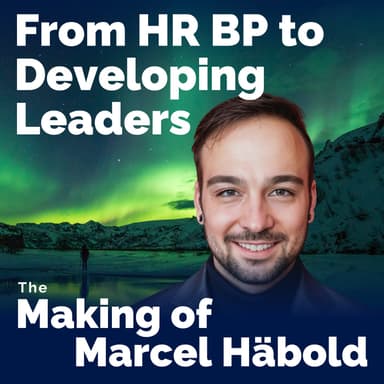
So we move on to presentation. And I see a night sky in a snowy, mountainous region, possibly in Scandinavia, and everything is magically illuminated by aurora lights. If you are only listening to this and not watching the video, you can probably see Marcel's image on the cover picture of the podcast episode.
Marcel, take us with you into this night sky.
Marcel's Aurora Experience
Marcel Häbold
That was a special night for me, and it happened in 2019. It was the first time my wife and I traveled to northern Sweden, above the Arctic Circle, and we got to experience the aurora for the very first time. I recall this night because we had been desperately waiting for it for another two or three nights, and it just would not appear, or it appeared but it was very cloudy so we couldn't see it.
And that night we decided to leave the hotel we stayed in and spend the night in the car in the woods. We drove off grid and found a nice place near a lake, in absolute silence, no one around us, no light surrounding us. And then we got to experience the northern lights, the aurora, for the first time.
I recall this very moment because it was so special. We spent four to five hours outside just watching. It was freezing cold, minus two or three degrees. And still we could not not look at the sky. That was really impressive.
And why does it describe my journey as a coach? It was the very first time I got to experience how small my concerns and worries actually are when I am in pure awe of a natural experience like this.
I got to feel very tiny. It does not play any role what my concerns are or what I am worrying about in this very moment, because this might happen either way, whether I am here or not, whether I am worrying or not, whether I am having my thoughts or not. I was just really happy to be part of it. That was a very mighty moment for me, and I could make use of it.
I transferred it to my career and also to my path of becoming a coach. Because every time feelings and thoughts get bigger than I want them to become, I just recall this very moment, and they are very tiny again.
Creer Background and HR Journey
Tobi
And back at that time you were working as an HR business partner. Take us a bit into your life. How were your life and your background looking at that time?
Marcel Häbold
I did an apprenticeship as a media clerk, and after that I headed into the HR department. Back in those days it was for a big media group called the Südwestdeutsche Medienholding, which combines newspapers and radio stations. I started as a junior HR business partner, and I also got my degree in economic law, business law, with a specialization in labor law, because that was what I needed to perform my job properly.
Tobi
So you had joined the Südwestdeutsche Medienholding, a media company. In order to become a radio moderator you joined after high school as an apprentice. Back then the whole media group was in a big phase of transition, having to reinvent themselves to a certain degree due to digitization and the media landscape changing, and you experienced HR as a department that drives this change, that has a creative job.
How did that evolve? And maybe you can also help us understand a bit what an HR business partner actually does day to day.
Challenges in the Media Industry
Marcel Häbold
Back in those days that was a huge change and a huge challenge for us. The subscribers to newspapers were dying out. There were no people who would subscribe to newspapers as a print edition anymore.
And at the same time, newspapers had always been displayed online for free, without charge. You could easily reach the website and get all the information without paying for it. So the big question was, how can we make users subscribers, how can we make them pay for the content they were actually using or consuming?
Joining in 2011, that was a critical phase. Where is it going? What is the direction we are heading into? It was very crucial. I recall that when I joined in 2011 lots of people were also made redundant, because their jobs would just not be necessary anymore in the modern world.
And at the same time you were desperately looking for people who could install or program apps, or deal with more IT-ish things, which had not necessarily played a role up until then. When I joined, HR was actually the driving force in embracing this kind of change.
So they would not just take care of all the legal stuff, writing contracts or making people redundant. They would also steer it towards solution orientation and try to figure out what the world of tomorrow could look like. That was really impressive to me, because I felt there is a huge power in shifting the perspective from, oh, this change is unfair,
my job might be at risk, what am I going to do, to a more positive perspective, saying it is a change which is necessary either way. It will come whether I am here or not. So I could make use of being here and actually drive this change forward proactively. And this is how I got to experience working as an HR business partner.
I really loved it. I liked it because I felt I could add value by helping people change their perspective and also see the good things in this major change.
Tobi
So you could help employees keep the vision in mind, drive this change and see the positive aspects of it.
Not only administering tough choices, letting people go, but also giving them a sense of security, and then optimism maybe, during those times.
Marcel Häbold
Correct. It was really about gathering or combining the powers that we had, and making use of the skills we already had. And then also, what is it that we need to develop for the future, to still fit the market.
Tobi
And how did that change throughout your later positions?
Marcel Häbold
It turned out that this was a really unique and really cool understanding of performing the role of an HR business partner. It was new, it was innovative back in the days. And it turned out that many other companies I then worked for were not looking for the exact same thing.
They would not necessarily see HR, and an HR business partner, as the driving force when it comes to creating a modern working world. So that meant I was then more managing people, writing contracts, writing reference letters,
making sure the time to hire is really low. That is more what I was doing as an HR business partner afterwards, and I did not like it that much, because I liked the creative part of the role.
Tobi
So the focus in your work shifted a bit from people to processes.
Marcel Häbold
Exactly. Correct.
Transition to Amazon
Tobi
And I had already learned that one of the last stops, and I think it was around the time you had this aurora night experience, was joining Amazon. That seemed promising, as I understood, because it was also a way of interpreting the role of an HR business partner at an American company. So how did that go? Take us into your Amazon journey.
Marcel Häbold
That was a short but very interesting journey for me, because at the same time it was the start of me becoming a coach. It was 2019, it was the aurora night.
I was on a limited contract back then, and my wife and I were very sure that we needed to change something about the way we live, because both of us were not as happy as we wanted to be. And then we learned in February 2020 that my wife was pregnant. At the same time I was looking for a new job, and it was clear that we also needed to break out of only looking for jobs in the area where we live.
So we would be ready to leave the place we live, to move and resettle. In this time I got to know someone from Amazon and we were in loose contact. Then one thing came to another and all of a sudden I was in this hiring process for becoming an HR business partner in Graben, which is in Bavaria.
That is around 200 kilometers away from where we used to live. The process went really well for me. There were four to five touch points, and the last one was a really intensive assessment center over six hours, performing in front of the boss of my boss and other country leads.
And I was offered a contract, so they really wanted me. They also suggested to me that there is no Amazon tomorrow without you joining us. They do really well in their hiring process.
They really give you the feeling that they need you and that you are the best. And it also turned out that in the hiring process they would of course shed light on all the great things that they do. Turning their processes green,
striving to become the first carbon neutral company in the world, zero emissions, zero waste. They would also highlight that they are building their own electric cars. So you really get the glimpse that you might be adding value not just for Amazon, but also for the planet and the world. And as I described, I was on my journey to become a dad for the very first time. You definitely think more and more deeply about what the world is going to look like when I leave, especially when there is someone on the way.
Tobi
And then how did those expectations turn out when you faced the reality at the company?
Marcel Häbold
They do care about their footprint, but it is not necessarily up to you as an HR business partner working in one of their fulfillment centers to do that.
Amazon Fulfillment Center Realities
Marcel Häbold
A fulfillment center you can imagine as a really, really large stock of items. You would have thousands, hundreds of thousands of items. They have everything there, from a football to healthcare things you can order online.
You can order anything, and that is a fulfillment center. They have a huge stock of all of these items, and they get the items, stock them, pack them if you buy them, and then deliver them out to the customers or to other fulfillment centers.
And the HR business partners are in charge of the different business units that operate on the shop floor, but also in the offices.
You help them make people perform, so to say, especially regarding low performance or no performance. That means you need to ensure that legally everything is correct if you want to make someone redundant. They are really eager for people to perform. So if you are having a bad day, you had better not have it twice, because that might lead to an end of your employment with them.
Tobi
And when you say make someone redundant, it means letting them go.
Marcel Häbold
Exactly. It means releasing them from their contract, and it doesn't matter whether it is a permanent or a limited contract. If Amazon wants someone to leave, then you leave.
Tobi
It also sounds a bit like, comparing this to your previous stations as an HR business partner, that previously you had worked with white collar office workers, helping them on a psychological level too, maneuvering change, staying optimistic, seeing opportunities. And now you were working with blue collar workers from potentially difficult backgrounds, being on the ground of the warehouse, on the shop floor, having to pack and send X amount of packages per hour. That is also a job that seems really easy to track. So you can really point your finger at performance and focus on that much more.
Marcel Häbold
Indeed. It was not the first time I was working with blue collar employees, but it was the first time it was that heavily performance orientated. And obviously they can measure everything.
They can measure how many items you stock in an hour, how many steps you walk. They can also see how many packages you pack, how hard you work, how many breaks you have. They have great opportunities to manage and display performance. And if you don't perform at all, well, it is a high performing company.
So you can either get yourself together and come back to a good performance if you showed it before, and if you are not able to do that, then that's it.
Tobi
And what did that environment do to you?
Marcel Häbold
It was kind of hard for me, because I can only speak from my point of view. To me this was always a black and white point of view: either you are performing, then you are good, or you are not, then you need to go. And I was used to trying to find middle ways.
To help people come back to their best performance, to the best versions of themselves. And if that meant I had to have a chat with them, or two or three, then I would focus on doing that, to keep them working for us instead of releasing them.
And finding someone new.
I was trying to take care of those cases in a personal way, the way I used to do it. And that was not required of me. Back in those days I could not see this, I could not understand it. That was finally one of the reasons, I am assuming, because I was not given feedback, why I then had to leave.
Defining Moments and Career Shift
Tobi
And what happened then?
Marcel Häbold
It was the end of January 2021, and it was towards the end of my shift.
I recall that my boss approached me and asked me if I had a minute for her to have a chat. And I was like, yes, sure, why not. So we went to those conference rooms, and there was this other site manager I had never worked with before, because he was not in my business unit.
So we would not work directly or closely together. And I was wondering, asking myself, what's happening? I entered the conference room. It was mid pandemic, we were all wearing masks, so you could just see the bare eyes of each other. And I recall my boss staring me directly in the eyes and telling me, Marcel, I'm sorry, but we have to make you redundant.
It's not working out anymore. And then she just gave me the termination letter and asked me to sign it, and I was completely lost. I did not expect that at all. It was as if someone pulled the floor from beneath my feet.
And then I tried not to cry or burst into tears. I tried to ask her for feedback. What is it? Why would you do that? And why couldn't we just talk about whatever it is that makes you feel it is necessary to make me redundant now, to kick me out?
And she would not share anything with me, due to legal pressure, because everything she shared could be used against her if I decided to sue them, which, by the way, I did. So she would not share feedback with me. She was just really professional, very distanced, having me sign the letter, pack my things, leave all my cards, permission cards and entry cards on the table.
And then I had to leave. That was the very last time I stepped into this fulfillment center. Then I drove home, and on my way back home, a ten minute drive, I was pretty okay. I was like, well, that's it, fine with me. And then when I finally arrived at home, I just burst into tears.
I cried all night long. That was a very, very tough night for me, but of course also for my wife.
Tobi
Thanks for sharing. I thought it was worth going into some detail on this HR business partner station, because it seemed a very defining point in your journey. I am wondering, how did it define you and your philosophy, your view of people development, going forward?
Marcel Häbold
In the first instance, after this incident, I would work for my own development and for myself, because I was at a point in my career where I had this huge responsibility for a little human being, for my daughter, whom I absolutely loved. I wanted to be there for her, to provide for the family and secure them in some way, whatever that means. And then I was laid off. There was no job, we had moved, pandemic. It was a delicate situation. So I really needed to ask myself, there was no other way.
What is it that you want? Because obviously this is the fifth or sixth business partner role you have taken over since Südwestdeutsche Medienholding, and you are not happy. That was the first time I really let myself say this to me. You are not happy.
That's not what you want to do. It is a hard thing to say to yourself if you built your whole career on this path, because it means that everything you built up so far needs to change. And first of all, that makes you very, very terrified of this step, of this transformation.
Becoming a Coach
Marcel Häbold
So what I did is, I looked for a coach who could help me through this. And I found myself a really, really good coach, and I could cope with all of the thoughts and things that were happening inside me, and I could successfully create the start of the transformation I was then heading through.
And on this way, while I was doing my very own coaching and aligning with my own thoughts and wishes and fears and everything that I feel, also dealing with my emotions, I learned that this is one of the core things I can add value with, not just for myself or my family, but maybe also in my professional life.
That was the first time I thought about becoming a coach myself. And then I decided to do a training. That was the starting point of my journey.
Tobi
What was that training like?
Marcel Häbold
I did a coaching training because I wanted to become a coach myself. It lasts over two years, actually 18 months, but I needed to prolong it a little bit due to father duties, so to say.
So I did it in 24 months. It was a hybrid setup. There were onsite meetings with peers and lots of practice hours, but it was also remote, so you would have some remote calls preparing you for the next section. It was called psychological consultant and business coach.
That is what it is called. After two years I finished it and got my degree, so to say, as a coach. You are probably aware that there is no literal degree you can get in coaching, but I did my certificate. At the same time I found a new role as a psychological HR consultant, and this is when I started to work for A Train and got to experience what the consultant life is like.
Tobi
So I understand you did the coaching education on your personal initiative, in your personal time. And then at the same time, after Amazon, you were looking to transition into HR consulting. So going from this HR business partner role, which to a certain extent joins a company for their own mission and contributes towards enabling those people to fulfill that mission,
then going into consultant shoes and also changing the way you saw yourself and your role in the world.
Marcel Häbold
Absolutely, that's correct. In my coaching we would use the sweet spot model, talking about strengths, about motivation and about possibilities, and then finding the sweet spot where you can perform your best.
And while doing this, consultancy was one of the possibilities I worked out for myself, which could be a fit for me, shifting from being an HR business partner but keeping the knowledge I gained over the years, and then adding value in a different kind of way.
And this was when I got to know A Train, I was introduced to them. It was really great, because I had the feeling that they operate on a very psychological level. I would definitely have a gap of knowledge there, but what I do have, coming from business, is a good business acumen, knowing how big companies function, how decision processes work and how to approach them.
And I had the feeling, or both of us had the feeling, Adrian and I, that this is a good fit, because I was then offered a contract. So I started my journey with A Train, from the point of view of what is it that I can add, how can I add value.
And I found myself shifting from adding value to a company I am employed at, to adding value to human beings who work for a company. My direct contact point is not necessarily the business or the company anymore, but the people. This is where my focus shifted from serving the business to serving the people who work for the business.
Consulting at A Train
Tobi
Can you take us a bit into the business of A Train? I guess there are many HR consultancies. Who are the clients, and what are the problems they approach A Train with?
Marcel Häbold
It is probably more complex than I describe it now, but you can say that A Train basically performs in two business units, or two business approaches.
On the one hand they offer a great assessment center and development center experience. They lead or manage companies going through those centers and help people to develop, to acknowledge their strengths but also their areas of development, and then provide them with concrete steps on how to develop further. And on the other hand they do a great range of transformation consultancy.
They help companies to transform themselves holistically, from the very start to the very end, if there is an end in transformation. That is what they do.
Tobi
And I guess you could connect to that on two levels, right? Because you had experienced, for example in the media group very early in your career, an industry and a company going through this sort of transition that HR, that A Train, and now you as an HR consultant would help other businesses go through.
And secondly, you had also worked in recruiting as an HR business partner. You had probably taken part in, seen and scheduled an assessment center to select talent, to select new leaders. And both of these things you were now doing from the other side of the relationship.
Marcel Häbold
Exactly, that's correct. I had good experience in performing those assessment or development centers, and I also had good experience in performing those transformation changes on a process level, but not necessarily on an interpersonal level. And it was also A Train who introduced the model to me that in order to create a successful transformation, you first have to transform yourself, because there is just no way to transform or change the environment
and then have the environment change you. It is actually you who needs to change first, and then you can change the environment. Because if you don't change your thoughts, your mind, your habits, your patterns, then you will always find a way back to what you used to do. I found this to be really impressive.
I worked three years with A Train, and it was a great time for me. I recall it as really, really great.
Tobi
And what did your day job look like?
Marcel Häbold
I was a senior consultant. We operated in self organizing teams, so there was no hierarchy within A Train.
That means we were also responsible for managing our customers and managing our costs as a team, and for adding benefit on a monetary level. So as a senior consultant I would work closely with customers, performing on site and off site with them, but also maintaining the relationships with them.
But I would also take over a kind of leading role within the team, to see if everybody is developing, if we are heading towards being beneficial to the company, or if there is something we need to do if there is a discrepancy between the money we take out of A Train and the money we bring in.
And that was my role.
Tobi
Interesting. That reminds me of the Buurtzorg story, the Dutch caretaking company, where social workers would work in these self organized teams, managing themselves, managing their schedule, working towards the client.
Is that the model you also followed?
Marcel Häbold
It is exactly the model we followed. It was like being self employed as an employee.
Tobi
So would that mean you would also really look at your own numbers as a team, see how much revenue you bring in and what your salaries are, and then make your own profit and loss calculation?
Marcel Häbold
Halfway yes, halfway no. We had salary bands, so there was a bandwidth, and we knew who was within those bands. There was not full transparency about the salaries. But we could tell how much cost we add to A Train, and then we would also see whether we can get enough revenue to cover it ourselves.
Because if not, then you are dependent on other teams overperforming. It was actually a cool way to foster collaboration within the team, but also to foster competition between the teams.
In a healthy kind of way, I would say. It was not unhealthy.
Tobi
Sounds great. And at the same time, we already said you knew the transformation side in some way from experience, and you knew the assessment center business in another way. What you were developing at that time, I guess, was your coaching abilities, your consulting and facilitation abilities.
How did that work? Doing the coaching education, working on the job. What would you say were your most useful learning grounds at that time?
Marcel Häbold
Coming from being an HR business partner, transformation or change projects would mostly mean negotiation with the works council, presenting the change to the employees, to the staff, being in that kind of role.
And now I would shift towards helping others. So it is actually facilitating, helping others to find the best possible solution themselves, creating the room for them to use their full potential to create the best possible solution and outcome. And that was completely new to me.
I had an idea about how transformation was created, or how you would perform a transformation from the HR point of view, but I had never enabled a group of leaders to find the best possible solution, to create a safe space for them. This is what I got to learn, really closely and deeply, from the other senior consultants working for A Train.
And then of course also being able to directly and immediately apply things I learned from my coaching education. Doing the facilitation and enabling leaders in this scenario, you can make a lot of use of what you learn to become a coach. It is all about active listening, paraphrasing, really crystallizing and sharing back what you are hearing to check whether it is correct or whether there is a misunderstanding in the room, and also acknowledging emotions, how they feel, whether they
act and talk the same way, or whether there is a difference. So you could definitely make a lot of use of the coaching education.
Lessons in Facilitation and Coaching
Tobi
If you look back now at this learning journey, what would be your advice for aspiring coaches, maybe working in HR nowadays, maybe in your previous shoes as an HR business partner or in similar roles, who say, okay, I want to become a coach. Would you say stepping from operational HR into an HR consulting role did help you?
And if yes, what would be your advice?
Marcel Häbold
Of course it helped me, and it also hindered me. So it is both stories. It helped me because I got to experience negotiations with leaders and with works councils. I had the seniority level that enabled me to operate with the leadership teams on the other side.
And it hindered me, because being an HR business partner also required me to be the professional. When you become a coach, it is actually the coachee who is the professional, and you just help them enable themselves, creating the room, as I shared. That was a huge learning for me.
My self assessment is that I appeared more like the trainer, who tried to tell people how to do things. But that is not really the task you have as a coach. At some point in time, of course, you can close the room and be more divergent and convergent, but not from the very start.
I had to learn this, because I really used to try to tell people what they should do. And that is just not correct when you become a coach. So my greatest advice, if you are on your journey to becoming a coach, is that even though you might resonate with all the things people share with you, or clients share with you,
try to hold your breath a little longer than you probably do, and let them find solutions themselves. Because if you manage to stand the silence that might appear, what happens afterwards is a mighty moment.
If everyone is quiet for a while, or if your client is quiet for a while, that is a thinking process taking place. And if you don't disturb it, it is really mighty.
Tobi
So getting from telling to listening and asking. Thank you.
I would like to understand a bit better how you applied these learnings, telling less, asking more, listening more, in your day to day work. Can you get us into that room with a client? What did that look like?
Marcel Häbold
I remember working with an industrial company.
They are located in Baden-Württemberg. They had a new HR lead, and this new HR lead wanted to transform the HR team, because they really worked as HR managers, writing contracts, writing reference letters, and he wanted them to become a bit more the creative part, and at the same time to divide them into units.
There is the service center for writing the contracts and the reference letters, there are the business partners who support the business in growing and scaling and performing, and then there are maybe also the HR development people who think about which classes we can offer and what development we need to do.
And as an HR business partner who did this for many other companies in different roles, I had a very clear understanding of how you could do this in an easy and efficient way. So from my point of view, being hired as a consultant to help them get there, I was adding ideas and ideas and ideas,
due to my knowledge. However, at the end of day one, it was a two day offsite that I had with them, I learned from the new HR manager that he acknowledged what I knew about how to set this up, but that he would also require me to add fewer suggestions, because he wanted
his people to get into this thinking process, to make it their very own idea, and not have someone present them the solution. Because that is what I mean with inner transformation and outer transformation. You need to transform yourself. If you don't do this, then you will find ways to go back to what you used to do, because it is not your transformation.
It is someone else's. I recall this as a really hard night for me, because it was critical feedback and I didn't like it at all. I wanted to feel acknowledged for what I know, and I also wanted him to be happy. However, it turned out not to be that good.
I really took this with me. I recall that night I did not sleep, maybe two and a half hours, because I was thinking about how I am going to do the next day. What am I going to do? I would shift the agenda and think about what I can do so that they are happy.
And then I finally recalled that one other senior consultant would have the team put the agenda together themselves. In the very beginning he would just present a timeframe and say, what do you want to do today? What is it that helps you the most? But I had never done that. I had no experience with it.
So I put together a timeframe, and the next day I just asked, what is it that helps you the most today? What shall we do?
And they put it together. And then it was my task to manage the room, to have them concentrate, and to listen to what they are sharing with each other. What is it that they are actually sharing? Is there something behind the things they say?
We tend to put something in front of our initial concern, to not let this happen to others or to ourselves. And that was immediately my job, to listen to them, to really get a glimpse of whether there is a concern behind it, or an emotion behind it.
Are we talking about the same thing? Does person A understand what person B says or not? It turned out that I could do this, thanks to my coaching education, better than I thought I was able to. From my own understanding I was still not super happy with the outcome of the day.
But the new HR boss was happy. He was really happy. He told me it was an absolute improvement on day one. And I was super grateful and thankful for this experience. Coming from the comfort zone, being put into the panic zone and then coming back to the learning zone. It was a good experience.
Tobi
You were on the client side in a room with the HR team for two days. And in a way the challenges they were facing were the challenges you had faced many times as an HR business partner as well. So you had been in their shoes, you were the best expert they could get.
And on day one you also showed that and contributed with your expertise, with your previous experience, bringing in suggestions, doing a great job from your perspective, I guess. But then you got the feedback: you need to shut up more, we want to create our own thing. That gave you a tough night, and on the next day you were able to step into the listener role, as you shared.
And then being able to listen. What are your goals? How do you phrase them? What are the words you use? Then also being able to keep those in mind instead of your own agenda and ideas. And that enables you, I guess, to remind people of their own goals when they go off track in a conversation, to hold them, to hold the space.
Is that it?
Marcel Häbold
That's absolutely it. Talking about this retrospectively, there were two things I tried to protect. First of all, I wanted to be secure. I didn't want anyone to tackle me in a way I could not foresee or manage.
The second thing is ego. I wanted to protect my ego, because I wanted to be seen as a professional who knows it all. But that was just not required of me. It was a tough process for me to understand, but I finally did, and then I could help them get where they wanted to head.
If I could not have let this go, if I had not received this feedback, I would probably have kept on performing the way I did on day two as well. And that would probably have led to a customer who was not that satisfied. It was a hard situation, but it was a valuable experience, because I can make use of it.
Tobi
Letting go of your ego and this wish of being seen as the expert consultant who knows it all, going into this insecure space of the listener, of the coach, in fact that enabled you to build a happy client relationship and a successful facilitation day.
Marcel Häbold
Exactly. That's it.
Leaving A Train: The Journey Begins
Tobi
So this was transformation work, facilitation at A Train. I think when I met you for the first time, you were about to leave A Train a few years later. How was this journey, and what sparked you to eventually start your own practice as an HR consultant, leaving A Train, leaving employment? Continuing the path from being employed at a company that has a certain mission and a certain product, to an employed consultant who supports other companies in fulfilling that mission, serving the product.
And then eventually starting your own practice, your own company, offering this kind of service. What prompted this transformation?
The Decision to Become Self-Employed
Marcel Häbold
I think the initial thoughts I had towards being self employed and running my own business came when I started my coaching.
The coaching that I did myself, because I figured out that I wanted to shift from being employed to becoming a consultant who can add value and help people grow, discover their potential and live to their full potential. And I knew that I wanted to do this in my own business.
From the very start it was just not possible for me to do it, because I was also a dad with a young daughter, providing for the family. So there was still this urge in me to also give some security to my family, to make them feel secure, because it is my responsibility now.
I don't know how to put this into words, but once you become a parent the way you see things completely shifts. It is unimaginable how much transformation happens when you have a child, and how much more deeply you think through processes or actions.
I knew that I wanted to start this business when I did my coaching, but I could also see that there was still a gap in experience and professional skills. So I had to look for an opportunity to develop and grow myself.
And with A Train I knew that this could be a really great opportunity for me.
When I started and got to learn the processes, how they work and the people, they have incredibly intelligent people working for them. This is also when I met Max, and he was partly self employed when I got to know him. He was my mentor, the very first point of contact I had at A Train.
And he runs a cool business. I don't know if you have heard of it before. It's called metaFox. So this is when I got to know him, and he also introduced me to the idea of being self employed in a more detailed and more precise way. But I needed this step. I definitely needed this step.
I needed A Train to become who I am today. If I had started being self employed right away it would have been way harder for me than it is today, because I got to experience the system they operate in, and the psychological way of the transformation business.
And I got to experience that Max was already leveraging being self employed and could provide me with inside views. What is it like to have a company behind you? How can you pay a salary? What else can you have running over the company, and things like this?
Things you cannot necessarily talk about with someone if you don't know someone who has it. So it was planned from the very start at A Train that I would be self employed one day. It then happened in the third year of being employed there, because of the great context and possibilities that I had, showing me a way to do this on my own.
Tobi
So if we look back at your journey so far, Marcel, and try to connect the dots, what I see is that you got into HR as an apprentice. You learned the craft of people work at the business. You took that experience and transitioned into a consultant and coaching role, also collecting all that experience of being in a room with a client and actually experiencing that I can add more value if I don't immediately share my expertise, but
I listen, I ask, I am vulnerable. And I guess that vulnerability also fostered the courage to be brave enough to transition one step further and do this on your own. How did you do that?
Marcel Häbold
It was a combination of things that happened.
I really grew with the idea to start my own business and try to do things on my own. There is a difference in the legal entity.
It is a limited company, but from a legal point of view they are pretty much equal. It is just that you don't pay as much Stammeinlage as you would for a GmbH.
Starting the Friluftslove UG
Marcel Häbold
So I founded the Friluftslove UG in March 2023, when I was still employed with A Train, because I got to know a lot of people and was introduced to some possibilities to perform gigs and jobs.
On my own business, so to say. But I could not earn money with it, because in the German tax system it is just not good to earn good money besides your main job. So I founded the company to create this legal entity, so that the legal entity can earn the money and not pay me out.
Just maintaining it. And then, when I had the UG, I started to perform two to three gigs, transformation workshops. In one of those transformation workshops I got to know another consultant, and he introduced me to another company that was providing lots of assessment and development centers to customers all over Germany, but also internationally in the EU.
And he arranged a conversation between one of the founders and myself. One thing came to another, and I did a short assessment for them. They assessed me to be a consultant who could perform in a partnership with other customers. And then it was a really concrete starting point: now I am ready to leave A Train.
Not necessarily having my own customers, but due to this partnership and two other partnerships I could already deliver services to customers and earn money with that. So this was a smooth way for me to head out of the employment contract and be self employed, because of the partnerships I had.
Tobi
So while you were still employed as an HR consultant, you started your own limited company and actually delivered your first services, had your first gigs as an HR consultant, facilitating transformation workshops. So work that is quite similar to the work you would have done with A Train otherwise.
And that enabled you to take the step further and say, okay, now I actually leave A Train, where I learned the craft, and start offering that craft together with other partners, as a self employed consultant with my own legal entity.
Marcel Häbold
Exactly. It is kind of similar to the start of my career, right?
When I tried to become a radio moderator I started an apprenticeship in a media group that also has radio stations, so getting close there. It was the same with A Train and then my very own business. I started with A Train because I knew this would benefit my personal journey of growth
and enable me to later do what I was actually striving for, which was becoming self employed. And then I saw the opportunity to do it in a good way, so that my family and I would not be in a situation of zero income, because it was just me working. My wife delivered in 2023, and I would become 100 percent self employed in January 2024.
That means she was not working, she is not working. So there is no income from her end. It is up to me to be responsible, to earn and provide for my family.
Current Business Focus: Assessment and Development Centers
Tobi
Let's now look at the business you are doing nowadays with your own legal entity. From what I learned, this is assessment centers, helping companies to select talent.
Can you take us a bit into that problem space? What kind of companies are your customers, and what are they looking for?
Marcel Häbold
Yes, absolutely. And it is also development centers, which are pretty much equal to assessment centers, but I will explain that in a minute. An assessment center is a possibility for candidates, for potentials, to show their skills but also the areas of development they bring when they join a company.
Most of the time you have a company offering a concrete job role, and there are candidates applying for it. After one or two instances, like a phone interview or a personal interview on site, they would be required to perform this assessment center. And this assessment center is completely moderated and facilitated by external companies.
For instance, I have a really great cooperation with a company called Profil M. They are really advanced in offering those assessment centers and development centers.
They are really experienced, they have great knowledge and they are established. They have a huge range of customers already, and I cooperate with them. That means whenever they receive a request for someone performing or moderating an assessment center, they reach out to me and ask if I have time.
Would you like to do this or that? And that means I go to the companies and perform and moderate those assessment centers.
Inside the Assessment Center
Tobi
So can you take us into the assessment center room? What does an assessment center look like, and who is in that room on this day?
Marcel Häbold
It is a variation of people. Most of the time it is the candidate and myself as the moderator, the facilitator, and then there are observers. Those observers can be from the business, they can be the hiring manager, they can be an HR business partner.
It depends on what the role is and who is involved or affected by the hiring. And in this assessment center there is a variation of exercises the candidate has to perform. Most of the time it is three to four exercises, and it always starts with a prepared presentation, so that the candidate can come with a presentation they were able to prepare beforehand, to gain some security and to arrive in the situation and in the day.
It is also linked to a short question and answer session afterwards. So they present for 15 to 25 minutes, depending on what they are asked to do, and afterwards the observers, myself and the other people in the room except the candidate, can ask questions for a certain amount of time.
That would most likely be exercise number one. Then the second exercise, and it also depends on what you are looking for, can be a case study. Sometimes you need to understand how able people are to navigate through complexity, to deal with a huge and complex amount of data in a short amount of time and maybe derive a strategy from it.
Then you would use a case study. Sometimes it is more like a team speech that you hold in front of your team, which is then represented and played by us as the observers, to see what their focus is and how they would position themselves, maybe as the new team leader. So that could be a variation.
It always includes an interview. In the interview we really dive deeper into psychological behavior and try to derive behavioral patterns from candidates. For instance, we would ask questions like, have you ever received critical feedback? If so, why do you consider it to be critical, and what did you make of it?
Another question I like to ask people who are becoming a team leader is, what is your definition of potential, and how can you detect but also embrace it in your employees?
Tobi
What strikes me about these questions is that you drill in on actual factual behavior.
So you ask what happened in the past, and you don't ask how would you behave if X, Y, Z happened. Is that right?
Marcel Häbold
That's correct. We try to make it very unartificial. We really try to make a use case out of it. What is it that you experienced already? And in every question we also try to see how much
ability they have to reflect on themselves and on their behavior. Do they address and acknowledge emotions? Can they derive certain behavior from the way they felt? And do they maybe know how to manage it already? Is there an ability for them to steer their behavior, or is it more impulsive?
Tobi
I see. So that means as a candidate I start with a presentation I could prepare at home. I feel secure, I feel confident, because this is the part I was able to prepare and think about before. That is step one. Then step two, I get another exercise, some form of case study or impromptu speech maybe, that I need to deliver.
I guess I also get a bit of preparation time, do I?
Marcel Häbold
Yes, absolutely. Because after each of the exercises there is an evaluation. The observers and I discuss what the strengths were, what the areas of development were and how we evaluate the candidate. In this time they can prepare themselves for the next exercise.
So it is most likely 20 to 75 minutes. For a case study it is longer, up to 75 minutes, but for an impromptu speech or for the role play it is 20 to 25 minutes.
Tobi
So I get to leave the room while you talk about me as a candidate. And I guess different observers in the room take different focus points. Naturally you as a consultant probably look more at the interpersonal, behavioral aspects, while maybe the hiring manager, the boss, looks more at the content of the presentation.
Does this guy, this girl have a good grasp of the business, of the problems we are facing? And then eventually we go through that interview. What is that role play part about?
Marcel Häbold
I love role plays. Role plays can be a variation of setups. It can be with a hierarchical dependency.
It can be on the same level. It can be between competing business units. It is really up to the role that we are assessing at the moment. But most likely it is either you talking as a team lead to your employee, so a hierarchical dependency, or you are on the same level, team lead to team lead for instance, or even above, and you need your conversational partner to change their behavior in order to progress on a goal you have.
But they would not do it, for many reasons. In this scenario you have pretty detailed instructions. There are fake names, fake ages, fake family background information. They get to read through their instructions, and I as the moderator get to prepare for the role I am playing.
And then we really dive into those role plays. And it is astonishing. It is an artificial situation, but the speed at which candidates can really dive into it is insane. They manage to accept the situation and take over the role they are playing very fast.
Tobi
So that means, me as a candidate applying for a position and you as a consultant, but acting as an actor who is also a colleague of mine, we step into this artificial scenario and play out how we would behave. And then I as a candidate am observed by all these people observing.
Marcel Häbold
Exactly. However, it is also fair to mention that we really mimic a one on one situation. In a remote setup the other observers would switch off their microphones and cameras, and in a face to face setup we would sit in a room so that the candidate does not see the other observers.
Tobi
So it feels to me that we are on our own on stage, and the audience is somewhat in the dark.
Marcel Häbold
Correct. It should be a one on one situation.
Role Play Scenario: A Practical Example
Tobi
Interesting. Can we actually try that for five minutes?
Marcel Häbold
Sure, why not.
So, you are my new boss. You are my new team lead. You joined recently, a couple of months ago, and I have been here for five years. And you recognize that my performance is getting lower, so something is odd. Now it is up to you to find out what I am struggling with. You overheard people on the floor talking about me, that I am not identifying with the new course of
accepting customers, internal customers. Marketing can be an internal customer, or HR can be an internal customer. We are working in the IT department. You and I are working in the IT department, and you overheard people say that I do not acknowledge that we have internal customers. And also that I had a fight with the HR head, because he was really
mad that the internet was down, and I fixed the bug but I did not tell him it was fixed, or did not tell them at all that something was wrong.
Something was going on. And now it is up to you to share the feedback with me that in the future I need to let them know what is going on. I need to pick up the phone and call them and say, hey, I detected there is something going on with the internet, I am already looking for the mistake, and I will let you know once we are there.
Right. Okay.
Tobi
What's your name? And what's my name?
Marcel Häbold
It's Peter. I'm Peter, and you are Dan. So give me a sign when you are ready, then I can go into my role.
Tobi
Okay. Hi, Peter. Thanks for making time and stopping by today. How are you doing?
Marcel Häbold
Yeah, I'm fine, thanks. How are you?
Tobi
I'm also good. As you know, I have only been here for a few months. So I really wanted to have this chat with you and understand a bit how you have been doing, because earlier today I got to talk to Chris from HR and he seemed quite upset.
Has anything been going on with you and him?
Marcel Häbold
I knew that this was coming. It's HR. They are super annoying and they think they are the center of the world. They are annoying. That's what's happening.
Tobi
What exactly happened from your perspective?
Marcel Häbold
What happened is that I tried to fix the bug that was putting down the intranet. And that's how grateful they are, talking about me behind my back.
Tobi
I learned from Chris that there has been an issue, and then all of a sudden it was up again, and he seemed a bit unhappy with the communication between us and them. So can you let me know exactly what was going on?
Marcel Häbold
I don't know what's happening in there. I cannot tell you what's going on, because I don't understand it. When I started work two days ago I realized that something was wrong with the internet, that it was down and that people could not make use of it.
So I immediately started looking for the error and fixed it eventually. I found a really quick solution, thanks to me diving into it and trying to grasp what was going on. I could find it and fix it. And now Chris is telling people how unhappy he is about me not communicating.
I mean, it was absolutely clear that the internet was working again.
Tobi
I'm not sure if he is all over the place. I just happened to run into him over lunch. It's great that you were able to fix it that quickly.
That's good. Has something like that happened in the past also?
Marcel Häbold
No.
Tobi
So how come you talk about Chris and the HR guys like that? Is there some history that I should know about?
Marcel Häbold
There's no history. It's just that I don't understand why we would empower them the way we do now with our new direction of internal customers, because that is exactly what they do, they behave like customers, they behave like they are kings. There is absolutely no acknowledgement for what I have done so far, or for how the intranet was set up. It's just talking behind backs, and I'm not willing to do this anymore. I don't want this. I'm an IT guy. I don't want to talk to people. That's not what I signed up to do here. I signed up to make systems run, detect errors and fix bugs, not to talk to annoying people like Chris.
Tobi
So what I hear is that you would want more gratitude, because when I just acknowledged that you fixed the bug so quickly, you also seemed happy about that.
So maybe that is something Chris and his guys and girls could also do more often. Should we maybe pass that message on to them? How would you feel about that?
Marcel Häbold
I mean, you're my boss. You should do this. Definitely.
Tobi
Okay, I can take that with me. And what could we do to make your situation a bit more productive, so you can find your sweet spot and be happy with what you do?
Marcel Häbold
I found it. It's just the new direction. I'm absolutely not happy with this. I do not want to talk to customers, whoever they are. I don't care if they are internal or external. I'm here to fix systems, I'm here to do IT things, not to do this customer relationship management, whatever. I don't want to do this.
Tobi
So what do you find most meaningful in your day job?
Marcel Häbold
I think I already shared this with you. It's working on the backlog. It's doing the IT things, heading into the system, creating the firewalls, eliminating bugs. That's what I want to do.
And that's what I've been doing so far. My previous boss was absolutely happy with me doing this. And now I need to talk to people and listen to the garbage they are sharing sometimes. I'm not willing to do this anymore. That's just not motivating for me.
Tobi
So, talking about internal customers, one way I might be able to help you is to be a service provider for this communication aspect, I guess.
I can do that to some extent, but probably not every day, because we don't get to speak that often. Do you have other ideas? How can you get help with this communication job that you don't like?
Marcel Häbold
No, I just don't want to do it.
Tobi
And are there other people in your team who could maybe help, or is there a way you could share these different roles?
Reflection and Feedback in Assessment Centers
Marcel Häbold
Maybe we stop here and do a short reflection. Based on the conversation we just had, how do you feel in this moment?
Tobi
Nervous, I guess. I want that job, or do I? And I was a bit unsure about the context and about my own goals in my role. So to what extent can I also just please him and be okay and come up with a solution for him.
I'm not sure whether in an actual assessment center I would have more information on that. And that would also possibly be uncomfortable for me, because then of course I cannot just please Peter. I also have to deliver uncomfortable news, I guess.
Marcel Häbold
I was about to say, most likely yes, there would be more information.
However, I now tend to say no, actually no. If you are applying for the team lead role, this could be a good scenario, and as a matter of fact this would be the amount of information you get. There is a demotivated employee and you need to find out what is going on with him.
He was motivated under the person performing this role prior to you, and now it changed, and you initiated the strategic change towards acknowledging internal business units as internal customers. Based on this amount of information you would start. There would maybe be more information about how he behaves in breaks, that he is sitting all alone, that he is not talking to his peers anymore, things like this. But as a matter of fact, that's it.
And based on this and on what you just shared, that you were uncertain about what your goals were and what you can do. You said you were unsure about how much you can force Peter into performing what you want him to do, and on the other hand how much you can be pleasant and try to maintain the relationship. What kind of behaviors do you see behind those two options?
What is behavior one, forcing him, and what is behavior two, being pleasant?
Tobi
I guess to some extent my own struggles as a leader shine through here, to the extent that I am not always as clear as I would need to be when talking to people, because I also have this need to be liked and to deliver only the good news.
And I guess that is a bit of what was coming through here in my conversation with Peter.
Marcel Häbold
Yes. And it is a tension between being solution orientated, goal orientated, and being relationship orientated, people orientated. That is the tension we are dealing with. And this is a pretty fair tension that most leaders struggle with. There is some goal you need to reach somehow. You need to make him perform again, you want him to perform again. And at the same time you also feel the urge to understand him and create
the room and the space for him to share what is going on within him. And it is fair to mention that in those role plays there is most likely no hundred percent solution you can reach or derive. It is more that we want to observe the behavior you show us. So if you are over-pleasant and just say he can do whatever he wants and he doesn't need to talk to customers,
that could mean that you easily give in and do not necessarily stand your ground and defend the business, defend the company. And on the other hand, if you were extremely hard and tried to force him into the behavior you want him to show,
then this could mean that you might be risking losing people in order to maintain your own goals and reach them, and that could be a risk for the company. It depends on which department we are talking about and what the other layers of complexity are, but in this scenario we could really observe the behavior you show us.
And then there would also be a reflection afterwards. What I did with you, asking you how do you feel. Other questions would be, what was your goal, how much did you reach it, what prevented you from choosing another way. That would also be part of a role play. I would literally ask the candidate right after the role play those kinds of questions, to see, if they did not make good progress, whether they can understand why.
Is there a certain ability to reflect on it, and do they maybe instantly see another possibility, or a key moment in which they could have decided to do something else to drive the conversation in another direction?
Tobi
It was surprisingly intense, I have to say. I guess if I could do it again I would talk more about this service attitude and customer attitude, which, as I learned now, I initiated. I could see myself conveying this mindset that all of us are service providers.
Also I, as Dan, am a service provider towards Peter. Peter is my customer, Peter has customers in the HR department. And maybe see if I can find a way to help Peter understand that, because that is actually what I genuinely believe in, both as Dan and as Tobi, I guess.
Marcel Häbold
It was Dan. It was Dan and Tobi.
Tobi
Yes. Interesting. So, let's be Tobi and Marcel again. I'm wondering, what would you look out for as a consultant? What is good, and what are red flags, or which kind of behavior are you looking for?
Marcel Häbold
That's a good question. I shared with you the tension that we have within this role play. If there is a tension embedded, I would always try to figure out in which direction he or she tries to go. What is the comfort zone?
What is it that they try to make progress with? And on the same hand I would also look at how authentic they are. Sometimes they mimic being the heart-led leader, but they are actually not. And you can really tell, because they don't make any progress with it.
And on the same hand you see dysfunctional behavior, where the body language or the facial expression does not really fit the words they are expressing. This is also something I am really looking at and observing.
And then finally, last but not least, the ability to reflect on this.
How do they assess themselves? Was there progress? Did they reach what they wanted to reach or not? What was the turning moment? Was there a key moment? Do they acknowledge it, do they recognize it or not? Those are the things I am really looking for, and then trying to put at the center of the evaluation with the observers afterwards.
Tobi
So that is what you are looking at. I can really see how this helped me, how I learned something from even this five minute experience.
Development Centers vs. Assessment Centers
Tobi
So how would a development center look different from an assessment center here?
Marcel Häbold
Basically it is pretty much the same. A development center can also be a variation of exercises.
The only real difference you can spot is that in a development center it is not about getting a job. It is purely about having a glimpse of your development, of your growth. What is it that you can develop? Where are you in your journey of becoming a leader, or becoming a greater and more experienced leader?
So this is the only real difference between an assessment center and a development center. An assessment center is linked to getting a position, a job, and a development center is a pure focus on your development journey.
Tobi
So the structure would be similar: presentation, case study, interview, role play.
Marcel Häbold
Just yesterday I arrived back from a two day development center offsite for a customer. We had three development centers, and they would start with a presentation. There was an interview linked right afterwards.
Then there are two different role plays. One has a hierarchical dependency, one is without. And then there is finally a self assessment, a reflection exercise in which we have them reflect on what was a good performance and what is an area of development. Afterwards there are 45 minutes set for feedback,
in which I would share my observations about key strengths, key areas of development, and also possibilities for how to build them up.
Tobi
And when you say there were three development centers, that means three people joined as participants and each of them had a one on one experience.
Marcel Häbold
Each of them had a one on one experience.
That means Monday morning, Monday afternoon, then Tuesday morning, and Tuesday afternoon was all the feedback, for candidates one, two and three.
Tobi
That's a big investment in people.
Marcel Häbold
It is. And you have to consider that this is only the starting point for their development journey.
Because with the observed areas of development and the shared feedback, the common understanding of what I as the candidate need to work on, they start their internal development journey.
So it is a huge investment from this company in their employees. It is absolutely great what they do there.
Tobi
Nice.
The Role of Partner Companies
Marcel Häbold
For instance, I have a really great cooperation with a company called Profil M. They are really advanced in offering those assessment centers and development centers.
Whenever they receive a request, they reach out and ask, would you like to do this or that? And that means I go to the companies and perform those assessment centers.
Tobi
What you just mentioned is also interesting, because it sounds like you are using another partner company for your client acquisition.
So you are working with an intermediary between you and the end client. Is that correct?
Marcel Häbold
That's correct. They have a huge network, established over years. They have really great competencies and they operate on a model where they have a little team of permanent staff
who maintain the customer relationships and ensure the processes flow smoothly. And they also have this pool of external, freelance facilitators they contact. Since they operate all over Germany, but also internationally in Europe, they would call me if they have customers in southern Germany, because it is easy for me to reach Austria and Switzerland too.
That is the way we collaborate.
Tobi
So from their perspective it is great to have you, because you are not a continuous cost on their personnel balance sheet.
And at the same time, when business is going well, they can call you up and you would take over the work.
Marcel Häbold
Correct.
Tobi
Interesting.
Financial Aspects of Freelance Consulting
Tobi
And would you say that is a model you can recommend to freelance coaches and freelance consultants starting out, partnering with someone like Profil M or possibly also A Train, and going into this role as a freelance partner? What are the ups and downs you see in it?
Marcel Häbold
I can definitely recommend it, because it provides you with some security.
Of course there is no guarantee that Profil M will be blessed with lots of requests all the time and forever. However, I can definitely recommend it for the very start.
Because it takes pressure off you. You trade in some security, because if business is not going well for your partner company, then you might also end up without any jobs.
Tobi
But at the same time you probably earn much more than if you were employed at such a company, because you are paid on a daily basis, based on the results you deliver.
Marcel Häbold
Exactly. At the very beginning you can really concentrate on the service you provide, and you don't necessarily have to concentrate on building up customer relationships, or on how to advertise yourself.
You don't need to deal with it, so you can concentrate on the content.
Tobi
So a great model for any coach and consultant who doesn't want to do their own marketing, because there is another partner doing that for you.
Marcel Häbold
Correct.
Tobi
So let's talk money for a minute. How much can you charge for an assessment center in your current role?
Marcel Häbold
That's a fair question, and it is probably very interesting for anyone thinking about this path. There is a variation of rates, and it also depends on the companies you operate with.
But I can tell you that my daily rate is between 1100 and 1500 net per day.
Tobi
And that includes preparation time?
Marcel Häbold
No, that does not include preparation time. This is pure performance. If I am performing an assessment center, which is a day, then I charge one daily rate. And if there is preparation, or maybe also post work, then I charge that additionally,
at the same rate. So this could lead to charging 1.75 daily rates for a one day assessment center, for instance.
Tobi
And how many assessment centers do you run in a month on average?
Marcel Häbold
On average I would say 8 to 12.
Tobi
So that's a nice monthly salary you can take home.
Marcel Häbold
It is. But due to the fact that I am operating with the UG, that does not represent what I am earning myself. It is what the entity earns, and then I pay myself a salary, which is lower than that.
Tobi
So you are running your own company.
The company also has some operating costs. And on top of that you also trade in some security that you would have as an employed consultant, because as soon as things don't go so well for your partners, you might end up without jobs.
Is that correct?
Marcel Häbold
That's correct. But that is the risk of being self employed. That is what you trade in. You get a great amount of freedom in choosing what you do, but you trade in the security.
Future Vision: Friluftslov and Leadership Retreats
Tobi
And the company you founded, you call it Friluftslove. Why this name?
Marcel Häbold
Friluftslove is actually an ode to friluftsliv, a Norwegian word that describes the joy of spending time outside.
It has many connection points to my attitude and my personal life, but one is especially worth sharing. An initial idea for starting this company was offering leadership retreats at the Arctic Circle or above, to foster a sense of responsibility for nature in leaders and people who run companies and drive decisions, and to gather leadership teams off grid, putting them in raw surroundings, having them face what it is actually like to survive and to live life at its purest.
So, similar to the experience I had in 2019 with the aurora lights.
Tobi
So this is the big next step for Friluftslove.
Marcel Häbold
I would not call it the next step. I would say it is the ultimate outcome. That is what I am striving for. I have a strategy put together for myself.
This is at the very end of my strategy, of my vision of what Friluftslove shall become one day. If I reach it, if I am lucky and disciplined enough to follow the way, then this will happen eventually with Friluftslove.
Tobi
This was my conversation with Marcel Häbold. For me he opened the doors to the world of assessment and development centers as a powerful means for development. I also found it quite interesting how he completely outsources his customer acquisition to his partner company, Profil M. If you are curious to follow this path, you can check out both A Train on atrain.com,
they work all over the world, or profil-m.de, they are mainly focused on the German market. If you want to discover other powerful coaching interventions, I can recommend checking out the brand new metaFox coaching tools handbook. In it, the metaFox team and the metaFox coach community collected over 50 methods with clear how-to recipes,
as well as some theoretical background.
You can download it for free on metaFox.eu/handbook. Thanks for staying with us until the very end. Our next episode is only a week away, when I'll be meeting Helene, a Belgian coach who runs a thriving corporate coaching and training business. Do not miss this. Subscribe on your favorite podcast app and send me your feedback on today's episode through the metaFox coach community, or simply as an email to tobias@metafox.eu.
Much success and joy on your journey. Cheers and bye bye.