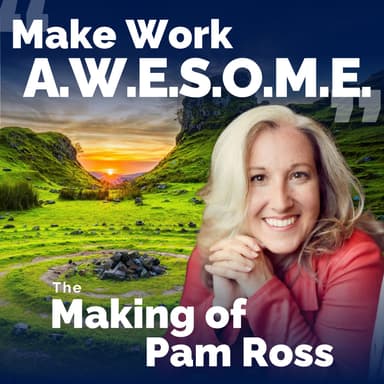
Becoming a Coach with Pam Ross: From Hospitality to Leadership Development
with Pam Ross, Leadership development, feedback, "make work awesome", training company, based in Canada
Transcript
Edited for readability: filler words removed, names checked. It may still contain errors. The audio is the source of truth.
Pam Ross
The other thing to think about is that when you're speaking you do not want to be selling from the stage. That is a total no no. So instead of just talking about a story, you also say, in our leadership program we did blah, blah, blah. And you're telling the same story. So you're just planting seeds about what you do.
Tobi
Welcome to another episode of the Making of a Coach. I'm Tobi from metaFox, and this is the making of Pam Ross, a Canadian coach, facilitator and speaker. Pam is on a mission to make work awesome. And for her, AWESOME is not only a synonym for great, but also a fully packed acronym. On this episode we unpack what AWESOME actually means to Pam, and also her, I found it quite moving, story of why this is the most meaningful work she could be doing. Pam also shares how she grew this from an in-house training role into a freelance job and finally into Blue Rebel Works, a small business with several freelance coaches that she's running today. I found it fascinating how Pam leaned into her sweet spot and used her passion for one on one coffee meetings to grow her business. So let's get started.
Understanding the Typical Client
Tobi
Just to get to know you a bit, I was wondering if you could briefly describe who your typical client is, and what challenge you usually help them with.
Pam Ross
Our typical client has changed over the years, but now I would say they are either in a scale up, so they're not at the startup stage anymore, they are certainly scaling, so they're 150 to maybe 2000 employees. Or they're going through a big change, a big cultural change. And usually these are companies that are hiring or promoting a lot of managers, either promoting from within or bringing them in from outside. And they are finding that they have managers who are excellent at the technical parts of the job, but not always thinking like leaders. So we really help to shift them into thinking and choosing leadership every day. So basic foundational leadership skills, and a lot of work on teaching
managers to be coaches, to be honest. So it's a little bit, I love metaFox, but it's a little bit meta, in that we are coaching, but we're also teaching managers to coach.
Tobi
And if I browse your website, your blog, your YouTube, I see a lot about making work awesome.
Making Work Awesome: The A.W.E.S.O.M.E. Framework
Tobi
So your mission is to make work awesome. What makes work AWESOME?
Pam Ross
A couple of years ago I actually created an acronym for AWESOME. So it is Accountable, people are able to take personal responsibility for their work, that's the first A. The W is about Whole Self, where people feel like they belong and are valued and can be themselves at work. The E is Empowered, so they feel free to use their personal strengths to do really great work. The S is Safety with team, so this is about being safe to
speak up, share ideas, challenge the status quo. O is about Opportunities to learn, people receiving development and feedback so they're growing. The M is for Meaning, bringing that contribution to purpose and to mission, and knowing that you're making a difference in your role. And the last E is about Emotional Resilience. This involves a lot of the emotional intelligence skills that really help you to be resilient and adaptable. So: Accountable, Whole, Empowered, Safe, Opportunities to learn, Meaningful, and Emotionally Resilient.
Tobi
And that basically also constitutes the leadership development journey that you offer.
Pam Ross
Yes. Those are woven through everything that we're teaching.
Leadership Development Program OverviewBalancing Accountability and Empowerment
Tobi
Can you take us into this program from a client perspective? How does that look?
Pam Ross
Our program consists of monthly or bi-weekly live sessions with a facilitator. Pre-work that they have to do, where they get the content, so in our sessions we're not lecturing at all. We're not teaching anything, because they learn the content in the pre-work. When they come to the sessions we're really facilitating discussions and practice of the skills they are learning. At the end of sessions they set a habit in our technology that tracks habits. So they are actually choosing a behavior to change and a new habit to practice, and that gets tracked in between each session. And then we also do peer coaching, where they learn to coach each other. So they're developing that skill of a coach for themselves. And they're also solving real problems and building connection
across the cohort. So there are many components to our program. They're pretty comprehensive. And over that course of six to eight months we are tracking the behavior change and the impact of that, so that we can really have an impact on these leaders and ultimately make work awesome for them and their teams.
Tobi
That sounds quite impactful. Starting with that comparison of how do other people see me versus how do I see myself, a cohort that is made up of colleagues, I guess, allows you to work on super concrete, tangible and non-hypothetical problems.
Pam Ross
Yes.
Tobi
And then going out with these habits to stick. It sounds great. I think we'll unpack all of this in a bit more detail. Let's leave the cliffhanger here and dive a bit into how you arrived at this journey.
Pam's Journey: From Hospitality to Coaching
Tobi
Because I think today you are at quite an impressive point from a coach perspective, having built this organization, Blue Rebel Works, where you actually managed to acquire teams from entire companies to go with you on this journey. And I'm curious to learn, how did you arrive there? To get started with this conversation, let's use our icebreaker.online tool. There you will find 52 pictures to pick from, and my prompt is: which picture describes your journey as a coach?
And what I see here right now is a landscape, very colorful green grass, and a circle sort of shape with, is it a campfire in the middle? And a sunset or sunrise in the back. What do you see, and what does it mean to you?
Pam Ross
There are so many great photos here. I love this tool, we have actually used it in our sessions many times. The first thing that drew me to this was that sort of spiral path coming out from the campfire. Because I would say it definitely hasn't been a straight journey. There have been jinks and jags all over. The next thing that drew me to this was, I am a lover of the sunrise. It's just this reminder that no matter what happened today, there's another day, here's this new day, opportunity rising. So it just speaks to, I feel
like I am constantly learning. I actually joke sometimes that I think I created a business just so I could learn all the time. I'm always asking myself, okay, what could I do differently? What did I do well today? What could I do differently next time? What am I learning here? What are the themes? So this opportunity to always be looking to the future is something that I think is the ongoing fundamental of everything.
Tobi
Super nice, thank you. You mentioned that in your early days you worked in hospitality. You were serving in restaurants. How was that?
Lessons from the Restaurant Industry
Pam Ross
I think you learn so much as a server in a restaurant, because you're basically running your own business. How you serve those guests is going to define their experience, and you can make it as custom, or as by the book, as you want. I loved to really build rapport and get to know my guests and find little ways to make things special for them. And that pays off, as a business person that pays off in my tip at the end of the day as a server. So I got the opportunity when I had just graduated university. I wasn't sure what I wanted to do. I had my honours BA and I thought, maybe I'll go to law school, maybe I'll go to teachers college, maybe I want to be a journalist, I'm not sure, I'll take a year off. And in that year I got this opportunity to travel around the country and open up restaurants. I studied psychology.
Tobi
And then you considered law school, but then during that trip. You're based in eastern Canada.
Pam Ross
I'm based near Toronto. So I was considering a bunch of much more academic ways to go. And what happened was, I was doing this store opening thing, and then my director of operations left and said, hey, you're going to take over recruitment. And basically gave me a few minutes on how he does interviews. I had never really done an interview for a manager before. I had helped hire waitresses and line cooks, but he handed me a pile of his recruitment files, a bunch of interview things, and said, here are my three favorite interview questions, and then left the role. And all of a sudden I was responsible for all the recruitment. So again, I had to figure things out on my own. I think this drove my ability to solve problems and figure things out, but also my belief that anyone can do this. We do
not have to solve problems for people all the time. I was doing the recruitment and then I was training managers. And what happened was, our management training program was 12 weeks long, and 11 of those weeks were spent serving tables, bartending, hostessing, doing prep cook, line cook, what they call expediter in the restaurant world, all of these very technical roles. And then there was a week shadowing a manager who's just doing table checks and that sort of thing. There was no actual how do you lead people training within our management training program. So we started looking. There was myself and there was another restaurant brand within that company, and we started talking, going, we need to teach people how to actually lead people. They're great line cooks at the end, but they're not able to deal with the challenges of leading people. So we started
developing leadership training, and we would do leadership workshops across the country. And this is where I got my start. I was maybe 24, 25 at this point. I had barely led people. I had led my training team, I had worked a bit as an assistant manager in a restaurant, but I was learning to lead while teaching people leadership skills.
Tobi
And that sounds like such a great coincidence, someone might call it fate, that you as a psychology student go on the trip, get into restaurant serving, from there get into HR and then into restaurant management. And the parallel I see in our brief conversation now is that earlier you said today you help leaders who are great in their subject matter expertise but actually haven't been trained as leaders, even though that's their job now.
And what I heard in your story is that this is also what you experienced in the restaurant business: the original leadership program, to serve the name at that point, was training people mainly on the hard skills of the restaurant business, instead of actually training them on how to lead their team of actual people.
Pam Ross
So true. I actually hadn't made that connection, but absolutely. I feel like that is definitely a theme. Interesting.
The Importance of Clear Feedback
Tobi
Are there any other learnings from this time of working the ground in the restaurant? In one of your videos I had seen this nice analogy of how you also learned what feedback can go right or wrong in this world.
Pam Ross
Oh my gosh, I learned so many things about feedback. I'm trying to think of what you might have seen, so that I can link to that, but I'll tell you a bunch of things. As a server, at one point I was actually told, you have a great personality, but you're actually a really bad server. He didn't use those words, he used different words. And my drive to prove that I could overcome that is probably what helped me get onto that training team. I just became so focused on how can I be really great at this, and watching the really great servers and learning from them. So it was actually really bad feedback. That is not the way I would ever give anyone feedback. But for me it touched something in me that drove me. I had been very nice in my feedback. I had not been direct and honest about what the
behavior was and what the impact of that behavior was on the guest, or on the work, or on the team. And after giving a lot of nice feedback, I had to let the person go, and they were shocked. My initial reaction was, how dare they be shocked, I've been giving them feedback all along. And it wasn't until that night, going home and still pondering over, what could I have done better, what did I do wrong, that I really thought about, okay, how honest was I in that feedback? How direct and candid was I in telling them what the impact of their behaviors was?
Tobi
So your feedback was nice in a way that it wasn't clear to the recipient.
Pam Ross
Yes.
Tobi
And so they also couldn't really work with it, couldn't do something with it.
Pam Ross
Right. How are you supposed to change your behavior when you're just getting this really ambiguous feedback? And I think Brené Brown is the one who says clear is kind. I love that. That resonated with me when I heard her, and it reminded me of these instances where I hadn't been clear. And that clarity is the most kind, compassionate thing we can do when someone is struggling.
Tobi
Or, thinking back to your AWESOME acronym, in a way you need this. Safety with the team
to then empower people. So that's maybe where the niceness, the fluffiness, comes in. But you also need the accountability, so that people actually know how they are responsible and how they can take ownership of the task.
Pam Ross
And opportunity. If I'm not giving you feedback to help you grow, you're not going to get that opportunity.
Tobi
So that's the O in your AWESOME: opportunities to learn. Super cool. So this is how you turned from restaurant server to HR to general manager.
Pam Ross
Yes.
Tobi
How did that continue, and what are some other relevant milestones?
Pam Ross
What happened for me was, I was working in this awesome company where I had opened these restaurants, I had done a restaurant manager role, I had taken on the recruitment. This was also a very entrepreneurial company. Two examples of how that would show up at work. One was, we for a while had some cubicles and offices in our head office that weren't being used. And when I was not opening a restaurant I would be working in the office, but I had no place to sit. So I would be sidled up to someone beside them, I'd bring my little laptop and sit beside them at their desk. And one weekend I just moved my stuff into one of these empty cubicles. It had been sitting open and everyone just was like, oh, that's Pam's office now. It was just this very free environment. Another example is, I had taken on this recruitment, we had decided that we needed to do leadership training. I don't remember having to get a lot of approval for this. It was just like, oh, this is absolutely needed. I'm sure I must have talked to my boss about it, but there wasn't some kind of really bureaucratic way to bring this into the organization. I just started doing different work. And then one day I said, you know, I think rather than being a management training coordinator, I'm going to be the training and recruitment manager. People
figure out what they're good at. People add to the organization and figure out what the organization needs. They fill these roles and they do great work and they get rewarded. And this is just how work is, and it's awesome. Over time, I was with that company for seven or eight years, and then the company got bought by a larger organization. They were moving their head office, and I thought, maybe this is a good time for me to leave. So I worked in environments where every email that I sent, actually at the time I was faxing a lot of times, but anything I sent to our locations needed to be read, and I would get my drafts back with red lines and, no, move this word here. Everything was so micromanaged. I worked in environments where people were counting the hours until they had to leave. I remember literally walking into one
of my colleagues in my first couple of weeks at one of the companies. He was at his desk, and I was trying to understand what everyone was working on and what they all did. I saw so much unhealthy behavior, and I saw how easy it is, when you're in a system like that, to over time become part of the system. So I saw myself like, oh, it's five o'clock and I'm leaving my job, or I'm working in this environment and working weekends and holidays and all of that. So I found how much the system affects you, and how important it is to watch out for those systems and bring awesomeness into them, because it's so unhealthy.
Defining Moments and Personal Challenges
Pam Ross
I think some of the turning points for me, there's a turning point that involves three stories that are related. It starts with when I was opening restaurants and I was traveling around Canada. I would go for six weeks at a time. My uncle had brain cancer. He's my favorite uncle. So I would come home from a store opening and have the weekend off and think, oh, I have to go and visit Uncle George. And I didn't, a couple of times. And then when I got home finally I was like, okay, tomorrow for sure. So I got up that morning getting ready to go visit Uncle George in the hospital, and he passed away before I could get there. So I had this realization, oh my gosh, I have to prioritize family. I have to explore other ways of working. One of the things that happened, because I loved work so much, is that I had a friend at work who also loved work. So we would finish work and then be talking on the phone at nine o'clock at night about what happened that day at work and what we were working on and what was going on. He contracted brain
cancer. I did go visit him before he passed away, and he said to me, Pam, you need to bring more fun into your life. So these two moments happened earlier in my career. And then in 2010 I was working at an organization that was busy, busy culture, stress, stress, stress, a lot of competitiveness, not a very healthy culture. We were terminating a lot of people. I came into work one day, had a particularly touchy termination to do that day, and at about 9:30 in the morning I completely went deaf in my right ear. And at the time I still went ahead and did the termination, and worked all that day, got home late at night. I was really dizzy from this hearing loss. Developed vertigo. Went to multiple doctors. Had multiple misdiagnoses and they couldn't figure out what
was wrong with me. They thought it was a brain tumor. So, having had these two people close to me pass away from brain tumors, this was the final defining moment for me, the straw that broke the camel's back, or whatever you want to call it. I am healthy, other than that I am completely deaf in my right ear still. And that was the impetus for me quitting my job. I finally went, I cannot work in this kind of environment. I need to help change organizations, to bring some of the awesomeness I had in my first role, along with the positive psychology I had learned, along with the mindfulness practices I've learned, along with, since then, I've taken neuroscience classes as well.
Tobi
It really helps to understand your why. And I think there are two strings that I see here. On the one hand this contrast of having at first this workplace where you created this accountability and empowerment for yourself, it sounds like, and then also experiencing that this is not a given, that's not how every company works. So experiencing that contrast. And then on the other hand the experience of what happens if work and life, even though I don't like this dichotomy,
are out of balance, and the awesomeness of work takes up too much of life, so other roles fall short.
Pam Ross
We're all going to spend a lot of time at work. So if we can make that time awesome, that only helps us. I just remember in that role I was coming home from work exhausted every day. I was so entrenched in work, and it wasn't even positive.
Tobi
And to get a bit more practical now and get to your journey as a coach. You had the psychology background from your studies. You had made yourself a training manager at the awesome job, so you knew how it is to design a training program. How did that translate then into this point of starting facilitation and coaching?
Pam Ross
So first was when I was in one of the roles where I was having a lot of challenges with my boss and with some of the things that were happening within the culture of the team. My CHRO was a certified coach, and she said, would you be interested in coaching with me, in me being your coach? And I said, sure, I'm open to it. I didn't really know what that meant. I was like, we'll see. It was so helpful to me. Years later I went back to the same company that had been the awesome company and had been bought by another company and now was a different company. And I actually came back to that company. None of the people I used to work with were there anymore. The last few of them got fired after I got hired, within the first month of me being there. And they were changing everything. And I think I was taking it a little bit personally, because I had helped build this company way back when. And I would go to my coach, this CHRO, and I would say, I can't believe they're doing this. Why would they do this? And I was totally in judgment all the time. And I remember one conversation, I can't remember exactly what she asked me, but it was something like,
why are they doing this? And I would say, they don't care about anyone. And she said something like, is that true? And I was like, yes, it's true. And she was like, okay. And then I was like, okay, you're saying it's not, you're saying I should question that. So I started questioning my thoughts. And then she said, what if you were curious instead of judging what they were doing? And I remember at that moment, because I had this strong value of learning, that simple question, what if you were curious instead of judging? I came to work the next day and literally just said to myself, I'm curious, I'm curious, I'm curious, I'm going to be curious. I went into the senior team meeting and instead of being in judgment I was curious, and I would ask questions like, okay, what impact will that have, and what makes us think that's a good idea. But I was asking these from a
curious standpoint, instead of, what makes you think that? It completely changed the conversation. It completely changed the way I showed up. I was learning again, we were able to have open conversations. Just that question changed me. And I was like, this coaching thing, this way of asking a curious question, it really had an impact on me. It totally changed the way I thought about things. So that was my first real coaching experience. I saw the impact it could have. When I started my business, this was probably maybe a year later, I also hired a coach at that time, and she had a niche of differentiation. And she was also wonderful. So I think going through these coaching experiences on the receiving end, as the
coachee, really helped me see the benefit of coaching, when you've got a really great coach who brings curiosity into those conversations, and how impactful that was. So I did take some coaching training, at the Coaches Training Institute, CTI. I took their first coaching fundamentals, and that changed the way I facilitated. When I used to facilitate in companies I was a bit of a trainer. It was like the training show. I was telling stories, it was very entertaining. People got a lot out of it, but I don't know how much they changed their mindset and their behavior necessarily. But they loved the sessions. After coaching training I became a facilitator, not a trainer. So instead of being on show, I was really getting curious in those sessions. And I could see, when people would say, whoa, you
totally changed the way I thought about that, I felt that that was so impactful and important for me, that I started bringing it more and more into what I do. So I say I'm not a coach. I do do team coaching, and we can explore that if you want. But as a facilitator, bringing that coaching style in, just from those coaching experiences I had, really made me a better facilitator and helped people to actually make change based on the sessions.
Tobi
So you started out as this sort of edutainer type of trainer
and then went into coaching. And was that in an employed role, or were you already freelancing at this point?
Pam Ross
This was when I was freelancing. When I was in the organization it was a lot more content driven. In that organization I think I also got my first taste of public speaking. So if we had a conference, I would often be explaining the new concept or whatever. I would be a big part of that. So I found a skill in actual public speaking. But as a trainer, or as a facilitator, that's not what you want to be. To me it is a different skill. You shouldn't be the one on stage. It really is about them. And when I saw how impactful thinking about it that way was, it really changed the way I thought about it. But yes, that was after I started my business.
Starting a Coaching Business
Tobi
Let's go a bit into this point in the timeline when you started your business. You said you had this frustrating turning point in your workplace, when you were too absorbed in your work and you saw you needed to make a change. That's when you started freelancing.
Pam Ross
So it was after the hearing loss. I started going, okay, I really need to change the way I'm working. I tried to do it within the organization I was at, and the system was so powerful, it was impossible for me to break myself out of it. I had done some consulting on the side a couple of times in my past roles, especially in those ones where I was like, when's five o'clock hitting? I wasn't that busy. I had a ton of energy to do great work and I wasn't making an impact. So I had done a few of these side gigs, and I loved getting in and learning that company and what they needed from their employees and what their culture was like. So I always thought this would be great to do full time, to learn about other companies and then help them. In five years I'll do that, in five years I'll do that. And 10 years go by. And so when I lost the hearing I was like, okay, this is the time. This is
the time to just do it. I gave four weeks notice when I left my role, and within those four weeks I reached out to two different former bosses of mine, actually former managers, and said, hey, I'm thinking of starting my own business, what's the chance you'd need some help with some training? At the time I thought it would be guest service kind of training. And I got two projects before I even finished my four weeks notice. So when I started my business I didn't spend the first year strategizing what the business was going to be. I was in the work before I even started the business. I had these really busy projects. I was developing a whole new online learning program for one. I was completely revamping the sales process for another one. So starting in a way as an organizational consultant, a people and culture consultant maybe. When I thought about
my tagline, what did I call it? It was something like integrating people operations and guest experience. So I was taking this kind of HR umbrella approach, looking at the areas of your culture, but the purpose was always designing a guest experience that worked. And my first clients were former employers, from my previous career network. They were both retailers. I also worked in retail during my time in the corporate world. They were both countrywide retailers. And I really thought that
would be my niche, this retail business. At the same time I was an early adopter of technology. While I was working corporately I was really active on Twitter. Back then Twitter was this place where we would have these chats about things we were super passionate about. I remember I would be up at night chatting about leadership, chatting about training and learning and development, in these global Twitter chats. And it was amazing. And I started to really see some new things that people were doing with technology, and how these internal technologies were changing the way people communicate in companies. So this was eye opening, to hear what people were doing with technology. And as I was learning that, I actually partnered with someone on the other side of the country, on the west coast of
Canada, and we held an HR conference focused on the intersection of technology and HR. It evolved into what we called the Reinvent Work summit. So it was very much on new ways of working, using technology, and new ways to connect and collaborate.
Tobi
And what I also hear is that you seem to be very much focused on making the business successful, focusing on how is their customer experience, how can we integrate technology to make things more efficient. So going way beyond your actual delivery in the training room, and thinking about how can we make this organization successful.
Pam Ross
Yes, totally, and that is important to me. I think this is from that ops background, I had P&Ls to look at. The impact on the business to me has always been important. Seeing that what we're doing actually changes things. I remember when I was working corporately we didn't have an enterprise system or anything, and I would take the restaurant P&Ls, all the individual restaurant P&Ls. I would also take all of our learning program spreadsheets of who had attended what workshops. I would take the guest experience scores, and I was trying to do my own correlation analysis of, if we had restaurant managers who attended our learning, did that impact their guest scores? I was doing all of this analysis with all these different spreadsheets. That was my way of knowing we were having an impact by doing these training workshops. And usually there was definitely a correlation. So, having the impact and knowing we were impacting the business has always
been important. That's the awesome part. That's why I say it's not just about people being happy. That's part of it. We want people to bring their whole selves to work and to feel engaged and happy at work.
Tobi
And I think that's also not super typical for the coaches I talk to. If we were to abstract it to make it useful for everyone, I guess what you did is you took that skill you were very good at from your previous career, and you took that into your career as a trainer and coach. And to get out some hacks and things that worked and did not work: you said your very first clients were previous employers. How did you get your other first clients?
Pam Ross
I truly think it's my overserving and overdelivering.
All of my business has pretty much been word of mouth. Actually, there are a couple of things that I've done. That first coach that I hired when I started my own business, the differentiation one, also helped me figure out where do I show up best. And I will tell you where I don't show up best, and that is at a networking event. I hate walking into an event where there are all these strangers and they already know each other, kind of, and I have to try to wheedle my way into conversations. That is not my favorite thing. I am skilled at speaking on a stage. I can do that and I love it, and I feel energized when I do it. And I love one to one conversations, over coffee, or nowadays over Zoom. So when she helped me differentiate, not only my business, she
also helped me differentiate what my business development strategy was. And it was two speaking engagements a month, and 10 coffee meetings a week. It was a lot. I actually, after the first month, went to six coffee meetings a week, because I could not keep up with that. And so by doing those meetings I just stayed in that public sphere. That first year I also did 21 speaking engagements. I wish I could say there was a secret to me getting those speaking engagements, but it was literally all word of mouth too. One of our speakers for the conference that I was producing was supposed to speak at an HR event and she had to back out at the last minute, and she said, you know, you should talk to Pam Ross, she knows this stuff really well, she could speak. So I did that speaking engagement, and then they started referring me to all of these other HR
networks, and then those people referred me to other people. So I do believe there is something in writing down your goal and thinking about your goal that helped me almost achieve that 24. I did 21 instead of 24 that year. But I had written down two a month and I almost made that. It's not like I was marketing myself as a speaker at all. It was fully word of mouth. So if I could give you a hack, it is a lot of just staying out there, meeting people. I was not selling anything. I was just going in curious: what are you working on? What's really exciting to you? Almost like a positive coaching experience for them. I would give away tips, I was not trying to sell, but it just kept my name out there and so people knew who I was. And then the
third hack that I was using at the time was Twitter. I mentioned how I hate networking events. You have to go to them, you have to go to conferences and things if you want to be known. So I would use Twitter to get to know people before a conference. I would use the conference hashtag: who's going to this conference? Let's do a meetup at two o'clock on the first day at this place. And so I would feel like I already knew all of these people going into these huge networking events with strangers. It wasn't strangers anymore.
Tobi
Thanks for sharing. And one thing I also hear, and for you it doesn't seem like a big deal, but I think the hack zero that you mentioned is knowing yourself. And then working with that.
Finding Your Networking Sweet Spot
Tobi
So saying, okay, I don't love these networking events, but I have this tech Twitter, social media bubble that I'm very engaged in and that I enjoy. And I enjoy these one on one conversations, so let me actually set up these coffee meetings. I think arriving at that conclusion is already great, because it enables you to be in it for the marathon, and to run a marathon that you can sustain, because you work in your sweet spot. You set the challenge in a way that works for you.
Pam Ross
Right.
The Value of Coaching
Pam Ross
And it was a coach that helped me figure that out. I wasn't thinking about doing that. I just thought you had to do all these things. And it was her who helped me figure out where my niche should be. So I credit her, Michèle Soregaroli. She is a great coach.
Tobi
Great.
Transitioning from Freelancing to Entrepreneurship
Tobi
So that also means that for not such a long time you were a freelancer. You actually started hiring your first coach to partner with you quite early on. Was that a freelance relationship, or do you actually employ them? How did you arrive at this switch from freelancing to entrepreneurship?
Pam Ross
So the first coach I hired, she has her own business and I just hired her to be my coach. Do you mean bringing in coaches to do coaching for our clients?
Incorporating Coaching into Business
Pam Ross
I realized the value in coaching because I've had great coaches. When I worked corporately, Anna Philipopoulos was a wonderful coach. When I started my business, Michèle Soregaroli, who has a business called Transformation Catalyst. I've also had a wonderful coach in Grace Churchill. I've worked with her multiple times over the years. She was a coach who helped me even know that there was something called team coaching, which is what I love to do, because I love to look at the system that is causing behaviors. And that's what I learned in ORSC, which is Organization and
Relationship Systems Coaching. It was because I hired coaches to work with me personally that I saw the value of coaching and started bringing it into my business. As I was doing these leadership development programs, we would include coaching in them. And I was doing the coaching, and I don't always love individual coaching. I don't love it unless I really feel a connection to the person I'm coaching. There are great coaches who are able to build that no matter what. And because I was also teaching content to them in these programs, I would find myself flipping into advice-giving far too often when I was doing individual coaching. I would love to get people who are really great at this and love this as their thing that they do. So very quickly, I would say maybe three years into my business, I started bringing in other coaches to do the individual coaching sessions that were part of our
programs. And it's great, because they can do what they love. The participants are getting more value for sure. And they're getting this totally external perspective, because I'm seeing them in this cohort experience, so I already have a bit of a judgment, unfortunately, or a bias, as to how I'm seeing them. Whereas these coaches can come in and just be completely external. They're not attached to the outcomes of the program as much. So that was something I started doing very early, and I have worked with some great coaches as subcontractors.
Tobi
That means that for a long time you were working without subcontractors and really focused on your, as I coined it earlier, edutainer trainer sort of role. In this period you were basically getting coaches for yourself that helped you bring your business forward. And that also helped you to realize the value of coaching as something you can bring into your own business.
Effective Speaking Gigs for Client Acquisition
Tobi
You say a lot of clients come through your speaking gigs. You also said that with those speaking gigs you just do one and then through word of mouth you get another one. So it's again being good at what you do, generally. But if we want to steal that practice from you, what kind of events is it that you speak at?
Pam Ross
A lot of the ones that I would get clients from would be things like HR association events. In Canada, or in Ontario where I am, we have the HRPA, which is the Ontario HR association, and HR professionals go through that organization. Over the years I've spoken at the area conferences multiple times. There are regional HR meetings, and I would speak at those, and those would sometimes range from just having a group of 15 or 20 people to 150 people, depending on how big that region was. They also have the large annual HR summit. So I started speaking at those, and I would say those were often an opportunity for potential clients, especially because people are choosing to go to the sessions that resonate with them.
The other thing to think about is that when you're speaking you do not want to be selling from the stage. That is a total no no. And so for my first year, I'll be honest, I probably didn't get clients out of my speaking gigs, because I was so far from selling on the stage. I was talking about all kinds of things but never about what I did. What I have learned is small tweaks to how you're delivering the content. So instead of just talking about a story, you also say, in our leadership program we did blah, blah, blah. And you're telling the same story. So you're just planting seeds about what you do. In that first year of speaking I don't think anyone could have told you what I did. I was talking about reinventing work, but I don't reinvent work. I do leadership development and culture development. So
you have to think about it if you're looking to use speaking to get business. And I actually don't so much anymore. I get paid to speak and that is the business a lot of the time, so I don't worry about it as a business getter. But if you do want to use it as business development, you don't want to sell from the stage, but you do want to weave through some of the outcomes you've gotten. So weaving in what you do into your talks, without trying to sell what you do, is a small strategy that anyone who's doing speaking to build business could do.
Tobi
So there are three things that I hear. Not selling in people's face directly, number one. Number two is be useful, deliver value, deliver free value by sharing actual real world hacks and practices. And number three, pack those points in a story where you can show people, look, this is what I do. This is on the one hand a valuable story, but it's also a sort of customer testimonial from my work. And you can also work with me. Not saying that, but that is what people also learn in the subtext.
Pam Ross
Yes. I have had some wins in providing something for free at the end. I remember one time I did an HR tech talk. I was talking about all kinds of technologies for HR, and I had a list of 40 HR tech platforms and what they did, kind of like a comparison, and, just drop your business card and we'll send you that. So there are ways to bring people into your email list by giving them something of extra value at the end of your talk.
Navigating Speaking Engagements During COVID
Tobi
How do you get people to attend your online events?
Engaging Your Audience Online
Pam Ross
One of the things that I do every time I'm doing speaking is I send a video to the producer of the event, of myself welcoming people and inviting them to attend my talk. It's just an extra personal touch, for people to already feel like they have a sense of who I am and what I'm going to be talking about and why they would choose that. I think that is super helpful. Most of the speaking I have been doing lately has been internal to companies though. I haven't been doing a lot of public conferences. I've been doing more, you know, when they're doing their internal
Tobi
summits.
Pam Ross
We don't have to sell tickets to it or anything. But I still always do the video welcoming people. It's just an added value for that conference producer. When I speak online, I very much engage people in the chat. In a normal room, when you're live, I will do some interactions with the audience, whether it's something
simple, raise your hand if you've ever, whatever. So in the chat I'll say, type awesome if you want to make work awesome. And you just see this flood of awesome coming through the chat. Because as a speaker you get a ton of energy from the room. If you don't feel it online it's hard to get that same energy, unless you're doing certain things that keep it up. So for me, using the chat to engage people is so important, so that I can still show up as my best speaker when I'm online.
Tobi
So connecting with the audience on the one hand before the event, by being comfortable enough to record a phone video, I guess.
Pam Ross
Yes, really simple. I do add captions to it, but that's all. It's nothing fancy. Just a phone video. Hey, I'm really excited to be a part of your upcoming conference. I'll sometimes talk about my mission to improve people's lives by making work awesome. And I'll be talking about XYZ, can't wait to see you there, make sure you're in room whatever at 11 o'clock. So I'll give a few details about the talk and about who I am. It just gives them a sense of my energy and what they can expect from coming to my session or to that conference.
Tailoring Talks to Audience Needs
Tobi
How do you choose what to talk about?
Pam Ross
I do a discovery with my clients. Over the last few years I've been talking about a couple of things. One is neuroscience hacks to making work awesome, bringing some of the things I've learned about the brain, both through neuroscience and positive psychology, into how anybody can make work awesome. And then the second one is something I call Leading Above the Line, which is aimed directly at leaders. It is about a bunch of mind shifts to help you stay in that curious, nonjudgmental zone as a leader. This is making me realize this is very similar to that workshop I told you about at the beginning of our talk, where we had about 15 different activities we could do but we could only do five. I have probably 20 different neuroscience talks that I could give. And I have about a dozen Leading Above the Line shifts that I could talk about. And I have an interview with the event producer, or certain stakeholders, before I do any talk, to find out what do you really want people to get out of this talk? What would make it successful? What's been successful in the
past? Tell me about the group. So I always ask a question like, if at the end of an hour talk you're leaving going, wow, that was the best talk we've had at a conference, what would have to be true? So I pull from all of the things that they give me and choose the hacks, or the shifts, that I'm going to use. So it's very much tailored. I don't say it's custom, because I already have the stories. For everything I talk about I have at least one story, at least one kind of tip that they will leave with, and a why behind it, or the science behind it. So I have all of those already. It's just choosing which ones will fit for their audience.
Tobi
So again, trying to abstract it, you have that shelf with components that are useful to your target group, in your case leaders of medium sized businesses. And then you have this exploration conversation with the client, finding out what the most pressing issues are, where you can deliver the most value. And based on that you pick your different puzzle pieces from your shelf and build that.
Pam Ross
Exactly.
Tobi
Very nice. And maybe one last question on the whole client acquisition, business development journey.
Leveraging Video Content for Business Growth
Tobi
I saw that you also have quite some video content online, on YouTube, on LinkedIn. How is that going for you? What have you tried? What seems to work? What works less? Where are you still experimenting these days?
Pam Ross
I am experimenting with all of that. I enjoy video. I find it easy. That's probably why you're seeing a lot of video content. It's interesting, because over time this has shifted. I used to write a lot. When I worked corporately I had a blog that I would write on a couple of times a week. And over time video has just become easier. I wonder if it's because I am on Zoom so much, so I'm just so used to being live on video. So what has been successful? I would say LinkedIn is my number one platform that I focus on. You might see, I think I still have it, I am what LinkedIn calls a top voice on LinkedIn, and those are selected by LinkedIn, people who continuously share content of value on LinkedIn. And as a member of that top voice community I have access to a lot of LinkedIn training.
And I do know that right now LinkedIn is certainly focused on video. LinkedIn is the place I tend to focus on. And video is something that's really resonating on LinkedIn. So what I find works is short videos. I try to keep it to less than two minutes. Definitely having captions in there. I would say short, always with captions, because some people aren't going to listen to the audio, so make sure you can tell what you're talking about. Authentic. I tend to really tell genuine stories, or my personal perspective, and add value. I do share a ton of free valuable stuff on LinkedIn. We have a free course right now, a micro learning course on a feedback model that we teach, which is a coaching style
feedback model. And we share all of it on LinkedIn too. It's all just adding value. The other thing that I think is helpful on LinkedIn is commenting on other people's posts, and really celebrating other people who are adding value on LinkedIn, and engaging with them. It goes back to that whole, it's not always the Pam show. You've got to make it everyone's show.
Tobi
That's a nice formula. Showing up, adding value, being yourself. Thank you.
The Blues and Oranges Feedback™ model
Tobi
If you could give the younger Pam, starting out as a trainer, advice from today's perspective, what would it be?
Pam Ross
It goes back to, it's not about you, it's about the people in the room. Be more curious, always ask, don't tell, more often. I think that comes with confidence. Starting out as a trainer I felt like I had to have all the answers. It's the same with managers, I feel like I have to have all the answers, I have to be the expert. And it turns out people have all the answers inside of them. It's about pulling the answers out of them. I don't have to have all the answers. It's not the Pam show. Help them solve. Facilitate, don't teach.
Tobi
Be curious, ask, don't tell, and trust in the capability of people to solve their own problems.
This was my conversation with Pam Ross is what I would usually say at this point, but actually this wasn't my entire conversation with Pam. Pam also told me a lot about her Blues and Oranges Feedback™ model that she's using with her clients at Blue Rebel Works. Pam even ran me through a small coaching demo with that feedback model, coaching me on my experience as a young podcast host.
If this sounds interesting and you want a small glimpse behind our podcast journey, tune in next week, when we will publish this second part of my conversation with Pam as another episode. If this was useful, please subscribe and share this episode with a friend.
If you say, ah, Tobi, I think you could still do this or that better, then please send me an email at tobias@metaFox.eu. We are super grateful for your feedback. Thanks a lot, and hear you next week.