Ebony Fagbuyi: Coaching Leaders in Collaboration with Top B2B Platforms
with Ebony Fagbuyi, Leadership coaching, relocation, Maxwell Leadership
Transcript
Edited for readability: filler words removed, names checked. It may still contain errors. The audio is the source of truth.
Ebony Fagbuyi
I think a good environment helps you to grow. And growth can happen when I can show up as the authentic me, even as my flawed me.
Meaning, I might be a pain in the backside. However, that's me right now, and a good environment can help me actually grow, shape, become better at not being such a pain in the backside. I would say a good environment is also determined by where I personally stand. Meaning, if I still want to grow and
I'm the biggest fish in the pond, it might not be the right environment. Although it's nice, it's comfortable, everything's fine. But if I have outgrown that environment, maybe it's time to say bye to that one and find a new one where I can grow.
Intro
Tobi
Welcome to the Making of a Coach, where we unpack how coaches turn their passion into profession. My name is Tobi from metaFox, and on this episode I meet Ebony Fagbuyi. Ebony is based in Berlin and worked her way from being a customer support specialist in the early days of mobile phone subscriptions to coaching leaders of SMEs and corporations.
Most of these leaders get to Ebony through coaching provider platforms, pools of coaches that partner with businesses and enable leaders to book a coach. For Ebony this takes away some hourly margin, but also a lot of exhausting marketing hustle. Let's hear it from the beginning, and from Ebony herself.
Who is your typical client, and what challenge do they usually come to you with?
Ebony Fagbuyi
That's a good question. Who is my typical client? If I think of a group of people, those are executives, leaders. Some of them are in higher positions, let's say C-level, board members, but they're also leaders at senior level, and sometimes even aspiring leaders, those who are advancing in their career steps and want to lead different teams, or come to the next step, or want to find out whether leadership is something for them.
Tobi
And who do they usually lead, or in which context?
Ebony Fagbuyi
That could be in any industry. Automotive, electronics, consumer electronics, health, e-commerce, you name it. Those are the clients that come to me.
Tobi
And is that usually more from SMEs or from large corporations, the typical size of the organization that the leader is employed at?
Ebony Fagbuyi
I would say the larger end of SMEs, to enterprises. So I have large enterprises globally as well. Which makes it for me personally quite interesting, because it's always interesting to see how many people are actually working within the company, and how they are leading, let's say, 1,000 people.
Tobi
And how does a typical client journey look, from getting to know you, or finding you in the first place, to then going into a journey?
Ebony Fagbuyi
Well, the leaders usually find me through other avenues than the typical direct one. I work a lot with, I would say, coaching service providers. You might know some of them, like Sharpist, which is more known in the German area, but in the Americas we have BetterUp for instance.
And what they do is they acquire the big companies that are looking for coaches within their organization to help their leaders develop. And then when they have these contracts, they have a pool of coaches, and they say, we can match your staff or your leaders with those coaches.
A lot of them actually come through those avenues. Which makes it nice for a coach, because I don't have all the marketing acquisition and all of that. My part is getting onboarded with one of those, or multiple of those, and then receiving the clients who are matched. However, my usual go-to was, and still is, word of mouth.
Working with NILO & Sharpist
Tobi
Super interesting. So that means you work with platforms. Which are the most important ones?
Ebony Fagbuyi
I have multiple ones. And I see waves, because we need to consider that I'm not the only coach there. There might be, in one company, let's say 500 different coaches. So you can do the math. If they get 500 clients, not everyone will be matched one by one. One gets maybe three and two others get none in this round of matching.
I'm also connected to one that does more mental health. And there I see a lot of people coming through, rather than through the typical business coaching area.
So I can recommend to listeners who say, hey, I like this avenue, I have never experienced that or heard about it, to think of where to onboard themselves, and to also think of those who are in mental health, because coaches are needed and necessary there as well. Although there would most likely be a differentiation internally between therapists, counsellors and coaches.
Tobi
For sure. So which platforms should I check out if I'm an aspiring coach and I want to get clients through one of these platforms?
Ebony Fagbuyi
I can recommend NILO, N-I-L-O. You can check that one out, that is in mental health. They do a great job in how they interact with the coaches as well. They have a wonderful coach platform.
I like that they call them experts, and we can exchange as well. Or if I have a client who might need therapy right now and I want to refer them, I can refer amongst us and say, hey, who is there? So I like all these kinds of aspects. That is one that I can recommend. Then there is also Sharpist.
Sharpist is one that I know of with regard to leadership and business, although those are a lot of the time also aspiring leaders, starting their journey. And then of course there are plenty of others, but I don't know them directly. So I can just say, do some research on the companies that are there.
Tobi
So the client journey actually might not even start with the client, but with the HR person who works at a company and has selected one platform, and then they maybe pre-qualify a certain group of coaches. And then as a leader at that organization I can pick from the 10 coaches that this organization is working with. Is that roughly how I can imagine it?
Ebony Fagbuyi
Yes, exactly. Those are mostly not 10, to be frank, that's usually three to four coaches to check out, and then you have a discovery call, or a clarity call, however you might call it. They would come to me and then we have this conversation and we explore a little bit: what does the person want?
What is coaching? What is it not? How can it help? And from that basis they make the decision on which coach they go with. And then it goes back to the HR person: you can start making the appointments and reach out to one another.
Tobi
So how does the HR person on the platform pick you initially? Let's take Sharpist, for instance.
Ebony Fagbuyi
They are there, and then we have a company with HR, and they do the negotiation of the larger contract and everything. And they're like, let's say we have a hundred leaders here, they can be coached by our coaches. They do the program. What are the benefits? How can they scale?
So that's where their discussion is. I am not in the picture. Then Sharpist receives the hundred and they are matching the hundred with what they know about them. They have conversations around that and give information like, this is what we do.
This is how we do it. And then they match. They receive the client's data automatically, with a hundred coaches, or 50, or whatever. The big work is done by Sharpist, basically. Does that make sense?
Tobi
Yes, I understand it a bit better.
Typical client case
Tobi
Now you meet for the first time with that leader from the organization. What situation are they in? Can you give an example?
Ebony Fagbuyi
Some of them find themselves in difficult situations. That could be, for instance, that they have started a new role and now they need to find their way. Maybe they feel not accepted or integrated by their peers yet. They don't know how to lead, because they are coming out of the peer perspective and now they become the leader, or something of that sort.
I have others who are exploring internal thought patterns and behaviors, where they see, I'm actually building up a wall here. I'm not getting anywhere, but I don't know why I feel this way.
Tobi
Very interesting. I think the first time the two of us met, you also told me that you work with leaders, C-level people from SMEs, who often lack people they can talk to, and you are the person with whom they can share what's going on. Would you say what you just described also includes that, or is that a different type of client that you also have?
Ebony Fagbuyi
That's the feedback I'm always getting, that they're so happy to have someone to talk to. And that they appreciate the space I'm holding for them, the presence that I'm there, that they can just be free and talk about anything and everything. They use this time to really have the moment to reflect, of course, but also to have someone who holds the space for them and has their back.
Tobi
What do you do to get into that role, so they see you that way?
Ebony Fagbuyi
That's a very good question. What do I do? The first thing is, I come prepared. Meaning, I can come mostly empty. I come prepared with my own hygiene, mental hygiene and emotional hygiene. That is very important. So that is the first thing I do, to make sure that I can hold space, that I can be present, so that not a thousand things are running in my mind, or that I have biases still running, and programs running.
icebreaker Exercise: "What picture describes you as a coach?"
Tobi
Nice, thank you. With that, let's move on to our next section, because I would be super curious, and this is also the point of our podcast, to learn how you arrived at having these kinds of conversations with leaders from all over the world today. And to get started in that conversation, I just sent you a link to our icebreaker app.
And now you land on a page with a prompt question that is, which picture describes you as a coach?
Ebony Fagbuyi
I go actually with this one.
Tobi
Okay, awesome. What do you see here on that photo?
Ebony Fagbuyi
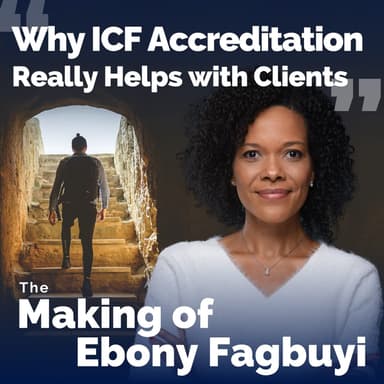
On the picture, what we see is a person who is walking up some stairs, into the above. So it seems that this person is somewhere underneath the ground and is now coming up. Like if you would think of a bunker, and you're going up the stairs, but you can see the light already.
So that's what it is. And the stairs have walls left and right. So there's no open space. It's just this staircase up.
Tobi
How does that describe you as a coach?
Ebony Fagbuyi
It describes me as a coach with regard to the intention, or the direction, I see myself in within the coaching area. So not so much about me personally, but about what I'm helping with. When I see myself, I see myself as a coach in this picture who is helping to find the way out, the way into the light, the way into the greater, the way into where they want to go, even if they don't see anything around them.
So if they see walls, blockages, whatever that is. That's what I resonated with.
Tobi
So the person in the picture is actually your client, on their journey into the light.
Ebony Fagbuyi
I am the observer, taking the picture. Basically that's me as a coach.
What also comes with the observer perspective is that as a coach I am not so much completely in the process.
So I look on a plain canvas and paint that path. That, I guess, is the internal map, the lens one looks through. That describes a coach. I feel like coaches, in a classical way, are there to hold the space, to see the blank canvas that they can freely move into and through.
I'm just helping to develop the picture of their life, if that makes sense.
Tobi
You're there in the painting process, while the client paints the picture of moving into the light.
Ebony Fagbuyi
All right.
Origin Story: Call Center
Tobi
Okay, nice. So with this picture that also describes your view on coaching nowadays, how did that view evolve? Thinking back to your origin and your becoming, can you take us a bit into that?
Ebony Fagbuyi
The view and the understanding of coaching started when I experienced coaching myself, in my first, I would say, proper adult work, where my parents would say, okay, this girl, our lady, she has a job. So I started working, and I started in a call center. And call centers, you might know or not know,
also have internal trainers and coaches. For communication, for sales and all these processes. And when I was coached there, I felt quite empowered.
I practiced it myself, because that's my learning model. I do things first and then I go to the theoretical part, like, what have I actually done there? However, when I then did my base training for coaching, I realized, oh, there's much more to it, and it looks a little bit different. Which means it's shaped into what kind of question am I asking.
And I saw even greater results through that than what I had seen before. And I thought, my God, this is actually really great. I also understood both ways, of what it does with me and how I can apply it to a person who wants coaching.
Tobi
I see some parallels to other stories I've heard. In the sense that when you started as a recipient, what you believed coaching was back then was more of a coach-sulting, consulting, maybe training, getting expert advice. And as your journey as a coach evolved, it became more of what maybe today you would say coaching actually is. Not the expert at all, but more the person who's there while the client paints their picture.
Role of Leadership[00:16:59] Jamba Call center pt 2
Tobi
Your interest in coaching started in parallel with an interest in leadership. Can you elaborate a bit on that? What role did leadership play for you?
Ebony Fagbuyi
A very significant role, because in the environment I was in there were many leaders, and of course you make friends there as well. And there were situations where I thought, this is not fair, or this is really hurtful, and they repeated themselves. So I was asking myself how it comes that some people are placed in a leadership position when they have such an influence over and into people. And I could see this influence. I couldn't name it at that time, but I could see dynamics that were happening. And it seemed a lot of the time to start, or at least circle, around the leader. So I became very curious about it. And from there I started a long distance study in management.
Tobi
And how did that translate into your daily work? How did the leadership education influence it?
Ebony Fagbuyi
It helped me to check myself, as I was going out on the route of becoming a trainer and a coach, not really knowing that that was leadership already.
I took that into consideration, because I had seen it firsthand. And learning a little bit more about how businesses work and so on, I looked through a new lens when I was in different companies working there myself.
And in that I needed to showcase some sort of leadership. Looking back, I guess, going first. Modeling what you were teaching. There is the saying, practice what you preach. So I did the things, and that's how it became a companion, I would say. Throughout my development, leadership was always there.
So, coming out of the role as a trainer and coach and stepping into the official role of a leader of a team or department.
A leader has a great influence on environments, on people's minds, on what they think about X, Y, Z.
A good work environment
Tobi
What makes a good environment?
Ebony Fagbuyi
We need to define what is good. For me that would be a healthy environment, where I feel I can be me, even if I get corrected in something because it doesn't fit into the overall culture agreement that I have agreed to. Cultures have certain main agreements that they stand on.
Not in terms of rules or laws, but a certain agreement about what is happening here and why we're coming together. So when I'm part of that and in that environment, then, I think a good environment helps you to grow. And growth can happen when I can show up as the authentic me, even as my flawed me.
Meaning, I might be a pain in the backside. However, that's me right now, and a good environment can help me actually grow, shape, become better at not being such a pain in the backside. So I believe that's a good environment. And then I would say a good environment is also determined by where I personally stand. Meaning, if I still want to grow and I am already, as John Maxwell says, the biggest fish in the pond, it might not be the right environment. So it might not be good in terms of being in that environment. Although it's nice, it's comfortable, everything's fine. But if I have outgrown that environment, maybe it's time to say bye to that one and find a new one where I can grow,
learn and become.
Tobi
So a good environment is one where you can be yourself, where you can grow. And then at some point you notice, okay, I actually need to change my environment now to grow further.
How did it evolve once you had arrived in Berlin?
Becoming a leader at Sony
Ebony Fagbuyi
I saw in the newspaper a job ad for a senior manager at Sony for complaint management. Mind you, I had never been a leader. Nonetheless, I thought, well. I had been in customer care. I love complaint management.
I had so much experience that I thought, of course I can do this, this is a job for me. And with all of that internal encouragement I just applied. They invited me, and I actually got to the last round, where I had to do a case study kind of thing, where this is a scenario.
What would you do? And they had all these words of senior management, and I'm like, I never heard about this. What is this analysis? What is that? And I just gave it my best shot. And they came back and said to me, unfortunately we can't give you the senior management role. However, we see a lot of potential in you and where you are right now.
And we have created for you a leadership role underneath the senior manager, if you want it. And of course I said yes. But I gave it the shot.
So that's my story with different environments.
Tobi
Super nice. And that's how you arrived in a leadership position eventually, after having had the training and coaching exposure already in the call center, then going through the leadership assessment and your leadership studies at the same time.
What were your key takeaways from that time?
Ebony Fagbuyi
The first thing that happened was imposter syndrome on steroids. That's what happened. I was like, oh my goodness. What happened was,
my boss and I were both new. We were at the same assessment and job application.
However, we did not have the best connection to where we could get the information we needed to really find our ways. So there was no full clarity and vision from him. How can I then have that, because my boss does not have it? So I needed mine, and I had a team that also needed one. So you can see how that already looks. And simultaneously to that,
I felt I had to catch up with knowing all the devices. They have so many different electronics, with little letters and numbers next to them, and what they can and can't do. There was so much at once that it was quite overwhelming.
So that's where I started. I needed to sift through. I had to think about how do I actually apply leadership. I wasn't aware of it at the beginning, because my focus was so much on, how can I swim now?
I have to learn a ton.
Everything is changing. Most likely Sony doesn't even know how things look. It was hard. It was really hard. Plus I now had a team that also started at the same time. The pressure was there.
Finding myself in this happened once that was settled. We had more structure and knew who's doing what, how are we doing it, and it got much better.
For me, I'm a servant leader, so I like to look from the perspective of how can I add value to the team. And in that, I also had conversations with people outside of the company, when I felt I needed a mentor or someone to talk to. And at the time they had different postures on certain things.
Tobi
You were still figuring out the subject matter at that time. You didn't have a clear vision coming from your leader, and yet you had to be there for your team. How were you there for your team at that time?
Ebony Fagbuyi
Well, I was there the best way I knew, which was hands-on. To be honest, there was not much leadership in that sense. My first thing was like, okay, how can I be a leader? Well, I need to show that I'm on it, I'm learning, I'm doing the same job as they do, basically, with regard to their jurisdiction.
And that's the first thing I tapped into. Which was, on one side, looking retrospectively, good, to see that I'm not too whatever to get my hands dirty. However, it also shaped the expectation that I would do that forever, because later on I had difficulties getting out of that self made
role of, I'm just your peer here. Not meaning in terms of how I look at you, but in terms of what our roles are and what my job basically is. So then I had difficulty with, okay, how do I get this disentangled now?
Tobi
And how did you disentangle that?
Ebony Fagbuyi
Personally, how I disentangled it: we were defining, okay, when do you escalate, and I would start to give those escalations back if they belonged to them.
They can come to me if they really have a question that no one can answer, that they can't find, or they don't know where to go. But starting that was crucial. To empower them to do their job and to grow in it, but also for me to keep the time free for what my actual role there was. At that time I would say that was more like training and managing certain things, until I could actually really lead.
So what I was doing, not knowing it at that time, is carving through management to get me to leadership, if that makes sense.
Tobi
Increasing your level of delegation, giving more responsibility and increasing the severity of the problems that people come to you with.
Ebony Fagbuyi
Right. We had some big challenges, and bigger challenges, to maneuver through with regard to leadership, and how I brought them to the table, and they shaped me, or shaped my leadership.
Leadership influence on coaching[00:28:12] Role model leader[00:28:12] Learnings on the job[00:28:12] Harsh feedback as a turning point
Tobi
We'll get in a minute to how you eventually became a freelance coach, but quickly fast forward: I'm wondering how that experience shapes how you coach leaders today.
Ebony Fagbuyi
Well, these experiences have shaped me exactly in the last thing I just mentioned, and in how I carry myself. Coaching, as we saw with this picture, and as I understood more and more, is less of exactly that. That is a huge differentiator with regard to how I coach today compared to how I coached before.
Before, there was much more pressure. Pressure of myself, for myself, but also pressure that then extended to my coachee, because they wanted to get somewhere, I wanted to help them get there, and they're not getting there fast enough, so to say. Or, don't you see it? Whatever might be going on within me at that time. Instead of a reflective question, being more directive because of that. But these are little nuances, and all of this has shaped me in how I lead them, and what they then sense and likewise multiply.
And if we break out a little bit of the classical coaching, I also have students of mentoring, and maybe coaching that is, yes, with the directive part. I share my stories there as well, which they value a lot. So that helps them. And how I coach is again by going first. I'm modeling that, that is how I lead them.
I model to them how, a very simple example, how feedback could look, for instance, different from what they thought it could be. Modeling it through, have you thought about X, Y, Z? What do you understand that the other person might have gone through, or imagined, or felt like? Where they're like, I've never thought about that. So this is how I lead them, where I can see it.
Also there is multiplication happening. Some people have even said, well, Ebony, now I'm doing what you did, now I understand what that was all about. And this is a silent multiplication, I would say, of good, favorable skill sets or qualities that I could leave with others, because I have been through it and understand where they're coming from and what could be a challenge to them.
Coaching = Mirorring to break the cycle
Tobi
And if we get a bit more practical, let's say I am now a leader and a client of yours. And you see that my area of development, my obstacle, is the pressure I apply to myself, the pressure that I therefore also transmit to my team members.
How would you help me out of that? Or is that question in itself already kind of the trap, because then I'm again getting away from that coaching mindset of nowhere to go?
Ebony Fagbuyi
Coaching is more the reflective part. So I'm not telling you or showing you how you get out of there. I would say, yes, I'm good at seeing patterns as you talk. I might see certain things. But as a coach it's not my job to say, this is what you now need to do.
So in the coaching conversation I would ask these questions, probing questions, reflective questions about certain things that come to realization for the coachee who has this problem. When I start to see, okay, this loop is happening, even as the person is talking about the loop, so in real time, I would then intersect and would say, okay, what do you understand when I tell you that at the beginning you started here, and now you're here, as you talk about this repeating itself?
What comes to your mind right now? I would bring it back as a reflection. Do you see the pattern yourself, that is just happening, and what do you need right now, maybe, that helps you to step out of it? What are the learnings that you have gathered throughout this entire process that have actually helped you to have less pressure, or to alleviate the burden that is there? Where would you like this burden to be?
We would find ways of, what do you want to do with this cycle, or with this burden? When they come back into the loop thinking, to help them get out of the loop thinking, by again bringing it back, like, that's the mirror.
And then they start reflecting on the next one. My job is to help them stay in the positive loop, of getting out either through new revelation about that, or at least leaving it there for later. Like, what just happened?
Does that make sense?
Tobi
So it is this mirroring, showing them the pattern that's there. And that is something different from feedback, where you would say, okay, I hear you behave like that and this has this impact on me. That's what a mentor would do, not a coach. And instead you simply record, reflect back, and then leave it to them what they do with that.
Ebony Fagbuyi
Right, yes. Always in the best intent of our agreement in the partnership. So if they tell me this is where I want to go, I might challenge them. Not everything flies with Ebony in your coaching right now, because you gave me permission
to get you there, and maybe to interrupt you, to be frank. Someone says, Ebony, if you see something, please tell me. I'm like, well, what I'm seeing right now, correct me if I'm wrong, is the following. Then I summarize and I just give back what I just observed. And they're like, thank you for that, that's exactly it.
And that's enough, usually, for them to take the next steps.
Marker
Tobi
Nice, thank you. I would like to explore a bit how you became a coach. What struck me earlier is that your journey at Sony is very much shaped by this hands-on learning. You learned the craft of leadership by actually being a leader. Then you got involved in partnership development.
You learned how to network within the Sony corporation. And I guess all of these things you also took with you then in your freelance career. So now I'm wondering, what were the formal learning steps that you took to then eventually become a freelance coach?
Ebony Fagbuyi
That was a long distance study. It went on almost three years. With intense learning, writing materials, but also supervision and practice.
So that's the next thing I did. I left Sony after my last position, with this wonderful man who was my last boss. And when I left, I had to decide what to do now. And I took this opportunity to say, you know what, you always wanted to try to have your own business and to freelance, or however you call it.
So that's what I did. Where I went is to the Job Center.
I went there and I discussed it and I told her, this is what I actually want to do, can you help me there? And they said, yes, we can. Instead of you getting unemployment money, you get the money to set up your own freelance business. So I said, well, I want to go this way. And that's what we did.
So we applied the investment of that fund into that. That was my formal step. And then obviously I had to go to the authorities to register the company. And when you are a freelancer it's a lot easier, you just use your name and give the company a name.
It doesn't take long.
Tobi
Are you a freelance solopreneur, or do you actually have a legal entity as well?
Ebony Fagbuyi
I'm still a freelance solopreneur. I have a legal entity in the UK, but I intend to use it differently. So I'm not quite sure if I move everything there at one point, but right now I'll keep it running this way.
Tobi
Interesting. And in terms of learning, I know that you trained as a systemic coach, you trained in NLP, behavioral profiling, DISC, design thinking. When and how was that journey? Did that happen in parallel to your employments?
Ebony Fagbuyi
While I was with Sony I already started looking into John Maxwell, which is the leadership certification. And of course the network we met through as well, here in Berlin.
So I thought, okay, let me have a look. That was the second one. And then I started working as a coach, and of course had to find my way. I thought I'd start with low hanging fruit, and as you just mentioned, I knew how to network and I like to speak to people.
So I went to a business breakfast around my corner. And as I went there, the people sitting there introduced themselves, but I had a feeling of, ah, it's more about eating than really doing something. So it was my turn then, and I was like, this is who I am, this is what I do. And then one gentleman at the end got up and said, Ebony, I would like to meet you.
And I'm like, who are you? He's like, well, I'm running a business. And what we do is, we have coaches in our company and we basically give them clients, either from the job center, they have a lot of coaching clients there, or from private companies that need coaching.
And then from there, the same day even, he spoke to me and he's like, you should meet so and so, she is there. And I'm like, I'm going to go home, get my papers and be there in half an hour. I said okay, went home, got my stuff, went to her, signed the deal, and the rest is history with that one.
It's different to say, I'm Ebony Fagbuyi, I do X, Y, Z, than, I'm Sony, I'm leading X, Y, Z. There's Sony behind your back. So that was different, and that's my first step into it, and the certifications I did with it.
Role of networks & associations
Tobi
You mentioned the Maxwell leadership foundation. What role do networks of that kind play for you, back then and today?
Ebony Fagbuyi
Back then it was for different reasons. One, that I was connected to a community. Going out there alone feels alone, and with the John Maxwell team it felt like I'm not alone. I had people who think alike, who are passionate about the same things. Plus it was a certification, although I have to be frank, from a German standpoint looking in, I would say it was a nice add-on training workshop with a certificate.
I would not consider it a full certification to become a trainer, coach or speaker by going there live. It's an online program. You really have to immerse yourself to go through this online program, rather than becoming that by having three days of something.
I like to network in general, but I don't subscribe straight to a network, because of commitment. I'm a person, if I do that, then I'm fully committed. I'm not just doing it like, okay, I'm here once and then bye bye.
However, networks I believe are good for all these reasons. And also for display, of course, especially if you start. You have platforms, and if you go in there and are friendly to people, get to know them, they get to know you, then you land on a metaFox platform, right in the podcast.
Hello everyone. So that's why I believe it's a good thing to do that. And to see wider than your own atmosphere.
Tobi
Trying to summarize a bit: you've got this community, you were not alone. You got the exposure, in the example of the John Maxwell foundation at least, to other markets, to the US, to the UK, getting out of your bubble, also getting the first exposure to the leadership coaching certification there. To what extent do you also acquire clients from there?
Ebony Fagbuyi
I do not really acquire clients from there. I do now through the ICF accreditation, through the possibility and the access to mentor those who would like to be accredited. If you, Tobi, would say, hey, I'm going on a coaching journey, I have finished my coaching and now I want to pass the ICF credentialing, then I could come at your side as your mentor. Because mentorship is required in order to apply for an ICF badge at any level, ACC, PCC or MCC.
So from that I could acquire customers or clients who say, that's what I need, and I want Ebony as my mentor to help me go through the process. Clients in the sense of coaching clients, I don't do that, I don't have that. What comes in terms of partnerships is the lady I mentioned with regard to coaching service providers.
A colleague of mine got me into a gig, so to say. She is also a John Maxwell member. So we are friends, we meet, we coach each other with regard to accountability. But that happens through building friendships, and coming up with ideas to say, hey, I could use some help as an accountability partner.
Tobi
You make friends, you meet peers, and then one thing leads to the other, which eventually might also include new clients, new business, but that is two, three steps down the road, not a direct client acquisition channel.
Client Acquisition Channels
Tobi
What would you say are your most relevant client acquisition channels today then?
Ebony Fagbuyi
I'm having those service providers, word of mouth, and networks where they see me speak.
Pricing B2B Coaching
Ebony Fagbuyi
There are different approaches, and I'm finding, as you can see, myself there as well. How could it work best? To find people who can trust you and book you, this could be an approach, that they get to know me and are able and willing to invest. Because to be frank, my coaching hour, if I just go by hour, is not 20 or 50 euros an hour.
It's quite some investment.
Tobi
But how much is it?
Ebony Fagbuyi
Right now I'm offering it for 400 euros an hour.
Tobi
And that's usually paid by the employer of your client, or by the client themselves?
Ebony Fagbuyi
It's by the employer. Or the client themselves, if they can afford it, or if we can make a package. However, I would say it would not be in a range of 100 euros, 150 euros per hour.
Tobi
Can you get to these numbers also working with the service providers?
Ebony Fagbuyi
Unfortunately not, no.
Tobi
My guess is that they take a lion's share of the coaching hour, to be honest, because they also have to pay for their whole company.
Ebony Fagbuyi
The pre-work that they're doing, the marketing and all these things. However, the payment is still, I would say, good on the front end, at a mid range, I would say. But everyone is free, obviously, to choose where they want to go.
So I had others where they said, you will earn 60, 65 US dollars per hour, where I'm like, no, sorry. And then there are others who say, we pay you 120 euros or dollars. So one has to decide where they are right now, what they feel comfortable with.
If you earn 65 euros, congratulations. When I started, I made 18 euros per hour. So I'm not saying this from a standpoint of, make 400, 500, 600. I'm embarking on my master level mostly to be acknowledged.
It took a long time, many, many hours, and two decades to get there. So that's where I'm talking from. I just want to make that clear.
Tobi
And that means that when you work with the service provider, you cannot get those 400 euros. Even if the client pays that per hour, it doesn't arrive at you, but maybe you end up with half of that.
Ebony Fagbuyi
That would be the higher end of service providers who give us that payment.
Tobi
But then at the same time, you don't have to take care of all that marketing machine and the effort that we previously discussed.
Ebony Fagbuyi
Right.
Choosing Coaching Service Providers
Tobi
How did you pick those service providers that you work with nowadays?
Ebony Fagbuyi
I came to it in a very interesting way as well. I gave a training at that time for young students within a company, and one of them, after I had helped them, went to that first service provider. They had just started out, a startup. They told her, find coaches. She knew one coach in her life.
She reached out and said, Ebony, are you interested? And I said, I am. And that's how they found me and I found them.
Tobi
Let's say I'm a new coach and I want to take a bit more of a structured approach to finding a service provider, a partner I can work with. What would you say I should look out for?
Ebony Fagbuyi
I would look out for, depending on your credentials, coaching provider companies that accommodate your structure. What I'm saying is, CoachHub, for instance, is one of those. They only take people with ICF accreditation or similar. So you need that credential. If you don't have it, then have that as a distinction of where you should look and go for. I would search anything around, as I said, coaching provider, mental health coaching, coaching business, coaching pools, pools for coaches. You can also go on LinkedIn, there are a lot of those companies saying, we're looking for coaches.
Tobi
Thanks.
ICF Accreditation to work with coaching providers
Tobi
You said you've been coaching for 20 years. Only two years ago you started your ICF accreditation process.
Ebony Fagbuyi
Yes.
Tobi
What made you do that?
Ebony Fagbuyi
My finally arrived humbleness. It is that I saw, through this process of wanting to onboard with more providers, because you never know how my own business is going with regard to acquiring clients in a natural, organic way without the marketing. And while doing that I came across all these great, amazing companies, but they all wanted accreditations.
Are you accredited here? Do you have that? And I'm like, oh my goodness, I don't have that. So I finally said, I will do it. And once I have it, then thank you, it's done. So it was out of necessity, I would say, to do it.
Tobi
So, to paraphrase, you found those coaching providers as your sweet spot acquisition channel, and in order to be onboarded with more of them you needed that quality mark, ICF, MCC, et cetera.
How was the process of going through that certification?
Ebony Fagbuyi
What you do is, you have to gather your base training material, because there are different paths that they have. I am a non-ICF trained one. You can go through a coaching training that already is ICF approved. Meaning, if you find a coaching school and they have the ICF label there, it means it already is a curriculum after ICF. But mine wasn't.
So what I had to do is, I had to send in all my training material to showcase what I have learned. You do that online. You build your own membership profile there, and you have different things that you need to upload. Then you have to let them know how many hours were synchronous or asynchronous, because they also have certain regulations on that. You also fill in the hours that you have done coaching.
For MCC now it's 2,500 hours, I believe, that you need to have.
You also need, I believe, 10 hours of mentoring.
And from that mentoring, you create two recordings of your coachings that you think showcase the level you are applying for. They should have a certain length. So there are also requirements here. You have a transcript with it, you upload it. And once you have fulfilled all of these things, then they will check everything.
And once they say everything's green light, then you have to do a test at the end, which takes three hours or three and a half hours. You can do that on site in a building where they have an observer there, or you can do it at home, which I did remotely. Which is next level observation, I would say. But I did it, I made it, and I was happy to get approved.
Closing words: life experience to mature
Tobi
Is there anything that you think we should still have talked about when it comes to your journey as a coach and the business building as a coach?
Ebony Fagbuyi
It's a very good question.
I would just summarize about the journey and the business building of a coach. What I think is wonderful and necessary is, in my opinion, your own life experience. I would like to highlight that again. I know we once talked about, do you need to have leadership skills to be able to coach leaders?
And back then I would have said, no, not at all, you can coach anyone as long as you can coach. Which is still my belief. However, I believe once you have gone through a certain experience, any kind of thing, you have a different view, perspective, empathy, all of these things, just due to that, due to the way you can relate.
So I would say, if someone wants to embark on leadership coaching, find opportunities to lead, because that will help you become a better coach for leaders.
Tobi
And that may not even be because you need to have that hard skill, but because in order to get to the attitude that you described, of coaching actually being doing less, you need to go through that journey of personal development.
Ebony Fagbuyi
Yes. And I know that some of these coaching service providers also ask how many years of leadership, what kind of position of leadership. If you want to be an executive coach, they will ask you, have you been an executive yourself?
From my personal perspective the more important part is that you have this empathy and understanding, as you just summarized it nicely, not so much the title. But still, to go through the hoop, if you want to go there, make sure that you take that into consideration as you become that coach, that you actively seek out roles where you can be a leader and an executive yourself.
Outro
Tobi
This was my conversation with Ebony Fagbuyi. What impressed me personally the most was the point Ebony reiterated at the very beginning and at the end of our interview: how today she practices her emotional hygiene, the preparation of emptying herself to be ready for a client. And how she got to that point through this maturing process that enabled her to do less as a coach, taking away all the expert attitude and simply holding a space.
And if you say, Tobi, that's all nice, but I found Ebony's client acquisition through coaching providers much more relevant and interesting for me, then I have two things. On the one hand, we link the companies Ebony works with, NILO, Sharpist, BetterUp, in our show notes. On the other, I would also like to recommend our very first episode with Marcel Häbold, who as an HR consultant and coach takes a similar, but also slightly different, approach, working as a subcontractor of consulting agencies.
Either way, if you enjoyed this episode, share it with a friend. Follow us on Spotify, YouTube, Apple, or wherever you listen to podcasts. That really helps us a ton. This was the Making of a Coach. I am Tobi from metaFox. All the best, and until next week.