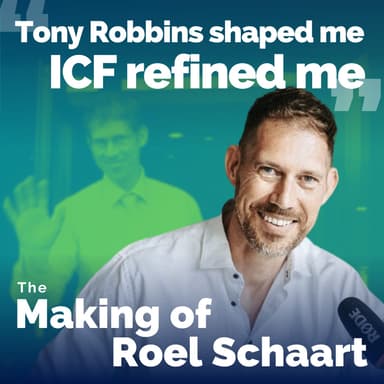
Becoming a Coach with Roel Schaart: From IT Nerd to Tony Robbins Coach and ICF Mastery
with Roel Schaart, Leadership & Impact
Transcript
Edited for readability: filler words removed, names checked. It may still contain errors. The audio is the source of truth.
Roel Schaart
How the coaching works at Tony Robbins is, you get nominated. So I got a coach, a Tony Robbins coach, his name is Mike. And I said to Mike, hey dude, what you do,
that's what I want to do. How do I get on board? And then that mindset that I described earlier: if it's in my mind, I want to have it, I want to do it, I want to get it. I got many rejections. You are not good enough. You are not ready yet.
I will prove I'm ready. So it took two years to get on board. And in those years I did volunteering work, I connected, and I pushed through that. That cost me a lot of money. But it has also been an amazing investment afterwards.
Tobi
What do you still build on from today's perspective? If you made this investment, how does it still pay back today?
Intro
Tobi
If we stopped a random person in the street and asked them to describe a coach, would they think of a guy on a big stage performing in front of thousands of people, or would they think of a person holding a safe space for one other human being? I'm Tobi from metaFox, and with my guest today on the Making of a Coach I'm exploring both of these worlds. Roel Schaart, a Dutch guy living in Germany, trained in the US and about to move to Cyprus, has been a Tony Robbins coach for 10 years, and today he's an MCC, a master certified coach with the ICF.
We explore Roel's stories from both of these worlds, and we compare the Tony Robbins, NLP driven approach with Roel's solution-focused coaching approach today. And if you make it to the end of the episode, Roel also has a small gift waiting. But first, let's get started, as usual, with Roel's typical coaching client.
Start of episode
Roel Schaart
My typical clients are entrepreneurs, business owners, C-level people, mostly founders, or in the second half of their entrepreneurship, in different areas.
I have a guy in Melbourne who has a big farm, top coaches in Tel Aviv, so it's really quite spread. The common thing is they are very successful. The more successful the clients are, the less I have to work. It's quite funny. So what it means is, they want just some reflections.
There are sometimes even provocative questions. They are very successful. And we'll come back later to the Wheel of Life from Tony Robbins. If you see those guys who are very successful in career, finance, family, it's just tweaking. Of course I really love to work with these guys and say, oh my gosh, what is possible.
So that's the common theme, entrepreneurs, business owners, and they're very successful. What I do is just tweaking, or accountability. I call myself a sparring partner.
Tobi
And if you say they're very successful, what's the challenge they approach you with, or what triggers them to find you?
Roel Schaart
It depends. For example, one client, the guy in Melbourne, he has so many things going on, he's very good at executing, and he uses me as a sounding board to approach different projects. Another client, for example, how to expand the business. There are different elements of their life, that could be career, that could be family, that could be finance.
I think we cover all of them. Most start with business topics. So they come to my coaching and they have a business topic to explore. For example, how can I double my income? Or how can I expand the business? Or how can I hire an even better, bigger team? The funny thing is that in the sessions it turns to family and connection.
These guys work hard, very, very hard, and sometimes they disconnect from other parts of life. So it always starts with business and it evolves into family and stuff.
Tobi
In the end we're all just looking for appreciation and love.
Roel Schaart
True.
Re-record question with framing as picture warm up
Tobi
So I guess this is a good moment to explore what helps you to connect with these high performers who are looking for love and appreciation. And maybe a nice way to explore that is by looking at this picture of yours that you posted on LinkedIn. It shows the younger Roel, very skinny, and in somewhat of a contrast to the trained machine that sits in front of me today in a suit.
So can you tell us a bit about that photo of yours?
Roel's journey
Roel Schaart
That was a funny picture. And not somehow different, I think they're completely opposite. Of course there are many elements, it's still me.
So, long story short, I worked and I was really a bit of an IT nerd. I was really a nerd, very shy, extremely shy. If people asked me to get on stage I was blushing and sweating and so nervous all the time. The reason is because I'm quite tall, I'm six foot three, 1 meter 91.
I always look younger than I really am. So I remember a story. When you are 18 as a boy, you want to go to the cinema. We were with some friends and they were actually younger than me, and they were allowed to get in. And there was one guy who heard, you are too young.
That was me, and I was actually older than the rest. And I hated it. I hated having a baby face, and being tall. And those stories were not very good strategies, because I always made myself small, and I was ashamed that I looked younger. Of course, later I worked and I got promoted to different positions, and then I was actually quite happy to be a manager at General Electric.
And my path actually was to be a CIO. But the university decided differently and I got trained as an internal business coach. Then I thought, okay, I like coaching, I think it's the way that I support my peers and my staff. I need to have a coach
myself. And back in the day I read a book, one of the first books Tony Robbins wrote, and I thought, that's the guy.
I need to go to that guy, and I need to have a coach from his team. Long story short, I worked my ass off to get on board, but they rejected me all the time. But my inner drive, if something is in my mind, I like to go through with it and I want to have it.
And I got it. I worked for Tony for more than a decade. And that made my whole transition, myself. So, long story short, from being an IT nerd, getting on board into the coaching scene, and transforming myself into a different person. Quite happy that I've been in the Tony Robbins world and seen my own growth.
So the picture that you saw, that was me being an IT nerd back in those days.
Tobi
Thanks for the nice summary. How was the IT leader different from the boy, and how is the coach today different from the IT leader?
Roel Schaart
I think my transition started when I was in the field of Tony Robbins. That means I went to events, I did a lot of voluntary work, I learned quite a lot about myself, my fears, my stories. And I think that time, the years before I came on board in the Tony Robbins team, those years transformed me as a person.
And that still helps me to approach certain things. So there are different phases. The first was the IT nerd, the shy boy, then becoming an internal coach, and then transforming myself in the Tony Robbins world.
Tobi
And earlier you mentioned your clients, often successful men, and that when you get to meet them and discuss business challenges, it also often comes to family and more personal challenges. How does your own story help you relate to them?
Roel Schaart
I think, and it's my own personal belief, that as a coach there's always a connection with the client. So, for example, I do share certain things with my clients.
I know there are coaches who say, oh, this is a pure coaching relationship and I don't share anything. Perfectly fine. I believe that the business coaching relationship I have with my clients is so strong because sometimes I share my own stories. And the other thing is, and I know it should not be the case, but in my experience it is,
when you are an example as a leader for the clients, it does help the coaching relationship. I'll give you an example. Let's say the client brings a topic, oh, I have worked so hard the last year and I gained some weight, coach, help me to find the best way to send some kilos back into the universe. And imagine I would have 50 kilos overweight.
It's not congruent. That's how I see it. Again, there is no golden rule for this. I strongly believe that it helps me to have a better bonding with my clients. And that's also the reason that I do crazy stuff. I've been with the Navy SEALs in San Diego three times. I do extreme sports, Spartan races, did a couple of marathons.
So, extreme things. One, I like to push myself, but it also helps me to build up my own story. And again, there's no good or wrong, but that's how I see it.
Tobi
It's interesting. When I prepared for today's conversation I noticed that, more than usual, you really make this point of, also in terms of physical shape and appearance, being the role model that maybe your clients want to be and come to you to become.
Roel Schaart
Yes. Actually, this is one of the ethical guidelines, ICF changed it. I need to be very careful not to bring across a feeling that I am better. That is now in the new ICF ethical guidelines. And that's not my intention. My intention is to be a role model in a way, not to be better, and to show that things are possible.
And so I push myself out of my comfort zones in different areas. Now we are about to move to Cyprus and people say, are you insane? You have a beautiful house, everything is established. Yes, maybe. And then pushing myself, that things are possible. It helps me. I'm not saying that this is the right way.
But it helps me. And, you know, Simon Sinek, leaders go first, and that is something that is very strong in me. I want to be an example, but not to be better.
Tobi
So, being that role model who is still interacting on eye level, but who has walked this path in the past, and therefore can also be in that sort of advisory role that possibly goes a bit beyond coaching. Earlier you called it a sparring partner.
Roel Schaart
Not really advisory. Yes, I have my ICF MCC, and clients say, by the way, you have been a leader for 20 years, how would you do this? And of course it is very easy to say, well, you may want to have a look at this. So in the coaching session I really focus on helping the client explore their own solutions, rather than me giving a couple of thoughts.
If people insist, and that's also what I say to students when they get themselves certified, you will break rapport if you say, hey Tobi, I'm the coach and you know the answer, figure it out yourself. So there are ways to explore where the client is not disconnected, but you're not providing the solutions.
So, advisory in a coaching setting, always in a coaching setting. I'm not a consultant.
Tobi
How do you stay in that coaching mindset, even though you have that leadership experience in IT, have done all these sports challenges, have basically gone through the nutritional example that you mentioned earlier? How do you stay in that coaching mindset?
Roel Schaart
What I learned is that solution-focused coaching is extremely powerful, because I threw overboard all the tools and stuff. How it helps me is asking solution-focused questions. And it sounds so obvious, right? So, I was on the track, I do racing on the track with my bike.
Out of your comfort zone, it is another thing. And the instructor said, if you look in your mirrors, you cannot look in front of you. And I think it's so powerful. If you look at the problem, you cannot find the solution. Now, of course there's more than that in solution-focused coaching. It is exploring with the client where the client needs to go, wants to go, and helping the client to get there in a simple way.
So, no diagnosis, no tools, no tricks. Very powerful.
Tobi
I find this metaphor quite powerful actually, that you brought up there. If you want the solution, it doesn't help to look in the rear view mirror. You want to look forward.
And that also is how you stay in the coaching stance. Don't look in the rear view mirror, and be the question asker.
Roel Schaart
Yes.
Tobi
And another thing that you dropped earlier was your training with the Navy SEALs. Can you tell us that story?
Roel Schaart
The coaching director I worked with, Mark Van Muer, I respect this guy very highly. He was a Navy SEAL and he believed strongly in the concept, get out of your comfort zone for personal growth, no matter what you do. It could be finance, it could be physical shape, it could be anything. And that is a concept I really grabbed in my life.
If you do it, and you may be scared, but you do it anyway, there's a growing moment. People do not grow if it's easy, because then they stay in their comfort. I think growing will help if you get out of your comfort zone.
And so, the Navy SEAL hell week. That is of course military, that is one institute. Then there is SEALFIT in San Diego. That guy is an ex Navy SEAL and he built a company completely like hell week, sometimes even tougher.
And what it is, it is a 52 hour crucible, they call it hell week. And it is all exercise. No sleep. You do eat, you do drink, but you keep yourself busy, or they keep you busy, for 52 hours. And you need to run with sandbags on your back, you need to do pushups and squats, in 52 hours. And I didn't know how intense it was. I had done a lot of training already and I said, yes, I'm on board.
So imagine, there was a room of so many people, all hands up, yes, we do it. At the end I think we ended up with six coaches going through the training. It was fun, well, not always fun. We trained one year very hard. And then I was in San Diego, imagine, two meter sized big guys, those Navy SEALs, and they looked like monsters.
And I know it's role play, but they want to get in your head. They fuck your mind, and they do that on purpose. So there are many, they call it evolutions. You have to do certain things in order to get to the next phase. And although I trained quite hard, it was not enough. So, the first 52 hours, imagine black pants, white T-shirt, black boots,
they shout at you and you have to do pushups, you have to run, and you have to go in the water and out of the water and into an ice bath and all that crazy stuff. And then I came to the evolution that's an exercise called the MF. And what this means is, you have a 1.6 kilometer run with 20 pounds of sandbag on the back, then you do 100 pull ups, 200 pushups, 300 squats, and then you run again, 1.6 kilometers, one mile, all the way with the bloody sandbag, I still have my scars on my back, and the time gap is 75 minutes.
And I got to 90 minutes, so, short exit. And that happened twice. And there was a smaller one, it's a 12 hour exercise called the 20X. And I did the full 13 hours. I'm quite happy and very proud of this. At the end it's mindset. Physical shape is important.
When I got kicked out, that's how I felt. I was crying, because I thought, I'm stupid, I'm not good enough, I can't do it. And all those fucking bullshit stories that came into my mind. And then the Navy SEAL coach who exited me turned up extremely friendly, very supportive, and was really a good mentor.
He said, listen, there's only a handful of people every year going through this crucible hell week program, and you are one of them, and you're not 20 like the Marines. There are a lot of Marines and guys from the military service, but I was already, yes, 50 or so. So he said, look at how you have prepared, what your physical shape, your endurance, your persistence have gained.
So, a lot of learnings. And I think my biggest learning is, it may look like a loss, like you lost something, but at the end it's a win. And, now with the learning of solution focus, which side of the medal do you look at? Do you look at, oh, I failed,
I'm stupid? And I learned to see the other side of the medal and look, oh wow, I prepared for one year, I learned many, many things, and I'm proud to have been in the most extreme program in the United States.
Tobi
And you pushed your comfort zone. You sort of redefined what's possible.
Roel Schaart
Yes, big time.
I remember one thing, and I had prepared, so that was actually not really a problem, but imagine this. I still do a cold shower every day. Why? If you do it every day, you start a little out of your comfort zone. And I also do a hundred pushups every day. Why? Because it is that little bit out of the comfort zone.
And if you do one thing out of your comfort zone, that's my belief, again, that's not the rule, it helps me to do other things. And imagine this: there's an ice bath, full of ice cubes, so it's freezing water, and they have a plastic bottle, they took out the bottom, and you have to put the opening in your mouth and you lay down on your back and you look up, and you need to be in the water for two, three minutes.
Now, looking back, I think, my gosh, what did I do these things for. Meditation, breathing techniques help me to go through those things, and still do.
Tobi
You are also a practicing Wim Hof practitioner, you could say.
Roel Schaart
I do box breathing. That helps me to calm down, because things happen, right? It means I inhale for a couple of seconds, then hold my breath, then exhale, hold my breath, inhale. Sometimes I combine it with meditation. Meditation is a funny thing.
This is soft, this is not working. And then I read an article that it's actually scientifically proven that the brain structure changes over time when you keep doing meditation, and it calms you overall. I thought, okay, now I know, now I need to do it. So it was proof of the pudding, that it does help.
Tobi
Nice. So, meditation and box breathing is what you just described, breathing in, holding, breathing out. And what I hear is, it is a deliberate practice that you box into a certain slot of your day, and it's also something that then helps you in the middle of the mess of the day,
when the train is late or whatever. It helps you.
Roel Schaart
And most of the time it works. So I'm quite good at going back, snapping myself out of a poor state. But again, it's not always working. Sometimes I'm really pissed, or whatever, or afraid.
Tobi
Still a human being. You mentioned it a couple of times now, you worked with Tony Robbins and his organization.
First encounter with Tony Robbins
Tobi
How did you discover Tony Robbins, and what intrigued you to actually attend an event?
Roel Schaart
When I became an internal coach more than 15 years ago, I was managing my team and leading my team, and I wanted to know more about it.
When I was a student I read some books from Tony Robbins. I can't remember the names, but the first book was about physical shape and health and stuff. And I thought, oh, there's one coach, I know this guy, Tony Robbins, he wrote a book.
I think it was also, now that you said it, when I was still really a student, so I was 17, 18, I still had those beliefs. Oh, I'm too tall, I have a baby face. And I wanted to know more about it. So I went to a hot coal walking event in Holland. At the time it was not Tony Robbins.
The reason I did all those events and learning is, what is the reason that I have those bullshit stories, about being tall and having a baby face? And then, yes, starting as an internal coach in the IT company I worked for, General Electric, was also about knowing myself. A lot of psychology students,
I think 90 percent, the reason they study psychology is because they want to learn about themselves. So that was also for me, I like to know more about myself. So it was slowly learning about myself, getting internal coaching, and then stepping into the Tony world.
Tobi
And then the step into the Tony world. I guess you attended an event first as a participant, right?
Roel Schaart
Yes. I did eight UPWs, Unleash the Power Within. That's a long time ago. And Tony, his business model is extremely smart. He positions being a crew member as something very, very precious.
You get on board, you become a volunteer. And if you become a volunteer, then you are so lucky. And I remember myself flying into London City Airport, paying my own ticket, paying my own hotel, paying with my own time, just to be a volunteer and help Tony. So, a combination of being a participant, but also volunteering work.
Becoming Tony Robins Coach
Tobi
So, joining the volunteering crew. Because I imagine at these huge events Tony Robbins is the speaker, maybe also doing a demo coaching intervention.
But then there's also lots of group work that is guided by coaches who facilitate smaller groups. And you were one of these coaches, if I got that right?
Roel Schaart
Yes. How the coaching works at Tony Robbins is, there's no coaching class where you sign up for a class and you become an internal Tony Robbins coach. How it works is, you get nominated. So I got a coach, a Tony Robbins coach, his name is Mike, I still remember him. And I said to Mike, hey dude, what you do,
that's what I want to do. How do I get on board? And then that mindset that I described earlier: if it's in my mind, I want to have it, I want to do it, I want to get it. I got many rejections. You are not good enough. You are not ready yet. And I thought, what the fuck.
I will prove I'm ready. So it took two years to get on board. And in those years I did volunteering work, I connected, and I pushed through that. That's actually what they wanted to see. They wanted to see, okay, do you really want it? And then I got on board and then the whole circus started.
But that cost me a lot of money. And it has also been an amazing investment afterwards.
Tobi
What do you still build on from today's perspective? If you made this investment, how does it still pay back today?
Roel Schaart
Many clients came back to me. Entrepreneurs, business owners, C-level entrepreneurs. That's one. Two is how I approach things.
For example, we were in class, my class was, I think, 12 people. A lot of trainers. And they gave us a certain exercise. I had to read it and I had to do it. So we were reading, reading, reading, but on the back of the paper was one sentence: don't do anything.
So I was reading this, and then they came with water pistols and they shot at me, and I thought, what the fuck is going on? And I think the learning is, we are so programmed. We get an exercise, we read it, we do it, instead of, hold on, what is going on?
Ask yourself a question, why am I here? What is the surrounding? Maybe look at the back of the paper. Is there anything else? And that happened a couple of times. Another exercise was also funny. It was in the middle of the night, and they said, okay, we will put you in the middle.
This was around Las Vegas. We will put you in the middle of the desert. And you don't have any money, you don't have any cell phone, and you need to prepare. So we were all so nervous, okay, what's going to happen? And I learned, and again it's not always working, to have a bit of a broader perspective, not just grabbing what you see.
And I think it's a great coaching metaphor, especially for MCC coaches. Don't grab what you hear the client is saying, because then you're at the surface. Sometimes it is way below the surface. I think that's what I learned, one of the first things I learned from Tony.
Tony Robbins is not coaching
Tobi
It's interesting that you mention that detail, because just this weekend I watched the Tony Robbins movie on Netflix, I Am Not Your Guru.
They accompany him throughout that movie. It's basically the one week story of his program Date with Destiny, which is this huge event, 2000 people in a big hall,
and then Tony Robbins goes around and there are these demo coachings, or interventions, that he does with certain people he picks out of the audience. Where I had a bit of resistance watching was these interventions in front of thousands of people, because it's the furthest you can get away from that psychologically safe space between a coach and a client.
How did you see that back then in the Tony world, versus today?
Roel Schaart
Yes. So, those interventions. I acknowledge Tony, what he has done, what he's doing. And sometimes it has nothing to do with coaching. I see many things happening, and he can really get away with it because he's doing it so many times, but it is not coaching. It's sometimes stepping over boundaries.
That's my personal belief, and I respect the guy, he's very good in those details. And of course, this is a whatever, seven foot guy, he is very heavy, he's very strong. Imagine there are 10 people, or 10,000 people, watching. So there is an intervention, and there is a lot of pressure.
So people want to change during events. Yes, I like the interventions, and there are things that I see a bit skeptically.
Psychological safety at Tony Robbins
Roel Schaart
There's one, I think it's either in the Netflix series or it was in one of the events that I was participating in. One hand went up and it was a woman, and she said, oh, I'm not happy with my relationship. And Tony did his questions and then pushed her to call in live,
with a microphone, 10,000 people listening in, her husband, saying the relationship is over. And of course there was a lot of pressure, she did it. And I thought, that is so not good. To be honest, I am not aligned with Tony anymore. Because during corona, the whole marketing approach, the American way is different from the German way, or let's say the European way, of getting clients on board.
And I don't feel aligned with the American way of sales.
I'm grateful, having changed in a way, being in that environment for more than a decade. And I'm also happy to have been out for the last five years.
Tobi
How would you say the marketing is different?
Roel Schaart
It is more aggressive. The approach in American sales is different from European sales. So it's, hey Tobi, give me a credit card, you want to book the session now. And that was not flying in Europe. I don't have money. Well, you will make more money when you go into coaching. Sell your car, give me your credit card now. I exaggerate, quite, maybe not, but that's the American way. And I did not feel aligned in the end.
Tobi
And connecting that with statements like, don't you want to invest in yourself, sort of blaming, or mind tricking people.
Roel Schaart
Yes. And I think what helped me, because when I came on board I was still this IT nerd, a bit, is the way ICF, there are interesting things going on with ethics, but the core of ethics is important. For example, I saw coaches selling stuff to their clients, because there's a dependency, and from an ethical guideline that's not flying.
That is not okay. And I'm happy that I learned the ethical framework.
Public perception of coaching
Tobi
And I think there is also a big debate now, because the public perception of coaching, for example in German media, is very much influenced by this, what you call the American approach to sales. I'm not sure these labels are accurate in this context, but this very aggressive way of marketing, versus
what ICF and what ICF coaches are doing.
Roel Schaart
Thank you for underlining this. We put labels on it with names, that's a feeling. But of course there is no American way of selling. Thank you for clarifying that. Go on.
Tobi
I'm wondering, from your perspective as a person who has experienced both of these worlds, and yet sits here with me on the podcast. You're the first guy in a while that I have on the show, and you also really portray that, very focused on nutrition, sports. So you could very well be in that sort of, oh, I make you rich quick, sort of coaching.
So how do you look at these two worlds of, what does it mean to be a coach?
Roel Schaart
There are so many coaches, and I think it's important for coaches helping clients to get to a coaching training program where you touch on different elements, because people share certain things in the session that they are not sharing with anyone else.
And if you have just read a book and say, I'm now a coach, I think there's a potential danger in approaching clients that way. If you are a brain surgeon, you want to have good practice and theory and study. You don't open a brain and then dig into it. It's the same with coaches.
And then you step into the ethical framework. I do chemistry sessions on purpose, to see, hey, are you and I aligned? Does it really work, you and I together, when we go deeper into the coaching, does it still be a good fit? And if you need the money, you take everyone on board, and that may not be really helpful.
So I see that happening in the marketplace. I am happy to see how, at Solutions Academy, we train coaches in a very good solution-focused way. And I think the students who leave the academy, when they have the certification, they have a solid framework and start coaching in a good way.
From Tony Robbins to Solution Focused Coaching
Tobi
Now I'm wondering, how does that desire for quality reflect in your own journey? After being a Tony Robbins coach, what made you decide to also get trained with Solutions Academy and get ICF certified?
Roel Schaart
When I started being a coach, the coaching market was growing, and I thought, okay, as a coach you need to have at least a certification. I was still with Tony Robbins, I think. I thought, okay, ACC is very important. And I already knew Kirsten for quite a few years.
I understood that certification is important. So I got support for the ACC, later on the PCC, and then we were in a cohort together with some other future MCC coaches. So I was not MCC, and five others were still PCC, and we were actually exploring recordings together. And that was a journey, years in time, to get to my MCC.
So that's how I know Kirsten. And of course I've been a member of the board of ICF Germany, in total six years, and vice president for two years. That network is actually quite small. Working in German coaching, I know a lot of people. I know Kirsten, it was a great time.
So I'm very grateful to be part of the team. I think her company is really unique. If you look at coaching academies worldwide, the way that academy approaches students is different from others. And it's really doing solution focus, really solution focused. So everything that you know about Steve de Shazer and his way of solution focus is embedded in the academy, and that makes coaching a lot more fun for me now.
Tobi
So what drove you was also the desire to become more certified, to go through the ICF stages of ACC, PCC, MCC, these are the certification steps. And that also brought you into the ICF organization, where you were involved on an organizational level.
Roel Schaart
Yes. And the reason why: when I was about to get on board as a student in the Tony world, the previous director said, oh, you need to get your ICF certification, at least ACC, you need to do ICF work. So I was volunteering, and then I was asked to be a board member.
It makes all sense now. It's all, let's say, a little piece of process.
Continuous development
Roel Schaart
What I do is, I meet every month with two other amazing MCC coaches, and we supervise, we discuss, we learn the markers. I am always busy discussing and exploring with other MCC coaches. That's very helpful for me. I have a supervisor, a mentor and a coach. The coach is to work with my own goals, the mentor to explore being an even better coach.
And the supervisor, case studies. Very, very important. You may want to underline this, dear coaches, when you listen: get a supervisor to explore case studies. Keep learning, keep training, keep being in a supervision setting. I'm a supervisor myself. That is very important. So it doesn't end when you have a certification.
I think it just starts. You have a certification and then you start your journey. And of course, when I worked for Tony for a decade, my assistant counted the hours, I think in total 11,000 hours, all the team coaching and the coaching in these 15 years. Now I'm thinking, what the heck, how did I do this?
Sometimes 12 sessions per day. But we learned really to get out of state, coaching, five minutes break. That is not sustainable, I was wearing down at the end. So how do I do it? Learning, keep practicing, align with other MCC coaches. And of course I am very lucky to be in a wonderful setting with Kirsten and her team at Solutions Academy, to support other students, to listen and say, oh, that's a great idea.
So, when I teach, I always learn. That's the beauty of what I do.
Tobi
That's the practice part. Keep developing.
Observing what matters
Tobi
At this point, let's get a bit more practical, in observing the art of the Tony Robbins and also the solution-focused coaching. And one thing I noticed in what he's doing quite well is, in these very brief coaching interventions, noticing what matters and where it's worthwhile going into. So I'm wondering, how do you do that?
Roel Schaart
That's a great question. I think in my coaching I focus more on, who do you need to be? Who have you been? How does it feel when you, et cetera. So, solution-focused questions on the who. That is, in my experience, more powerful than just the action. And I'll give you a reason why. Most people at the beginning of the year set new goals. I want to stop smoking, I want to stop drinking, I want to do more fitness.
And my observation is, they start working on their goals the first two weeks of the year. In general they're all writing down their goals. And the third week 80 percent stop. And the fourth week there's only a handful of people who keep working on their goals. And I think, why is that? It's not about the strategy, because now with AI and Google and all the other tools you can find how to do it so easily. It's not about the how and the action.
It's more, hey, what is my story? What is the story that I need to have? How does it feel? That's way more powerful, and that's more sustainable, than just action. So I look at action, but more at the person itself.
Tobi
What's the motivation behind the action? What is it they actually want when they say, I want to become more fit?
Roel Schaart
They may look in the mirror and they think, what the fuck, I have 50 kilos overweight, and I see a picture from when I was 20, I was a young dude, I'd like to get back to that feeling. But if people do not have a real reason for the change, and then you come back to the who, then people stop.
If he looks at his belly and he thinks, I'm quite fine, there's no chance. He may get a push from his mates, hey, lose some weight. He may do it, but he comes back and stops. So the reason why people change is because they have a benefit from changing. If they don't have a benefit from the change, they keep doing what they do.
Tobi
And that benefit is often on a deeper level, on a sort of identity level. I want to become the person that I was when I was 20.
Roel Schaart
For example. Or unconscious. Sometimes there are underlying patterns that on an action level you may not catch.
Tony Robbins vs. Solution Focused Coaching
Tobi
And if you compare these two worlds: you spent many years working with Tony Robbins, and now you're much more embedded in this constructionist worldview, solution-focused coaching mindset of Solutions Academy. What would you say are the differences between those two approaches to coaching?
Roel Schaart
When I was in the Tony Robbins world, a lot of tools and, let's say, systems, which I still like. A little sidestep: when I got my ACC I was a happy camper. Then I worked on my PCC and it was really tough, because I was a Tony Robbins results-focused coach with tools, and it didn't really land well in the whole ICF world.
There were moments when I thought, I'm stupid, my brain capacity is not enough to be an ICF PCC coach, I cannot do this. With Kirsten, and I really thank her still for this, I found, and this is for the coaches listening, keep your own coaching style. So important. Yes, the ICF markers are important.
And yes, the way of coaching when solution focused is very powerful. And then I learned to find a way. My coaching style is still fast, still results driven. I always call it direct, packed with love. That's a bit of a fun way of saying how I coach with my clients.
And it is solution focused, and it does fit in the whole ICF framework. And then it happened again with me working on my MCC. I was really in a happy space with Kirsten and some other super cool people, getting to MCC, and there were moments when I thought, what the f, this will not work with me.
I cannot do it. Keep my own coaching style, have it in an MCC framework, aligning to the ICF standards. So I think the bottom line is, keep your own coaching style, learn to embrace your ICF framework, and I think solution focus is a very powerful way of coaching.
So I got away from all the tools.
Tobi
So what I hear is that the Tony Robbins approach, I guess it's quite driven by NLP, there are lots of cooking recipes, how to approach things. And then when you got into the solution-focused world, it was more dancing in the moment, fewer tools, fewer cooking recipes. And that brought you a bit into this existential crisis that you described, where Kirsten also helped you to befriend, in a way, your past, and
combine these two worlds.
Roel Schaart
Yes. The funny thing is, now in hindsight, Tony has two very powerful tools, if you wish, and if you link it now to the ICF world, how I see it now. One tool is called RPM, the Rapid Planning Method. So that's action, next steps, that's the what level, if you wish. The other thing is state.
That means, Tony says, the way you feel, your emotions. And again, there's no good or wrong, this is how I frame it. How he frames it is based upon three elements: your own physiology, your clothing, your eating, your breathing, your internal mindset, and the language.
You'll be in good physical shape. If you tell your story all the time, and I was very good at this myself, I'm not good at it, I'm stupid, I can't do it, guess what happens? You start to believe your own bullshit. And when you use negative language it has an effect on how you feel. So that was more the who level.
So in a way Tony is doing the same, but he packs it more the Tony way, I guess.
Tony Tool: Rapid Planning Method
Tobi
The Rapid Planning Method. How does that work exactly?
Roel Schaart
So let's say you want to do a speaking event, I make this up. So, okay, great, excellent, tell me more about it. And then we explore what is really the reason behind all this, your emotions about having that event. Then we say, okay, what could be done?
And what is the most important thing? So the Rapid Planning Method is, what is the result that you aim for? Then we look at all the possible steps, and we highlight the top ones, which give 80 percent of your outcome. And we look into, what does it bring you? What is the feeling that you have?
So if you have an internal, intrinsic motivation to do certain things, you're in a drive. It does help to get results. So that's, in a package, the RPM way. And I still do this. I ask myself, okay, what is the reason I want to do this? Okay, what are the top action items that bring the most leverage?
When I started coaching I thought, business cards, I need business cards, I need a website. All nonsense. It doesn't bring any clients. I did not go and connect with clients and offer complimentary sessions, getting out in the world. I was busy with websites and business cards and flyers and stuff.
Guys, that will not bring you any clients.
Tobi
So if I try to break it down, you start with the goal, you tie it to an identity level also, who is the person you want to be. And then a bit like the GROW model, instead of options you map out steps, or options for steps, and you identify the high impact steps.
And then it's about will.
Roel Schaart
And there is more. So, if you'd like a bit more RPM. It's not that this is the best way, but I put actions straight into my calendar. Why? Because we know to-do lists only get bigger. So, putting an action into my calendar. For example, before we had our recording I had one thing I added to do, and I put it in my calendar.
Tobi
For you personally, in your personal life, and as a coaching method. You have this Rapid Planning Method: goal related to identity, step, step, step. And now in the solution-focused world, what would we do differently? We would ask, if that goal was achieved, what would be possible, sort of the miracle question.
Roel Schaart
Let's explore that same sort of challenge from the solution-focused approach. I am very aligned to the ICF markers. I would say, hey Tobi, what would be your best hopes for our session today? And then explore what it means, not only that you have a solution for this particular session today, but how does it work for your future? And then questions like, okay, tell me more about it, how does it affect, all the solution-focused ones. And then my questions may lead to, okay, what do you think is needed to go there on an action level? What have you done in planning in the past? So I will not push an RPM method in your face.
If people insist, hey, I don't have any way, then I would say, oh, if I look at my successful clients, people do this, people do this, people do this. Would this be something that could work for you? Or, now I've said this, would there be some other way that you can approach this? So I have only questions in my tool bag, not tools.
Tobi
Nice. Thanks for this small exploration and comparison of the Tony Robbins, I would say NLP driven world, versus the solutions world.
Clients[00:51:37] Relocating to Cyprus / Business Setup[00:51:37] Priorities: Health, Family, Business[00:51:37]
Tobi
And now that we've explored a bit the different coaching approaches, I'm wondering, how has this transition from the Tony Robbins world to the ICF world impacted your client base? How do you find clients today?
Roel Schaart
I think the clients are growing with me, because I have clients who have been with me for quite a few years. I think when I started coaching we were really on the action level. I think that's behind me.
I'm not saying that my coaching is turning into supervision, but there are elements of supervising in coaching. I think the MCC way of coaching is not that I always do MCC coaching. I think I'm flexible in adapting to what the client would actually like to get out of the session. I think at the beginning, me as a coach, I wanted results for the client.
I have left that behind. So it's more exploring together, eye level, constructive, solution-focused coaching. Most of my clients, for example one guy in Peru, he owns different mines and logistics companies and financial companies in Dubai,
and it's just exploring and checking in.
These guys are really at the top of their level. And being in a safe space, I think that's also key, because there is no one to talk to at that level. You can't talk to your wife, you cannot talk to your peers, you cannot talk to your employees. So I think I'm very honored that I have clients who share their stories, their fears, their beliefs, in a safe space with me.
[00:53:30] Give give give: marketing approach
Tobi
So you are choosing for yourself the ethical framework of Solutions Academy, of ICF. And yet, when you say think as an entrepreneur first and as a coach second, is there anything that we can learn from the, let's call them, get rich quick, aggressive marketing coaches?
Roel Schaart
I learned the hard way. I thought, okay, I have LinkedIn, so I posted, I have a special offer for coaching. And that's too quick. The secret of living is giving, that's a Tony quote, but it does cover what it means. You need to warm up connections, and getting clients is hard work, and I put it perhaps a bit harshly.
You may already have a client base when you come from another company, but if you start completely from scratch and you don't have a unique concept. I sometimes hear, yeah, you know what, I don't like sales and I don't like marketing. And I really say, well, you may really want to consider if coaching is your true profession, because the foundation of getting clients is marketing and sales.
So that's what I see, and I have a bit of a double thought. Yes, I see wonderful coaches getting on the marketplace, and I also see coaches who are not going into the marketing and sales. And there are things that I really don't like, getting myself on video and stuff. But I compare this.
Let's say you are on a mountain trip, you're climbing. Most coaches are at the top of the mountain regarding knowledge and experience, but they're in base camp, or not even, about visibility. They're not visible, they don't have any connection. And then they hope to get clients by making a nice business card.
That's not how it works.
Tobi
But how did it work for you?
Roel Schaart
Connecting with people, offering complimentary stuff. First focus on supporting, and then find a way to get into a coaching relationship.
So what I figured out is, if you see the number of touch points, that means an email, a phone call, sending them a message on WhatsApp, on average before closing a deal it's 13 touch points.
So what I see happening is, people send an email, people may send a WhatsApp, and they think, oh my gosh, now let's pick up the phone, he's not there, leave it, he's not interested. You need to go more.
13 times before people sign a deal.
Tobi
In the entrepreneur community I'm coming from there's this, give, give, give, ask. So deliver value before asking for something.
Roel Schaart
Give, give, give, give, give. Yes, that's true.
Book Tomobola!
Tobi
And talking about giving, I heard you also have something to give. What is it?
Roel Schaart
Yes, I have. It's a few years back. Anne Schweppenhäußer is an amazing ICF master coach, well connected in the ICF Germany world, and with 12 other amazing coaches in total, Anne was the project manager writing a German book about quality in coaching, quality assurance in coaching.
And it's actually this book. It's really a great book. It talks about quality assurance, and Kirsten wrote a part, and really top coaches did an amazing job in this book. And I have 10 copies. As a gift to your audience, the first 10 having an email address and an address and a telephone number,
I will give it away. So it's a complimentary book, and the first people may have it.
Tobi
And for you as a business person, you just said, think first as an entrepreneur, then as a coach. What drove you to participate in that book project?
Roel Schaart
Give, give, give, and then ask. The one thing that I'd like to underline, about coach trainers and mentors and
MCC coaches: I'm very grateful, in my own transition in the 10 years with Tony, for having received amazing support from MCC mentors and MCC coaches like Kirsten. Without those support elements I was not able to do what I have done.
And I think that's so important, and that's something that I like to give back.
Outro
Tobi
Give, give, give, ask. This is how we conclude today's episode. And as you heard, our gift for you might be the book on quality assurance in coaching that Roel has contributed to. So if you are a German speaker, or more importantly a German reader, who's listening to this in May 2025, drop me an email at tobias@metafox.eu and we'll send you one of Roel's books entirely for free.
If you are currently in your certification process for ICF, you can get Roel as your mentor, find his contact in our show notes. After this gift, my ask is, please leave us a rating on your favorite podcast app, share this episode with a friend, and tune in next week, when we again meet Roel for a deep dive into his favorite tool.
This is the DISC personality assessment. This has been the Making of a Coach. I am Tobi from metaFox. Until next week, all the best and bye bye.