Becoming a Facilitator with Paris Thomas: Mastering Team Dynamics and Communication Science
with Paris Thomas, Co-founder, Talent Hacks
Transcript
Edited for readability: filler words removed, names checked. It may still contain errors. The audio is the source of truth.
Paris Thomas
A hundred percent.
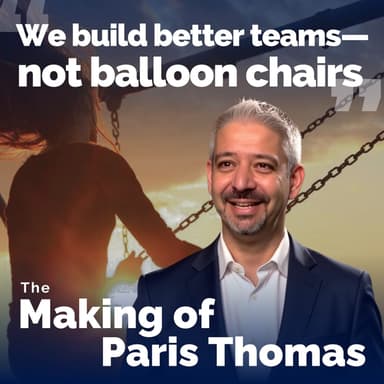
And so, team building. It was, and still is, a buzzword, a loaded buzzword. We do team building, of course we do team building, but what we do is, we build better teams by helping them understand team dynamics.
What we realized through our experience was that when people are sent to do team building events. An example of a team building exercise popular around the world is, here are 30 balloons, make a balloon chair with them. That's fun. It's a lot of fun. It's a high energy event. You're usually at an offsite at some nice hotel in Cyprus, you're probably by the beach.
You have catered lunch. Why would you complain to HR that this wasn't a fun event? You want more of that. You took a mini holiday away from work. But did you change? Are you a better team?
Intro
Tobi
Corporate training sucks, says Paris Thomas, a facilitator and my guest on the Making of a Coach today. It sucks when leaders send their people to training without going themselves. It sucks when it tries to change people without giving them an experience and a reason to change. And it started sucking even more when experiences turned into webinars, because what corporate training competes with today is TikTok
and the next email in our participant's inbox. These are other themes we explore today: how Paris built a team building bootcamp in Cyprus, how he designs and debriefs exercises, and how he turned all of this into the most entertaining blended learning experience I've seen so far. I'm Tobi from metaFox, this is the Making of a Coach, and let's get started with the question.
Meet Paris Thomas: From Canada to Cyprus
Tobi
Who is Paris Thomas?
Paris Thomas
Sometimes I say, if I was a plumber it would be the easiest thing on earth. What do you do? I'm a plumber. End of conversation. In a nutshell, I like to explore how we can learn better.
And how we can stay relevant. And I do that in two ways. One is through learning and development, so my business at Talent Hacks, helping professionals learn in a meaningful way and improve themselves. And the other way is through innovation, specifically through the business model toolkit of a company in Switzerland called Strategyzer, known globally for their thought leadership and tools, and using innovation practices, being agile, to test everything.
My mantra in life is that even about the things you're most certain about, there's a very good chance that somebody else has a different opinion. So the only way that you can create evidence to make better decisions is to test. So I help companies do that. And at the same time I help companies learn in better ways, more fun ways and more relevant ways.
Tobi
Nice to get to know you a bit more. I would like to explore a bit your bio. You are from Cyprus originally, today you're also speaking with me from Cyprus, but you also worked in Vancouver, Canada for 10 years.
The Journey into Facilitation
Tobi
And once you got back to Cyprus, that's when you started to really get into facilitation, right?
Paris Thomas
I got into facilitation when I moved back to Cyprus, but in my different roles in Canada I always had to present to people, whether it was boards of directors or stakeholders. So I've been quite comfortable from an early time in my career addressing large audiences, and I honed those skills when I then had something to educate them on and became a facilitator.
Tobi
And if you think back at that time. At this point I just sent you a link, and I'd love to explore that a bit with a picture card. Thinking back at that journey, your early facilitation days coming back to Cyprus, which of these photos describes the journey, or maybe a specific turning point in that journey?
Paris Thomas
So, moving from Canada back to my home country, that space, that mindset. I'm putting myself in that mindset as I explore some of the pictures that you shared. I think the one that would describe it best is this one.
Tobi
Could you describe the picture to our audience first, and then what you see in there?
Paris Thomas
There is a person on a swing at the highest altitude, ready to be propelled into the other side of the pendulum, I guess. And that's exactly what it felt like to me. Being in a place that was certain, I was comfortable, I had a very clearly defined career path ahead of me. And I didn't move back to Cyprus because I didn't know what to do in Canada.
It was all quite clearly laid out. I moved to Cyprus for the one key principle that I hold throughout, which is, in life I'd like to regret the things I did, not the things I didn't. And so I decided in that moment in my career that this is the time to propel myself into a brand new experience, even though it was the place I grew up.
It was brand new to me at that time to come back and explore what life could look like being closer to home, or at home. And it felt exciting, risky, uncertain, almost like the person in the picture who is probably just maybe going a bit too high and taking a little bit too much risk.
So it was a mixed bag of feelings at the time. And that picture does the job.
Tobi
What is it that you were doing in Canada?
Paris Thomas
In Canada I spent the majority of my professional career working as a government lobbyist for the dairy industry. So my job was to represent local agricultural farming interests to the government, specifically for dairy. And it was a very interesting world of policymaking, environmental stewardship programs, quality programs, and basically making sure that Canada is quite progressive when it comes to these principles, and very different from many other countries, especially neighbors to the south that adhere to more scalable farming practices.
Canada has always been a family farm run kind of enterprise. And I connected with that purpose and I tried to represent those interests and make sure that they were heard. Fascinating, because it allowed me to explore different aspects of the entire industry, from writing policy to participating in boards, to talking to people and understanding how to bridge the gap between different audiences.
It's very different when you talk to, likely, a Swiss or Dutch farmer who immigrated to Canada, whose job starts at four o'clock in the morning, and who has a family that's larger than the average nucleus family. That's one audience, all the way to members of parliament, or even a more extreme audience, people who are consuming the products and have their own paradigms of what reality looks like, especially in the advent of environmentalism and animal welfare and the trend to be vegan, and so many different dynamics.
So that was my job, to make sense of all that and find where we can create win-wins for everybody.
Tobi
And I can imagine that this also involves a lot of translation between different sorts of groups. So that has this inherent element of facilitation in the job, right?
Paris Thomas
Yes. And to me the key word here is communication. It is such a big, all encompassing word. It actually is what I studied, I studied communication science, so I was deeply involved in decrypting: how do we communicate, what frequencies are we on when we speak, how do we actually get our message across from the transmitter to the receiver, in a way that not only
has been done but also has been heard. Most people communicate in a way of, I spoke, I said my piece, that's it. And it's never as simple as that. There's a lot of accountability and responsibility in sharing ideas, in communicating, in making sure it adds value.
So that is the space in which I grew my expertise. And moving to Cyprus and facilitating and getting into corporate training, especially in the topic of communication and team dynamics and leadership, there was a lot of progress on that expertise in terms of how we communicate.
Tobi
Let's go back to Cyprus. When you were propelling yourself into that new part of your life, how did you train as a facilitator? What were your first formal steps, so to say?
From Open Box Communication to Talent Hacks
Paris Thomas
My baby steps were that I got a job at a company that was doing this. So I became a trainer, as an employee. And I got into the world of what that looks like from a business perspective. How do you get clients? How do you approach them? How do you write proposals for that particular job?
And what does it look like? How do you do program design and workshop design? So I learned what that world looked like in Cyprus. But then at some point, very early, within about 10 months, I decided that I wanted to add my own flavor and do things my own way.
Not to say it's better or worse, but it was just different, and I had some other inspirations at the same time. I had met my business partner, Dino, who was also at that company. So we both decided to say, you know what, let's just give it a go, try it out. And we basically made the decision to start our own thing.
And that was the moment in time where entrepreneurship became my way of being.
Tobi
And that was already Talent Hacks, your company today?
Paris Thomas
Yes. We had a different name back then. It was called Open Box Communication. And a funny story to that is that when we were discussing with Dino what it could look like, what could we do, we made a mind map. And in the center you have the starting point, and then you branch off to all sorts of ideas, the typical mind map format.
And I didn't know what to put in the starting point as a name. So I just said, it's an open box. Let's just open this box and see what's inside. And it stuck. And then it became Open Box Communication, which also reflected how we do our training. We kind of open Pandora's box and talk about communication.
And when you do open Pandora's box, you have to be ready to see what's inside, and you can't just open it to peek in and let it go because it stinks. You have to clean it. So we made all sorts of analogies that to us make sense, and to people outside are just blah, blah.
But to us it aligned us. It created key principles and values that we adhere to. And eventually, over time, that's an interesting, maybe a later, story: why did we change to Talent Hacks? But we were Open Box for about 10 years.
Talent Hacks is the last five years.
Tobi
So overall a 15 year journey, 10 years as Open Box and five years as Talent Hacks.
Paris Thomas
Yes.
Tobi
Who were your typical participants? What were the topics that you were discussing in the session room?
Paris Thomas
In the beginning it was mostly mid-management, or even lower level employees. Talking about team dynamics. At the time, the company we worked for, that was kind of sold as team building. And that's one of the things that we quickly realized we didn't want to be involved in.
I actually have a key principle that is sometimes shocking to people when they hear it. I get a lot of phone calls saying, do you offer team building? My knee jerk reaction is, I don't believe in team building. And that's kind of controversial, and it's also part of our personalities and our brand, to be a bit of a challenger brand.
I think team building can be accomplished by a team going out for beer or bowling or something like that. It's way more cost effective, and they get to spend time with each other. I also think that having a professional facilitator doesn't change things in the office on Monday when you get back to work.
So that's why we reframe this as team dynamics. It's when you go deep into the dynamics of a team that you can hopefully begin to comprehend the gravity of the situation, and the responsibilities that lie upon you when you're in a position to communicate. And that's when we built a brand around team dynamics.
The Bootcamp Effect: Transforming Team Dynamics
Paris Thomas
And we created a product that we called the bootcamp effect. We wanted to differentiate. So, back to your question, in the beginning we were talking to lower level and mid management, and eventually focused more and more on leadership. There's an expression in Greek.
It says, the fish stinks from the head. And whether that's true or not, because it's not an absolute statement, it could be that the leadership is responsible, but maybe they're not. The reality is that, whether that statement holds true or not, you have a group of people in a situation where they're expected to change,
because they've been sent to do training. So therefore there's the assumption that you need to develop. Why do you need to develop? There's that assumption again, that you're not good enough as you are. So therefore I'm expecting you to change, that's why I sent you to training. So there are all these subliminal sub-frequencies that are important to understand when you're addressing a group of people who are expecting you to make them better.
If the leaders are not in the room, and I am a participant who believes that it's the leadership's fault, I will be very closed, guarded, and not willing to change myself, if the people who I think need to change are not here and present.
And so, very quickly we realized that we had to create a rule for ourselves, which was: we will not do training unless the leaders are also in the room. And that was a condition, and still is.
Tobi
So that means the people who contracted you, the leadership of the company, you didn't want them to send their people to improve. If you did it, then it was this sort of team exercise with both the leadership and their team in the room, facilitating a conversation. Because when you say you don't believe in team building, what I hear now is, okay, it's a provocative statement, but in fact what you do is of course facilitating a team conversation, going into team dynamics. You very much believe, and this is your role, that a facilitator can ease that process and help the team go in depth, unpack their dynamics.
Paris Thomas
A hundred percent.
And so, team building. It was, and still is, a buzzword, a loaded buzzword. We do team building, of course we do team building, but what we do is, we build better teams by helping them understand team dynamics. Minute one, when you talk to me, I'll say, we don't believe in team building, because team building as a label means you hire a facilitator to get you to play around and have fun, and nobody ever complains about that.
What we realized through our experience was that when people are sent to do team building events. An example of a team building exercise popular around the world is, here are 30 balloons, make a balloon chair with them. That's fun. It's a lot of fun. It's a high energy event. What happens? You're usually at an offsite at some nice hotel in Cyprus, you're probably by the beach.
You have catered lunch. Why would you complain to HR that this wasn't a fun event? You want more of that. You took a mini holiday away from work. But did you change? Are you a better team? Because you could sit on the balloon chair.
So it was about helping them shock the system, to say, we don't believe in team building, but here's how we build better teams, by helping them understand the dynamics, complexity and beauty of communication.
Tobi
So what is it that you did, if you don't believe in balloon chairs?
Paris Thomas
What we did, and still do, it's changed names over the years, but the first name that we went for, for about 10 years, was the bootcamp effect. And it was a bootcamp, at the time that we called it a bootcamp. It was more an expression to say that it's not going to be your luxury hotel scenario, but it's going to be something different.
And why we put the effect there is because what we had created really did create an effect on people. So the key principle, before I explain what this looked like, was that, as opposed to expecting you to change after the fact, we wanted to instill in you a few aha moments and triggers that would cause you internally to want to improve during the two days.
It was a two or three day event. Within this there's another key principle that might be interesting to say here, which is, we don't actually believe people can change. When you go to a training provider who says that to you, again, it's one of those controversial statements. So why am I hiring you then?
Well, here's the thing. People don't change, because unless there's some deep immersion into a topic, or some life-changing, altering event, the loss of somebody near and dear to you, or the loss of your assets, something that shocks your system and allows you to kind of hit reset, you are not going to put in the effort that it takes to change.
And people use that word so liberally, about change, that they don't really understand the magnitude and the gravitas of true transformational change. So we want to call it what it is. I don't expect you to change. You are going to be Tobi when you leave the meeting, just as you were when you came into this training.
When you go back, if you're a person who is not a good listener, and all your life you've been told by those around you that you need to listen more actively, you need to listen better.
You went to performance appraisals and your managers told you the same thing, your colleagues, your spouse, everybody in your ecosystem at some point. How am I going to make that stick? Why am I the one who has the superpower, who's going to magically make you be a better listener? The only thing I can do is to make you aware of what consequences you create when you are the way you are, and give you some tools and tips.
What we eventually called hacks. And why we called them hacks is that you can actually apply them to not only appear to be a better listener, but over time understand the value of that behavior and own it. And if you do, you've built a habit. So I'll give you a quick example.
I have a lot of ideas rushing through my mind. I always listen to somebody and then I want to take the microphone. My entire career I've always owned the microphone. So what happens? The way you behave is also a form of training, right? You train people how to treat you.
And if I trained my colleagues to enter a situation where you don't have to say anything because Paris is going to say something, then guess what happens: at every meeting Paris is the one that's speaking. And at some point my boss in Canada, my mentor and still a really good friend, Robin Smith, told me, why don't you try to speak third in a meeting?
Force yourself to speak third. And it was such a beautiful, what we now call a hack, that when I applied it, within very little time, like three, four days later, a couple of meetings, my colleagues came to me and said, there's something different about you, you seem to be listening more proactively. And I wondered, am I a better listener, or do they think I'm a better listener? And if they think I'm a better listener,
that is their perception. Perception is reality. In their eyes I'm a better listener. But I see the effect it's having on them, and I see the effect it's having on me, through the feedback I'm getting because of this behavior. Therefore I will continue to speak third, or not speak at all, because I see the value in doing so.
Now, Tobi, have I become a better listener or not? It doesn't matter. The fact is that I'm creating value, and that's exactly what we approach as hacks. And the bootcamp that we created was an experience that allowed people to see that behavior in action. It's an experience we still offer today, at a beautiful village up in the mountains in Cyprus, where we use the entire village as a playground.
For professionals to roam around, a moving venue. You're not stuck in one boardroom or training session, you're out in a field, you're in a forest. You get onto this 1960s vintage bus for a short ride somewhere else. You might get on quad bikes. You do all sorts of interesting, mind resetting things.
To then put you in a situation where we run certain exercises inspired by HR assessment center mentality, which is my business partner's expertise. You can think of exercises that involve large items like pallets and buckets and hoses, and there's a problem to be solved.
There's a story around the problem. There's a village on fire, you need to rescue them by raising the flag. There's something that you have to build with your hands, or work as a team to actually get to that objective. It's time boxed. There are certain roles that are delegated, and then people are left on their own to actually do that.
And as they do, we observe. A whole team of us, with psychologists, are observing your behaviors. Little things. Did you go and open the toolbox before they finished reading the instructions? Did you react in some weird way that was disregarding, when somebody approached you to say, hey, there's this water can right there,
maybe we should do something? Did you brush them off? And when all of that is said and done, whether they achieve the objective or not, we sit down under an olive tree and we have a very honest, transparent conversation about what happened. We don't just do this blindly.
We know who the people are, because we've already run psychometric assessments, we've already done interviews in the organization. We know where what we call the elephants in the room are. And we are trying to extract that behavior in a neutral zone. Nothing to do with work, everything to do with people and human development.
And so it doesn't matter if you're the CEO, you're equal. During the bootcamp everybody's just another player in this big game that helps you understand how you're behaving. And then we have conversations that are triggered by us, in the way of, Tobi, you opened the toolbox and John was still talking about the instructions.
Peter, does he do that back at work? And then things get interesting, and that's when you have heated conversations. Yes, he always does it. But you're listening and you go, I had no idea you felt this way. Well, it's about time you did. And then we enter into mechanics and tools and tips and hacks.
How can you do better? So that was the essence of the bootcamp. And it's always more than one day. It can never be one day, it has to be at least two, if not three, because there's what we call the overnight effect. When people go to sleep and their mind has a chance to reboot, reset and rethink what just happened, with the combination of fresh mountain air, a lot of walking around in nature, and lots of feedback from people.
Eventually people get into a safe space where they go, you know what, this is an opportunity. It is not a seminar, it's an opportunity for me to be a better person. Not a better professional, a better person. And that has a profound impact on people who participate. It was a long-winded answer, but I've given you the gist of that part of our training methods, and of the actual product as well.
Tobi
Sounds super powerful. And I would love to go maybe a tiny bit deeper and ask you, how do you design these experiences?
Designing Effective Training Experiences
Paris Thomas
Seventy, thirty. 70 percent is organic, 30 percent we prepare.
Tobi
Oh, wow.
Paris Thomas
This is almost the opposite of what people expect. So, 30 percent means we know the client, we've interviewed a sample of people, we've spoken to key stakeholders, we've run psychometrics. And then we have a template of how we run the two day or three day event.
In terms of program design, there's a lot of psychology involved in this. How you get started, how you build expectations before the event, how you claim the right to speak in the beginning of the event, how you build credibility, how you create shock factors that get people to slowly open up.
And what happens is that over the course of the days you literally see a tremendous improvement in the performance of the team, in spite of the fact that the exercises get progressively more difficult. They actually start to perform better and finish the exercise with a successful outcome.
And then you look back and say, could you have done this last exercise if this was the first exercise we did when we started? And a hundred percent of the time they say, no way. Because they've learned one or two or three things max per exercise, that they applied for the next one and the next one.
So there is a template in that sense. But what happens during the exercises, and what happens during the whole event, has to be organic. We don't like agendas. We work a lot with European companies, Germany in particular, send us the agenda a month before the event.
Just so you can check that box and say, I have an agenda. Well, the agenda is so generic. It says introduction, exercise one, exercise two. What good is that? I'll never forget, we had a session we call the hot chair. We don't always do this, it has to be, we crank the lever up to intense bootcamp mode.
And the hot chair is a session where, imagine a semicircle of people sitting on their individual chairs, and in the middle of that there's one person sitting in a chair looking at the semicircle. But behind that person there is a screen that has live voting. Before these online tools and smartphones, we were using actual devices that we had to carry in a briefcase, where you had to do voting and you get the results at the back.
And it's a bunch of really revealing and challenging and very vulnerable questions about you. So imagine now 20 of your colleagues voting about you, and you don't know the answer they gave. And now you get a chance to look back and see the results, and defend yourself, while they give you feedback as to why they voted that way.
It is extremely vulnerable and it makes people very uncomfortable. They have to be brought to the level where they can accept that vulnerability. And we were having this session, it was five o'clock, we were supposed to finish, and at seven we had dinner reservations at a Cyprus taverna and all that great stuff.
And the CEO goes, we haven't finished, we're only halfway through. I said, I know. What would you like to do? And he goes, we're not leaving here until we finish this. I'm like, fantastic. So we postponed the reservation, we went at nine o'clock for a late dinner. Because there isn't an agenda. You find a pain point and you need to kneel into that and dig in, to find out what's causing what.
That's why also the decision maker, it's not always the CEO, but a decision maker needs to be there. Because eventually I will point the microphone to them and say, you've been here the whole time, you heard everything that was said, you also have recommendations now, in front of everybody: what are you going to do?
And they have to make a decision that they have to stick to. A verbal contract is just as good as a written one. They leave the bootcamp with new contracts formed amongst them. And that's what transformation is. That's what change is. It's not about, we will do this later.
It's about now. So, preparation wise, it always keeps us on our toes, especially on day one when we realize that, whoops, we broke them, now on day two we have to fix them.
Tobi
And I think what I hear is, there are two elements. On the one hand you have the exercise, very experiential, to some extent improvised, and then there's the debriefing where you bring out learning points, the hacks if you want. I hear there's a lot of improvisation, but what are the ingredients to provoke these moments of shock, as you named it, so that you can create this environment where the learning happens?
Paris Thomas
There's a huge list of things that we look for, and it has to do with behavioral observation. For example, one of the key things is, we always have the instructions delivered to two people. We call them the coordinators. The rest of the team is somewhere else, they're not listening. The instructions are only delivered to two people. Their job is to then
communicate the instructions to the rest of the team, and start to plan and get organized before they do execution. One of the design criteria is, who are you going to select from the team of 20 to be the two people that get the instructions?
And you're not going to get everybody to be in that role. So we have to make careful selections, where we weigh the personalities of the people from what we've seen of them so far, and what we know of them, in such a way as to give an opportunity to extract meaningful feedback, where other people can say, I'm like him or her too.
So they can create some sort of connection with what's happening. And there are other things. This is high level, it's the first starting point, who gets to do what. But then, what does the exercise actually bring out? For example, there's an exercise where you need to find water to be able to complete the task.
And we run the exercise somewhere where we know there is water, like maybe 30 meters away. And so we designed the exercise with that constraint in it, to know that at some point they can't complete the exercise unless they look at external resources.
And so we expect that point to arrive where they run out of the water they have, and now they need to fill the jerry can with water. And that's by design, because we know what's going to happen is that there are people who are just looking around. Did they see that there's water somewhere else?
But what's more fun, and more psychological, is that we will then proactively approach the people who we call the harmonizers. They're the people pleasers, very good at listening, focused on relationship versus goal. And they're the people who are the least respected, because they're the quiet ones, but usually they're the ones who have a really good view of what's going on, if you only give them the chance to speak up.
And we'll approach those harmonizers, that in two minutes we've identified as harmonizers. We also know from their psychometrics, but we also play a fun game to say, can we spot it? And then we go to them and say, hey Tobi, just in case you're thirsty, there's water right there. So I'm telling you the answer. And you go, thank you, Paris. And that's it. And you don't share it, because you're a harmonizer. Now I'll go to another harmonizer and another harmonizer, and they don't share it either. They're like, thank you for that information. And then finally I go to a commander and I go, there's water right there.
And what's the first thing they do? Guys, there's water right there, we need to go get the water. And you go, okay, that's a beautiful moment to give feedback later. How do we interact with teams? How do we actually create value? And so we design the exercises to bring out these things, and each exercise has a different set of behaviors that we are trying to reveal.
But there is a sequence too, so you don't start with the most complicated. You start simple and you build your way up to something complex, where people can appreciate how they came to that realization.
Tobi
So what I hear is, on the one hand you play with this element of, we just tell the instructions to only a few people, and that already brings in some group dynamics, where it is about how these people then pass on the mission. And the mission is about solving a problem that requires me to think outside the box, or find something that is outside our direct environment, and we as a team have to resolve that.
Paris Thomas
But it also requires you to apply everything you do as a professional. I have a problem to solve, I have resources. What are those resources? 20 people, or 15 people. Well, are they all good at everything? No. We have different strengths and different weaknesses. So how am I going to allocate those resources? If somebody's really good at problem solving, and now, as part of the exercise, I have a riddle,
maybe give them the riddle. Now, the other question is, who decides who is the leader of the exercise? We don't define it. So when you start the exercise, we gave some people the instructions, we call them the coordinators, on purpose. The coordinators sometimes might decide to say, I'm going to lead this. Or sometimes there is no leader allocated, nobody's making decisions, and they can't complete the exercise.
So all of that is real life. Back at work you need to have coordination, you need to have planning, you need to have project management, you need to have proper resource allocation, you need to have proper time management, you need to have all these things.
So in a 30 minute exercise, in the beginning people will plan for one minute, but then they realize that if we plan for eight minutes or nine minutes we'll finish faster. Some teams realize that they're planning for 17 minutes and they don't have enough time to finish. So you get to see all these extremes, but it starts to create a gut instinct inside them for what's right and what's not.
And then suddenly, by the end of the experience, there isn't much communication going on. They just work. What we create is basically harmony. It's like the perfect chord. And you have this harmony where people just know. And there's a very popular reference to team dynamics, when you look at the four stages of teaming, you know, norming, storming, performing.
Tobi
Storming.
Paris Thomas
Forming, storming, norming, performing. So forming was the first one. What's interesting is that the way we create some sort of understanding around that is, no matter how many times you worked with the same people on a different project, you will go through those stages.
Understanding that is the first step to making positive change. You should expect to spend some time forming, some time storming, some time norming, and then, because you've been good at it, you will get out of the storming stage and you'll start to normalize, and then you'll perform. The key thing to understand is that you can reduce the time it takes to do that.
So whilst in the beginning you might still be in storming when the time has finished, in the end you have 10 minutes remaining and you've performed already, because you've managed to get through that curve. And so we get people to live that and experience that in real life, and that changes the way they look at how they do work.
Tobi
After the exercise, how do you approach the debriefing of the exercise? Is there a certain framework that you apply, or how do you facilitate that conversation?
Paris Thomas
We do a couple of things. First thing we do is, we get in a circle. We ask them, how do you think that went? We first get perceptions. Everybody goes around, they give us their perceptions, if they're happy, if they're not happy, about their performance. And then we ask, what could you do differently next time?
What are the things you identified as problematic areas? So we workshop it, but standing and verbal. People give their own suggestions. Once we extract that, this conversation flows. I ask people, who agrees with that person? We kind of democratically say, yeah, this was important, this was not. But it moves fairly fast.
People want to move on to the next thing. So we spend maybe about 15 minutes on that debrief. And then what I do, and people always want to see this, is: if we were the perfect team, what would be the play by play to get this done as best as possible? To see what best practice is. So I go, well, if I were you, here's what I would have done.
Number one, I would have done this, two, three, four, five. And they hear out the steps and they get, yeah, that's a good thing to do next time. And the final thing we do is, we split people into pairs or groups of three, and we let them go for a walk and have a coaching moment.
So they coach each other. What did I see in you that I think you could improve? And what did you see in me? And so they go and sit on a bench, under a tree somewhere. And they have these moments where they get to deflate, debrief, and take notes. We have handbooks and clipboards and they take their own notes, to reflect on that once the event is finished, and overnight as well.
Tobi
And that allows them to take out any vent, any emotion that is still stuck there, and to derive some conclusions for themselves.
Paris Thomas
Exactly. And as they get more comfortable, they express those emotions during the plenary feedback as well. No, I don't agree with that, I think this. And then usually as a facilitator, when somebody's really controversial, how do you deal with that? You go, who agrees with him or her?
So first you want to see, where does the group sit? Is it just you against 20 people, or is there more? So your job is basically to facilitate the conversation. It's not to educate them. Yes, you do some education in micro-learning moments, because you've seen them so many times.
The Four F's Model for Self-Reflection
Paris Thomas
You've seen these kinds of companies so many times, there's value in that, they want to hear that too. But it's not to tell them the answers, it's to get them to think it through.
Tobi
One model I learned in my trainer's education, or a hack, as you might call it, is the four Fs: feelings, facts, findings, future. So, how am I right now? Am I still really pissed off, and do I just get some steam off? Then, what did actually happen, let's look at that, let's analyze it a bit. Then, what are my realizations, what do I find out here? And how does that affect my future?
Paris Thomas
It's fantastic.
Tobi
I still build on that today, mentally, actually.
The Importance of Self-Awareness
Paris Thomas
Because it promotes reflection. It prompts you to take a step back, look at a situation from a different frame of mind, and be able to question yourself. You cannot lie to yourself. That's the only person you cannot lie to. Deep inside there is this little voice that you can hear that basically says the truth, and there's an uneasy feeling.
Some people try to mask it and tell themselves that they can ignore it, but ultimately it will come back and bite them. You cannot lie to yourself. So that ongoing reflection, sometimes with a group, sometimes just you, is probably the be all and end all of self-awareness, and where the growth opportunities lie.
Outro
Tobi
This is where the growth opportunities lie: in creating real experiences for participants. And then we can ask them for feelings, how do you feel after this experience? We can ask for facts, what happened, what did we observe? And that allows us then to look at what findings we can take away, and how that affects our future.
This four F model is what Paris and I leave with you for today's episode. And if you're looking for a conversation prompt to extract these kinds of facts, feelings and findings from your team, maybe even without a two day team dynamics journey, I can recommend the Speak Up conversation prompt cards from metaFox.
They offer conversation prompts to really help people speak up. There's a bunch of different categories in the card set. For example, the after effects category allows you to debrief what happened, for example in the last two weeks of collaboration. The explosive category helps people to speak up with inconvenient truths, and the compliment corner
makes appreciation easy. The link to this card set is in the show notes, and with MAKINGOF10 you'll get 10 percent off your next order. And with this small ad we end today's episode. On the next one we continue Paris's journey into the year 2020, when the pandemic hit Talent Hacks. They had to reinvent their group experiences, and reinvent
they did. On the next episode we look at the absolutely amazing blended learning experiences Talent Hacks created in response to the pandemic, and we'll unpack what makes good online training, why the real competitor of online learning is TikTok, and how Paris and his team built their online training hardware setup.
And last but not least, also how you can build your hardware setup if you want to deliver better webinar experiences. If you're curious to connect with Paris already, you'll find his LinkedIn as well as the Talent Hacks website in the show notes. I am Tobi from metaFox. This was the Making of a Coach.
All the best on your own journey, and hear you again in two weeks. Bye bye.