Edutainment with Paris Thomas: Innovating Online Training and How to Become a Coach
with Paris Thomas, Co-founder, Talent Hacks
Transcript
Edited for readability: filler words removed, names checked. It may still contain errors. The audio is the source of truth.
Paris Thomas
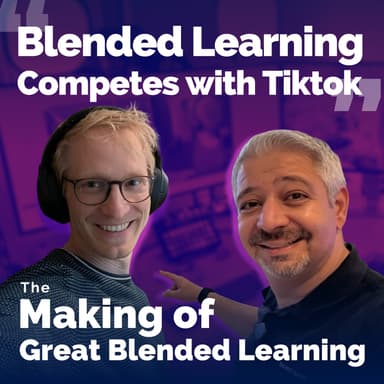
First we realized that it has to be a course that we want to take too. And to be fair, and that's part of our branding and our messaging, corporate training sucks. Online learning sucks even more. And what happened in the time of Covid and the years that followed, with LinkedIn Learning, and everybody has an online course. Who really watches anything anymore?
We always say it's more fun to watch paint dry than to do an online course. So it has to be a course that makes us want to watch it. How would we do it if we did that? And the first thing that came to mind was, well, what do we like watching? We are on TikTok,
Instagram and Facebook and LinkedIn, and we like watching videos. And which videos do we like to watch the most? The ones that are funny. Which videos do we share with colleagues? The ones that are really funny. And so when we realized that we're not competing against other online courses, we're competing against the entertainment industry, that's when
it hit.
The Concept of Edutainment
Paris Thomas
We need to do something that's entertaining while we're training.
Intro
Tobi
Welcome to the Making of a Coach. I'm Tobi from metaFox, and today we'll unpack what makes great corporate team building in a blended learning world. To do so we'll continue the journey of Paris Thomas, whose Talent Hacks in Cyprus created in-depth team dynamics experiences. You can listen to how they craft team building journeys
that hit deeply on our last episode. But for now you can also just stay with us here and continue listening, because with this being said, you have all the context you need. Paris's work was obviously tremendously hit by the pandemic in 2020, but instead of just hitting pause on their work with corporate training customers, they truly reinvented online training.
We'll unpack what makes good online training, why the real competitor of online learning is TikTok, how Paris and his team built their online training hardware setup, and what hardware you can use for delivering better webinars. And as an intro to our conversation, we'll dive into a two minute video insight that takes us right into Paris's experimentation journey of turning team dynamics experiences online.
Enjoy the ride.
Adapting to Post-Covid Online Learning
Tobi
The title still holds very true. Even in the advent of AI, working with humans is probably the most challenging thing we can do.
So this was the one minute twenty-two trailer of an online program that you are selling. How did you build that?
Creating the 'Working with Humans' Course
Paris Thomas
Okay, so first it's 2020. It's the middle of lockdowns, Covid, and my partner Dino and I decide to go on a three, four day offsite, just the two of us, to rethink what's going to happen with the company. All cards on the table. We also combined it with watching the Tony Robbins Unleash the Power Within virtual session.
So we said, let's go watch that. It's a good opportunity now that it's virtual. And then what really happened was that 50 percent of the time we're watching Tony Robbins and the other 50 percent of the time we're chatting, inspired by these conversations. We had already started playing with online training and online videos,
basically asynchronous learning and development, for four or five years before that, but nothing compared to what eventually became what we were doing. We basically said, there's a couple of things to figure out. How do we clone ourselves to be able to do more? Because we rely on in-person training, high touch events like bootcamps, or traveling 150 days a year at the time to deliver training on site.
How do we change that, now that we've been forced to change that? And so we decided a couple of things. One of them was that the Talent Hacks name and brand was born at that offsite, because we wanted to lean in on our users, who had changed. They were no longer Gen X. There were millennials and Gen Z who didn't care about the theory of anything, but they cared about, give me the shortcut to get from A
to Z as fast as possible. So that's a hack. But we reframed that into a habit anyone can keep, because the whole idea is to understand why that habit can be of service to you. And if you employ that, then it's a hack and you can get there faster. And so that became the brand, and hacking your talent became the ethos.
And we wrote a manifesto. And then based on that we said, so how do our products change? We need to build a community of talent hackers. We need to get people trained on the stuff that we've built
tremendous expertise in, which is communication, team dynamics, the psycho-communication aspect of how we combine psychology and communication and make everybody able to communicate better, therefore be a better employee, a better person to work with, a better colleague. When you look at all the HR buzzwords of the day and still to date, productivity, efficiency, engagement, buy-in, ownership, all that kind of stuff, HR comes to you and says, can you make my team better?
Well, what do you define as better? And they state those 12 buzzwords that everybody recycles. And in the end, for us, none of that matters. The key is understanding how you communicate and the responsibility you have when you do so. And if you do that well, you will be
more productive, more efficient, a better person to work with. And you'll probably be more engaged, if we align with the strategic goals of the company and your role specifics and all that kind of stuff. So that was the decision. And then we said, okay, what does it look like if we build a course?
Well, it can't just be another course. It has to be different. And that's when we went into the Working with Humans concept. I'll give you the highlights of what the unique selling points of Working with Humans are, as we had envisioned them and as we eventually built them.
First we realized that it has to be a course that we want to take too. And to be fair, and that's part of our branding and our messaging, corporate training sucks. Online learning sucks even more. And what happened in the time of Covid and the years that followed, with LinkedIn Learning, and everybody has an online course. Who really watches anything anymore?
It's so dry and pointless. We always say it's more fun to watch paint dry than to do an online course. So it has to be a course that makes us want to watch it. How would we do it if we did that? And the first thing that came to mind was, well, what do we like watching? We are on TikTok,
Instagram and Facebook and LinkedIn, and we like watching videos. And which videos do we like to watch the most? The ones that are funny. Which videos do we share with colleagues? The ones that are really funny. And so when we realized that we're not competing against other online courses, we're competing against the entertainment industry, that's when it hit.
The Concept of Edutainment
Paris Thomas
And we said, we need to do something that's entertaining while we're training. And at the time we didn't know that the actual trending buzzword existed, which, as we know now, is edutaining. We called it entertraining, and then eventually somebody said, oh, you're doing edutainment.
So nothing too extreme. It's not stand-up comedy, where you have almost creative forgiveness, permission to do stuff. So we went with something like The Office on Netflix, which is acceptable. It's got that sarcasm, self-deprecating, bozo characters, like a Mr. Bean kind of thing. And we also wanted to be more youthful in the way that it was shot.
So the cinematography was more like Brooklyn Nine-Nine. Fast cuts, no transitions, just weird shots of somebody's look, that kind of stuff, which adds to the humor. And so that was the first thing. It has to be edutaining, and that was the approach.
Personalized Learning for Different Personality Types
Paris Thomas
The second part was that we were also wondering, does any training content adapt to the way I learn? And everybody learns the same way. No, everybody doesn't learn the same way. And we said, what do we know about people, based on what we are good at? We know that everybody has a different personality type. We understand that through our psychometrics.
We actually focus on those different types and subtypes when we do our bootcamps. And we know that in any psychometric test you take, whether it's the DISC by Wiley or Myers-Briggs or whatever, you end up with four to five primal personality types.
And then you go into the world of combinations. So you end up with 12 or 16 different personality types that are combinations of one and the other. So we came up with our own language. We call it commander, analyzer, harmonizer and energizer. And the word itself, to us, does justice to what the stereotype can be,
because in this world you have to stereotype in a healthy way. And then we said, if you combine all those, you have two different subtypes. So we said, we're going to have to shoot 12 different courses, aren't we? And that was the aha moment. We go, well, yeah, because if I'm a commander, it means that I want to listen to you telling me actionable things I can do.
Because as a commander, I get a high from checking a box. Dopamine actually flows through my brain when I check a task. I can't listen to you talk about theories forever. So that video and that content needs to be a little bit different. Faster, maybe brighter light. But if I'm a harmonizer and I just want to nuzzle on my couch, maybe grab some popcorn and just listen to you without responding,
maybe that video needs to be slower paced, maybe deeper in relationship focus, maybe darker lighting as well. We started to explore what that could look like for 12 different subtypes. And that's probably the most amazing thing, and the biggest mistake we made, because it took us two years to develop it.
With a lot of shooting, as you saw in the clip there, outdoors, it wasn't just studio. We then hired sound effects people, music production, motion graphics, so it felt and looked like YouTube. We were competing against YouTubers, so it had to look that part. And then we went into micro-learning, and how do we create all these videos?
So it became a mammoth of a project. The idea, and how it works now, is that when you sign up to the course, the first thing you do is a psychometric, which is now evolving to be done with AI, so it's even faster. Being able to introduce AI to ask certain key questions and have incredible reliability in understanding your learning style, which is a function of your personality, allows us to put you in the right lane.
And there are 12 lanes, that you don't choose, we do, as a consequence of your results. And when you go into that lane, the course actually directly speaks to you. It doesn't say your name yet. Once the AI avatars become better, it can actually say, Tobi, blah blah. But for now it says, as a harmonizer, here's how you see the world, or here's how you might experience some challenges in your world.
So it speaks to you. And it's not about every style, although it helps you understand the other styles. It really focuses on you. And we found that to be the most incredible feedback we got, when people said, this is insane. The kids are asleep, my wife is on her phone, and instead of watching a movie on Netflix, I'm actually watching Working with Humans on my phone. And I go, yes, that is the moment that people typically open TikTok, and we're now competing with TikTok and we're getting people to learn. And they're not just watching the video because they can't skip it.
They have to watch the video, or read the content. So that's it in a nutshell. I can go deeper into any part of it if you like, but that basically gives you a sense of what we aspired to build and what we did build, over a crazy learning curve for us as well.
Tobi
I'd be curious about the mechanics, but I think even more interesting to unpack with you is how you now package that and sell it to corporates. Is it a self-service, on demand course, or is it blended with online live sessions? Do you even bring people to Cyprus still? How does that typically look now for a company that books Talent Hacks?
Delivering and Selling the Course
Paris Thomas
There are three ways we use the course. The first one is self-paced. An individual can go to our website and buy the course, and then they'll get sent the logins and they'll be onboarded onto the journey. It's self-paced. You can do it within a week.
You could be done, or you can drag it out over five weeks. And that's typically the range that we see. And then there's also a leaner version of it. We make it a bit more bite-sized. People don't have time, so there are some topics where we go, okay, let's choose not to deep dive here.
But the whole point is to understand the essence of communicating with humans and working with humans. It goes into the chapters that you saw in the video as well. The onboarding first, to put you in the right mindset. Then the topic of psycho-communication, to understand the relevant facts around how we communicate and how psychology is a big part of it.
Then we call it hack yourself. So that's the self-awareness chapter. And you go in to understand, as a harmonizer, as a commander, what is it that you do, and so on and so forth. And then eventually, once you get that understanding of who those characters are in your life, in your ecosystem, and who you are as a function of that, you go into the next chapter, which is hack others.
So then, what can you do to be able to communicate and get across to other people, owning the responsibility and accountability of the act of communication? And the final one, which we didn't know about at the beginning and were hesitant to include, but then through feedback from our users we realized it was a really good thing to do, was the offboarding.
And the offboarding is basically a very nice condensed summary of everything you've learned. And people said, we really appreciate the offboarding, because after four weeks of doing it, it was nice to be reminded of some of the key concepts. So we have that offboarding as well.
The second thing is you can do it as a team, which is really fun, because we've also done some beta tests to understand what is the best channel and how do we actually change the design of the course to facilitate the enterprise. So maybe you're a team lead and you have 10 people, and you go, let's take this course, the 10 of us.
So in that case it's a different journey, where everybody's doing the course, but there are checkpoints to make sure everybody's at the same part of the course. So we decide on that cadence with the clients, depending on their needs and their urgencies at work and their industry.
For example, a very common one is that every two weeks we'll do a live coaching session. A coach from our team will sit with the team on a call to talk about what you've read, what you understood, what inspired you, what challenges you have. And they do that as a team.
And then what we include with our team plans is one live session in the middle of the course. What happens is that, as you can imagine, if they're a team of 10, 20, 50 people, a company of 150 people with smaller teams divided, what's really interesting to see is, what is the collective psychometric of the company?
How many doers and analyzers do we have? Which departments do they come from? What is the personality of the company, of the team? And so we do a live session to present that. And the funny story here is that the first time we did this, we showed up on our virtual training with our studio, it's a remote session.
And then I walked on stage. People's reaction was that they immediately started applauding. And I'm like, why? I've never seen that reaction. Oh yeah. In their mind I'm a YouTuber. I'm like, I'm not a celebrity. But in their mind they've been watching me on their couch, on their phone, for three weeks, and now I'm live.
So the third way we deliver the course is, we embed it in everything we do.
So whether it's a bootcamp or an academy, the parts of the course are dropped on the phones of the participants, either before they arrive, during, or after. So we've taken that really great content and we're repurposing it to have a blended learning approach, where there's async, but also fun.
And we found that it really works well when people are watching us on the app before they come to an event. They're now primed for what to expect. Nobody's asking for agendas anymore. They understand it's not a seminar, and so it gives them a sense of our personality as well. So we found that that's a really cool way to use the content too.
Tobi
I love that. I really love this sort of blended learning approach that you're taking. And I'm wondering, which one is most in demand? How are your buckets of sales across these categories?
Paris Thomas
The reality is that because of our priorities, we focus more on the B2B market, on enterprise. So teams is what we're promoting, and now we're taking some steps to actually go into B2C and promote the self-paced learning as well. What we do find, though, is that there needs to be a community, and that's a big word.
The community business model is massive. To be able to say, I will take this course on my own, maybe even pay for it with my own disposable income, only if I've been referred to it by multiple sources. I've seen it on a podcast here, I've read about it, somebody on Reddit said something about it.
So that is an insurmountable amount of effort for any business. And it comes very naturally to teenagers and younger folks who are working from their parents' garage, if they're a TikToker, they know how to do that. So we've had to learn, and we're focusing a bit of our marketing at this point on getting into those and forming those communities.
Tobi
So that means usually it would still be a company booking Talent Hacks. And then you use your content and combine that with your entertraining webinars, and you have a super impressive setup.
The Evolution of Remote Training Setups
Tobi
And maybe at this point we can also quickly look at that, because it's mind-blowing, the setup that you've built and how you built it over time. So let's quickly look at that.
Paris Thomas
We are at rebuild number seven right now, and the office is a bit neater. We actually moved location as well, and all the cables have been managed properly. But that was unforgettable for me. Hand on my heart, admittedly I am one of the biggest tech geeks ever, so I've always been tinkering with technology in so many different ways.
There were shots in there where you could see screwdrivers behind me, and I was soldering cables and figuring stuff out. Amazon was delivering screws and little cables three times a day while I was trying to figure it out. And that's where I spent my lockdown. I was in the office until late in the evening, figuring out what this could look like.
While at the same time, in the world, there were a lot of other companies trying to create software to make that possible. Zoom was advancing its capabilities. And even until today, what we set up is better than everything I've tried outside of my setup. And why? Because we decided to go hardware instead of software, and that gives us ultimate control and reliability.
You can't sell four hour sessions of live training to leaders of Nestlé and then show up and all of a sudden you have software issues. It was something that really changed the game for us. The reality is that when we do a Zoom call, just saying that it's a Zoom call is such a discount to what you get. Because it's almost like watching an NFL or an NBA game, with motion graphics coming up, changing my size, my location, a nice fade into a movie,
coming back to this, sound effects. When people go into a breakout session there's a beaming up sound effect. When they come back, it's a rock concert, so there's rock music. All of that stuff is now sort of second nature. And there's an incredibly large set of buttons that I've memorized.
I think I developed a part of my brain. I allocated that RAM to only focus on pressing the buttons, because I'm the one producing it live, while my team is also supporting me in so many other ways.
So one of the things that we built, that was an empowerment and I think one of the things that makes training better remotely than in person, is what we call the behind machine. The behind machine is basically the brain behind. It's a screen above the large, 98 inch TV where I see people's faces.
Above that I have a smaller monitor with messages sent from my team while I speak. If somebody asks a question, my team might do research, and now with AI faster than ever before, and give me tips towards the answer, and I'll go, well actually, for a fact, here's what's happening, John. All of a sudden I have a more expanded brain, because I have feedback coming from other sources. It's also useful for, John has a question, his hand is up, you haven't seen him, or your microphone's not working well. So with these kinds of things it's become a full on TV production show. And it's been a lot of fun and I enjoy it thoroughly.
Tobi
And when I was watching the full documentary, what we see now were just some shorts, and there's an almost one hour version on your YouTube channel, right? I thought, wow, such a massive hardware show, and then also always a minimum of two people managing that hardware.
I thought, that's so much effort. But then, if you compare it to traveling to Switzerland to deliver that workshop, that's of course also a huge effort. So if you compare it to that, both of you can sit in the comfort of your home and co-deliver that session.
So if you compare it to the live training effort that you had before, it's actually probably a downscale in terms of logistics.
Paris Thomas
A huge one, because I will come to the office and 20 minutes later I'm live. Living in Cyprus, I need a day to travel anywhere. Usually I'm there the day before to prepare, so that's two days, and then one more, that's three days I'm saving, and I'm condensing that into 20 minutes. And the best thing is that when I'm done, I just power off and go home.
A lot of it is obviously automated. Alexa is a big help here. I'll say, Alexa, studio on, and things will start to happen. There are about 22 buttons that need to be pressed, so that's obviously not manual. There's a lot of work that went into the lights and the sound and all those different things.
It was definitely a change in direction. And I think the whole world was accepting that this is going to be the new norm. Of course, it isn't. A lot of the requests that we get now are, can you please come? And so what we always do is look at a project as a function of time,
something that has a duration of three months. It's never a two day event. What we do is, we might kick off in person, that helps build those relationships with people and the rapport, and then we'll continue in this fashion, online, remotely, but still with that level of excitement, or a different type of excitement.
And then we'll conclude, maybe sometimes, in person, so you can have a drink together and celebrate the success. It is definitely not what we thought it was going to be in 2020, when we thought we'd never do in-person training ever again. That didn't pan out to be the case.
Tobi
So now your reality is maybe kickoff in person, on site at the client. Then they get sort of their homework, entertraining on the couch in the evening. Then there are some live interventions online, where you again rely on your massive setup.
Paris Thomas
Exactly.
Advice for Trainers and Facilitators
Tobi
And if I were now a Tobi at a very modest company, or even a solopreneur trainer, and I want to level up my webinar and online workshop game, what would be the minimum viable alternative to what you have built?
Paris Thomas
You have no idea how many times I've been asked that question. In fact, at some point it became a service. I would charge people for consultations, just to see what people actually use. There's the basic, basic minimum, which is, you need a good camera, and you need good light and good sound.
And there are tons of YouTube videos to guide people to do that. The key decision criterion is, if you decide to go the hardware way, and that's the only way I can speak to, I don't profess to be an expert in the software way. I mean software like Ecamm Live and OBS Studio. I don't use that.
Some people do and they're very happy and I have nothing against it. I go the hardware way. So for me, what you need is basically what's called a video mixer. The ability to have multiple HDMI inputs or USB-C inputs, where it gives you the ability to mix it into whatever you want. So when you output, you output into your Zoom call, whatever you want.
So you could have my image from the camera, but picture in picture with my slides, so that's a second input, but maybe I'm writing with my iPad, that's a third input. And so you start to layer these inputs. And that's the programming that would be needed, and that's no longer a minimum viable product. It becomes a bit more sophisticated when you go into the programming. So at a bare minimum, what I would suggest is having a DSLR camera, not a typical webcam, but a proper camera. I use the A6000, I think it's a Sony, and it's connected to a battery that goes straight to the power supply, so I never have to worry about battery.
So that gives you really good 4K resolution, even though on Zoom the maximum you can get is 1080p HD, if you ask Zoom to enable that. And I remember the calls I had with Zoom in 2020. They didn't have 1080p, they had 720p, and my job could not be done with 720p. So I had to contact them, get on multiple phone calls, and they then, behind the scenes, enabled my account to be 1080p.
There are other things, like the Cam Link that I refer to in the video, which is basically a little dongle that has HDMI on the back, USB-C in the front. That can also do the job. And so that would be something that really levels up the quality of the picture. For example, if I go to show you the little heart tattoo that my daughter put on my hand, immediately the focus changes and it's crisp, right?
A webcam doesn't have that responsiveness, or the depth of field of the colors behind me.
And so that's an example of, you need to figure out what that looks like for the user, so they can have a good viewing experience. And your lighting is fantastic. You obviously have a light point in front of you. You have a light point behind you. You have the dark depth of field, it's out of focus behind, and you're in focus in front.
These things are more than enough to get a pleasant experience. And then it gets more complicated.
Tobi
So I went the software route, but I also have pretty much the setup you just described. I have a DSLR in front of me. I have a small Rode mic down here.
When I went down the YouTube rabbit hole a bit, how do you build an efficient but still great setup, I think the biggest learning for me was lighting. I would even say, if you have the choice between light and camera, stick with
Paris Thomas
light.
Tobi
the smaller camera and get a proper light.
Paris Thomas
I love it.
Tobi
Super cool. Okay. I hope that is also valuable for trainers and facilitators who take their practice online, who have probably done that already, but I think
Paris Thomas
Tobi, sorry to interrupt you. Can I say something? Because our audience is probably going to be a lot of facilitators, workshop facilitators, trainers. I just want to say something, because I see it all the time and I feel it's also worthy of being noticed. The world is usually divided into two parts.
You're either Mac or you're PC, you're Zoom or you're Teams. The reality is that you're anything you want to be, and if you want to figure out a solution to a problem, you can. And so there are the people who say, I'm going to find an excuse to say, ah, but I'm not on Zoom,
I'm on Teams, therefore I will not even try to get on Zoom. And that doesn't mean Zoom is the solution. Or they might say, yeah, but I don't know if I can actually do what Paris does. He's running a workshop while producing. My mind doesn't work that way.
I made it work that way. And whatever it is that you complain about, it's like, oh, where is that share screen button again? How many times do we get on calls where people are like, well, I'm sorry, we're Teams people, I can't find the share screen on stupid Zoom. That negative predisposition is not going to get you to up your game in any way.
So it's just to say, you know what, it can be done. I can put in the hours, and if I put in the hours I can figure it out, no matter your age and no matter your operating software.
Outro
Tobi
I love Paris's spirit of exploration and invention today, and for me it's the red thread throughout his career as a facilitator. If you want to learn more about his Working with Humans course, how they approach the whole online experience and the hardware setup, I can really recommend the
Talent Hacks YouTube channel. There's tons of making-of and behind-the-scenes material there. And also the Talent Hacks website. We link both in the show notes. Paris's spirit of reinvention is also the origin of a whole other Paris persona we didn't show much of in today's episode.
Paris is also a seasoned innovation consultant and expert in working with tools like the business model canvas and customer personas. So he built a tool called Rapid Visual that helps innovators and consultants 10x their innovation output. So this is what we are going to explore on our next episode of the Making of a Coach.
Again with Paris, we'll explore what facilitators and coaches can learn from product innovation. But for today, this is it. If you like the episode, please leave a rating and share the Making of a Coach with a friend. I'm Tobi from metaFox. I say bye bye, and until next week.