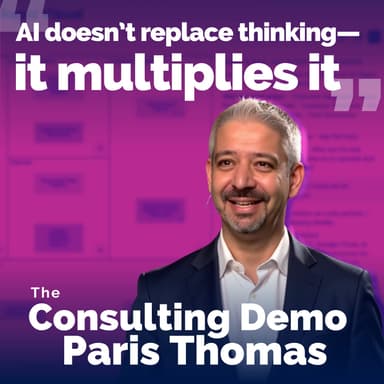
Innovation Consultant Paris Thomas: Leveraging AI and Business Model Canvas for Success
with Paris Thomas, Co-founder, Talent Hacks
Transcript
Edited for readability: filler words removed, names checked. It may still contain errors. The audio is the source of truth.
Paris Thomas
The biggest mistake is that people look at it as a planning tool, and so they go into execution mode. And innovation is a mindset. There's a methodology that helps you carry out that mindset, but innovation is a mindset. And so it's the job of the trainer to explain that and prime the audience to be ready for that, because very few people in the world
have a job of being an innovation manager, innovation director. Most people think, I have a job description that says, here are the jobs to be done, and nowhere in that job description does it say, I need to fail. But innovation comes with that job description. The job description is simple. Get out there and fail as much as possible, as quickly as possible and as cheaply as possible.
Tobi
Have you ever put out an offer to the world and found that nobody wanted to buy it? At metaFox we had this experience quite a few times. For example, last year we tried building a training program on creating deeper experiences with our coaching cards, and only a few people were interested in buying it.
Maybe you know that situation. For us, I always thought this was a marketing problem. The few people who had attended the workshop were actually quite enthusiastic, but maybe there are still issues with how we design and frame the offer, and how that connects to our customer persona. So today I'll explore with Paris Thomas, who's not only a leadership trainer but also an experienced innovation consultant,
how we as entrepreneurs, solopreneurs and consultants can leverage AI and methods like the business model canvas and customer segmentation to really revolutionize these kinds of innovation processes. I'm Tobi from metaFox, and welcome. On this demo episode of the Making of a Coach you can firstly listen to Paris and me, and later
it might also be worth getting out your phone and checking what's happening on the screen. Enjoy, and let's go.
So in our last session we explored and really got to know in depth Paris the leadership development trainer. There's also a different side to you, which is Paris the innovation consultant. You started the first startup accelerator in Cyprus,
and you've also worked as a consultant for Strategyzer. And that makes me wonder, what brought you from leadership training to innovation?
Paris Thomas
Thank you, Tobi. On the last episode we also explored Paris the geek, and those things are related, because from a young age, as far as I can remember, when I was eight years old I disassembled my parents' TV set and never put it back together. But I've always tinkered with things.
When I went to do my graduate studies, I always had this dream of becoming an inventor. So I would build things, I applied for patents. I would use CAD software, the early days of Google SketchUp, if you remember this, this was the early two thousands, and just find a way to visually manifest my ideas in such a way as to either get traction or use that to do something with it.
I have a huge folder of ideas that I've tinkered with. But at some point I came across this book called The Art of Innovation by Tom Kelley, who's the COO of IDEO, one of the leading firms, and the one that popularized the design thinking methodology. And that's when I had the aha moment, that it doesn't mean I have to be an inventor, but I can be an innovator.
And I saw how my personality, my love for communication and getting people to work better together, coupled with innovation as a discipline, I could find a home. So that was the beginning. And then through my career, starting my own company in learning and development, I got into entrepreneurship, which is all about innovation and being agile and looking at that mindset.
And eventually, at some point, I crossed paths with Alex Osterwalder, who is the inventor of the business model canvas, the value proposition canvas, five bestselling books, all sorts of great stuff that's now considered the number one toolkit for innovation and value creation around the world.
So that was back in 2012. I was also running two other startups. We started the accelerator, I had my own startup, I had the learning and development company. Some of you who are listening to this might be wondering, that's not a good thing. And you're right, it's not. I had way too much dilution of focus, but a lot of love for exploring and figuring out things.
My journey led me to work closely with Alex Osterwalder to deliver this toolkit to corporates. I worked a lot with startups. Three to 400 startups a year I would train. We co-founded the largest global green ideas competition, called Climate Launchpad, in partnership with the European Union.
That got me traveling all over the place to train entrepreneurs. But then you realize that startups don't pay. The same mindset is also very useful for corporate startups, and that's where I ended up, using that as my playground to go and deliver value to them.
So I've used innovation tools, I've coached hundreds of teams. I've seen ideas go from a shower, where somebody had the thought of an idea, all the way to, now we're in the product, we're in the market selling a product. I've experienced what the pivots are, and I know what it's like to go home after you realize you need to pivot and cry in an embryonic position, because you're sad.
But then eventually, with time, you realize that you've been educated by the market. Now we're in 2025, and in the last two years I've followed a journey that allowed me to answer the question, is AI one day going to take over my job? Is AI going to sabotage my job as a consultant and advisor on topics of innovation and entrepreneurship?
And the best way to answer that question was to do it. So we built the tool that fired me, and now we have Rapid Visual as a spinoff of our venture studio here, where we basically created an AI that is, almost on a daily basis, scaring us as to what it can do. And it's still early days, but it's getting a lot of traction and I'm very excited about it.
Tobi
So as an innovation consultant, you are building the innovation consultant to replace you.
Paris Thomas
Yes.
Tobi
In some ways.
Paris Thomas
And who knows what the future holds.
Tobi
And if I check out your YouTube content, your posts on LinkedIn, you talk a lot about experimentation and about failure.
You just mentioned it. What would be an example from your entrepreneurial path?
Paris Thomas
There are a few that come to mind, but I think the one that's more entertaining for me is that in 2017 I embarked on a journey. To cut a long story short as to why we got into it, it was very exciting at the time to create something that adds value to the world of 360 degree video. At that time we were very excited. We had a technical co-founder, and together we built a four axis stabilized gimbal with nine GoPro cameras on it.
That, today, is this.
Tobi
Right.
Paris Thomas
But that's not our product.
This is an Insta360.
Tobi
For those listening and not watching, Paris is holding a kind of two-sided camera into the camera.
Paris Thomas
Yes. This is a two-sided camera that gets 360 video with better stabilization than we were ever able to create with our rover, that was remotely controlled, that we walked into a scene, that Netflix was going to buy and make 360 degree videos with. That never became a thing. So, a lot of assumptions. And you can be the best doctor in the world, but you're the worst patient.
So everything I was telling my clients to do, I didn't follow that advice. The best advice, I realize now, is that you need to have good mentors. I didn't have good mentors, because I was a mentor, so why would I need a mentor? That was a big lesson learned. Nowadays I have an advisory council of people telling me what I need to hear.
That is really important, because we focused on building the technology instead of figuring out if there's a market for it. We spent some money, we invested in it, we spent time. The key thing to understand, to make it simple, is that there are always going to be assumptions about what your ideal future looks like.
So my rule of thumb is, if you can build something in less than two weeks, build it first. Get that off your chest and then go test with the thing you built. But if you can't, if it's the next electric vehicle, figure out ways to experiment.
And there are many ways nowadays that we know of to get out in the market and get some really good evidence, data points to help you course correct that idea towards a better place. And that's what we built Rapid Visual for: the ability to help you have that conversation with your team and figure out, what does the business model look like?
What else could it look like? How can I align with my team so I can begin my work towards validating whether I should build it?
Tobi
So in your story, you got super excited about this idea of this fisheye camera, and your assumption was that people would be excited about that as well. The viewers would be excited, maybe the likes of Netflix would be excited to use that sort of hardware. And then you realized, after spending lots of time and possibly money, that that's not the case.
Paris Thomas
A year and a half later we decided to shut it down, because it wasn't going to go anywhere. And already GoPro and DJI came up with cameras that basically did what we were trying to do with hardware. They did it with software, way better. But the biggest learning I got from that experience has become one of my top pieces of advice I give to my clients.
About a year and a half into this venture I was visiting New York, on a mission with my accelerator to meet investors for the startups that I was coaching. And, as a geek, I went to the ultimate Disneyland for electronics, a shop in New York called B&H Photo. And for those who might not know B&H Photo, imagine an entire New York City block, three floors high, only electronics.
And so I went there and there was an entire section on 360 degree video. And I went to find the salesperson in that section, who was educated not only by understanding the technology, but more importantly by talking to customers all day long. And I had a one hour conversation with him.
I never told him what we were trying to build. I was just quizzing him, only to realize that nobody cares, nobody's buying, and this section is going to be dismantled soon, because DJI and GoPro are coming up with something new very soon. If only I had known that on day one, which was a year before that.
So it wasn't that far off. And then my advice that I give to people is, when you're thinking of building a product or a service, find something adjacent to it, something that's similar, that you probably will be competing with for the same job to be done. Find the person whose job is to sell that thing, and take them out to dinner.
Heck, pay for their vacation and spend a week with them if you can. They're a goldmine, because they're interviewing customers all day long. It's their job. And obviously that's not always possible. But what we help to do is get people to understand that you need to get out of the building and talk to potential customers.
You cannot outsource that to consultants. You need to get out and listen to it. And so we have a systematic method that allows you to do that. I'm now in the process, myself and a fellow advisor from Strategyzer, Christian Doll, of, well, together we invented this system of how to get you prepared and how to have conversations with customers.
And we're now in the process of actually writing that as a book. So, very excited for that.
Tobi
Awesome. And I love that example, because if we now get back to our audience, coaches and facilitators, probably very few of them would say, ah yes, I always wanted to build a camera, thanks for that advice, Paris. But of course these sorts of fallacies are also out there waiting for us if we build a new coaching offering, or a new training program, or maybe an online course, or even a webinar or an email course. So I'm wondering,
which learning or advice from this product innovation world is underused from the perspective of facilitators and coaches?
Paris Thomas
Well, why don't I show you?
Tobi
Yes, let's do that.
Paris Thomas
Why don't we take metaFox as an example and use AI to do the work that we would do in two days, but let's do that in seven minutes.
Tobi
Okay.
What we've been trying for a year already is putting out training offerings for our clients. How can I best work with the stronger you strengths cards, or how can I use the power of pictures in my coaching and facilitation practice?
We thought, let's not build a three day program, or even a seven day journey, no bootcamp like you are doing, but let's build a 90 minute training program. And the people who attended were also really enthusiastic and loved it. But we also figured, ah, this hour and a half thing, it's kind of too small.
It's not a certification, I cannot say I'm now a better coach. And it's also too big to just be a webinar where I say, okay, let me take half an hour during my lunch break to get a small prompt, a small teaser.
Paris Thomas
What you're describing is the constant leadership dilemma, where you're wondering what is the better thing to apply. And the only way you're going to get answers is, you keep trying different ways and keep failing until you don't fail. And so what you learned there is that shorter will probably echo more.
And this is the world we live in. I mean, our course was five weeks when we started. Who wants to do a five week course? They want it in five hours, or five minutes if you can give it to them. If I could plug into their brain, they would choose that every time. Nobody's going to sit there to watch five hours if they could plug in for five minutes and get an upgrade in their mind.
So that's the way to frame things, and the way to get to those conclusions is through coaching and mentoring, or with the help of AI. So why don't we do this? We'll take your business model, which will include products as a preamble, but then we can edit it. And one of the key things to know is that the way we created this AI tool is to allow you to edit things.
It's not a place where you make decisions with AI. AI gives you better alternatives, so you can decide where you want to take it, and also be able to edit it. So, start from a place of edit is our mantra here. And the way to do that is, first, let me show you. Are you ready? Should we get into it? This is Rapid Visual, which helps you make smarter business strategy decisions.
And it does that by instantly visualizing those strategies, with AI trained experts and guided insights. So there's a lot of IP in here from the world of innovation, from my experience and other people in my network who basically came together to say, let's train this thing to do our job.
And so that's the homepage, that you can browse through, but it allows you to do certain things that you can see are quite visual. Now I'm logging into a dummy account I call garage. And in garage I have a few examples I usually do as demos. So the first thing I'll do is, I'll create a new business model.
We're going to call this metaFox. And here I can also put in the context and the question I'm wondering about. Now, in the world of AI, anything you type anywhere in this tool is training the AI. So I can't just type anything.
So for now I want to leave it empty, because I'm going to get there faster in a more unique way. Here's your business model. It's a blank business model canvas and it doesn't say anything. So we can spend the next 10, 20 minutes creating it one by one. But why would I? So what I've done is, I went into ChatGPT and I said, give me a business model using the business model canvas as a framework
for this company. And in there I put the link to your website. Now what I will do here is, I will import this link. I'm going to take a prompt that is recommended in Rapid Visual and I'm going to go back to my ChatGPT.
Eventually, in a few days actually, we're going to have this built into the tool itself. I can see here already your business model, but I'm going to drop this prompt in here and I'm going to send it. So what will happen now is that ChatGPT already did the hard work of going through your website and understanding what you do, and reconfiguring that as a business model canvas.
Tobi
Can you briefly explain the business model canvas for anybody who's not yet familiar with the framework?
Paris Thomas
Absolutely. What we see here now is basically a function of probably four hours of a workshop, but we just did it in less than four minutes. So we have the value proposition. There are nine elements to the business model canvas, and they're used to describe any business on the planet.
And so they're the nine ingredients to make a business. You have the value proposition. What is it that you offer to your customer segments? So, who are the customer segments, and what revenue are you creating from them? Not how much, but the revenue stream. What are the revenue types? Subscription, transaction.
Then you have your distribution channels. How do the customers reach out to get access to your value proposition? On the metaFox website it's your official website and social media, this is how they reach you. For example, if we take one customer segment, professional coaches, they want to come to you because they want access to visually engaging coaching tools, which are cards, cubes and visuals to aid reflection and discussion.
This is what you offer to that audience. You also offer that to corporate trainers. And you also have an additional customer segment, the educators and facilitators, to whom you offer free educational resources. At least that's what the AI understood from reading your website. And it's a nice brand audit here.
The channel is your official website, which I'm going to do some color code correction on because it signifies relationships here, and also your social media. That's how people reach you currently. And what you offer to create relationships with these customers is the newsletter and free content that you deliver.
And you also offer customer support. So if we stop here, as we explain the business model canvas,
what do you get as revenue? You have product sales, that come from your visually engaging coaching tools, and you have partnership development, which covers collaborations on custom tool creation, which is derived from your educators and facilitators customer segment.
Tobi
Yes. So in the end, the core of our business model today is that we are a publisher. That means we sell print learning materials, you could say. And those are sometimes created in collaboration with authors or with subject matter experts, and they co-create with us.
Paris Thomas
And the partnership development, does that come with a revenue sharing agreement?
Tobi
Yes.
Paris Thomas
Now, what we just explained here, these five boxes, are what we call the front stage of the business. This is what everybody can see, including the AI, by going to your website. Now the AI will make a guess as to what the backstage looks like.
So the AI is asking, what are the key activities that folks at metaFox do really well to be able to sustain this business model? Things like product design and development, which I know you do. E-commerce management, which I also know you do, because you're selling stuff online. And community engagement, which you obviously must do, especially with your educators and facilitators.
So it's guessing, to say, to be able to give this business model to the world, what are the things I need to be really good at? It's not everything, it's just the key things. Usually five, six, seven things maximum.
And then you have, what are the key resources that you need to be able to do that? Well, I need a product development team. Without that I'm not going to be relevant or fresh with what I'm offering to the world.
And I need to have a digital infrastructure. That's probably going to be one of my cost drivers. If I look at my costs below, you have product development, you have manufacturing and logistics, and you have marketing and engagement. And probably we should also add IT development here as a cost, for all your infrastructure.
So that gives us a bit of a sense of what your business model is like. But it also gives us the opportunity to see who you need to partner with to be able to bring this business model to life. And it says coaches and trainers are customers and partners in some ways. Is that accurate?
Tobi
That's quite accurate.
Paris Thomas
Nice. And it also says, collaborate on product development and feedback. So you have a little subnote there that's also used for AI knowledge. And then you have printing and logistics partners, which I'm sure is a big deal.
Tobi
We are also selling our products on Amazon. Even though we spend most of our time building our own shop and promoting our own shop, Amazon still is a key partner in our distribution.
Paris Thomas
Amazon is there now. And now let's also align everything so it looks nice and pretty. And there we have a high level understanding of your business. What can we do from here? Well, the first thing, which we're not going to do live because I would spend 10, 20 minutes on this, is to go through every single box and refine it.
Understand, is it super accurate? Am I happy with this? If I was briefing a team of McKinsey consultants, would this be the information I would give them, or would I correct it? Because if it's garbage in, it's garbage out, and it costs a lot to hire McKinsey, so you would give it as much of your attention as possible.
That's the same mindset you need to have here. So once you've done that, let's assume we did, and this is the result of what it looks like.
Tobi
I could also do that now if I didn't have metaFox. If I were simply a coach, a facilitator, I could also feed ChatGPT or Rapid Visual my website and get that external view on what it is that I'm doing today, and how this looks to the outer world.
Paris Thomas
Yes, almost like a brand audit in some ways.
So that's one thing.
Tobi
And then the other thing would be to actually expand the business model. So in our case, and maybe that is also something we would have in common with our customers, our community, the trainers and the facilitators, is that we have an established business. We have a community. And now we would love to build an online course.
Paris Thomas
Okay, so you would want to explore what it could look like if you were to add an online course to your list of value propositions, and what would that do to the rest of your business model? That's a great strategic question, Tobi. So this is exactly what this is for. Let's do it in two ways.
First, let's see if the AI would recommend it. I clicked on plus on value proposition and I clicked on generate value propositions. What is happening now is, the AI is reading everything that we gave it, and it's saying, if this is the business, what else could they offer that utilizes and leverages the existing infrastructure, with a few additions perhaps, but that makes sense to add to their suite of offerings? As it's doing that,
I'm going to prepare, in case it doesn't suggest online courses, and I'm going to write online courses, which I can manually introduce to my business model here. I'm just going to change its color to blue. But before that, we have the results. Now, you could do an interactive mobile app, customizable workshops, community forums, AI driven insights, gamified coaching tools, subscription based content, personalized learning paths, virtual reality experiences, live webinars and events, integration with CRM systems, mental health resources, and cultural sensitivity training.
So does any one of these look like what you had in mind, or maybe different, but interesting enough to pursue?
Tobi
Overall it's quite an interesting suite of suggestions. The mental health resources, that's something that we are doing already, we have lots of free PDFs online. And we are also working on our web app and later possibly a mobile app. But I think what would be really interesting, and maybe also comparable for our audience, is to go into the personalized learning, all the educational offers. And what I see here which resonates with what we have in mind is this blended learning offering, in a way similar to what we actually discussed about Talent Hacks in our previous session. So what we have in mind is an online learning offering that is on demand, that I can basically watch on the go, and that is then combined with live online workshops where I can go into practice, and also combined with a community forum where I can interact with my peers on the course. I can ask them, hey, how are you doing this? And we have this very social, interactive learning experience. That is what we have in mind.
And I can see that combining three of these post-its.
Paris Thomas
So that's one way to do it, where you take the initiative and say, I want to combine some of these things. I've been inspired, and I wrote, based on what you were saying, on demand online learning blended with workshops, as a title description of that. If you're happy with that we can go with it, or you could pick any one of these and then make that the thing.
So once we put it in, then we go in and say, building a learners community. Was there a particular topic you wanted to tackle here, to make it more specific?
Tobi
I would start with strengths, because the stronger you card set is one of our best sellers, and we are also building a Strength Explorer assessment feedback app on the side.
Paris Thomas
Strength Explorer assessment. Okay, so I wrote that in. And again, it's almost like I'm educating the AI now, so it can give me better recommendations. And so the first thing I want to do is ask, which is the audience we're looking at? Educators, facilitators, professional coaches? Is there a new customer segment?
Tobi
That's a very interesting question. What we see with our cards is that they are used by all of these. I could use them in one-on-one coaching, but I could also use them in a team.
Paris Thomas
So let's pick one for now to simplify it, and we'll pick corporate trainers.
Tobi
Let's do that.
Paris Thomas
So now we see the customer segment details, where you can fill in the details of your customer segment, your potential customer.
Corporate trainers. What are their age brackets, their gender, their location? But you don't have to start from scratch. You start from a place of edit. So the AI took a stab at what it could look like, and it decided to present it to you and you get to influence that.
So what we see now is that the tool went in and decided to give you an explanation of the customer segment. So, corporate trainers, age 25 to 65, tech savvy, education and HR professionals, and so on.
An example of that audience is Leo Perez, who is from New York. And Leo Perez is a seasoned corporate trainer with a passion for innovative learning technology. So it gives you a persona. It's always nice to put a face and a name to the customer segment. And on the right we see the jobs to be done, pains and gains
of this particular person. And that's a tool popularized by Clayton Christensen that allows you to explore what the primary things are that they're trying to accomplish, in the context of the space where they're trying to create that innovation. So in the space of online learning, what are the types of things they're trying to get done?
For example, design engaging training content, maximize learner engagement, facilitate community building. What are some of the obstacles that might be there? High dropout rates in training sessions, or lack of engagement from participants. And what you do is, you go through this in such a way as to accept the recommendations of the AI or decline them,
so that by the end of the polishing you have no more check marks and X marks left on this canvas, because you have now transferred ownership to you.
Tobi
And I guess in reality I could do that not only based on my own assumptions and biases of how I view the world and my customers, but ideally I would call up my corporate trainer friend Paris and say, hey Paris, do you have half an hour to maybe define that persona? And you could actually tell me, is that a pain? Is that a gain?
Paris Thomas
Absolutely. The question, though, looking at this again, so I've accepted some of them and declined others. What I've learned in the last year of using this in workshops with teams is, when you have a corporate innovation team, usually about four to six people, so let's say five people, they come up with jobs, pains and gains that they think this person, who they don't know, may have. Or the AI comes up with the jobs, pains and gains.
What do you think is usually more detailed, more beefy, more qualitative, better overall? A large language model that knows everything about these people that's out there in the world, or you and your four colleagues who are guessing? And I found the quality of the output of these workshops to go up 10 times.
Even if I sit there as a coach, if I don't know this audience I can't tell you. But really it doesn't matter, because the job isn't actually to know. The job is to have a starting place, so you can get out of the building and interview people like Leo to find out if what you have is true or not. So this is your preparation.
It's not your final output. And to do that, you start to profile the customer. And then the next thing you do is, you create a customer value scene. The way you do that is, you select your value, which is the on demand online learning blended with workshops.
Once you select your value proposition, you also select the job you want to manifest here. So maybe maximize learner engagement, and lack of engagement from participants. So once I say, please go ahead and create that storyboard for me, what will happen is that the AI will create a visual storyboard that you can then use in your interviews with these potential customers, to explain to them what possible value you might be able to offer them.
Tobi
So I could start even from the jobs, pains and gains canvas, or also from that scene, and then start crafting my landing page where I would put out the offer, or go into interviews with that and say, hey, do you actually see that as a realistic description of your reality?
Paris Thomas
And I wouldn't do a landing page first. The first thing I always tell people to do is get out and talk to people. But when you do, bring some stuff with you. Have a profile that you can align on, to see if they really have those jobs, pains and gains. And have some value scenes, maybe five, six, seven of them, that show what value you want to communicate.
The moment of need is basically the one area where you articulate where the problem is. Today is the second area, where you articulate what they do today. And tomorrow is what can happen with your value proposition in mind.
But it's told as a cartoon. So, the moment of need: I wish there was a way to make these sessions more engaging. But today, at least they're paying a bit more attention today, if you were to do it as a workshop, maybe. And tomorrow: this online workshop is fantastic,
everyone is participating and learning so much. So now you have a place, again, of edit. You can change the narrative, you can change the script, you can change what the image looks like. You have a starting point. I see that eight out of 10 times it's good enough as it is, but we started a bit more generically, so making it explicit is key.
Maybe it's a feature of the thing you have in mind that we want to test here. But we also addressed it with the job and the pain of engagement, that was inspired by the profile that was driven by the AI's knowledge of that particular customer segment. There's so much knowledge that was in play to get us to where we are right now.
We're going to get out of the building, we're going to talk to these people to see how correct or incorrect we might be. And that's the learning process. Now, with that in mind, a final thing I want to show you is that you do this for your customer segments,
you do this for your value propositions, you create your multiple value scenes, but eventually what you want to get to is a conversation around your business model. What else needs to happen in your business model? How can I strengthen this particular business model? And let me show you something in that direction.
So what I'm showing you now is back to your original business model. I opened a feature called strategic lenses, and here is where you have access to thought leaders. For example Michael Wilkins, who is a partner of mine in Denmark, who's come up with a concept called resilience as a strategy, which is all about improving your revenue so that you have not more revenue, but better revenue.
Subscription based, fixed based revenue is 20 times the value of revenue that's generated by a lot of sales effort every year, that's unpredictable. So this is a huge win for leaders who say, I want to improve the valuation of my company, I want to get more stability and predictability in my revenues.
Everything is good news when you have better revenue, not just more revenue. So what's happening right now is, the AI is having a conversation that almost feels like eight AI agents walk into a coffee shop and have a coffee together talking about metaFox. It takes around 10 minutes for this conversation to finish, because there's a deep research component going on between multiple AI models, about your business.
One of these AI models is Michael's AI twin. So he's in there driving that conversation, facilitating a conversation with other AI agents, who are going to hopefully give us some really interesting insights as to what you could do to your business to drive better revenue.
So now what you can see is that the conversation is finished. We have seven different criteria: customer retention, prepayment, contract length, co-development, data and digitalization, community and fans, personal relationships. And you also have a score. So let's go to the one that has the lowest score, which is contract length, which is minus three, and unpack that a little bit.
What we see here is the key question that was asked by the AI, which was, how much of the revenue for the coming year is on fixed contracts? On a minus three to plus three scale, it's minus three. Why? All current revenue streams are one-off or variable sales with no legally binding, multi-year or minimum commitment contracts. Which makes sense.
That's what you put into the business model. But it also gives you advice. What could you do? Design an annual subscription or licensing model for physical and digital tools. Well, how? Guess what, if you look at the business model, it's giving you what those shifts might look like. For example, an annual subscription license would be added to your revenue streams.
Subscription onboarding and account management would be added to your customer relationships. An automated renewal portal would be added to your channels. And if you like what you hear and you read all that stuff, then you go and apply the shift, and then you get your leadership team on board and you get to go out there and talk to more customers to figure out if they will pay for this.
But now you've just received incredible advice, and this is just one of many pieces around better revenue, and multiple lenses around other configurations. You end up in a place where you're having a conversation with an AI model that admittedly has more information about the world than I ever will, but has been trained on my knowledge, so that it has guardrails to make the advice specific.
And so the idea is that using AI as an empowerment and an enabler and an enhancing tool is what has been referred to by our clients as thoughtful use of AI. It's a tool that helps you design a better strategy. Why? Because it actually comes up with better alternatives. And that's the idea behind Rapid Visual and the work we do there.
Tobi
And I love how that basically prompts us in the direction that we were already going ourselves. This idea of, okay, we now have people who buy one-off card sets, it would be great to, on the one hand, train them to get even more out of the product, and then also ideally convert that into a community and an online learning environment that is so useful that people are willing to pay a subscription fee, for example. And I guess that's where we are, too. But what I hear now is, okay, it's all nice and fancy, the AI, but it doesn't replace talking to customers. We will actually hop on calls and talk to people.
Look, what do you think about that moment of need that I show you on this small prompt picture that I created with Rapid Visual? Does that moment of need actually arise in your reality?
Paris Thomas
Yes, a hundred percent.
It doesn't replace talking to customers. It doesn't replace people to people interaction, but it accelerates it. And so what we're looking at now is, could you get a phone call from an AI agent who has been trained on this methodology and this content, to run an interview with you?
So you're not talking to me as a human, but the AI agent is talking to a human customer. The answer is yes, we can do that right now. And the person will know they're talking to an agent. In some cases they won't even figure out the difference, because it sounds so good and so real. But then, is that enough?
And my answer is no. You still need to pick up the phone and call some people. But whereas in the past you had to talk to a statistically significant number of 25 customers, now you could run 20, 100, 1,000 interviews led by AI agents in one hour, because you hit a button and a thousand interviews happen concurrently.
You get the data, you have the ability to course correct, and you find where it's an even more interesting rabbit hole to go into. And there you call them yourself. So there's a sequential change that's going to happen in how we create focus. I don't have to do everything from scratch all the time.
Tobi
And I can see that example of yours being applicable when I'm, for example, Nestlé, and now I'm calling up all the customers who buy my, I don't know, chocolate powder or whatever. How would it look in our small business? We have a bit of an email newsletter, where we could maybe send a survey. In that survey we could ask, what are your big ideas, and would you be up for a phone call? Would that be a more realistic scenario? Or how could we scale this down again to, I'm a coach, I'm a facilitator, I want to put out an online offering?
Paris Thomas
I think the novelty of the times we live in right now is actually an opportunity. So if you were to send a newsletter to your followers and say, we're conducting some experiments because we're exploring a new offering, and in order to help us refine our experiments, the first hundred people who click here will get a phone call from an AI agent for 10 minutes, I think a hundred percent of the people will. There's going to be a waiting list, because people just want to see what that looks like. But that's a great experiment, right? You get a hundred conversations happening live. And then you get the results. And you train the agent, when they call them, to say, do I have your permission for Tobi and his team to follow up after our conversation, if needed?
The person might say yes or no. For those of them who said yes, depending on what the content was, you then have permission to just pick up the phone and call them, because they said so. So it actually gets easier to have interviews when you have the AI agent do the filtering for you.
Tobi
And just a week ago I actually set up a Google Form, a simple Google Form asking a bunch of questions. And you are telling me now I could also have an AI agent call them, with Rapid Visual.
Paris Thomas
Rapid Visual doesn't do the calling just yet. We work with other tools right now, because we're focusing on the IP. But ideally that would be the end place. Right now there are other tools that we go to to get that done. You mentioned Google Forms, and the realization is that Google is suffering right now.
The Google search engine. When was the last time you googled stuff like that? It's an index card of all the possible places you can look for the answer. And why not go to ChatGPT or Gemini or any one of the other ones? It gives you the answer. Site traffic is suffering right now. Web, SEO and everybody who's doing that, they're suffering right now, because, I don't know if we realize it, the search engine is gone.
You have a search brain that's going to give you the answer and where they got it from. Why would you need to go through all that? So a Google Form, to people, very soon, if not already, is an old tool. And they're changing in front of our eyes. But I think the novelty can be used as an opportunity, and you can leverage that right now.
I've just created today, this morning, an agent you can talk to live. So if you want to talk to the CEO of Rapid Visual, I have an interactive version of myself. You can ask me questions and I will respond back, but I might be with my kids having fun. And on the website you know it's not me, but kind of, it's kind of cool.
Tobi
Yes. Yesterday I had a conversation with Delphi AI, with Lenny, the guy from Lenny's Podcast, and got advice on my product question.
Paris Thomas
And that's a good reminder, actually. One of the things that we do a lot of when we do workshops under Talent Hacks, and I stand there for a day or two days giving content, having workshops: everything I say is being recorded. That's then transcribed, and that's then used as knowledge, which is used to train an AI agent, which is then sent by email to the client, so they can go back to that agent anytime they want and ask questions about the workshop.
When in our history did we have an opportunity to do Q and A unlimited? And it's fascinating. People will go to that thing and ask questions. What did Paris say about this thing, can you remind me? And then, not only does it answer questions about the workshop, it also starts giving recommendations,
maybe cross-selling, upselling, figuring out opportunities for more value creation for us. How long does it take me to make that agent? Five minutes. And it's the ultimate sales agent.
I mean, it's a different world. And if you're still wondering, but I'm not a Teams person, come on, get over it. The tech stack is evolving in front of our eyes, and you need to be relevant, because it's not a choice, it's a survival tactic. And that's my mantra for over a decade now. Being relevant is not a choice, it's a survival tactic.
Tobi
And yet, if I invite our customers to these online workshops, many of them struggle just using Miro. So I think this whole thing will also take some time. Just like when the pandemic hit and then people had to figure out, I have to mute myself on Zoom when I'm on a call with many people. I guess this will be a process. So I would like to take a step back from the geeky tech tools and get back to the craft. From your experience working with Rapid Visual, but also maybe even in the physical session room, working with such a customer segment canvas, what do you see as common mistakes?
Paris Thomas
The biggest mistake is that people look at it as a planning tool, and so they go into execution mode. And innovation is a mindset. There's a methodology that helps you carry out that mindset, but innovation is a mindset. And so it's the job of the trainer to explain that and prime the audience to be ready for that, because very few people in the world
have a job of being an innovation manager, innovation director. Most people think, I have a job description that says, here are the jobs to be done, and nowhere in that job description does it say, I need to fail. But innovation comes with that job description. The job description is simple. Get out there and fail as much as possible, as quickly as possible and as cheaply as possible.
And if you do that all the time, you will stumble upon something very interesting that's going to be called Gmail.
Tobi
So a scenario for failing would be, I prototype my idea for my online course using the business model canvas, as we just did. Then I hop on a call with one of my customers, my clients, my community members. I show it to them and they tell me, ah, no, not really interesting, I wouldn't spend money or time on that. That would be such a desirable failure as you talk about it.
Paris Thomas
It would be a data point. You would then have to question it rigorously to understand, were you talking to the right customer segment? Is that enough data? Should I try another experiment? Am I missing something there? When we were testing our Working with Humans course, one of the things we wanted to test with people who had taken the beta version was pricing.
So we reached out to them, with their permission, to say, you're getting the beta, but we're going to need to talk to you for an hour when you finish the beta, and you're going to need to answer a survey. That was the contract. And so they responded to this survey. One of the questions was, if you were to pay for this from your disposable income, what would be the maximum amount of money you would pay?
And obviously pricing questions are tricky. A bad question is, how much would you pay? A better question is, what's the maximum you would pay? So there are some nuances, and experience tells you where to be careful.
And then, we were expecting people to say around 800 to 900 dollars, but 20 people responded and the average was around 85. And that was a really bad shock to the system. We were wondering, oh my goodness, we're not creating as much value as we were expecting. And at that point, based on what you said before, I should have said, fail, move on.
But we didn't. We said, let's actually talk to somebody and ask, why did you say what you said? And we got on the first interview and said, John, why did you put 95 dollars? And John said, because I tried to put a lot more, but the field was limited. The maximum I could put was 100. I go, oh my goodness.
We've just stumbled on a system failure. And although we had rigorously tested it, we hadn't cleaned our cookies, and we should have checked our survey from an incognito browser. We had limited them. So that created a frame of mind. If they think that it's worth a hundred dollars maximum, well,
I'll put 95. So in that context, 85 was good as an average. Then we fixed the mistake and then the responses came back again. After 10 people the average was 23, and now we go, it's a failure. So we get on a call and ask another person, why did you say
23? And he goes, well, you know how in the field you sometimes have an example answer? It said, for example, 27. And I'm looking at the team like, are you kidding me? Fool me once, shame on you. Fool me twice, shame on me. What happened here? Some system error, it was Typeform we were using I think, actually put in an example that we didn't put there. So we created anchoring, psychological anchoring.
If they think the example is 27, I'll put 23. We go for a third round. 1,200, 1,100, 1,300. Same course, same value. Just the psychology behind the testing changed the output. And that was amazing to see. So eventually we got on interviews and we validated with everybody, including the ones that said a hundred.
Once we explained, we said, hi, can you take another stab? How much would you pay? Of course they didn't put as much as the other people put, but they were already primed in a way that we could not correct, because that created a bias.
Tobi
And yet, when we discussed the creation of your Working with Humans online course in our last session, you said that your bestseller is still the B2B blended learning offering.
The B2C, where I just buy and do the self-service course, doesn't really seem to work. How do you explain that?
Paris Thomas
One way I can explain it, and one way I can't. The way I can explain it is, we haven't put enough effort into promoting the B2C, so I can understand that, but nevertheless there could have been some organic traffic. The way I can't explain it is that there are a lot of experiments that still need to be done with users, to understand their willingness to pay.
I mean, the course is quite expensive compared to the sea of online courses on Udemy, Coursera, LinkedIn Learning. You're talking double digits, like 20 bucks, nine bucks, and this is three digits. And so it's obviously a big ask. So to have the right to ask for that much money, you need to create the right priming, community based or referral based, for people to see that there's that much value in it, that I will pay from my disposable income to buy it.
It's a difficult nut to crack, but we're working on it.
Tobi
And then there are also offers like Masterclass, right, that you are also competing with. And I guess that is a very tough product market fit question. How do you frame your offer to compete in that space? And would it maybe even be a strategy for you to go for a hundred euro pricing and just try to convert many more people, rather than selling it for 800?
Paris Thomas
A hundred percent, you're right. Yes, it would. I mean, if we can drop the price to even 50 euros, to say I'd rather have thousands of people using it at 50 euros than a hundred people using it at a hundred or 200 or 300, obviously. So it's a profit maximizing curve equation, and the only way to get to that is actually running those experiments.
A-B testing, different markets, different languages. Maybe it's a cheap course that gives you a teaser so you can get into something bigger. And we can sell a B2B one that's way more expensive, that has a lot of high touch stuff in it.
So it's not easy. And when you see a success, people think it's overnight, but there are years of failure before that success.
Tobi
So, good luck on that journey. We will also go on that journey and try to build minimum viable offers, test them, experiment. And my main takeaway here is, talking to customers.
Paris Thomas
Absolutely.
Tobi
I would also like to run a small experiment, and that is a lightning round of questions, where I will ask you a bunch of questions and you take just a minute to answer them. And that's how we'll round up the episode.
Paris Thomas
Sounds good.
Tobi
A book or thinker who shaped your facilitation and consulting.
Paris Thomas
It wasn't a book, it was more the exposure to other facilitators and thinkers from the Strategyzer ecosystem. There are expectations when you do innovation type of work. It is world class, best in class. You cannot go to a boring innovation workshop, right?
So being in that world, I think, just uplifted me and everybody else around me as well, and how we consider training and development.
Tobi
A workshop fail.
Paris Thomas
A workshop fail. Okay. We were recently doing a workshop with a pharmaceutical company. They were going to be designing custom GPTs using ChatGPT.
We made sure they had access to ChatGPT and we actually bought the licenses for them. We were then at the hotel, and we had only checked the software limitations, but their computers were hardwired to block it.
So suddenly I'm in a place where we have seven teams and they're supposed to work on this for the rest of the day. And it was midday and nobody could go to ChatGPT. And thankfully the AV company had some computers, some people had personal computers.
The hotel had a computer, and within 10 minutes we sourced seven computers that didn't have the limitation. We fixed it. And because we fixed it, I can laugh about it.
Tobi
Your go-to energizer activity.
Paris Thomas
I have people talk to people. So basically anything that gets them to have something valuable to say to somebody sitting next to them, or somebody sitting away from them, and usually standing. Whether that's a coaching moment, or whether that is just introducing themselves.
Anything that gets people to stand up and get the blood flowing and have a conversation. I know not everybody likes it, but nobody regrets doing it.
Tobi
A must-have in your facilitation kit.
Paris Thomas
I've always used Stattys, and for me it's been a lifesaver in so many ways, to just be able to pull out Stattys and go on any surface and start to workshop things out. It's almost like, we always said with Dino, my business partner, that as long as we have a block of Stattys and a marker, it doesn't matter what the situation is, we will workshop the solution out. And that's it.
Tobi
Stattys, electrostatic notes.
Favorite question to ask in a workshop.
Paris Thomas
To get asked of me, or for me to ask participants? What is one juicy thing about you? I ask this as a way to do the introductions, and when people get to know each other, I tell people, raise your hands if you have kids. And then a lot of people put their hands up, and then I shock them by saying, I don't care.
I have kids too, it's not interesting. And who has pets? They put their hands up. I don't care. But now tell me something juicy that I'll talk about during the break, because you shocked me. And then some incredible stuff comes out, and then you have conversations that resonate for days.
Tobi
Nice.
Paris Thomas
I love that, because it also gives me a good laugh as well.
Tobi
Okay. The most surprising lesson you learned from a participant or client.
Paris Thomas
I guess there are so many, from learning from clients.
In my mind I have the bootcamps. We were doing a series of workshops for a cruise company, so we had captains of vessels in our audience. And there were some moments of wisdom that kept coming from that particular audience, where you would see the most powerful people.
And a captain is literally God on a vessel. They can decide to marry you, bury you, everything. There's no other position that gives you that much power on a vessel. And they were the most quiet and attentive and listening folks, who you would otherwise think would have the legitimacy to be the opposite.
And I always took note of that, thinking that's incredible. The humility and the humbleness of people who have seen power and used it and have it, but in a learning situation could actually shut up and listen. And it was an indirect lesson, but it's one that I got again and again, because I worked a lot in shipping. And it's fascinating to see. Maybe not every captain is like that, but the ones that I've met validated that for me quite a few times.
Tobi
Wow. Thank you. Okay, as a very last one, I have a question for you that comes from one of my previous guests, Todd, who is a coach that is very much into presence and listening. He's doing energy work, so not on the innovation end, but more on the inner work.
And his question for you is, who are you not being?
Paris Thomas
I am not being my seventh grade math teacher. And that's the person who had an impact on my life, because the way he treated me made me hate math. The way he asked me questions, or pointed at me, made me hate an entire discipline. At which point I realized the incredible power that comes with educators and parents.
And so I try to be sensitive to the power that's bestowed on anybody standing on a stage and commanding an audience. Because in those moments, those few hours, you have incredible energy to transfer to those people, and you can do it both positively or negatively. So I try as much as I can not to be that guy. And I feel I haven't, hopefully, but maybe we have to do an experiment and ask people to see what they think.
Tobi
Thank you.
Paris Thomas
Beautiful question.
Tobi
And what question would you leave for our next guest?
Paris Thomas
Okay. I love this feature, by the way, that you added to your podcast, so kudos to you for that. One question would be, what is one experiment you can run tomorrow to test the most critical hypothesis or assumption you're making about the way the world is?
Outro
Tobi
What is an experiment that you can run to test the hypothesis you make about the world? This is the question Paris leaves for our next guest. I'm very curious about that, and maybe it's also a good question for you to take home. What is a test offer that you can put out there very simply,
and which client or customer can you maybe quiz on how they actually see the world, and which pain points make them look for someone like you?
Doing this more is definitely one of my biggest learning points for today, besides all the fancy tools that Paris showed us. And nevertheless, I'll for sure also keep playing with Rapid Visual a bit more. And if you also want to do that, go to rapidvisual.ai and try everything for free for a week.
Paris created the code metaFox 15 for the entire Making of a Coach community, to get 15 percent off the pro version. Thanks for today, for staying until the very end of this slightly different episode. And I'd be curious, do you want more of this? Is it practical to have these very video driven episodes, or should we simply stick to audio on the podcast and publish those videos separately?
Let me know what you think about this, or give any other feedback. I'd be super curious to hear from you at tobias@metafox.eu. Looking forward. All the best on your journey, and until next week, bye bye.