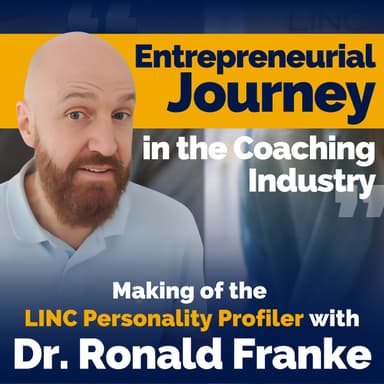
Entrepreneurship in the coaching industry: Making of the LINC Personality Profiler with Dr. Ronald Franke
with Ronald Franke, Geschäftsführer (Managing Director), LINQ GmbH
Auch auf Deutsch: Unternehmertum in der Coaching-Branche: Das "Making of" des LINC Personality Profilers mit Dr. Ronald Franke
Transcript
Edited for readability: filler words removed, names checked. It may still contain errors. The audio is the source of truth.
Tobi
Have you ever used personality assessments in your work as a coach, or maybe as an end user in a coachee role? I'm a huge fan of such assessments, as they give us a common language to talk about preferences, behaviors, and how we are different from other people. On last week's episode of the Making of a Coach we got to know one of the most popular professional assessments in Germany right now, the LINC Personality Profiler. It's used by more than 5,000 coaches, running over 40,000 assessments per year, and it's going international these days. So on this episode I was super excited to unpack the entrepreneurial story behind this success. I'm meeting Dr. Ronald Franke, one of the founders of LINC.
Before this conversation I had planned to dig deeper into personality psychology and the Big Five model that they're using, but I found Ronald's entrepreneurial story so interesting: how he did a coaching education next to his studies, how he went into research, started a company, didn't really succeed, and eventually then combined his coaching practice with his research and entrepreneurial work and made the LINC Profiler a success. We had the original conversation of all of this in
Interview
Tobi
German, so if you speak German, click next and listen to the original. But for everyone else, we will just follow here with an AI transcreation. Stay tuned, it really works surprisingly well. And what came out of this is not so much a coach story, but really a masterclass in entrepreneurship inside the coaching industry, told through Ronald's story. So let's hear from him.
Ronald Franke
So the LINC Personality Profiler is a digital personality analysis. That means it basically consists of a questionnaire that you fill out digitally, and a report that is then created, which allows me to get to know myself, my personality, my potential a bit better. The whole thing is based on a scientifically validated model, so that I really have a realistic and nicely visualized picture of my personality, which I can use to further develop myself.
Tobi
Thank you for the brief overview. Before we go deeper here, I would be interested in how your story in this area began.
Ronald Franke
So, starting right from the beginning, it naturally began with a certain interest in psychology that I developed back in school. And I then started studying psychology, and it continued to fascinate me. It eventually became clear that I actually did not want to become a therapist. I think most people who start studying psychology begin with the desire to become a psychotherapist, and some eventually stray from that path. I was one of those people, and eventually realized, okay, I would like to do something a bit different. I always wanted to understand how personality actually works, so it was more of an analytical thought behind it. And after university, after studying psychology, I continued working and researching at the university in the area of culture and personality, collected a lot of data and also led a research project. Then we thought, okay, what can we do? We had a lot of research data, and we then converted it into a personality analysis. And that became the LINC Personality Profiler. And from that this company was founded, that was already eight years ago, and since then the whole thing has been developing.
Tobi
And today it is also a respectable company, I believe you have 40 employees today. What were you researching back then? Was it already the Big Five model, or how far was that from today's LINC Profiler?
Ronald Franke
Pretty far away, to be honest. I think it's like most startups and company stories: it never turns out the way you think at the very beginning. So I think that is the more normal case. I worked as a coach, I offered coach training at the time, but what I did at the university was more related to culture, like intercultural communication. I spent a long time in India conducting research on intercultural differences in business, and on how Germans can manage and do business with Indian partners, and how the cultures can fit well together in this context. We somehow spread this idea around the world and conducted a research project, implementing this research approach in different countries. And eventually we had an incredible amount of data on cultures around the world and on how to collaborate well with them, which then led to the creation of the first personality test. It was still called Culture ID, meaning my cultural identity. And it wasn't as successful as we had
imagined, because it turned out that intercultural personality analyses are really quite a niche. And from that, because we knew how to create good digital personality analyses that can be nicely visualized and implemented, the idea emerged: why don't we create a personality analysis for a larger area? And at that point you needed a little bit of time, because there were already some options, and you had to figure out, okay, which field do we want to occupy? Which niche, which group do we want to address? Based on my experience with coaches and in coaching, it made sense to say, hey, let's focus a bit more on this target group. Because existing personality analyses were actually more directed towards human resources, and not so much towards the people who filled them out, meaning the end consumer, and definitely not towards coaches, who can use such tools very well to apply them in coaching sessions. That was kind of our twist on the topic, and it worked
really well, because it turned out that both coaches and consumers appreciated it when the results are presented in a respectful and nicely visualized way. But the HR people also actually liked it quite a lot.
Tobi
How did you get into that? What was your career path as a coach?
Ronald Franke
Well, that's obvious when you are studying psychology. And I was lucky that in Lüneburg, where I studied, there were indeed application oriented seminars, which is not something you can take for granted, I knew it differently too. In the context of the application oriented seminar on the topic of coaching, I think it was really called that, I got to know it and found it super exciting. And it was actually the same for everyone who was sitting in this seminar. That means more or less everyone who took the seminar went on to do coach training. So it's kind of something that naturally follows. And in a way it's crazy that not every psychology program actually offers something like this directly. Funnily enough, I then adopted the concept: when I later offered coaching training as well, I went to a university where I had previously worked as a lecturer, also part-time, and said to them, hey, why don't we offer coaching as an application oriented subject? Then they said, okay. And in this course I got them so excited about it that I was able to recruit them all as participants in the training. So that's something that's just very closely related. When you study psychology, you basically just wait to finally be able to do something practical, and not just cram statistics and quantitative correlations and stuff all the time, which is totally overrepresented, from my point of view, in classical psychology studies. But that's another topic. It definitely comes up very quickly when you are confronted with it in your studies. I then did such a training, funnily enough also with someone who studied the same thing in Lüneburg and was just a few semesters ahead of me, and they had already started it that way.
The seminar at the university sparked the enthusiasm. I then just did the training privately, it wasn't available at the university back then. Now it is available at universities, however it's very expensive, because it's really aimed at external people. And then I was a lecturer, especially for psychology. That means there was, again, a closeness where you could ask the students, are you interested in something like that? And because the interest has always been very high, I then conducted this coaching training accordingly at a university and in cooperation with this university. And the participants were largely recruited from among the students of this university.
Tobi
Super exciting. When we look at the career path as an independent entrepreneur, that's something I often see when I have people here who have been very successful in business: they always bring together various aspects from their lives. That means, in my employed job I was somehow a leader here and there, and then from this network I essentially built my coaching business. And what I hear from you now is that you actually combined academia and industry with entrepreneurial coaching activities. And to maybe get a bit technical and work that out, how can I imagine that? So you lectured at the university as an employee, and when did that transition into, okay, now you're doing your coaching training not at the University of Lüneburg anymore, but at Ronald Franke Consulting? How was the dividing line there, and also the synergies?
Ronald Franke
I was never employed at the university with which I then did this cooperation. I was always there as a lecturer, and as a lecturer you are usually self-employed, at least if you are doing it at different universities. You can of course also be employed as a lecturer, but I had worked as a freelance lecturer at various universities from time to time. And at this university I just said, do you want to collaborate? And then I was basically self-employed the whole time.
Tobi
And so it happened that the provider of the training was still the university, and you didn't build a brand or a company around yourself as a coach trainer, but were actually self-employed at the university, so to speak.
Ronald Franke
Yes, exactly, just like that. That didn't really have anything to do with the LINC Personality Profiler, as you already said. It was just a different activity. If you ask me now, since you have many entrepreneurs on your podcast: this is of course partly because I always wanted to work independently. That's just a value in itself for me. So you always look around to see how you can do it, how can I implement this? And you are always looking for ways and means to somehow live this type of work arrangement. There were various roles: once as a lecturer at some universities, then as a coach trainer, again in cooperation with the university, and then with this spin-off from the university, which then became a real company in that sense and has further expanded and developed.
Tobi
That means actually, if you look at it, in the course of your work as a coach and coach trainer you actually discovered the target group for your actual product, the LINC Personality Profiler.
Ronald Franke
Yes, you could say that. So that was definitely a key target group. Above all, that was also the important target group at the start of the company, because coaches, because they are oriented towards further education, were a target group that was therefore very easy to excite about our product, much more so than HR employees, who are constantly besieged by people offering some great tools. The coaches are more open, or at least it was like that eight years ago. I mean, now they are also overwhelmed, because everyone is basically overwhelmed. But back then we found a niche, and the coaches quickly realized that the product itself is of high quality, can help them, and is very fair in terms of conditions. They quickly said, okay, I'll try it. I want to continue my education anyway, I feel like I want to do something every year.
Tobi
So you're already mentioning the coaches. I often do a coaching training not only because I necessarily want to be a practicing coach, but also because I want to develop myself further. One cannot go without the other. And that is of course a need that you are fulfilling there. How did the product come about? So when you say you actually came from cultural research, and then you realized, okay, we can do statistics, we can do factor analysis, what do we do with it now? What did this development process look like?
Ronald Franke
So first of all, we had already developed a personality analysis for the topic of culture. It was more about whether my behavior and personality fit with a certain culture, and where the discrepancies are, and how I can deal with them so as not to get into conflicts with people from this culture. That's obviously not too far away. And then we had the advantage that both Martin and I had already taught personality psychology quite intensively. We were very deep into the topic of personality, Big Five. So we have a very good understanding of how personality is constructed, what building blocks are there, and what models of personality can also be used when you want to measure personality. That means the idea was more or less actually born from the fact that we understood how to build and implement such a digital analysis, and what to pay attention to. And then it made sense to look at what other topics there are where this knowledge can be applied. And then of course personality was an obvious choice, especially because we both know it very well. Martin had a professorship in psychology at the time. That was simply much more exciting in terms of scope than this niche topic of culture, and also very close to our knowledge. And then we just incorporated that knowledge into this tool.
Tobi
When did you then say, okay, forget about the whole culture, let's focus on the Big Five instead?
Ronald Franke
Actually, it was like this: we believed in it, and then said on the side, well, one could also do a test for personality. Then it developed so quickly that this topic just worked so much better. It pushed the other topic to the side. So it is often, I believe, more of a process, more of experimenting and orienting oneself towards what simply works better. A bit of trial and error, rather than making very hard business decisions and saying, we stop this now, we do this now. When dealing with other people's money, I always feel like you can just say, no, the project is stopped now, and so on. But when it's your own money, then you think, okay, we'll try this, but we'll let the other thing run a bit longer, to be able to switch back. But everyone might be different in that regard. Maybe it's not even such a good strategy, it always depends on the situation. Of course there are situations where you have to say, okay, this thing is done, we end it and put zero point zero resources into it. But we weren't at that point when we started with the personality profiler.
Tobi
Makes sense. And I believe it also reflects the entrepreneurial reality for us at metaFox, definitely, but I also think for many coaches and our listeners, in that we have many interests, a desire for many projects, and we always do them in parallel. How do you handle that? What is your philosophy, focus versus experimenting?
Ronald Franke
Oh, that's difficult. I often sit together with the team leads at our place, or with my managing partner Martin, and that's a difficult topic. So we simply try to find a balance. We have to explore and test something, see if there is any resonance, is there interest. But we've also had product development where, in an initial survey, everyone said, super exciting, this is a great topic, but then when the product was finished and it was really about spending money on it, they preferred to use the free version available online. That is very hard to predict. I am more of a person who tries out many things and doesn't make those hard, strictly scheduled decisions where you immediately make a project plan and then follow through with it. But we have also already said, okay, we can't start too many things, because we are also a small company, and sometimes you have some grand ideas and then at some point realize, okay, these are big topics. If you want to bring a reasonable product to the market, then so many resources would have to flow into it. I think that's the crucial thing, that you can already tease things and try them out, but you have to be clear that you start with a minimum viable product, so to speak.
Tobi
It resonates a lot, what you're saying, the difficulty of knowing how much to invest where, and how to measure if it's worth continuing to invest. Do you have an example from your past? For example, maybe the LINC Profiler itself? It sounded like it was so successful that it kept drawing more resources, and then a positive story developed.
Ronald Franke
Yes, exactly. So the LINC Personality Profiler is definitely a story where that was not a question at all. No major business decisions had to be made, it was just completely clear, it expanded on its own. Then there were other things in our company that more or less presented themselves without needing any great visionary decisions. More and more companies started asking, hey, great tool, can you also handle the conversations, like the feedback sessions, the coaching with it? Because companies often don't want to do that internally. It's clear that one might want to have external people more often when it comes to such sensitive topics. Then we built areas in the company that offer services around personality analysis, we call it HR Solutions. And that was obvious, it's something where you don't have to be very visionary. And then of course we also wanted to bring products to the market that seemed incredibly meaningful to us. And we called it the Coaching Board. That was also during the Corona period, where we said, okay, digital coaching, that's actually the future topic, because everything is becoming digital, and there is no platform that really allows for good digital coaching, one that is specialized, with a whiteboard and embedded coaching methods and everything that makes up coaching. And then we asked the coaches and they said, great, you absolutely have to do it, definitely. So we did it, and then Corona was over, and now it turns out that actually no one wants to
coach digitally. Every coach tries to avoid it if possible, and to coach on site. Well, that's how it goes sometimes. And if you only do it two or three times a year, then you just take a Miro board and do it over Zoom, I can understand that. And then you ask yourself, okay, could, should, would you have done more market research maybe? Yes. But honestly, I think it's very difficult to really find out if people are just saying they are willing to spend money on it, or if they actually spend money on it. That's a big step for people, I believe.
Tobi
So you actually mentioned three examples now. The LINC Profiler itself, so the psychometric tool, which also has many sub-products, if I understand correctly. Then the service, essentially a consulting business, where you say, okay, you actually want the all-around service, we provide you with coaches. And then, from your work with coaches, an online tool emerged that makes coaching in the online space easier. At the same time, my impression from the outside, from how I got to know you at a trade fair, is that you actually seem like a one product company: there's the profiler. So how does it look today, if you had to sort the revenue into rough percentage buckets?
Ronald Franke
That is definitely the core product, but now, as you already mentioned, differentiated into various variants as well. That means if you offer personality analyses, then it is of course obvious to also say, we offer analyses for different topics. So for example in-depth profiles on the topic of leadership, or on the topic of stress. Or specific consulting forms, because, for example, one might say there is startup consulting, so we naturally offer an analysis for the topic of entrepreneurial personality. Or there are many career advisors, career coaches, so we have the Career Profiler, which specializes in determining which personality fits which job profile, based on the Big Five for example. We have a lot of such differentiations. That means it's always the question of whether you take it as a separate product, or then say, okay, it's all actually still this one LINC Personality Profiler product. Then it would be the product plus services. The Coaching Board is its own product, it is definitely something quite different. That is definitely correct, and the profiler also makes up the main part of the revenue. There are growing areas like HR Solutions, which are developing very well, but the core product is definitely the LINC Personality Profiler.
Tobi
And the LINC Personality Profiler is then a product that I, as a consultant or coach, can use. I do the training with you, pay about 800 euros, an easy two day program, and then I can offer it. If you now say HR Solutions, is that something where you also work with freelancers, with coaches you have trained? Or do you really have employed coaches there as well?
Ronald Franke
Exactly, so you outlined that correctly. We do B2B business, we do not target end consumers. That means we provide a tool that independent coaches can use to find a different approach to people in their coaching, because it is naturally obvious to say, hey, we have a very nicely visualized, very appreciative depiction of your personality, and we can use that to discuss your topics in coaching, or to delve deeper into them. That's obvious, I think it's clear that this is exciting for coaches. The same also applies to other target groups: when I do career counseling, or when I do something like outplacement counseling, when I do personnel consulting, these are other areas where it is used. But these are freelancers who use it to have a tool, an instrument, that simply allows them to become a bit better at what they do. Then there is the other main target group, which consists of HR managers who say, okay, we want to further develop our employees, we want to support our leaders to lead successfully, we want to engage in team development. And as a modern company you naturally use appropriate tools for that. And then there are always various offerings. There are type-based instruments, which are viewed critically from a psychological perspective, because they simply generate stereotypical thinking and somehow establish it in the company. And that is actually the exact opposite of what you want to do when engaging in HR development.
Tobi
What is a specific problem that I have when I use the tool, or that my client has, if I now say, okay, now I'm pulling out the LINC Personality Profiler? You've already touched on a few, of course, but I'd like to maybe go a bit deeper. Because I also notice myself, here in the podcast I often do demo coachings, and we always call it demo coaching. And often, depending on which tool or method we want to showcase, I bring a concern with me, or I have filled out some profiler beforehand. So we've already done this with DISC, for example, or now with Lars and the LINC Profiler. And then I also realize, okay, we're not necessarily having a coaching conversation. I'm just learning new things about my personality. That's quite nice, but it doesn't really solve a problem for me at all. So what does that look like in practice? What problems do you address with tools like the LINC Profiler?
Ronald Franke
Yes. So what you did with Lars was an evaluation discussion, not coaching. That means, in the evaluation discussion, as you correctly say, it's primarily about you being able to ask your questions and the results being explained. And the idea is not that you get coached. For a coaching session it's like this: let's look at a normal coaching session, what happens there? I develop a question, and then I first try to see what influencing factors there are on this question, very individually for me. And then afterwards, what solution options come to mind to somehow solve this question? My coach is only there to somehow accompany me on this path, and also to guide me a bit, so that I am well guided through this conversation process, from working out the question through gathering information to finding a solution. An instrument like the LINC Personality Profiler, such a differentiated personality analysis, I can use to specifically apply the results to the question. This means the fundamental question
is always, what influence does my personality have on this topic? And in coaching only topics are actually addressed where the answer is, a huge influence. Because in coaching you typically don't do your tax return, where hard facts and knowledge are needed and personality plays no role. That means all topics that come up in coaching are extremely strongly influenced by your personality. For example, let's take a concrete example. You are a leader. You have to master this extremely challenging process of leading someone. You sit with the coach and want support, by thinking about how you can lead even more successfully. It's just that your personality has the greatest influence of all factors on how you lead. So it makes a lot of sense to take a detailed personality analysis to see what my leadership style is, which aspects of leadership are easy for me and which are difficult. This depends on your personality. Whom can I lead more easily, and with whom is it more challenging? That depends on your and his personality. The question is rather, why coach
such a topic without the topic of personality? It doesn't really make sense to me. It's different if you have a differentiated personality model, with very different profiles, where you have a model behind it that can truly capture personality, like the Big Five model, where you can also address the question of motives. So: do I even want to lead, or not? Where you can address competencies: what is easy for me, what is difficult for me? Then you get further.
Tobi
That means it's about explaining the challenges I have, for example as a leader, having a language for it, and through explaining these challenges perhaps also finding flexibility in my behavior. So finding out, okay, I have a preference to behave a certain way in this context, but I see there is a spectrum, and I can perhaps consciously move to the other side of the spectrum, or find peace with being on this side of the spectrum, and somehow bring more calm into it. Does that capture it, or how would you further specify it?
Ronald Franke
Yes, definitely, that comes close to it. It's like this: you first understand why you behave the way you do. You understand that your behavior fundamentally stems from your personality. This means our behaviors are not solely oriented by the situation, but people have behavior patterns, people have thought patterns. And if I understand why I behave this way, where does it actually come from, then I can deal with it. Only then can I consider, do I want to continue behaving this way? Can I simply drop it? Because that's also something often said in coaching: yes, then just do it differently. But if I understand that of course my personality always comes along, you always bring yourself into every situation, then I can consider how I want to deal with it, what does that mean, and how can I perhaps, instead of just always changing something, also inform people more about why I behave this way. I use personality as an extremely important influencing factor. I make it visible in the first place. And, by the way, you can do that without such an instrument. That means there are plenty of coaches who simply ask questions in that direction and say, hey, tell me, who are you really, and how do you lead? Of course that's possible, I don't want to deny that at all. I
would always advocate for using the topic of personality as an important influencing factor in all sorts of topics, also in coaching. But it doesn't have to happen with such a tool, you can also do it without. With such an instrument, if it's good, then it just goes faster. I have more information, I have it presented very clearly, very structured and systematically. I could also do that in coaching, if I take many hours and then create a wonderful picture, then I can definitely do that.
Tobi
Alright. If we take a step back and look at the company LINC and your organization again, how can I imagine that? What sets you apart from other companies? Does everyone do the LINC Profiler during onboarding? What role do your products play? Take us into your company and your culture.
Ronald Franke
So it is of course the case that we focus a lot on the topic of personality, even in our company. So in recruiting we naturally use our tools, we also use them for the development of our employees. And above all, we try to live what we talk about in our corporate culture. For example leadership, or that people are taken seriously in their personality, that different personalities can also develop, that different styles are accepted. And that is somehow a core part of our DNA, that we say, hey, we don't just want to delight others with the topic of personality, but also ensure internally that everyone feels, I can be myself here, I can unfold and also develop my personality here. And for that we naturally try to use our tools, but also to implement it in, for example, the leadership culture and the communication culture.
Tobi
Now, I believe you are currently in the process of internationalizing your marketing, bringing the LINC Profiler to the USA. What are you noticing on this journey?
Ronald Franke
Cultures are different, but in this case it is something positive, because the Americans receive it very well and are very positive about it. And we also feel in these certifications that there is a lot of that classic enthusiasm. We also go to other countries and look for partners there, at the moment primarily English speaking countries, and we are currently having very positive experiences, especially regarding communication and openness to new things. So at the moment it's a very nice process.
Tobi
And what role does that play for you today? How many trainings, how many LINC coaches are there who are not in the German speaking region?
Ronald Franke
Yes, not yet playing a very big role. So that is something we are currently building and developing, and which at the moment does not yet have a very large scale. The goal is to have 10 languages by the end of the year, the 10 most important languages, and to offer the instrument in these languages. But we are still in the process of internationalization.
Tobi
Great. Then I might finish with a short lightning round. I'll ask you a series of short questions, and you can respond with short answers.
Ronald Franke
Okay.
Tobi
The most overused buzzword in the coaching market these days.
Ronald Franke
Artificial intelligence.
Tobi
A book every coach should have read.
Ronald Franke
Our Big Five manual.
Tobi
Where do clients perceive things incorrectly when it comes to coaching?
Ronald Franke
They think that coaching is consulting, and somehow want tips, assistance, solutions from the coach.
Tobi
The most exciting innovation in the coaching and coaching tools market.
Ronald Franke
AI, definitely.
Tobi
If you had to choose a KPI, a measurement, for coaching success, what would it be?
Ronald Franke
To what percentage the developed solution is really implemented in practice.
Tobi
Your favorite method to recharge after a full work week.
Ronald Franke
Sauna.
Tobi
Your advice, your recommendation, for anyone who wants to start a coaching business.
Ronald Franke
If you want to know honestly, I would always offer training. It's the easier way to make money with coaching, always training people. That's my experience.
Tobi
A tool or an app that you can't imagine your daily life without. And last but not least, the best investment you've made in yourself in recent years.
Ronald Franke
Well, ChatGPT, right? That's obvious at the moment. And the best investment: the sauna.
Tobi
This is it for our entrepreneurial masterclass with Dr. Ronald Franke. You heard it: now, off to the sauna, Ronald's best investment into himself. If you're thinking, ah, sauna, not right now, but I'm curious about this personality profiler that Ronald has built, then head over to linc.de, or, if you're in the US or Canada, lincnorthamerica.com. You'll find all the info about the profiler tool and also the coach certification program there. And if you're thinking, I want to see a bit more about that first, then I can also recommend our last episode, where we really unpacked the profiler tool together with Ronald's colleague Lars and looked at my own results for the personality profiler. We'll be back here in two weeks, then surely again with an English original, and also with an actual coach, looking both into the business and the actual
coaching practice and conversation. Thanks for joining the Making of a Coach today. I'm Tobi from metaFox. All the best and bye bye.