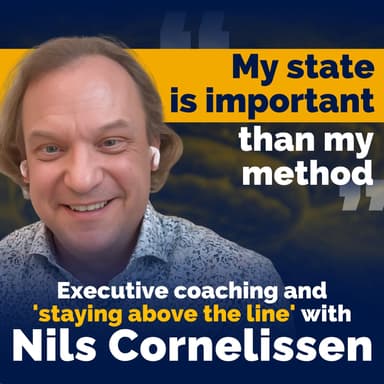
Executive Coaching and Preparing your State for Difficult Conversations with Nils Cornelissen
with Nils Cornelissen, Founder at Return on Meaning
Transcript
Edited for readability: filler words removed, names checked. It may still contain errors. The audio is the source of truth.
Teaser
Nils Cornelissen
I usually have some form of top executive, and he or she rings me and says, I want my people to behave differently, they should change. Right? And my first question is usually, well, how are you going to change?
Tobi
What are your thermometers to actually notice, oops, I fell below the line? I'm not thinking about them, I'm thinking about myself. The most important tool in any of my conversations is my own mindset, and we talked about humility and about gratefulness. How do you prepare yourself today?
Nils Cornelissen
It is very simple. So you can join me actually, if you want to.
Intro
Tobi
How do you facilitate change in a huge organization? Why do transformations fail, even though the smartest consultants have worked out the strategy? My guest today says, because change does not start with structures, it starts with the leader's willingness to look at themselves. Nils Cornelissen spent a decade at McKinsey and Company before founding his own consultancy, Return on Meaning. Today he works with top executives in large corporations who navigate restructuring and the pressure to perform. So we talk about why leaders often want others to change first, and why treating employees like adults is surprisingly difficult. But we don't only leave it at philosophy, we make it super practical. How does Nils help leaders change their attitude with tiny questions? How does he prepare himself before
going into difficult coaching conversations? These are themes I've read and talked about before, but rarely have I heard such actionable advice, that also helps super cognitive people like me to stay aware of my personal state in a difficult conversation. So let's get started, let's meet Nils.
What mission are you on in your life?
Nils Cornelissen
A very interesting question. I used to say, I'm here to make people happy. My purpose is to make people happy. As you know, Tobi, but maybe not our listeners, I used to work for McKinsey for 20 years, and I often said to people, I joined McKinsey because I want to make people happy. And people often had a question mark on their face. It sounds a bit banal, right, making people happy. So it's not a superficial, hedonistic type of happiness, but it's more, at the moment I'm working a lot on helping leaders or executives to become more honest with themselves and with their surroundings. And I think that creates closeness and proximity and intimacy, and that creates psychological safety, and that enables then better performance in the end.
Tobi
So when you say happy, you don't think of pleasure, but more of meaning and a purposeful work life, it sounds like.
Nils Cornelissen
Exactly. It's very much in the direction of purpose. You know, there's this book called Flourish, on positive psychology. And there are elements of flow in there, there are elements of meaning and purpose in there. There's peace, inner peace. Contentment is also part of it. It's not necessarily the ecstatic enthusiasm, so it can be a very silent happiness as well.
Tobi
And that also reflects not only in your personal mission statement, but even in the name of the company that you co-created and lead, which is Return on Meaning. In order to dive a bit into what you are doing at Return on Meaning, I would like to ask you, what is a typical client of yours, and what challenge do you usually help them with?
Nils Cornelissen
Yes. So we work a lot for the big corporate companies in Germany. I think in the last 25 years as a consultant and coach I've worked for half of all DAX companies. And big corporates can be in any type of industry. So currently an automotive supplier, a pharma company, one of our big mobility companies in Germany, there's only two, we work for both. Big trade companies. But increasingly there are also startups that have grown big, e-commerce or fintech companies. There's also a unicorn as part of our client list. And of course there are
also public organizations that are interested in some form of change. And you also asked what the work is I'm doing. Usually people come to me because they're in some form of transformation or transition. They have a new strategy. It used to be becoming more agile, or achieving new sales targets. In the last year it has also been a lot of restructuring, downsizing, thinking differently about how to deal with all the risks and dangers and insecurities that are out there in the world. All of these can be content business challenges. And then my job, or the job of Return on Meaning, is to take the people on board, basically. Just to give you an example, there was this automotive supplier we worked with last year. They needed to restructure. The Boston Consulting Group was in there as a big consulting firm, they did all the restructuring, they've been there with 35 consultants, and our job was to take the people along. So we got
the top team together. We did have some form of team coaching, I would say, with this top team, where it was a lot about how they interact with each other, but also with others in the organization. How can they drive the change for 25,000 people? But we also worked with the 25,000 people out there. We often form some type of ambassador group in the organization, that complements the top down drive, or change from the top, with something bottom up.
Tobi
Super interesting. And I think maybe with today's episode we can gradually zoom in on how this works. So to get us started, can you describe a bit more how the beginning of such a journey looks? If this was a one-on-one coaching conversation, we often say you do a contracting at the beginning of the journey, right, finding out what is the issue that we want to work on. How does that usually look in your world?
Nils Cornelissen
Well, I usually have some form of top executive, and he or she rings me and says, I want my people to behave differently, they should change. Right? And my first question is usually, well, how are you going to change? And usually the answer is something like, I sort of thought it's more about the other people in my organization. Then I'm asking again: well, how are you prepared to change your own demeanor? If you think you're doing everything right, this will trickle down in the organization, so if you think you do this, then the middle management will do the same, and then in the end the shop floor employees will feel the need to change. So it has to start from the top. And that is already starting some kind of personal journey, even though it's been about the organization and about the organizational change that you talked about. In addition to the whole broad organizational change, there's always some form of team or group dynamics on
different levels. And there is the individual perspective with the top executives who are leading it. Often it's about creating these aha moments: well, actually I have to change as well, otherwise this will never be successful.
Tobi
And what kind of change are we talking about? Because I guess the first thing that people would answer is, there is some sort of business need to change. So, I don't know, let's say we are at a big car company and there's now the electric mobility revolution happening and we need to do some catching up, but I have all these engineers that really like engines. I guess it's that sort of world. But it sounds like you are talking more about a shift of mindset that then starts at the top. It seemed like you want the leadership to be humble, in a way. Or how exactly would you describe it?
Nils Cornelissen
Humility is definitely a helpful attribute if you want to lead, and if you want to lead change or transformation. And I think the example you gave is actually quite accurate. So there is usually a business need, an outer change, right? Electrifying cars, a different strategy, restructuring, downsizing, innovation. We worked for a pharma company where it used to take them six years to develop a new drug and they wanted to size it down to three years in total. So these are all different kinds of business needs, and there is the content perspective. And there they usually have content consultants, as in the example before there was Boston Consulting Group, or they do it themselves internally, or you have a consulting firm that talks about innovation. And all of these content driven people, or the engineers, they always think it's more of a structural issue. And, as I mentioned earlier, I've worked for almost 10 years for McKinsey and Company as a consultant, and I realized that to make
change happen you need a solid business case, you need a thorough analysis, you need the right technical or content solutions, definitely. But that wasn't the reason why change efforts or transformations failed. Transformations fail in two thirds of the cases, and it was because the people weren't getting on board. There was a gap between the top executive board, they said, oh, we need to change, but the employees didn't want it. And I think every business problem has both a content side and a people, or change, side. So what is this change side? It's the psychological dimensions of all the people involved, it's the group dynamics, et cetera. And we are always looking at the change or the transformation with this perspective. Usually the reason why we
change in the first place is a business need. And clients tell us we are the ones who bridge the business and this people perspective on the problems they have.
Tobi
So, bringing the human side, the kind of mindset shift, into the leadership team for it to trickle down. How do you diagnose what the issue is? How do you find out what tool to unpack from your toolbox?
Nils Cornelissen
A very good question, and I'm often being asked it, and I find this question so fascinating. I would say, I don't need to understand what the problem is. What do I mean by that? The classical idea of consultants, when I was working for McKinsey, right, is that the client has a problem, McKinsey thinks through the solution and then offers a solution to the client. But when I talk about this, you already hear a potential implementation gap that might come up. I don't know how you feel about it, but if somebody comes up to me with a great idea that I was never involved in, at Return on Meaning we are 25 people by now, and I founded it together with my friend and colleague, and there are now three partners in our company, even though I talk a lot about change and innovation and so forth, if one of my employees comes up to me and wants to change our whole business, I'm first being defensive, right? I wasn't involved, where does this come from, et cetera. These are all kinds of thoughts, and I think it's very normal. So it's a not-invented-here syndrome. One of the ways of how we think about change is that it's not that somebody comes with a problem and we solve it for them, but it's like in good coaching: the coach doesn't solve the problem, but the coach helps the client solve the problem
themselves. And in a similar way you can think about organizational development, or the organizational frame. So I see my role as less of me solving the problem. I would say I'm co-responsible for the problem being solved. So I'm not completely systemic, saying it's not my thing and I just let it happen. In the real world I do have a stake in getting it solved, and yet it's not me who is solving it, but I'm creating a space where the client can solve their issues themselves.
Tobi
Yeah. It reminds me a lot of that small hack that I learned in my early trainer education. Imagine a semicircle of people, and one of them asks, okay, and how do I now approach X, Y, Z, this challenge in public speaking? And the first answer that you give is not an answer, but it is asking back, what do you think? And rolling the ball back into their field, so they can come up with their own solution. And what I hear from you is also, it's a lot about the ownership. You want the idea to be owned by them.
Nils Cornelissen
Exactly. And what I like about this tool, if I think about our listeners, is that one of the tools is helping executives also not to solve the issues for their employees, but to give the responsibility back to their employees, by asking, what have you already tried? I am hearing an interesting question. You are asking me how we could solve X, Y and Z. What have you already tried? Who have you talked to? What are you going to do to get it solved? If you think about these three questions, they leave the responsibility with the employees. So many of the executives I'm supporting always say, how do I get my people empowered, how do I get my people empowered? And if their employees ask them a question, they provide a solution. That's the best way to disempower your employees. So one way to empower your employees is to take them seriously. It's interesting, right? They don't take them seriously, they don't really treat them as adults. Treating them as adults would be, if the employees come up and say, how would you solve this problem, would you do A or B, I would recommend most executives, in most cases, not to give them a simple answer, but simply to ask the question: what have you already tried? Who did you already talk to? What would you need to get it solved? And what would you need from me?
Tobi
Yeah.
Nils Cornelissen
And if you do this, you empower your own employees and they will show more ownership. So, very little, sometimes in coaching, I find this fascinating, I don't know how you feel about it, Tobi, but sometimes it's this little question that makes a big difference.
Tobi
Yeah. The coach in me thinks this is amazing and yet obvious, and the leader in me thinks, ah, guilty as charged. So I think it's a big leap from theory to practice. And that's maybe also what I would like to dig a bit deeper into. Because if you ask this question, let's say you have this executive who says, they don't take ownership, and you ask them, okay, what have you tried already, how do you make that stick in particular? Do you have a certain intervention that really anchors that, not only on a cognitive level where they say, yeah, okay, you have a point there, but that actually leads to this behavior change?
Nils Cornelissen
There are lots of steps involved, right? And what I find so amazing, I don't know how you feel about it, but we talked about humility early on: the longer I do the job I'm doing, the more I just feel grateful for being in the position of being asked for help, and being able to help other people, and even earning a living with it and running a company with it. And I'm also getting much more in awe of how we tick. Tobi, it's January when we have this conversation, and, I don't know, did you have any good intentions for the new year?
Tobi
Yeah. So I have partnered with a good friend and we set up this habit tracker app, and we committed to making time, one hour every day, to work on our thing. And our thing is the not urgent, important project that we always say we want to do and don't get to. In my case because workdays are just full, and there are emails and there are some podcast episodes with deadlines and so on, and meetings, and this sort of stuff where you really need to sit down and block out some time, that rarely happens. And then I always thought, okay, I need to make four hours' time for that, but four hours don't happen, especially with a baby now. So I said, okay, let me just cut that down to one hour, and that's my new year's resolution. So, a long answer to a simple question.
Nils Cornelissen
To cut down what you just said: I'm hearing I'm talking to an expert, right? Because what you did with the big challenge is, you put it into smaller steps. It's the one percent challenge. It's one of the books, Atomic Habits, is another one. It's making it into small habits. The other bit, what you did is you partnered up with somebody else. Very good, peer pressure works a lot. And you have some form of vision or positive example. So if you wanted to do more sports, in addition to just wanting to do more sports, maybe you want to sign up for a marathon in a year's time or something. Having this vision is also important. So there are all these things that help us to keep good intentions longer. But in the end, if people ask me, what would I need to do to do more sports, I can do all of the stuff out there, but what would I really need to do? I would simply need to do it, to act. And it's a priority, simply.
I wouldn't need a lot of advice on how to do more sports. If I look at companies or executives, and if they want their employees to work differently or change, they often explain how people have to act to achieve a certain goal. For example, on the issue of empowerment or taking ownership, very often I find that executives explain to their employees how they have to create more ownership. The thing is, if I talk to the employees, they know what they would need to be doing. They know everything. It's a priority issue, it's not an issue of how you do it. That is very typical: they treat the employees as if they were children, as if they had to explain to them what they need to do. No. What the employees have, often, is ambiguous goals. There is my
boss who says I have to work harder on X, but there are also all the other tasks that I have, and people don't know how to prioritize. And sometimes it leads to a standstill. And then, if you do this for a long time, you get to burnout eventually. So the question that you're asking, if an executive talks to their employees, is, how can I create a joint vision and prioritize correctly, and then maybe create a support network of other people, of peers, to help you do it? That would be a way of how you get people into action.
Tobi
Can we make that even more practical? Like, how many people are involved? What are the group dynamics? Can you take us into this boardroom where these things are discussed?
Nils Cornelissen
So, as I said, there are three different levels. There is the organizational level, where we work with these ambassadors. There is the individual level, where I have one-on-one conversations, coachings with individual leaders. And there is this team dynamic, let's say a boardroom. I'm working with the top team in an organization, the executive board, the CXOs of an organization or of a certain business division, and I have them in the group. And of course, normally, if I do something like this, I try to build rapport beforehand with every individual. So how do I do that? I have one-on-one conversations with each of them, and I'm trying to understand what drives them. How long have they been on this team, so who joined when, and who do you like, and what do you like about others, and what do you appreciate about them, what could they be doing better, et cetera. I'm also trying to understand where they stand emotionally, and where they stand towards such a process, because usually it's not a one-off, usually I'm working with teams over time. And so I need to get the buy-in of the individuals, and particularly of the most skeptical participants, often the CFO.
Tobi
Yeah, it's interesting. So when I asked you what the things are that keep you busy, in our prep talk you said team coaching, and what I hear now is that one of your first steps in such a team coaching process is actually to meet people one-on-one, to build this rapport, to make sure that the chemistry between you and each member of the team is there, and that there's a certain openness towards you as a process facilitator, I guess.
Nils Cornelissen
Exactly. And, Tobi, you asked earlier how we make it concrete, so to become even more concrete, and I'm oversimplifying things here: what do I do for this conversation? The first thing is, I'm not thinking about them, I'm thinking about myself. The most important tool in any of my conversations is my own mindset, and we talked about humility and about gratefulness. And I'm doing mental training, there are different forms and we can talk about what this is, but I'm doing some form of mental training to prepare myself, so that I'm entering the conversation in a very creative mindset. And with creative I don't mean creative in the sense of having lots of ideas, that usually also happens, but with creative I mean not being reactive, being very curious about what's going to happen, even if the other person says, oh, you suck. I had clients, in my first conversations, saying, thanks for being here, but let's get this straight, I don't want you being here. So you can reimagine what we do. So it's working on myself. In my whole education, at the beginning, when I participated in my first coaching classes or training classes or constellation
work, I was very much looking for the right tool or for the right questions and so forth. And more and more I realized that whether I'm prepared to actually ask the right question has more to do with my own fears, my own angst, my own shame. And so I started working more on my psychological dimensions, so that I'm not as triggered as I might be if somebody tells me, oh, that sucks, or, you suck, or, I don't want you here. It's nothing anybody would want to hear, I guess.
Tobi
So I guess this inner work that you're describing has been a long process, and I'll ask you about that in a bit. But to stay on the topic of concrete actions: how does this preparation look for you before going into this boardroom, where conversations might get difficult, where you will receive resistance, possibly? How do you prepare yourself today?
Nils Cornelissen
It is very simple. So you can join me actually, if you want to. Are you sitting on a chair, or are you standing, Tobi?
Tobi
I'm standing.
Nils Cornelissen
So, everybody of the listeners, you can also join us. You can stand, simply on your two feet, feel your feet. If you're sitting, stay seated, that's also fine, then you can also feel your bum on the chair. Straighten up a bit. Yeah, I'm actually making a sound. Breathe out with this big sigh. It relaxes everybody. Everybody knows it, but it's amazing, right? If I enter the first class in a train, or if I enter business class in a plane, there are so many people who are so tense and tied up and have a red face. I always want to shake them up and tell them, just sigh once. Really sigh, it helps. Do you feel a bit more relaxed? It works, right? We all know it.
It's almost banal, but we so often don't do it. We hold on, we cramp up. So try to relax, let your shoulders fall down a bit more. And then I'm thinking about what I am grateful for. And this can be very different for different people. For me it's my 10-year-old daughter, and I'm imagining a moment with her. I'm also grateful for being now with this client, and then building some form of connection with this client, and saying, if I expect a difficult conversation, why could the world be difficult for this person? So I'm trying to come up with empathy for the situation of the other person. I'm not doing this if I'm having a fun conversation anyhow, right? Like this one, before this conversation with you I didn't think about what would be difficult. But there are sometimes these conversations or coachings where you know this client is in a difficult, or maybe towards me hostile, position,
because it was their boss who told them to come to me. So in those instances I feel empathy for the other person. I'm trying to take the perspective of the other person, and not only feeling with it, how does it feel, but I'm thinking about why it would make sense to feel that way. Why would it make sense to feel angry in this situation? Why would it make sense to feel helpless in this situation? And all of this creates empathy. And then I'm breathing in and out, stretching my arms, sighing again, and that's it. It sounds simple, right? But it's a simple centering exercise, getting into humility, gratefulness, and into empathy and connection.
Tobi
Yeah. And getting into your body, like that, I think is also what the sighing and becoming aware of your stance does. I love that, especially in that combination. I'd heard the individual parts before, but especially with this very proactive empathy exercise, it reminds me even a bit of metta meditation, this kind of meditation where you wish wellbeing to the other and to all beings, in a way that brings you into this very open, above the line kind of mindset.
Nils Cornelissen
It is indeed metta meditation. In my twenties I did, twice, a 10 day meditation retreat with two great teachers, Australian by background, Rosemary and Steve Wiseman. And they do meditation and compassion-felt meditation, and it's similar to what is also called metta meditation. So it's wishing other people well, basically, that's it. And of course it helps that I've done it for days, for 10 hours a day. It helps me now to get quicker into that state. I think if you're doing it for the first time, it might take a bit of practice to get directly into a different state.
Tobi
Yeah. So in a way you've been going to the mental gym, by meditating, I don't know, every morning or whatever, regularly, to ground the state, to anchor the state, and now you can turn it on with this small micro exercise.
Nils Cornelissen
Yes. And I had phases in my life where I didn't meditate at all, where I drank too much wine, where I slept too little and so forth. I'm a bit skeptical about this always-self-improvement hype. I've read some piece of research that says people who read self-help books are more unhappy than people who don't read them, because they read what they could be doing and then we feel even more pressure to perform, and then it gets even more ambitious. So I'm a friend of sighing, and of humility. And that's also something with many of the executives I'm working
with. They are very disciplined, and they are very controlling. And often part of my process with them is stepping out of this cage. Because it's great that they have this, it's about appreciating what they have and where it brought them, but at the same time not trying so much to hold on and be always in control. Because I think their happiness and their ability to lead increases with them letting go. There are other people who find it difficult to motivate themselves to do sports or to have a structure, and for them it's great to be disciplined and to have a plan and all of this. But I think people are very different. And most of my clients are very hardworking, for them it's rather that they neglect the family. I just recently had a very expensive coaching, and the outcome for the coachee was that he goes out, goes to a flower shop, buys the
biggest bunch of flowers and tells his wife that he loves her. Sometimes it can be simple things like that, that they lose sight of.
Tobi
Yeah. So it's also this act of letting go and holding things more lightly that actually helps the leaders get into this state that you just described you want to get into when you talk with them. And, in a way, for this to trickle down and spark this cultural change, basically what the leaders need to do is to, I don't want to say model you, but, yeah, model you in that regard, at least, to then actually empower their team members.
Nils Cornelissen
And one of the exercises I often do in these team coachings is simply a reflection on which state I am in. As I just called them, a creative state or a reactive state. And creative is curious, is open, is feeling I am in control of life, feeling energetic, usually feeling being in flow, et cetera. And reactive is sometimes, because it's triggered, well, it's not a real trigger, it's not a trauma, where the term trigger originally comes from, but it can be a little bit of an amygdala hijack. It can be, sometimes, being angry, or feeling fear, or wanting to run away, or feeling frustrated, or all of this. And simply, for me, life is, I'm either in that one or in the other state. And for any type of leadership I think it's important to be in this state of creativeness. But the issue is, we often don't notice it if we are in the other bit. I just recently had a leader standing there saying, I'm not in a reactive mode. And it can happen to me as well. I remember situations where I told my wife, no, I'm all
fine. And if we are all honest to ourselves, we all know these situations: we are the last ones in the room to notice that we are in a reactive mode. And I'm not saying you can't become angry. Being angry, or even feeling rage, is simply an emotion, that's not bad or positive. So, for example, for me, I was very harmony driven in my upbringing, and I had to get into the creative mode to allow myself to become loud. So that's also being creative: at the moment I'm not triggered, I'm being loud myself. So creative doesn't mean nice. In a creative manner I can also clearly hold my boundaries. Tobi, you know that we've written this book, Culture Change in Organizations, and there is a big chapter on this whole reactive and creative. There's also a great video there, it's called Above and Below the Line Leadership, and we
can put it in the show notes. And there's the Arbinger Institute, they have written a book about being in the box and out of the box. So there are lots of these, they're all similar to each other, but it's simply: am I curious at a certain moment, am I grateful? Or am I in an ego thing, either making myself too big, like an American president somewhere, or making myself too small and thinking it's my fault and I'll never get it done? It's both reactive. And having people reflect on their own stances and on situations where they are triggered, or where their hot button, their red button, is pushed, as we sometimes call it, it opens people up, it creates, nobody's perfect. So I'm also saying, we are all in this reactive mode, we are in there dozens of times a day. And it's not about, I'm never getting into this. It's rather becoming more fluid, and becoming
more imperfect, by saying, oh well, yes, I get into it. And it's more about recognizing sooner if I'm in it, to get out of it sooner. And if we have this conversation between the executives in a team, we create psychological safety, and that enables more openness and honesty, and that in the end creates, hopefully, also better performance in the team.
Tobi
I'd like to ask you one more question about this reactive versus creative state, or above the line versus below the line state. You mentioned you are also getting into this state below the line regularly still. How do you notice? What are your inner thermometers to actually notice, oops, I fell below the line, how can I pull myself out? How do you manage this yourself?
Nils Cornelissen
So one of the things is, if I'm thinking, this time I'm right and they are wrong, it's very likely that I'm in a reactive stance. If I'm thinking, do I have to hold this project or this company or this whatever together, am I only surrounded by idiots, most likely I'm in a reactive mode. If I'm thinking, I'm the one to blame for everything here, oh, I did something so wrong, I'm probably in a reactive state. But it's a very good question. So with one executive I actually agreed that he measures his pulse in a meeting, when he feels, oh, could I be? He's a doctor and he's counting his own pulse. So it worked for him. I wouldn't even know how to count my own pulse, but he did. And he counts, and if it went beyond, I don't remember what exactly, then he thinks, okay, it's time to call a break and to get out of this situation. So there's one more thing I want to tell you. For me it's a fundamental aspect of all of life, whether it's business life or private life or happiness in life: it is just reactive
versus creative. I think any meditation, any enlightenment intensive, any psychological therapy is basically about this, in the end. What struck me when I started thinking and reflecting on this is that I first noticed I get into the reactive mode more often than before. And I thought, hello, what the hell is going on? I'm working on myself, I'm meditating, why am I getting more into it? And the reason being, simply, I got more sensitive to my own inner state. In fact, it happens to me now, I'm noticing it, it happens to me a dozen times. If you stop smiling, if you look away, I'm thinking, oh, am I getting too boring? That's a little oomph, that's a little reactive. And it's these little things, noticing them and being honest to myself and to others. Yes, it happens, I'm not perfect, I've got shame, I've got fear, I've
got all these unpleasant emotions and feelings. And that's fine, that's okay. But many of the executives I'm working with, as I said earlier, can be very controlling. Sometimes they find it very difficult to admit that they're not perfect, and that they're getting into this reactive state that is not so great, et cetera. So for them it's about opening up to this idea that, yeah, I am not there, there is something happening inside me that is not great, and I'm still okay. But that was a big learning for me, it took me a couple of years to actually get into this acceptance of, yes, I am judgmental about other people, I'm judgmental about myself. And I think we all are, actually. But it takes a while to truly accept that.
Tobi
Yeah, this really resonates. In fact I can even also relate it to my meditation retreat experience, where I was also coming out of the experience and noticing, wow, I'm so annoyed constantly. How can that be? I'm coming out of the experience and I'm supposed to be relaxed. No, but I was also constantly annoyed. And then at some point realizing, wow, this is probably because I'm just feeling it more in my body. And it also stopped, and that was not because I became more zen, but simply because this sensitivity faded away. And now I also find it very difficult. And this is also what I love about your answer. Because when I asked you, how do you notice, what is your inner thermometer, I expected you to say, watch out for your body, when you tighten in your chest, et cetera. Which, sure, I get it, but it's so difficult, especially when I'm below the line, to feel my body. And so I like that you have a trigger that is more of a cognitive trigger, that the alarm bell is not your chest tightening, but the alarm bell is, watch out, are you believing that all the other people are idiots,
or, watch out, are you believing I am right and you are wrong? So that's the alarm bell, not your chest. So this seems super actionable to me.
Nils Cornelissen
Very many of the executives I'm working with are very cognitive, right? They're very smart people. And so for them it's easier to look out for mental models, or for mental sentences: am I only surrounded by idiots, this time I'm really right, et cetera. And therefore I'm using this. But of course you can also use the body to get out of the reactive state. I think the body is easier than mental models. Of course I can think about mental models, like, what am I grateful for is a mental model, or thinking about my daughter, as I said earlier on in this little exercise we did together. But there, the first thing is the body. And that I actually learned from Tony Robbins. I find Tony Robbins very strange. I was once at one of his seminars and he said his biggest value is love, even though this was
all about performance. If you think in spiral dynamics, you know these different value systems, there is the orange value system, which is performance, and this was so orange. Tony Robbins is just orange, he's so eighties and so orange. And he claims that his biggest value is love. Either he's lying to himself and to others, which is not very nice, or he is simply wrong, which is also not very nice. So I can't take him very seriously. But of course he also has a lot of competence as a trainer and as a coach. At the seminar, one of the things that he said, he was telling about a person who was in a very depressive mode, and he said, the first thing is, sit up straight, because that's the easiest way to change our mind. And so sitting up straight, or loosening up, or raising your arms, sighing, these are all bodily functions and they help us a lot to get into
a different mindset as well.
Tobi
Even a nice image: when I hear the I-am-right-you-are-wrong alarm bell sounding, imagining the massive Tony Robbins in front of me, and sitting up and taking a sigh. That's a nice one. Okay, wow. What is the change that you would love to see in the culture, the mindset, the attitudes of people in these rooms? And what is it that you have already started doing about it?
Nils Cornelissen
Yes. There are two dimensions, right? There's something I would like to see out there, and I'll tell you a little bit about it in a second, and there's something that I would like more executives to focus on. So one of them is, I would like every executive out there to really take how they think and feel as seriously as their technical competence in their job. These types of future skills, my psychological dimension and psychosocial dimension, these are the future skills of people. Emotional intelligence is a concept of Daniel Goleman, and you can train it, you can learn it. We've even put up this program, you don't have to take hours, there are other ways of learning it. But we, for example, we formed this program, it's called Momentum. For seven weeks you meet with a small cohort of 12 people, you reflect on how you think and how you feel about certain things, and then you get a 10 minute audio, kind of a podcast meditation, every day, with an app, and you can train how you think, how you view the world, how you feel about others, how you feel about your connections. And it's fascinating. And I would love, and luckily nowadays people do it even in Davos, right? Nowadays in Davos at the World Economic Forum you can meditate every day at several locations. It has become more normal for executives to think about the way they feel and think. But if you haven't
done so, I think it's time to start, for any executive, and to learn that. And one way could be Momentum, maybe we can also put it in the show notes, to have a bit of advertising. But there are also other ways. And what would be my view or vision for the boardroom? I would love it to be also, I think we've learned to create vulnerability. So for example, in the workshops that I'm doing and the team coaching that I'm doing, it can happen that individuals cry, and at least they feel very touched and they open up. And I think that's something that is happening and could happen even more. Ideally executives would learn not only to do it in the workshop with me or with other facilitators, but also in their boardroom at home. We have one client, a big German mobility company, and there they actually spend 45 minutes on an intensive check-in before they start their full day
boardroom session, and they talk about everything that's on their mind, and even the things that they don't like or that they find challenging. And I think that's a big start. I don't think they're there yet, that they would share what they are really angry about, or that they could hold each other's anger. I think that's the next level. I think society will need 10 more years to actually acknowledge anger in such a way, as vulnerability. But I think we are on a good track to getting there.
Tobi
Wow. So, bringing vulnerability, bringing humility to the boardrooms.
Outro
Tobi
That's it for today. And I know it's quite a cliffhanger ending for this episode. When I started the conversation I also thought we'd go right into the facilitation and team coaching methods of Nils. However, I found his ideas on staying above the line so valuable that I simply had to dig deeper there. So if you found this approach to mindfulness and self-management valuable, and you happen to be employed at an organization, you might also want to check out what Nils and his colleagues developed in that regard. They have built the Momentum program, a 12 week group coaching journey towards more emotional intelligence and resilience. You can find that on mymomentum.life. And of course I was also curious to learn more about what happens after Nils has prepared himself and once he steps into the boardroom or the executive offsite space. This is a conversation we will have here again in two weeks. On our next episode: what does Nils's approach to the conversation itself look like, and what feedback facilitation methods is he using? So tune in again for The Impactful Coach in two weeks from today. And if you enjoyed this episode, please share it with a friend. I'm Tobi, co-founder of metaFox coaching tools, and I wish you impactful coaching conversations ahead. See you back here
again in two weeks. Bye bye.