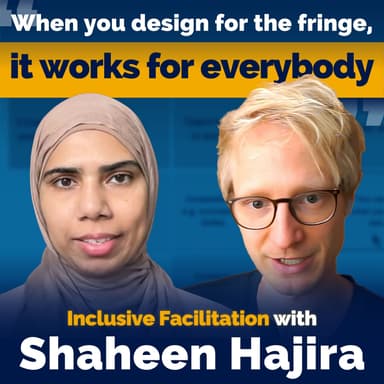
Inclusive Facilitation with Shaheen Hajira
with Hajira Shaheen
Transcript
Edited for readability: filler words removed, names checked. It may still contain errors. The audio is the source of truth.
Shaheen Hajira
People process knowledge in different ways. I might process better when I write, and I actually do process better when I write, hence my long LinkedIn posts. Some people process their thoughts when they speak. And so they might turn to the person next to them, and as they share they go, yeah, that's what I meant, this is brilliant. And you build on that. But I think it's exactly to your point, you kind of touched on why I do this work. It's because I think there's so much brilliance in the rooms that we're in, but we just miss it, because we haven't designed it properly. And if we gave people options and choice and autonomy, it just means that we can uplift all of those beautiful ideas that people have but have not had a way to bring out, because of the systems and the processes that we had, that favoured a certain kind of thinking and talking and doing.
Intro
Tobi
Have you ever asked a question during group facilitation and always got the same two people who raised their hands? Everybody else at this point in the workshop is still thinking, and by the time they know what they want to say, the conversation has already moved on. This is a design choice, says my guest today, Shaheen Hajira. We just stopped noticing that we are making it. She's a facilitator and inclusive learning designer, and the founder of Taleem Consulting in Sydney. She co-designs solutions together with communities who rarely get asked, and she trains facilitators in inclusive facilitation. The question on today's episode is simple: what do we actually change in the way we facilitate a session, so we can get all the knowledge that's in the room out there? So we talk about why learning happens in context and connection, not only in the content, what is wrong with raising hands and speaking, and what you can do instead. And we unpack the email she sends out before every single workshop. We look at her POWER framework, five lenses she puts on any agenda, and what trauma-informed facilitation looks like in an ordinary session. And in the end she even takes apart one of our own metaFox warm-up exercises. So let's see how that goes, and get started.
Learning in context and connection
Tobi
You are a facilitator and learning designer. And when preparing for today, and listening a bit to what you said on other occasions, I heard you say that we as a facilitator community need to move from learning content to learning in context and in connection. Can you explain that a bit?
Shaheen Hajira
Sure. Can I get a bit nerdy on you right at the start?
Tobi
Yes, please.
Shaheen Hajira
So this is my learning design lens. One of the things that I've learned academically as part of my work is how humans learn. What is it that makes people learn things? There's a bunch of things, but one of the things that we often talk about is what we call the constructivist, social way of learning. What constructivist means is, we take prior knowledge and then we build on it. We were just talking about shoelaces. So if I am a hiker, I know that there are different ways you can tie shoelaces when you're going uphill versus downhill. And if you're just starting off, that's just new knowledge for
you. If you taught the same to, I don't know, your three-year-old, the different ways of tying shoelaces, it's probably too much. But if you do know how to tie regular shoelaces, then you can build on that knowledge. So what you could do in the class or in the room is say, hey, remember how you tie shoelaces? I'm now going to show you two different ways to do this when you're hiking. That's what we call the constructivist way of thinking. You build knowledge. So, in answer to your question, that would be what's called learning in context. Why am I learning this thing? What is it that I know from the past that adds to this knowledge? That's learning in context. And then, when we say learning in connection, that's the social part. All of us have pieces of knowledge within us, and it debunks this idea that the person at the front of the room is the one with all of the knowledge. We no longer go
with the sage on the stage model. And so, can we focus a bit away from the content, but also place it in context with each other, so everybody's adding to this beautiful thing that we are doing, and we learn from each other? That's what we call social learning. So when I talk about context and connection, that's what I mean. And for me those two are more important than the content per se.
Tobi
Yeah, that makes a lot of sense to me, and I think it's even more true in areas where there is no objective truth. When it's about communication, when it's about emotional intelligence, these sort of softer domains, then I think this constructivism is even more important, and so is the social aspect. Because what I learned about constructivism, and now I need to collect my knowledge there, is that we construct our model of the world.
Shaheen Hajira
Yes.
Tobi
It goes back to this: the map is not the territory. We all have these mental maps of the world, and those are shaped very much by our experience in life and by what we have learned, not only in classrooms, but also just in interacting with other human beings, in life, growing up and beyond that.
Shaheen Hajira
Yeah. And what you call a map, I call a lens, Tobi. We all have our own lens for looking at life, and that depends on my identity, who I meet, what I do. So my context is very different from what your context might be.
Tobi
Sure. Let's actually learn a bit about your context. Can you tell us a bit about who you work with, and what your work looks like, especially from your clients' or participants' perspective?
Shaheen Hajira
Yeah. I think of my work as happening in two pieces. One part is the actual work. This is where I am in workshops, co-designing, working with communities and doing the work. And then I talk about the work. A lot of my work is focused on inclusive design practices, universal design, human-centred design. And so I also work with learning and design teams, as well as with facilitators and trainers, to upskill them on inclusive design practices. So I kind of see my work in two ways: actually doing the work, and then talking about the work, or teaching the work that I do. From a client perspective, again, it depends on which side of the table you are. I work with communities, for instance with local governments, on doing the co-design, and they'll bring me in and we run a whole co-design project. Often it's with communities
who are not asked questions about what a solution for them might look like. They're not asked often enough, and so we create that safe space and co-design solutions with them. But then for a client on the corporate side it might look like me coming in and training their teams on, oh, we're just about to embark on this project, what might be some things we need to keep in mind? For example, I'm about to start a project in a couple of weeks. They are an Australian not-for-profit who get a lot of calls from people who might potentially have been scammed. And so I'm training the team on trauma-informed practice and inclusive design practices, so they can speak with consumers better. So those are the two parts.
Tobi
Super interesting. So on the one hand you are a practitioner, and on the other hand you train other practitioners about design. When you say these communities who don't get to have a say often enough, can you give a few examples?
Shaheen Hajira
There's one fascinating project I'm doing at the moment where we are looking at mental health navigation systems, that's the term. Basically, if somebody is going through a mental health crisis, and add to that the intersectionality of being a woman in a lower socioeconomic class, a migrant, a refugee, what does care look like for you within that mental health context? That might be quite different from somebody who's more affluent, who understands the Australian medical system and knows where to go and who to talk to. And so we are co-designing what that care system might look like for a woman who is a refugee, for instance. Who potentially doesn't understand English, definitely doesn't understand the system, but also culturally has a different idea of mental wellbeing in general. Those are some of the
differences that lie between different communities in Australia. And so I often work with the underrepresented communities and ask them what their view is, so we can design something that works best for them, with them.
Tobi
And you've said the term co-design a few times already when you work with these people. What is co-design?
Shaheen Hajira
Co-design is when the organization, or I as the facilitator, give away all of my power to the participants to come up with a solution. In the example I was giving, we're actually going through the whole process with them. So starting with almost co-discovery: the team has already gone out and spoken with about fifty women about what this feels like to them. Based on that, we've done some personas. And we're
taking these personas as stories back to the women in the room and saying, does this resonate with you? What are we missing? What else do we need to look at? Once we've identified what the problem or the barriers to mental wellbeing navigation might be, we then say, okay, what would help you? What are the best supports you can get? How can we reduce these barriers for you? So when I say co-design, what it means is we are designing with them, with neither the organization nor the facilitator nor the participants having an overarching power over it. All views are heard, and we design what's best for the group, as they have decided.
Tobi
So what you describe is in a way a design thinking process, right? You said there's a discovery phase, then you look at the problems, and then you consider different solutions, and you do this in a very inclusive way, where participants have an unusually high degree of participation and a say in where this is going. Though in the end you are still in charge of the process. You still say, okay, we've done this discovery phase, now let's look at the problem to understand it better, and eventually let's move forward to a solution. That is still your role as a facilitator, right?
Shaheen Hajira
Yes. The process is definitely something where we will use evidence-based models. There are co-design evidence-based models and frameworks that we use, there's been a lot of research on it. So we will hold the process, but it's what happens between the guardrails that we have set. And this might be something that, I'm not a service designer, I'll say that upfront, but from what I understand of design thinking and how that works, there's still a person who might consult with the group, but they're not actually co-creating the solution with the
group. In co-design, and it's a spectrum, you can start with, I'm going to ask questions and do empathy mapping and build the process, through consultations where we're having deep consultations, to doing pure co-design. But even with pure co-design there's always what we call a subject matter expert in the group. An example that I sometimes try to explain to people: if one of our participants says, I want to go to the moon, that's what will make me happy, there has to be somebody who will say, no, we can't do that technically. So it doesn't mean we go fully with what the group says, but within the guardrails that the process and the subject matter expert set, they have full autonomy to choose the solutions that work for them.
Tobi
Yeah, and it's true, I guess, that in most design thinking processes there are the designers, the people who do the service or whatever, and they have talked to customers, and now they are in the design thinking phase and they try to empathize with the customer. In your co-design practice the customer is in the room, as part of the whole process, and really co-shaping it.
Shaheen Hajira
And for me the simple difference is the power hierarchies. Who has power? The designer ultimately has the power. I will try to understand my customer as best I can. But in a co-design process, participants and the designer have equal power.
Tobi
Yeah, I understand. So it's in a way also an attitude thing for me as a facilitator. I am approaching this in a very humble way, with this idea that my participants know much more about the problem we are working on than I do. So I really have to step back, focus on the process, and leave all the solution creation to my group of participants.
Shaheen Hajira
I think you've nailed it, Tobi, yes. So as a facilitator, my job is to really take a very big step back. My real job is to create spaces where people feel comfortable to speak, and have all of the resources that allow them to speak and to be heard. And then the next step from there is, how are we capturing all of those ideas? Sometimes the ideas are not presented in an articulate, polished way, and then it's my job to still capture them, use some of my coaching and facilitation skills to polish them, and then get back to the group and say, hey, this is what we heard, what do you think about this now? Does this sound right? So there's a lot of creating safe spaces, a lot of giving people options and autonomy, and really making them feel comfortable that they're being heard, which is a big part of running these co-design sessions.
What is wrong with raising hands
Tobi
Let's look at how you do this in practice. In our get-to-know call we also talked about how the default practice in most workshops is to raise my hand, and then I maybe get called on by the facilitator, and then I speak. What do you consider problematic about this traditional way of facilitating conversation in a group?
Shaheen Hajira
The biggest problem I see is that it normalizes a way of working where speaking out orally and verbally is the only way I'm getting a response from the group. Everybody has to raise their hand and speak. And it doesn't work for a lot of people. It doesn't work for somebody who might have been ridiculed for their accent and is not comfortable sharing. In the past, when I said this, I always thought of the hierarchy of accents. In Australia at least, a European accent is much cooler than, let's say, an Asian accent. Recently I was speaking with a friend and they were like, hang on, do you know
there's a hierarchy of accents even within the UK? Because when people listen to even people from one country, they'd be like, oh, which part of the UK are they from? Is it a posh area or is it not so posh? So there's a lot happening in accents and how we articulate ourselves. It also assumes that people have had the time to listen to the question, process it and think about their answer, in those few seconds, and then it's a race to the end. Who is faster at raising their hand? So fast thinkers are favoured by something like that. And any of the introverts, or somebody who's quieter or might need more time to process things, might not be able to do that as quickly. Again, as we said, if you speak five different languages and English is not the language you think in, you're doing the translation in your head. And English is
notoriously low context. So not everything that is available in a lot of the richer languages can be translated into English. And so people are doing the mental gymnastics of, how do I say this in English, because there's no word for this in English. And there might be power structures. A new person in the team, or an intern, might be like, I don't know if I can raise my hand, or, am I going to look too eager if I raise my hand, I shouldn't be showing off. So there are all of these mental hurdles that people have in their heads, unless they're used to that forum and able to express themselves. So yeah, I see a lot of problems with just raising hands and talking about your idea.
Tobi
Yeah. And the problem is not that I have some form of disability with my hearing or with my hand or whatever. It's really normal stuff that you are describing.
Shaheen Hajira
And I think also, there have been times, to be honest, when, as much as I love raising my hand and talking, and I can articulate my ideas, there are just some days when I don't want to do that. I want to participate, but I've had a busy week, or I'm tired, or I'm thinking about somebody at home. There can be a million reasons why my participation shouldn't be constricted to raise your hand and speak.
Tobi
So what do we do instead?
Shaheen Hajira
Give people options. That's one of my basic principles of inclusive design: give people options and give people autonomy. So, talking about things that we can actually implement, give everybody thinking time. Let's take 60 to 90 seconds to think about this question, so it gives everybody time to process the question and think about the answer. Then write it down, or share it with the person beside you. Give people options, so they can do what they want in order to get the idea out of their head. But you've already levelled the playing field by
giving them time to think.
Tobi
So, say we have the question or the problem to think about, everybody thinks about this in silence, maybe takes a few notes. Then we could go into conversations, and people could rely on the thinking time they had and the notes that they have taken, and that already makes everything more, yeah, it probably also increases the quality of the answers in general. Not only that you don't only hear from the outspoken ones anymore, but you also raise the quality. And then what I heard you point to could be that we go one step further and say, instead of discussing this now in the plenary, in the big group, everybody talks about it with their neighbour. And then you already get the best ideas from these pairs, and that's what you bring to the plenary, or even to another group of four, and then to the plenary, et cetera.
Shaheen Hajira
Yeah. So I think you're talking about 1-2-4-All. Some people call it think, pair, share. The idea is always the same: you think by yourself, then you pair up with somebody, and then you share with a bigger group. Because people process knowledge in different ways, Tobi. I might process better when I write, and I actually do process better when I write, hence my long LinkedIn posts. Some people process their thoughts when they speak. And so they might turn to the person next to them, and as they share they go, yeah, that's what I meant, this is brilliant. And you build on that. But I think it's exactly to your point, you kind of touched on why I do this work. It's because I think there's so much brilliance in the rooms that we're in, but we just miss it, because we haven't designed it properly. And if we gave people options and choice and autonomy, it just means that we can uplift all of those beautiful ideas that people have but have not had a way to bring out, because of the systems and the
processes that we had, that favoured a certain kind of thinking and talking and doing.
Tobi
Cool. So we have: have people think in silence before speaking. And we have 1-2-4-All, or think, pair, share.
Really nice, I haven't heard that before. What else? Give us more like this, more facilitation practices for common problems, like, let's get ideas out into the plenary, or anything else.
Shaheen Hajira
One of my other favourite practices, and it ties into what we've been talking about, is helping people be prepared for what's coming their way. One of the issues with raise your hand and talk is that people don't get enough time to think. Priya Parker calls it the pre-game in her book. It's about sending out an email to participants, to the people who are going to be in the room, to say, this is what you can
expect from this workshop. Every time I run a workshop I'll send out not just the agenda, but also a what to expect. This works really well for neurodivergent brains, who might want to know what to expect. It can be things like, these are the details. The why goes into my emails: why should you be here, what will you learn, why is this important? Sometimes I even share slides. And if the purpose of the workshop is brainstorming, what's the topic that we're going to brainstorm, and what questions might I ask? That actually goes into the pre-game email, so people have a chance to think about it if they want to. And then things like, when is the break? Are we serving tea, coffee, snacks, lunch? These are important things, to stay comfortable and to keep our nervous systems calm,
because that's when we can think. Walking into a space where I don't know what to expect, that's one of my biggest pet peeves. I'll be invited to an event and two hours of my time has been blocked off, and there's a fireside chat for an hour. And I'm going, when is the fireside chat? When is the networking? I need to get home by this time. I want to know all of these things, because evenings are an important time for me, and I have no idea what's happening. And sometimes it's just, whenever somebody walks on stage is when the event starts. So it's things like this: how can we get people to be more prepared? That's actually a strategy that I've found works quite well.
Tobi
So you're taking away people's worries, in a way. You help them calm down and be present, because they don't need to worry about, oh, when is the next time I can get some coffee or food, or be home with my children, et cetera.
Shaheen Hajira
Calming down nervous systems and reducing cognitive load are the two basic principles I always think about. So we just talked about calming down nervous systems. Other things around that are, what's the environment like? Are there bright lights? Is there natural lighting? Is there sound? All of those things are really important. I have neurodivergent friends who, because they're sitting in these really bright spaces, have to put on sunglasses inside, because they need to calm down their nervous systems. And then the other one is cognitive load. How much information are we giving? I think this is one of the first things we started with. Often our workshops are designed around content, especially if they're trainings. We try to think about the largest amount of content I can fit into these next 60 minutes. That's cognitive load. The human brain can only remember three to five, seven pieces of data. So, can we reduce the content and increase the learning? That's always what I'm thinking. So I think as
principles, those are probably the two biggest ones I think about.
Tobi
Yeah. I think that has also been a big piece of learning in my path as a trainer and facilitator, because especially when you're starting out you're still so fascinated by all that cool content that you want to get all of it across, not realizing that by being so eager with all that content you even decrease the amount that comes across.
Can you help me empathize a bit with a neurodivergent person? Because all of what you are describing makes total sense. I also love to have an agenda and to understand what's happening and what the structure will be. I'm wondering, why is it even more important for them? And maybe for that, can you tell us a bit what's going on in their brains, and how they perceive the world?
Shaheen Hajira
Yeah. Can I first pick up something that you very briefly touched on, but that is my passion point?
Exactly to the point that you made, everybody, even I, want an agenda. I'm not neurodivergent, I should say that upfront, at least not diagnosed. But I'm an ally. I understand this, I've studied this, I've created courses on this, I've got friends who are. That's my work. I used to have a slide where I'd put up how neurodivergence shows up, and 100 percent of the room would be like, oh, maybe I'm neurodivergent. And it's because it's a spectrum. There are ups and downs in the various ways that it shows up. The language is now being changed a bit, to say it's not really a spectrum, because there are so many different ways that it shows up. The best way it's been described to me is to think of it as a radio mixer, with the dials going up and down, and each dial is a sensory influence, or how the brain works. And so that changes. And somewhere in the middle is this line, above which, if your dials are there, you're diagnosed as neurodivergent. But what works for neurodivergent brains
works for all of us, which is the basis of inclusive practice. So we say, when you design for the fringe, it works for everybody. This is part of the reason why you and I love these practices, because they work for everybody. One of my favourite examples, that I keep talking about, is curb cuts. On the sidewalks, the curb cuts were originally designed for wheelchairs, and now they work for everybody, from luggage to prams to trolleys. So, the reason we design for one group of people and it works for everybody is the basis of inclusive design practices. But that was a side note.
Your question was around, how can we design best for neurodivergence?
Designing for neurodivergent brains
Tobi
And how does the world look from the perspective of a neurodivergent person? And you just told me there is not one neurodivergent person. I also really like that, because I've heard that phrase, it's a spectrum, a lot. But what you are saying is, it's not a one-dimensional spectrum, it's multidimensional. So, being aware that it's a complex world and there's not one example, let's pick one persona, just to understand that a bit.
Shaheen Hajira
I will try my best. But one of my favourite sayings is, somebody said, if you know one neurodivergent person, you know one neurodivergent person. So again, it's really hard to have an overarching way of describing a person, and there's a certain danger in saying, oh, I know John is AuDHD, and so I also now know Emma is AuDHD, so I can apply the same principles. So that's my little asterisk warning up front. Some of the ways that it does show up: sensory influences is what I call it, or sensory overwhelm. Neurodivergent brains and bodies will feel the same
senses differently. Lights are brighter, sounds are louder, tactile things are different. I've had friends who would look at a carpet and go, that carpet pattern is making me dizzy. So there's the whole sensory influence part of it, and how can we reduce that for people and make it easier for them? Another way that it shows up is communication differences, that's probably the best way to put it. Autistic people, for instance, are quite literal and will take things quite literally. And this is where the myth of some neurodivergent folks being very blunt and to the point comes from. It's because they say it the way it is. They'll ask questions to clarify. They just want to get to the heart of the problem. They're not being a troublemaker. So that's another way it shows up, communication. From a facilitation point of view, what that means is that our instructions need to be really clear. Often when we put up
instructions, we think we understand them because we've written that entire slide deck, but people in the group might not understand them. So just being really careful about being literal and giving as much detail as possible is another way that shows up. Change is another way that shows up. I had a meeting at 3 PM and I was going to prepare for it, but now the meeting's at 1 PM, and it's completely thrown my brain into a loop. And I know, and I'm thinking about some of the pushback that I get about this: but if you're a facilitator, you don't always stick to the agenda. And that's fine. I will still send out the pre-email with the agenda, but I might say, this might change, or this might look different depending on the conversations we're having on the day. So they still know what's coming, but it doesn't have to be down to the
minute. So change is a big one, too, in terms of how it shows up. I think those are the big ones that I can think of.
Tobi
And what I hear is, I imagine a person who's very sensitive in many respects, maybe to change, to colour, to sound, and we design for them.
Shaheen Hajira
Yeah. I'm not sure I agree with the word sensitive, I might have to think a bit more about it. I'm not saying there's something wrong with it, but there's a certain baggage that I think that word carries. Again, depending on your context it might be different from mine, but for me there's a certain baggage with that word which I do not want to apply to all of my neurodivergent friends.
It's just being conscious of the differences, I think. And they really are just differences, and we can all feel that way. I sometimes think about the days when I get a migraine, for instance. If you've ever had a migraine, you'll know exactly what neurodivergent folks feel like every day. Or something similar.
The POWER framework
Tobi
Okay. Moving on to another framework that I heard from you, that helps us think about this and that I think also goes beyond, into a broader societal context. That is the POWER framework. What is the POWER framework, and how does it help us to facilitate and design better workshops and experiences?
Shaheen Hajira
I designed the POWER framework when I started to have conversations around my inclusive design practice, and a lot of people would say, I want to do the right thing. Which, as you would know, most facilitators, coaches, trainers, we're people people. We want to do the right thing, we just don't know how. And so one of the ways that we can think it through is five elements of inclusion, or of social justice, as they might be. This is based on Nancy Fraser's three Rs. Nancy Fraser
already had this model, and I looked at it, thought about it from my own experience and expertise, and added two more. So, the five elements that I talk about, these are lenses that I look through when I'm looking at any content, the slides, any interaction, whether I'm thinking about the workshop itself or about the content. Let's start with O. I call that the opportunity to access. In a regular way, that might be accessibility. These are what you might call the web content accessibility guidelines. What's the font? What's the colour contrast? Don't put text on images, it doesn't work, people can't read it, screen readers can't read it. So there are all of the accessibility guidelines. And then also thinking about accessibility in terms
of who has access to your workshops. What can we do to make them more accessible? That can be financial. It can be, can they fully participate, because we've sent them that pre-email that we were talking about? That's another way of actually opening up access, for me. So, O is opportunity to access. W is what I call wider representation. You might have heard, you can't be what you can't see. What that essentially implies is that if we don't hear stories, and if we don't see, going back twenty years, women in leadership positions, for instance, you can't imagine you'll ever be there. I know somebody who's a disability advocate. She uses a wheelchair, and she started a petition for a Barbie doll to be disabled, because none of our Disney characters or Barbie dolls or princesses are disabled. That's where that comes from. It's like, you can't be what
you can't see. Humanity is so diverse, but we build all of our stories around Shanes and Janes and Emmas, whereas the stories can be a lot more nuanced, in the way humanity is. But then, when we do that, we also have to be careful that we're not being tokenistic and that we're not amplifying harmful stereotypes built around some personas. So that's wider representation. E is expression. Expression is a lot of what we've talked about today. How can people participate a bit more? How can they express themselves? Are we giving them choice in expression? One of my favourite things to think about in expression is, how are we thinking about silence? Sometimes people jump in because they're not comfortable with silence, but that's just processing time for a lot of people. So how do we think about silence, and use it as a form of expression? R is what I
call responsive action, and this comes a lot from my practice around co-design. Unfortunately, what sometimes happens is that when we do consultation or co-design, we work with participants, and then that's the end of it. They never get to hear what's happened with their thoughts, what's happened with their ideas. We never close the loop. We might do this in our practice as workshop facilitators too. We ask people for feedback, but nobody knows what's happened with that feedback, and there's just this ritual of asking for feedback but never really going back to people and saying, we heard you, thank you for your time, this is how we've changed it. That's what I call responsive action. How are we closing the loop? In a workshop, how are you acknowledging people's contributions? How are we saying, yes, I hear you? And then P stands for power, and we can talk about this all day. How are we equalizing power? Thinking about
the power we hold as facilitators and trainers and coaches, and how can we give parts of that away? There are a lot of different ways that we can do that. But that's a very quick overview of the POWER framework, Tobi. I run half-day workshops on this, so that had to be very quick.
Tobi
Wow. And I can see it's a lot, and it's deep. I tried to take some notes, because it was a lot. So, I think you started with O, which is opportunity to access.
And surprisingly for me, these are actually simple things. It's the contrast I have on my slides: is this black font on the green post-it still readable? Or, is the font size overall too small, shouldn't we at least increase the size? And then you also said, the other aspect of accessibility to workshops is, how much do they cost? Can people afford them who maybe need them most? And then you had wider representation, which is similar but not the same. There you had this phrase, you can't be what you can't see. Can you explain that a bit more deeply, and maybe give an example?
Shaheen Hajira
Yeah, that's wider representation. I don't know where the phrase comes from, it might come from disability advocacy, but it's a fairly common phrase about how hard it is for us to imagine a world if we haven't seen it. Unfortunately, one of the things that happens to people with disabilities is that they can't find employment. It's because they don't see other people being employed. And being that first mover, being the first person who brings about that change, that's very hard. How that translates into wider representation is, if we are running a case study and the
CEO is a woman, that normalizes the idea that CEOs can be women. And so, you can't be what you can't see is a way of changing the dial and shifting things by making representation more common and obvious for women, for people from different races, for different genders and all of those kinds of things.
Tobi
Yeah. It reminds me a lot of this phrase, you are the average of the ten people you surround yourself with. And in my privileged world, an example I can think of is that I recently joined this organization, Entrepreneurs' Organization, EO, just because I want to surround myself more with people who are maybe ten years further along in their entrepreneurial journey, so that I can see what the world looks like for them. So I guess from a facilitation perspective this can also mean, who do I bring as an example for my participants to engage with, so they can really picture and imagine the world that these other people live in?
Shaheen Hajira
Yeah, I love that. Picking up on that entrepreneur example: if that's the kind of people we want to amplify, I don't have a playbook that lets me see what that looks like for somebody who blends my culture and entrepreneurship in Australia. And so it's a lot harder for me to pave that way. Whereas if we started to see more examples, and had more representation, then it makes it easier for me to see what that could look like.
Tobi
Yeah. That also makes me think of my example the other way around. Because if we think of these philanthropists, then I guess oftentimes it's also not bad intention or racism or anything, but simply that they also cannot picture what they cannot see. They only live in their privileged bubble. So it's actually also them who you should bring to a gathering of, for example, people of colour, if you want to help them envision what that world looks like, and where it might be worthwhile for them to engage.
Shaheen Hajira
Yeah. And this is the systems work. Digging a bit deeper into that: the way philanthropy and VCs work is that you stand up there and do a pitch for 90 seconds. It has all of the problems that we talked about with raising your hand and speaking up. If that's the system, then it takes away people with disabilities. It takes away people of colour. There's this whole set of people who are quietly taken out of that cohort, because they still have to follow the rules of the system: you have to come, you have to stand in front of people, you have to pitch your idea in a neat, clean way. In a majority of the cultures and societies around the world, they work with what we call yarning in Australia. It's telling stories. It's connecting with
people. That's how you talk about ideas. You don't stand up and talk in polished 90-second bites. But that's what the system has built. And so this is part of that systems work that we need to do, to make sure that everybody's included. It's a mindset thing, but it also has systems elements to it.
Tobi
Yeah. And if we go back for a second to the POWER framework, I would like to unpack the P a bit. You asked, how are we equalizing power? Does that go back to what we talked about earlier, the co-design aspect, giving as much representation and say to my participants, and co-designing not only for but also with the customer? Or what else is in here?
Shaheen Hajira
Yeah, that's definitely one of those things. Other simple things that I would do are, for example, not having a boardroom style setup of the room. Because again, there's one person standing at the front of the room, the trainer or facilitator, who holds the power. But what if we had a circle in which we are sitting, or a horseshoe, so I'm part of the group? I am also very conscious of the power I hold as the facilitator. If we map the privileges, I'm the one who's designing the agenda, I'm holding the process, I design when the breaks are. I design all of these things. So, to give away some of that, what could that look like? A really simple thing that I do, especially when I'm working with communities, is that I stand at the door and greet people when they walk in. Or, if they're sitting in a chair, I'll sit down beside them so they're at my eye level, and have a conversation with them, offer them tea, coffee, water, whatever. How we dress is another big one. I'm very conscious of which gathering I am holding and what I should dress in. For somebody who plays in
corporate and community, I intentionally choose what I dress in. I'm not going to show up in a blazer and heels when I'm running a community session, for instance, because that shows power. That shows a certain socioeconomic class. There are certain things that go with it. So that's another way. I also design for a lot less content, because then, if there is a conversation that the group is having, we can go in that direction and deep dive into it, instead of me having to rush through the content. So every time I'm designing an agenda and I go, oh, I should shave off two minutes from there and add three minutes here, it's like, no, that's too tight. Because conversations come out, and then I'm not holding the agenda. The group holds the agenda, in the direction that they want to go. So again, simple things we can do.
Tobi
Yeah, and I guess we can also play with these simple things in both directions. Because maybe there are parts of the workshop where I actually want to have that perceived position of power, because it's the lecture part or something. And then maybe power, maybe competence is the better word. I guess it sometimes goes together. And then, when it is about, I don't know, we are after the exercise, we want to debrief it, and I want the whole group to be very vulnerable and talk about their experience, then it's particularly important that we maybe go even from a U shape into a circle, and that I as a facilitator also sit down instead of standing up, so that we are really at eye level and everybody can be vulnerable and open up.
Shaheen Hajira
Yeah. And so you're talking about being a subject matter expert versus being a facilitator. That's the difference I see: are you training people on something and you hold the knowledge, versus are you purely facilitating? And again, that's a spectrum. You could go from, I don't know, a TED Talk or a thought leadership piece where you are on the stage, and then on the other end is where you're purely facilitating. It's like, when we say good design is invisible: how can you make your facilitation powers invisible, to get to what the group wants? So it's a spectrum.
Tobi
Yeah. And I also figure more and more that inclusive design, or inclusive facilitation, is simply good facilitation. Because it is not about making room for the people with a disability. Maybe it's also about that, but it goes far beyond. It's about enabling the knowledge in the room to really come to life and get out there.
Shaheen Hajira
Yes, spot on, Tobi, spot on. If we designed things the way they should be, in a good design way, then it just naturally helps everybody. There's nothing in inclusive design that goes against good design, really.
Trauma-informed facilitation
Tobi
Cool. I like how deep we went into this, and we've used up a lot of time already. But one thing that I know you're also quite competent in, and I am not very knowledgeable about, is trauma-informed facilitation and coaching practice. Having now learned so much about inclusive design and inclusive facilitation, what does trauma-informed facilitation add here?
Shaheen Hajira
Trauma-informed facilitation is basically taking care of, similar to when we're talking about calming down people's nervous systems, that's again how I think about it. According to a recent Australian statistic, about 75 percent of Australians will go through a traumatic event at least once in their lifetime. And with everything that we're seeing on our phones, with COVID and the isolation that brought on, and
potentially the whole world dying because of climatic events, there's a lot of, we call it small T versus big T. So there's a lot of small T trauma that a lot of us are facing in our everyday lives: cost of living crisis, accidents, et cetera. And so I think, personally, it's really important for all facilitators to understand what trauma-informed practice is. Again, this is a much deeper topic, but what I will try to chat through are some of the things that we can do. It's very similar to inclusive design. So, letting people know what to expect is one of the best ways for them not to feel the shock or the change when they're in the room. Telling people what to expect is a very good design practice. Another thing that we can do is understanding whether there might be some big T trauma in the room. And you would know this from the
cohort that you're working with. So, as the facilitator team or the project team, just understanding what the protocol might be if something does happen during the workshop. As I was saying, I do co-design work with people with mental illness, people from different linguistic and cultural backgrounds. And so I know there's some part of that in there, and we'll think about what might happen if somebody gets triggered. In trauma-informed practice we talk about how most people can still function even if you have had trauma in your life. And then, when you get triggered, there's either hyperarousal, where you get triggered and you're upset or you're anxious, and you might lash out, or whatever. It comes up in different ways. The other thing to watch out for is what we call hypoarousal, where you just go quiet, and you don't say anything, and you don't interact. Because
what you're doing is focusing on your own nervous system and calming yourself down. Often, people living with trauma understand their triggers and understand how to work through it. And so, again from an inclusion point of view, I'm not going to walk up to somebody and say, oh, you look like you're not feeling very good, you should do this. It's more about, how best can I support you? Do you want to go outside and take a walk? Do you want a drink of water? What can we do? Because they often know. If something happens during the workshop, just being really careful. A few weeks ago I was on a panel with somebody, we were talking about belonging, and I knew they needed some help. So we had a safe word. We had a chat before going on the panel, because it was live at a conference, to say, do you have a safe word? What do you want us to do when you say it? It was something as simple as, just hold my hand. That's all I need, because they know. So it's just being a bit prepared. But yeah,
in the lead up, what can we do so there are no surprises, so they know what to expect in the workshop, being aware of how they might react and how to work with that? And in terms of how to work with that, it's just acknowledging that people want to be heard. So, how do we acknowledge them? How do we say, yes, I'm listening to you, you're being heard? And then following up by checking in with them and saying, I know that was a bit of a hard conversation, anything else? These are some support lines that you can speak to. Those kinds of things. One of my absolute favourite tricks, that I learned at a trauma-informed facilitation course, was, you know how we have holding slides in our slide deck? Replace those holding slides with photos of nature, or cute pets and animals. Because universally those two things calm down our nervous systems. And I was like, I love this, I'm going to apply this in all of my slide decks. So
there you go. That's one really tangible thing we can do.
Tobi
Yeah, cool. I guess one tangible thing I take away from our Inner Journey events is asking people about big T trauma upfront. Is there any topic or any area we should be aware of? So that we as facilitators know, basically in the sign-up form or the needs assessment form, long before the event. And then you talked about how we respond to that if there's a trigger for some sort of fight, flight, freeze reaction in people. And that made me go, oh, we all need to do mental health first aid training or something. But what you actually said is much simpler: trust the participant, that they know best about the problem again, and just be there for them, hold the space and ask what they need. They will probably know what they need in this situation.
Shaheen Hajira
Yes to both of those. Understanding trauma and mental health and all of that is a really good thing. One thing, and to your point around the sign-up forms, one thing that I do is to have just one line at the end of my emails. I say something like, I want all of us to have an amazing experience tomorrow, or next week. If there's anything I need to know, please let me know. So I don't ask whether it's disability, whether it's trauma, what is it. But just, if there's anything, let me know. And then we can give a trigger warning if there is any content that we're presenting during the workshop.
Tobi
Yeah. I guess this needs assessment form example is also rather something for when I'm bringing people together for several days and this is a big thing, then it might make sense. Otherwise, of course, we can't do that for a two-hour workshop. And then asking an open question seems very sensible.
Auditing a warm-up exercise
Tobi
Okay. I heard that if I'm a facilitator, I can also come to you and you do audits of my workshop design. Is that right?
Shaheen Hajira
Yes. I have designed a framework that allows me to apply the POWER framework to the content, to the engagement, to how this training is actually useful in helping the society and the organization and all of that. So yes, that is something that I do.
Tobi
Cool. I think that's great to know for all the facilitators out there listening. And I was also wondering if we can quickly demo that in a small way. One exercise that we at metaFox often do at the beginning of workshops is this arrival check-in warm-up with pictures. So we ask people, depending on the goal of the session, how are you here today? Which picture describes how you're here today? We've done this in our get-to-know call in a small way. But we also do it in bigger workshops, and then we talk about it in the plenary, or have people talk about it in groups of four or something, just so everybody gets a chance to share a bit about where they are. Can you react to that, and give feedback on that approach from an inclusivity and trauma-informed perspective?
Shaheen Hajira
My little asterisk to my answer would be, it depends on your context, and it depends on the people you're working with. As an example, for the most part, 80, 90 percent of the time, if I'm working with a group of facilitators, I know there'll be a lot of conversation, because people are comfortable talking and they are comfortable with these exercises and games. So it depends on who you're doing it with, that's my callout. The one thought that I
had as you were explaining the activity to me was, what are we doing to make sure that people are not performing what they're saying, but are actually feeling what they're saying? I think if you're neurodivergent, or you're from a different culture, or you're working in a system that's not yours, not designed for you or built for you, we learn very quickly how to perform things. I know what you want me to say, and I know what the right way to say it is. And so I'm just going to be a little more cautious about, if I genuinely want to know how people are doing, are they saying that because they think that's the correct answer? Is there a way that it can be anonymous, maybe, is my other callout, to bring in that genuine understanding of how people are actually doing. But otherwise I do like the idea of having photos, because photos mean different things to different people, and they get moulded into what I'm thinking and how I'm feeling. So that's a really
good way of doing that. But I think, going back to what we said earlier, do they have the option of not doing it, and have we normalized that, so they have the autonomy to engage in it or not?
Tobi
Yeah. If I think about it myself, with all I learned today, it is also a lot about psychological safety. And I think doing this how-are-you-in-a-picture exercise invites people to go beyond the plain performative, yeah, now I'm supposed to say that I'm fine, thank you. It invites people to really relate to that picture in a non-threatening way. Because if they don't want to talk about themselves, they talk a bit more about the picture. But it also invites them to talk about the picture and still reveal something about themselves. And I'm not sure the anonymity is super useful, because I think a lot of the power of this exercise comes from giving people the chance to be heard, and a lot of that also depends on being heard as a person, and not just having written my answer in some anonymous form.
That being said, the risk I also see is that you can have people be triggered by photos. Because maybe some pictures show something that seems completely non-threatening to me, but because of their experience it seems very threatening. And that makes me think of different ways to do this exercise. The simplest possible one is that I don't even let people choose, I give them a photo and ask them to relate to it, and I think that is risky, because there you might invite this threat. Whereas when you give people the autonomy to choose, then they have it under control to a certain extent. And then, yeah, not participating should also be an option in that choice part of the exercise.
Shaheen Hajira
Another thought I had, as you were speaking, was that somebody I know had talked about how people could open up their phones and use a photo from their own photo library. Because then it's personal, it's connected, and then you don't have to worry about anybody being triggered, because they're talking about a photo that makes them smile.
Tobi
Yeah. And it even adds this aspect of revealing something about my life, because I'm talking about a photo of my children or something like that. Cool. Okay, thanks so much.
Shaheen Hajira
Thank you. That was a really fun conversation, Tobi.
Tobi
And to close it off, my last question is, where can people find you, and what is Taleem, which I think is the name of your business? We haven't even mentioned that, so tell us a bit about that.
Shaheen Hajira
I'm very active on LinkedIn, they're my people, I love hanging out there. The website is taleemconsulting.com. It's my social enterprise, and we do all of the work that we talked about, in terms of co-design as well as upskilling other trainers and facilitators. But you can also reach me by email.
Tobi
So we'll also put all of this in the show notes.
Thanks, Shaheen.
Shaheen Hajira
Thanks, Tobi.
Outro
Tobi
This was my conversation with Shaheen Hajira. If you also want her pair of eyes on your own workshop design, you can contact her for a session audit via LinkedIn or on taleemconsulting.com. Both of these are in the show notes, alongside an article on her POWER framework. If you want to try the kind of exercise that I asked Shaheen for feedback on, you can go to metafox.eu for physical card sets, and to metafox.online to get a free trial on the online platform. If this episode was useful and entertaining, share it with a facilitator friend, or subscribe wherever you are listening. And if you have thoughts or feedback, write to me on LinkedIn or to tobias@metafox.eu. I'm Tobi, co-founder of metaFox, and I wish you all the best on your own journey towards becoming an impactful coach. See you back here in two weeks. Bye bye.