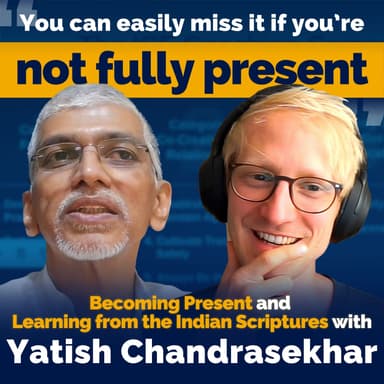
Becoming Present and What Coaches Learn from the Indian Scriptures with Yatish Chandrasekhar
with Yatish Chandrasekhar, ICF PCC coach educator, The Yogi Compass
Transcript
Edited for readability: filler words removed, names checked. It may still contain errors. The audio is the source of truth.
Yatish Chandrasekhar
Not knowing is not a put on. It's not a fake. You don't have to pretend not to know, but you're coming from a space of wonderment. I see it this way, but I wonder what my client is seeing. I wonder what my team member is seeing it as. So when my team member comes to me and says, boss, how can we do this? I don't have to say, do you know A, B, C, D, E, or one, two, three, four, five, because I've done this several thousand times, so I know this. But for me to pause and say: hey, if you were taking all the decisions, how would you do it? What does it take for a leader to be able to say that? That's the difficult part. So curiosity is a very powerful thing in coaching.
Tobi
India is not catching up with modern coaching. It has already been there 10,000 years ago. This is what Yatish, my guest for today, argues. And as a fan of Buddhist philosophy, of course I wanted to understand that better. Yatish is an ICF PCC, a mentor coach and coach educator based in Bengaluru in southern India, and he runs the Yogi Compass, combining Indian philosophy and modern coaching. On today's session he takes us into the Indian scriptures. He maps their stages of learning, which are listening, reflecting and contemplating, onto the ICF competencies. He also argues that presence is not one of these competencies, not a competency that you build, but a state of being. He calls it the Sakshi Bhava, the witness, and describes it as a lamp in a windless chamber. And he shares how all of these ideas can be groundbreaking, both for leaders and for coaches who want to let go of having all the answers. So let's go into this state of not knowing and hear Yatish.
I'm super excited to have you here and be able to talk. On The Impactful Coach I really speak with people from all over the world, with coaches, facilitators, practitioners.
Yatish Chandrasekhar
Mhm.
Tobi
This is also why I got super curious when I read a piece you wrote on Indian coaching culture. At the Yogi Compass, your business, you also interweave classic Western coaching tools and coaching methodology. You are quite involved in ICF, the International Coaching Federation, which I believe is also rooted in the US, in Western culture.
And yet you are also very well-read and deeply rooted in Indian culture. Today I would love to explore that, and see where these two cultures and teachings meet. In one piece that you wrote, I found something very insightful. You said that India is not catching up with modern coaching, that it has already been there 10,000 years ago. Can you tell us a bit what you meant when you wrote that?
Yatish Chandrasekhar
If you look at what is called the Indian Knowledge System, the IKS, it refers to the whole body of wisdom that sits in our scriptures, right from the Vedas all the way to the Upanishads, and then the Ramayana and the Bhagavad Gita. All of these collectively constitute the scriptures, and many of them are in the form of dialogues. The teachings have happened in the form of dialogues between two individuals. It could be, in the traditional sense, a teacher and a disciple. It could also be between two people who have always been friends, but realize that in that moment one is playing the role of a teacher and the other is playing the role of a student. In the case of the very popular Bhagavad Gita, which was propounded on the battlefield by Krishna to Arjuna, Krishna was actually his friend from childhood and had to take the role of the teacher there. So when I say teacher here, in the Indian knowledge systems a teacher is referred to as a guru, and the student is referred to as the shishya. When we refer to the concept of guru, it is not someone who is the authority. It is from a point of relativity. From the standpoint of the student, the guru is at a higher level, someone who has been much ahead in this journey. And if you were to look at the guru, the guru himself or herself considers themselves to be a shishya, a disciple. So they're not claiming to be the authority on anything. That's the lineage of guru and shishya, the teacher and the disciple, that has come down in the Indian knowledge systems. And so all of these scriptures have been handed down from one generation to the other in the form of dialogues, conversations. That is the reference I was trying to make: coaching as we understand it today, as a modality, a support function, helping the other person overcome their immediate challenges, conceptually has existed time immemorial, right from the days of the scriptures.
Tobi
Mhm.
Yatish Chandrasekhar
That was the context the reference was made in.
Tobi
So maybe if we compare it with Christian or even Jewish philosophies, what I hear is that the difference in the Bhagavad Gita and also the other Indian scriptures is that it has always been a coaching relationship. That is a stretch, but one person accompanying another through a journey, with the guru being further ahead in that journey. How do you relate that to coaching? Because I now say accompany, but it also sounds a bit like there is a hierarchical relationship, which in coaching we maybe wouldn't see. How do you look at that aspect of it?
Yatish Chandrasekhar
That's a good question, because in coaching we say the coach and the client are at the same level. I think that's what Carl Rogers calls unconditional positive regard. The guru is someone who is able to bring that unconditional positive regard for the person who is in front of him or her, without any bias, without any judgment, without any ego hierarchy that says I'm better than you or I know more than you. The guru is someone who just offers that space, which is what we also call in coaching: offering that safe space for the other person to explore.
Tobi
And to get to know you a bit more, how do you translate that into your approach at the Yogi Compass? Who are your clients? How does that find its way into your work at the Yogi Compass?
Yatish Chandrasekhar
For me personally, I've been educated in modern management science, and I've also had the privilege of being exposed to the Indian scriptures right from when I was in school. All along, as and when I get exposed to something new in either management or leadership, I'm always able to trace it back in some way to what the scriptures have already said, which in my own opinion appears to be the purest form of that concept. Just to give you an example, let's use the ICF competencies. I must say that ICF has done a brilliant job of articulating the competencies to make them so practical, so universal and so democratic. They obviously had to present it in the form of competencies, which are still referring to the skill level. For example, we talk about a coaching mindset, which is competency two. Competency two, embodies a coaching mindset, talks about your continuous learning as a coach. It talks about reflective practice. Now, what are these and where do they find their origin, so to speak? In the Eastern philosophy, or in the Indian systems, we say that learning happens at three levels. The first happens at the listening stage, which is called Shravana. And just listening alone is not enough. If you listen and you forget about it, you don't assimilate what you've listened to. So what is recommended is that you go to the next stage of dwelling on it, reflecting on it, called Manana, which is the next stage of learning. When you do that, it actually generates for you a new dimension of knowing or learning that wasn't present before. And if you see, essentially that is what happens in a coaching conversation as well. The client knows their world very well, and it is the space that you've created and the questions that you are asking them that help them to see things very differently. They're able to come up with their aha moments, for example. They are able to see things differently from the way they have seen all along. That is what I trace back to what we call the Manana, which is the reflection. You are able to create reflection in the client. And it further says that mere reflection is not enough. You have to go into the next stage, which is contemplation. Which means you have to really contemplate on what you've learned, what you've listened to, what you've reflected on, what you've churned in your mind. So to me, listening, reflecting and contemplating seems to be what really happens in a coaching conversation, and that gets represented as the remaining competencies. For example, competency six, listens actively, directly correlates to Shravana, which is the importance of listening. And ICF says, listen to what is said and not said, and be able to pick up even the micro expressions. If you go further, competency seven talks about evokes awareness. Now, where is that awareness coming from? It is coming from reflection. The coach is able to provide that environment for the client to reflect. So evokes awareness is where the coach facilitates reflection to happen in the client, and the client is able to churn their situation in their own minds and be able to see it through a different lens. And then comes competency eight, which is facilitates client growth. And what is growth really? If you break down the competency further, it says, be able to use this learning not just in this situation, but beyond the situation, in their general life, their general context. That is what competency eight says.
Tobi
Mhm.
Yatish Chandrasekhar
So Shravana, Manana, Nididhyasana, which is the line of learning as prescribed in the scriptures, to me directly correlates into competency six, seven and eight.
Tobi
Fascinating, yeah.
Yatish Chandrasekhar
It is, it is. But then if you look at five, for example, presence. That to me is the most favorite, and I feel very close to it. And ICF is right in putting it at number five and then following it up with six, seven and eight. Because even in the Indian knowledge systems, it is the presence which is a prerequisite that allows you to listen actively, to evoke awareness and to facilitate growth. Without presence you will not be able to do any of that effectively. For example, if the coach is not fully present, perhaps they're missing out on what the client is saying or intends to say, what is not said, their micro expressions, their emotions, their shift in energy, their body language. You can easily miss it if you're not fully present. And therefore you will not be able to go deeper to create more awareness for them, and hence a new learning. So I see presence as a prerequisite, as the essential, primary requirement for a coach in order for the coach to be effective in the subsequent competencies.
Tobi
And how do we see that in the relationship, let's say in the Bhagavad Gita between Krishna and their student? How do the Indian scriptures talk about these competencies, let's call them?
Yatish Chandrasekhar
Well, that's the difference here. The Indian system doesn't look at it as a competency.
Tobi
Mhm.
Yatish Chandrasekhar
Competency is something that you develop, it's a skill. The Indian system looks at it as nature. The nature of the teacher or the guru, or in this case the coach, who can embody the spirit of true presence. And when we say presence, we are talking about being neutral, we are talking about being non-judgmental and all of that. So the Indian system calls it the Sakshi Bhava, which is the witness principle. So how can you be a witness? When you are a witness, you are not the doer, you are not the subject.
Tobi
Mhm.
Yatish Chandrasekhar
Now, that in the true sense is presence, in my opinion. And that's the presence that the Indian tradition talks about.
Tobi
So this is also what we would see in meditation when we ask, okay, who am I if I'm not my thoughts? I'm the one watching, so I'm the presence.
Yatish Chandrasekhar
Awesome. You brought it out so well. Yes, that's the essence of the inquiry that is prescribed in the scriptures. And that concept itself is called neti neti. Neti means not this in Sanskrit. Not this, not this. For example: my body is paining. So when I'm able to say my body is paining, therefore, who is it that is saying that my body is paining? When you're saying my body, you're referring to it in a possessive case, something that belongs to you. So if something belongs to you, you are not the belonged. You are someone else. And therefore your ability to say that I am not the body, I am the observer of the body, or I am not this emotion, I am the observer or the experiencer of this emotion, or I am the one who is aware of this emotion. So being able to discard: this is not me. Neti, neti, neti. If you're able to do that, you will be able to arrive at a state which is the true Sakshi Bhava, the witness principle. And the way that I can metaphorically express it is by referring to it as a lamp in a windless chamber. The lamp is just glowing. There's no wind. There's nothing else that is distracting or disturbing its peace, its equipoise. It just exists there. So the concept of the witness, the Sakshi Bhava, is to be metaphorically expressed as a lamp in a windless chamber. And to me that's the core essence of presence.
Tobi
Mhm.
Yatish Chandrasekhar
Not a competency.
Tobi
So it's...
Yatish Chandrasekhar
Of being.
Tobi
Yeah, it's deeper. It's sort of the presence, the being, the attitude maybe in some way, which I bring to the coaching conversation or to life in general. And this idea of neti, this is basically I am not my thoughts, I am not my body who's experiencing pain. I am the lamp, the one who shines light, who observes in a way. I find it fascinating. It's kind of maybe the Buddhist way to self-awareness, the Buddhist way to personal development. What does it mean for you to be present?
Yatish Chandrasekhar
One of the ways I describe this, mathematically, is to say that as a coach, if I'm able to get to a stage where I tend towards zero and my client tends towards 100.
Tobi
Zero and 100 of what?
Yatish Chandrasekhar
Well, if you take hundred as the whole, as a coach and a client, the ICF definition at least says that you're equals. Which means technically you're fifty-fifty. The way ICF describes presence as a competency is where you're able to at least be fifty-fifty, not more, so that your ego, I know this, or you having to know all the answers, is curtailed. Now, to me, in the purest sense, a coach who can be fully present is someone who can bring himself or herself closer to zero and let the remaining be my client. Which means I'm able to create that space for my client, and my client can be themselves without having any reservations of being judged or being evaluated or being led into anything. So the sense of psychological safety that we talk about, in its purest sense, is where the coach tends to zero and the client tends towards hundred. The lesser I am in the equation, the more is my presence. So putting it mathematically.
Tobi
And how do you become less?
Yatish Chandrasekhar
By all the things we've discussed so far. Where I'm not the one who's having all the answers. I don't have to solve my client's problem. It's not my job. I'm here to provide the right environment, appreciative inquiry, bringing in unconditional positive regard that Carl Rogers talks about. I'm here only for my client.
Tobi
Yeah. This also requires you to be very humble, it sounds like. You don't take up space. You don't assume not even that you're equal, but you give all the room and the space to your client.
Yatish Chandrasekhar
Yeah, yeah.
That to me is a very long journey of being a true coach, where you're able to offer the entire space for your client. And if you look at it, even chemistry talks about it as being a catalyst. What is a catalyst? A catalyst is an agent in a reaction which facilitates the reaction but doesn't undergo any changes itself. That's the technical definition, to the best of what I understand of chemistry. So a coach therefore is that catalyst who is just present but doesn't undergo any change, doesn't cause any change, doesn't absorb any change, doesn't contribute to anything, but just is there.
Tobi
Do you think there are exceptions to this? I'm thinking of a client who maybe has a blind spot. Would you say it's okay to point out that blind spot, or even disagree with something they are saying? Or are you giving up your place of being free of judgment, being very humble, being present? How do you put these things together?
Yatish Chandrasekhar
I think the closest word that describes it is curiosity, and that's what we keep talking about as coaches. As coaches you need to be curious, and that's different from being inquisitive.
Tobi
Mhm.
Yatish Chandrasekhar
Curiousness is being: I wonder what is making my client see this this way. I wonder what else my client is seeing here, or what else are they not seeing here.
Tobi
And this is also how you would phrase the question. I wonder what makes you see it this way.
Yatish Chandrasekhar
Yeah, absolutely. And that's what I was headed towards. The more curious you are, and not inquisitive, the more your questions come from a space of wonderment. And that is what I was also referring to in our earlier conversations of not knowing. Coming from a place of not knowing. As a coach, I don't have to know your context. And what is becoming popular nowadays is that organizations are seeing the importance of helping their leaders play coaches, not just managers. So I find myself in situations where I'm talking about leader as a coach. I do workshops about it, and I also help organizations appreciate what being a coach means while being a leader. So if you look at leaders, leaders are rewarded for having all the answers. They are rewarded for troubleshooting, for a solution for every problem. That's what traditionally they have been rewarded for, and that's how they have grown in their journey as leaders, in their hierarchies. But therefore the concept of being a coach is very alien to leaders. And one of those tricky points that I frequently encounter is helping them appreciate the fact that you're coming from a place of not knowing. That is very counterintuitive to many leaders.
Tobi
Mhm.
Yatish Chandrasekhar
Not knowing is not a put on. It's not a fake. You don't have to pretend not to know, but you're coming from a space of wonderment. I see it this way, but I wonder what my client is seeing. I wonder what my team member is seeing it as. So when my team member comes to me and says, boss, how can we do this? I don't have to say, do you know A, B, C, D, E, or one, two, three, four, five, because I've done this several thousand times, so I know this. But for me to pause and say: hey, if you were taking all the decisions, how would you do it? What does it take for a leader to be able to say that? That's the difficult part.
Tobi
Mhm.
Yatish Chandrasekhar
So therefore curiosity is a very powerful thing in coaching. Coming from a place of not knowing. Although you may be a subject matter expert, although you may be the authority on that issue or topic, still coming from a place of saying: what could the other person be seeing?
Tobi
And what happens, especially in this leader as a coach context, if a leader manages to adopt this state of not knowing? How does the relationship to their team members change?
Yatish Chandrasekhar
That's very interesting. What I have seen in my own experience of coaching senior leaders is that they're able to come back and say that, one, I'm able to understand my teams better. And my team is really seeing me differently. Initially they used to see me as someone who has all the answers, who has a solution for every problem. But the moment I pause and ask them, how would you do it left to yourself, initially they are taken aback, they're even shocked. But over time they're able to appreciate and see what the manager is trying to do. And if you see it in the truest sense, as a leader you are expected to grow your team. That's one of the definitions of being a leader. If as a leader you're not able to grow your team, then you're not doing justice to that role. So one of the ways you're able to develop your team is by letting them figure things out, while you scaffold them when required. Provide them the resources, provide them with all that is required to run a project or an assignment. Just being there and saying: hey, I have your backs. I will let you figure things out. Come to me only if you absolutely need me. If a leader is able to get to that stage, then I think he or she would have done phenomenally in terms of developing their teams. And these are some of the issues that I encounter in my clients very frequently. Things about capability building, things about delegation, things about freeing up their time. So time management is a very oft-repeated issue. Now, all of this finds its root in the leader not being willing to give others a chance.
Tobi
Mhm.
Yatish Chandrasekhar
From a place of I know it all.
Tobi
Yeah, because that requires you to give up the expert stance.
Yatish Chandrasekhar
Yeah, the agency of someone who has solved this problem.
Tobi
Mhm.
Yatish Chandrasekhar
Or achieved this goal, this target, accomplished this project or whatever.
Tobi
So this I find fascinating. How concretely does it reflect in your coaching practice?
Yatish Chandrasekhar
It's more to do with my own being as a coach. For me, presence is not merely a competency to develop. To me, presence is to be able to get to that state of being just the witness, which means I'm not invested in, I'm not interested in what my client is bringing into the conversation. And that's easier said than done. I mean, you know it as a coach, the struggle. And we refer to it as sadhana. Sadhana is practice, continuous deliberate practice. So the whole purpose of sadhana is to ensure that that state of presence can become your natural state, which you can get into effortlessly, and that takes years and years of practice.
Tobi
So we have sadhana, which is the practice that goes way beyond the coaching conversation or the conversation between guru and student. It is the path of life, of development, of developing the state of being.
Yatish Chandrasekhar
Yeah. That's the ongoing practice that the coaching mindset, competency two, talks about. Embodies a coaching mindset talks about continuous learning, continuous reflective practice. So sadhana is all of that.
Tobi
And how do you practice your sadhana? How did your journey towards where you are today look like?
Yatish Chandrasekhar
That's a good question, and something that I don't normally get to discuss. My own introduction to the scriptures happened when I was just out of school, almost 40 years ago. And I got so fascinated by what I heard when I was listening to the discourses and the commentary of various scriptural texts. I got really drawn in and got absorbed into reflecting upon it. So it all started there, and all thanks to my parents and particularly my father, who got me introduced into all of this. So the journey began then, and I've had the privilege of being exposed to it on a continuous basis and also doing my own study and practice. So, to answer your question, I have my own set of sadhana. The set of practices that I do on a daily basis, which, metaphorically speaking, is going back and chiseling at that structure so that you remove the unwanted, so that what truly matters can express itself.
Tobi
And for you?
Yatish Chandrasekhar
Yeah, very similar. So it's a combination of all of that. In fact, if you look at journaling, all of that is also part of that culture. So here there is also what you can do in terms of writing, writing down your own feelings, your own experiences in a journal. All of that can also be very remedial, helping you in your sadhana.
Tobi
And when your father introduced this to you, what was it that stuck with you? Was there a concrete story or something that impressed you, that put you on this trajectory?
Yatish Chandrasekhar
Well, it helped me to look at myself from a personality perspective, from a behavioral perspective, as I was a teenager at that point. And one of the things that I used to be famously known for is saying, I don't have the time. I don't have the time to do this. I don't have time to do that. So I used to be so flippant and casual about things. And once I heard about this thing being spoken in a discourse and I started reflecting upon it, it said how unfounded that claim was. It all was an excuse to not really apply myself to the task, or not commit myself to an action or a decision. I was just going about loosely, saying that I don't have time. In reality, I wasn't willing to be doing the hard work required. So that really struck me and I said, okay, this is what is really happening. And I started implementing those small corrections or changes in habits, and then I could see how it changed my life and my outlook towards life and the way I related to others. And that's when it all started. So it all, I must say, is mostly experimentation with myself, my own life and the situations that I've come across, and how that has really helped me to be resilient, to be able to rediscover, reinvent myself every time life threw a curveball at me. So I saw that playing out in my own life.
Tobi
And is there a certain story or a part of the Bhagavad Gita, or I think you also mentioned the Upanishads, that influenced you, that you would highlight, that you would recommend for reading?
Yatish Chandrasekhar
That's a very interesting question. And the answer obviously is the Bhagavad Gita, which is very universal in its concept. So just to give you a perspective, the Vedas contain the true essence of all this wisdom. This wisdom has been passed on. So the Vedas really contain the essence, which is not for everyone to appreciate, and many of us will not be able to appreciate it in its sense, because it is too deep. The Upanishads are the essence of the Vedas. So it's a distilled form of the Vedas that is offered in the form of Upanishads. Now, the Bhagavad Gita is a further essence of that, and it is translated into everyday life. For example, if you look at the context of the Bhagavad Gita, like I said before, it is two families. So Arjuna as a king now has a rightful claim to the land which his cousins refuse to give him, he and his brothers. So there has to be a war to settle this.
If you see, all of this is symbolic. At a deeper level, it's also symbolic. It is the war that happens in each one of us on a daily basis. There is always a tug-of-war happening between the good and the not so good, the right and the not so right. So it is symbolic in that way. The Bhagavad Gita, therefore, is set in such a context that it is so easily understood by the common man. So Arjuna gets into the war, in the middle of the battlefield. The war cry is gone, and the first arrows have to be shot. But Arjuna says, sorry, I can't fight. I can't kill my own cousins, so I want to run away from here. But Krishna says that, look, your job as a king, as a prince, your job is to protect the right, to uphold the right, the dharma. And therefore it is inevitable for you to fight this war. And don't think that you're killing your cousins. They represent the negative forces. They represent the evil. And as someone who stands for dharma, the righteousness, it is your duty to vanquish the evil. So it is set in that context. So Krishna has to remind Arjuna in the middle of the battlefield that his duty was to perform action, not to run away. Now, what can be more appealing or more relevant to each one of us in our day-to-day lives? We are constantly at war with negative feelings, with wrong decisions, with unpleasant circumstances, with challenges, and we still have to remain here and fight it, and fight it from the standpoint of dharma, which is the righteousness.
Tobi
Mhm.
Yatish Chandrasekhar
So the short answer to your question is undoubtedly the essence of the Bhagavad Gita.
Tobi
Mhm.
Yatish Chandrasekhar
Contextualized in the situation of a modern-day life, where you and I are experiencing upheavals, challenges and difficulties, and it's for us to fight them from the standpoint of the right mindset, the right attitude, and that is what the righteousness talks about.
Tobi
And now you describe this scene of the war between righteousness and evil represented by these two families, and Krishna saying, okay, you cannot run away from this, you need to fight. Which, from my distilled Western perspective of all of these teachings, seems very violent and not this judgment-free presence, like accept your emotion, observe the emotion, don't try to suppress it. It feels more like on the suppression, fighting it side. How do you make sense of that?
Yatish Chandrasekhar
Yeah, that's a very smart question. A brilliant question, actually. So in this context, it is the fight because you're in the middle of the battleground. But in essence, it is perform your duty. What is your duty as a prince? What is the duty of someone representing a large kingdom that has been snatched away from you? You have a whole kingdom that is looking up to you to restore properties, restore homes, provide them a living. The whole community is looking up to you for help. So it is your duty to perform here. In this context it could be the war, but it's not the war that is being encouraged. It is the sense of duty that is being encouraged. In a different context, the duty could have been very different. Because it is set in the context of the battlefield, it says that you have to fight for what is right.
Tobi
How you phrase it now, the sense of duty, which happens to be now on the battlefield, that makes me connect to the boardroom leadership coaching environment. How do you bring that there?
Yatish Chandrasekhar
Interestingly, the Bhagavad Gita is one of those texts that has been so widely used in management. So to answer your question, it is very contextual, and the way you can relate to it is because, as you know, the Bhagavad Gita itself is a series of almost seven hundred verses, which is a dialogue between Krishna and Arjuna. In it Arjuna presents to Krishna a lot of excuses not to fight. Which is the different challenges that our clients bring into the conversation. I don't like this, but I can't do this. I'm not equipped to do this. Or, there is a sense of imposter syndrome, I'm not ready to do this, or I'm not fit to be here. So what you see happening on the battlefield of the Bhagavad Gita or the Mahabharata is exactly what happens in our boardrooms, everyday challenges, if you look at it essentially.
Tobi
And then this unwillingness to fight on the battlefield may reflect, as a metaphor, in procrastination to take a decision.
Yatish Chandrasekhar
Yeah.
Tobi
Of some sorts.
Yatish Chandrasekhar
Avoiding a tough conversation, avoiding a tough decision. Or feeling ill-equipped to do it, or feeling that I will be doing injustice by taking this decision. So a lot of that is reflected in modern management situations.
Tobi
And do you bring those stories then as stories and as metaphors? Or do you rather bring them as the wisdom that you absorbed, and then you bring that through your presence, through your being judgment-free? How does that unfold?
Yatish Chandrasekhar
I must say at a very subconscious level. It manifests itself through presence, and the way I respond to my client, for example, or how the question comes out and how the question lands in that situation. So I think essentially it'll find its way in all of that you mentioned: my presence, my ability to listen, my ability to ask the right questions, to evoke awareness and all of that. But for those clients who can appreciate it, I'm also able to present anecdotes, examples and metaphors that they can appreciate, and they can perhaps start seeing their situations from a different lens from what they are currently seeing.
Tobi
Interesting. And if we take this from your coaching practice to your activities with ICF, you are an ICF mentor coach and a coach educator more generally. What would you say can the archetypical coach that you observe, supervise, take from this?
Yatish Chandrasekhar
I got introduced to a coach in the context of my manager almost 13 years ago. He was a senior vice president in a particular function. His coach was visiting the office one day, and I happened to be around, and so my manager, my boss, introduced me to him and said, this is my coach. So for me, while the concept of coaching was already there, I didn't know what coaching meant in that context. I was wondering, wow, my manager is himself a very accomplished person. He's very successful and very effective, and he has a coach. So what must a coach be able to do that my manager himself is not able to do on his own? That set me thinking, and that's when I got curious about what coaching is, and I explored further. And then I enrolled into a coaching program, only to be told on the very first day that your job as a coach is not to advise. I was shattered. I said, what? So if my job as a coach is not to advise people, then what am I really doing being a coach? And that got me all the more intrigued, and that's how I got deeper and deeper into exploring what coaching really is and how it happens. So it actually helps me see my mentees and my trainees make those mistakes that I have made myself and which I still continue with at times. For example, the importance of silence, which is a very commonly occurring thing. So the coach becomes so impatient, or doesn't know what to do in that silence, so they try to fill that silence with another question, or elaborating their question, or asking the same question in a very different way. Now, what you're therefore doing is you're actually aborting a process of self-reflection, Manana, that your first question started with, or that your first question triggered. You don't have the patience to wait, and you try to fill that silence with another question, therefore coming in the way of that reflection that your client is actually going through. So as a mentor coach and a coach educator, I see these things come up on a regular basis. Or the client brings in a story and you get carried away by the story, not waiting to explore further. Now, this is just a story, which is the content. What is the real context? Where is this client coming from? What is making my client see things the way he or she is describing it to me? That is what is going deeper.
Tobi
Yeah. So it is part of your continued practice, your sadhana.
Yatish Chandrasekhar
Absolutely, yeah. It's my ongoing practice, ongoing sadhana. Yeah, your earlier question of what constitutes your sadhana. So I must say, being a mentor coach and a coach educator are also a form of my own sadhana, because if I have to teach a class on presence, for example, for aspiring coaches, then how do I present that concept if I can't really experience it myself?
Tobi
So what you say is the sadhana is an ongoing thing. It's not a quick hack that you bring to the coaching session. It is your own inner journey in a way. And yet I'm going to ask you now, let's say you had a very full day. You have been in a rush to get to the session, to the office maybe of your leadership client. What from these set of practices helps you in that moment to arrive, to bring that idea of being able to hold silence, this judgment-free presence? What helps you to get to this state?
Yatish Chandrasekhar
Yeah, if you're asking me about what I do to get to that presence, it's largely being aware of my own state of mind, honestly. Which means, to quote an equivalent of what we discussed already, it is the Manana and the Nididhyasana state. For me, being able to be in that state of silence, observing my own thoughts, observing what my thinking is, what my emotions are, and what I am experiencing at that moment, and becoming aware of that and trying to become the Sakshi, the witness, helps. And in many cases it doesn't have to be deliberate, it becomes almost second nature at times. But at times I may be required to even do some breathwork. Which is what we in the Indian system call the pranayama, which is regulating the breath. And they call it box breathing, which is inhaling from one nostril, holding for some time and releasing from the other nostril. Breathing in from one nostril and releasing it from the other nostril. So this technique of what they call box breathing today is, in the yoga system, called pranayama, which is regulating the breath. Prana is breath. Yama is to regulate.
Tobi
Mhm.
Yatish Chandrasekhar
So the exercise: just take a moment to sit down and watch your own breath.
Tobi
So in a way, the metaphoric state that you are trying to attain is this idea of becoming the observer, or the light that shines on there, that enables reflection. And your path of getting there is pranayama, which is box breathing.
Yatish Chandrasekhar
In fact, there is research to prove that pranayama done in the right way is able to even stop panic attacks, anxiety attacks, and calm that person down. So these are all from the school of yoga.
Tobi
And if we put it in a coaching context, it is the observing your own breath that enables you to attain this observing state as well.
Yatish Chandrasekhar
Yeah.
Tobi
Which is nicely ironic.
Yatish Chandrasekhar
It's the easiest way to do it. If you go downstream a little bit, if you look at what NLP says, NLP talks about mirroring. NLP talks about pacing. Now, mirroring and pacing are also techniques where you are trying to reflect what your client is going through, and thereby enable the client to accept you, accept what you're going to do with the client. So if you see, NLP is also a whole bunch of practical techniques that you can do to achieve this state of mind that we're talking about, which the Indian scriptures talk about, which the yoga systems talk about.
Tobi
And then the Americans came and looked at it and modeled it and said, okay, let's take this and that. That seems to work well.
Yatish Chandrasekhar
Yeah, I mean, the frameworks are useful. I think the Western world has been able to give us frameworks that are easy to apply and remember and appreciate. But of course it requires a deeper sense of steadfastness and commitment and the willingness to actually dive deep in order to appreciate it in the true sense of the term.
Tobi
Yeah. Now we took quite a big loop from the Indian scriptures to coaching to leadership. And in that sense it is very fitting that this is also, of course, the path to becoming a better leader.
Yatish Chandrasekhar
Mhm.
It's not so much of wanting to be a better person. I think the better person was an outcome, or I don't know how much better it is, but it is someone who is on a journey of self-inquiry. That is what I'm invested in, self-inquiry and understanding who I really am. Who am I really? Now, if in that bargain or on that journey I'm able to provide that presence or provide that space for others, that's a gratification for me. So I didn't get into it wanting to be a better person or a better coach or being there for others. I got into it because I started looking at myself from a different lens, and continuously, not just one-off. And that state of being in self-inquiry and self-awareness allowed me to appreciate the role of a coach. So therefore, even if I didn't know the concept of coaching, I would still be on that journey of self-inquiry and trying to understand myself better. Coaching is a profession that lets me be myself, without having to put on a facade, put on any external makeup.
Tobi
Mhm. Thank you, Yatish.
Yatish Chandrasekhar
Yeah, you're welcome. And thank you also, Tobi, for your very deep questions that really set me thinking, for giving me this opportunity to reflect with you. It has helped me clarify a lot of these concepts for myself, hopefully for your viewers and listeners as well. I'm extremely grateful to you for this opportunity, and I loved our conversation. I look forward to many more. Thank you.
Tobi
Thank you. This was Yatish. And I think personally, rather than answering all my questions, this episode was rather a starting point for me. I definitely want to read the Bhagavad Gita now. If you want to find out more about Yatish, go to the Yogi Compass. Of course, you can also find him on LinkedIn. We'll put both of it in the show notes. And if you want to check out the visualization tool that we also used on today's episode and let your client pick a picture, let them share what you see so you can practice the state of not knowing, then go to metafox.online. If this episode gave you something, share it with a friend, leave a like, a subscribe, or also your feedback in the comments. Drop me a message on LinkedIn or on tobias@metafox.eu. I'm Tobi, co-founder of metaFox, and I wish you all the best on your journey towards becoming a more impactful coach. See you back here in two weeks. Bye-bye.