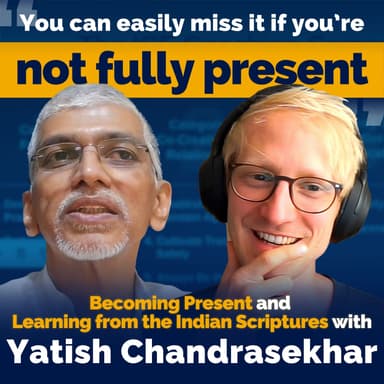
Becoming Present and What Coaches Learn from the Indian Scriptures with Yatish Chandrasekhar
with Yatish Chandrasekhar, ICF PCC coach educator, The Yogi Compass
Show notes
A coaching podcast with Yatish Chandrasekhar and Tobias Weghorn about coaching skills through the lens of Indian scriptures and modern coaching. Yatish, an ICF PCC coach educator from Bengaluru and the mind behind the Yogi Compass, shares why he believes India didn’t “catch up” with coaching—it’s been practicing it for thousands of years through dialogue-based teaching. Together, they connect the ICF core competencies to stages of learning like listening (Shravana), reflection (Manana), and contemplation (Nididhyasana), and explore coaching presence as a state of being rather than a technique. You’ll also hear practical ways to build a not knowing mindset—especially relevant in leader as coach conversations—using ideas like Sakshi Bhava (witness consciousness), silence, journaling, and breathwork.
Key Learnings:
- Treat coaching skills like listening, reflection, and contemplation as a sequence: listen fully (Shravana), hold silence to let Manana happen, then help the client translate insights into action (ICF core competencies 6–8).
- Build coaching presence by “tending to zero”: reduce your need to contribute, rescue, or impress, so the client experiences more psychological safety and does more of the meaning-making.
- Practice a not knowing mindset (especially as a leader as coach) by asking curiosity-from-wonder questions like, “If you were taking all the decisions, how would you do it?” instead of jumping to solutions.
Resources:
- Find your Coaching Tool: https://metaFox.eu
- Try the metaFox Strengths Discovery: https://strengths-discovery.com
- Connect with Tobi on LinkedIn: https://linkedin.com/in/tobiasweghorn
Episode Chapters:
00:00 Not Knowing Mindset and Curiosity in Coaching
01:00 Indian Scriptures Meet ICF Core Competencies
09:00 Shravana, Manana, Nididhyasana as Coaching Skills
13:00 Sakshi Bhava: Coaching Presence as Witness Consciousness
19:00 “Coach to Zero, Client to 100” and Psychological Safety
23:00 Leader as Coach: Shifting From Answers to Wonder
44:00 Mentor Coaching: Silence, Reflection, and Avoiding the “Fixing” Trap
47:00 Pranayama and Box Breathing to Access Presence
Transcript
Full transcript, edited for readability. Every timestamp jumps the video to that moment.
Yatish Chandrasekhar: Not knowing is not a put on. It's not a fake. You don't have to pretend not to know, but you're coming from a space of wonderment. I see it this way, but I wonder what my client is seeing. I wonder what my team member is seeing it as. So when my team member comes to me and says, boss, how can we do this? I don't have to say, do you know A, B, C, D, E, or one, two, three, four, five, because I've done this several thousand times, so I know this. But for me to pause and say: hey, if you were taking all the decisions, how would you do it? What does it take for a leader to be able to say that? That's the difficult part. So curiosity is a very powerful thing in coaching. Tobi: India is not catching up with modern coaching. It has already been there 10,000 years ago. This is what Yatish, my guest for today, argues. And as a fan of Buddhist philosophy, of course I wanted to understand that better. Yatish is an ICF PCC, a mentor coach and coach educator based in Bengaluru in southern India, and he runs the Yogi Compass, combining Indian philosophy and modern coaching. On today's session he takes us into the Indian scriptures. He maps their stages of learning, which are listening, reflecting and contemplating, onto the ICF competencies. He also argues that presence is not one of these competencies, not a competency that you build, but a state of being. He calls it the Sakshi Bhava, the witness, and describes it as a lamp in a windless chamber. And he shares how all of these ideas can be groundbreaking, both for leaders and for coaches who want to let go of having all the answers. So let's go into this state of not knowing and hear Yatish. Tobi: I'm super excited to have you here and be able to talk. On The Impactful Coach I really speak with people from all over the world, with coaches, facilitators, practitioners.
Read the full transcriptRelated episodes