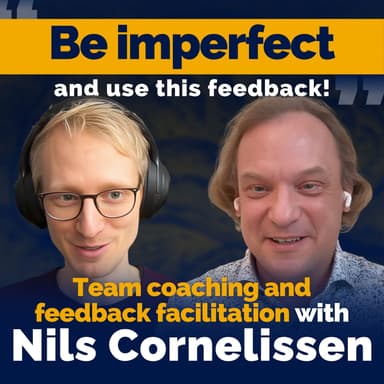
Facilitating Feedback and Psychological Safety in Team Coaching with Nils Cornelissen
with Nils Cornelissen, Founder at Return on Meaning
Show notes
A coaching podcast with Nils I. Cornelissen and Tobias Weghorn about psychological safety in teams and what it really takes to make high-performing groups speak honestly. Drawing on Google’s Project Aristotle, Nils shares how he helps executive team coaching clients build vulnerability in the boardroom (or offsite) without turning it into “touchy-feely theater.” You’ll hear why he intentionally “stains the white tablecloth” to role-model imperfection, plus two practical feedback methods you can use right away: the Keep Consider feedback method and a laser feedback exercise.
Key Learnings:
- Build psychological safety in teams by role-modeling imperfection: name what you notice (as an offer), normalize reactive vs. creative states, and invite the “stupid questions” early so honesty becomes a habit.
- Use the Keep Consider feedback method as a 3–5 minute micro-ritual (e.g., monthly in exec meetings): each person shares one thing to keep and one thing to consider next time—no debating, just collecting patterns to improve collaboration.
- Run a laser feedback exercise to make behavioral feedback happen more often: pairs give 1 minute of pure appreciation, then 1 minute of “I’d appreciate it even more if…”, rotating partners to build trust and performance in executive team coaching.
Resources:
- Return on Meaning, Nils' consultancy: https://www.returnonmeaning.com/nils-cornelissen
- The Momentum Program of Return on Meaning: https://www.my-momentum.life/
- Nils I. Cornelissen's LinkedIn: https://www.linkedin.com/in/nilscornelissen/
- Find your Coaching Tool: https://metaFox.eu
- Coach online with https://metaFox.online
- Connect with Tobi on LinkedIn: https://linkedin.com/in/tobiasweghorn
Episode Chapters:
00:00 Failure Culture vs. “No Mistakes” and Missing Behavioral Feedback
01:00 Intro: Psychological Safety in Teams (Google Project Aristotle)
02:10 Entering the Boardroom: Executive Team Coaching Context and Characters
06:00 Individual Journeys, Group Dynamics, and Creating Vulnerability
08:00 Asking “Stupid Questions” to Shift Team Habits
10:30 Contracting and Shared Responsibility in Team Coaching
13:00 Role-Modeling Imperfection: The “Stain on the Tablecloth” Story
20:30 Keep Consider Feedback Method (Fast, Balanced, Repeatable)
26:00 Laser Feedback Exercise: Appreciation + “Even More If…”
30:00 Habits, Feelings, and Getting Rational Leaders On Board
Transcript
Full transcript, edited for readability. Every timestamp jumps the video to that moment.
Nils Cornelissen: Many of my clients come up to me and say, well, we want to have a failure culture. And I ask, what are you prepared to give? What if somebody makes a mistake? Well, they shouldn't make mistakes. We want a failure culture, but no mistakes, right? One other important aspect is also feedback. Even board members all ask for feedback, but do they actually give each other feedback? They give feedback on documents or on content points, but this behavioral feedback, they don't give each other. No. Tobi: Can you describe a very concrete facilitation method for bringing out this kind of feedback? Tobi: What makes a high performing team? What helps them navigate rapid change? 12 years ago at Google they studied these questions and looked at more than 180 different teams and potential factors. And what made the single biggest difference was psychological safety: being able to feel safe in a group, to ask stupid questions and to disagree without feeling threatened. My guest today, Nils Cornelissen, helps top executive teams to achieve this level of vulnerability in their conversations. And on this episode Nils shares why he leaves a stain on the white tablecloth on purpose, why he wants to be seen as imperfect by his clients, and how he facilitates team feedback with the keep-consider method as well as the laser feedback exercise. So if you're working with teams, there'll be lots of methods to adapt to your own coaching and
Read the full transcriptRelated episodes
Executive Coaching and Preparing your State for Difficult Conversations with Nils Cornelissen
Nils Cornelissen ·