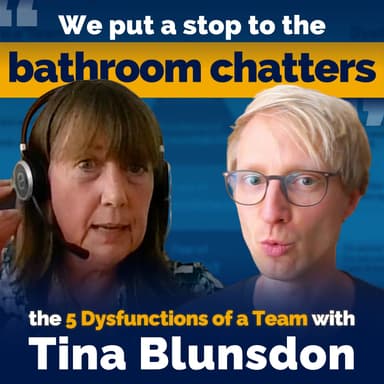
Team Coaching with the 5 Dysfunctions of a Team with Tina Blunsdon
with Tina Blunsdon
Show notes
A coaching podcast with Tina Blunston and Tobias Weghorn. They get practical about team coaching by tackling “bathroom chatter” (the real conversation that happens after the meeting) and using Patrick Lencioni’s five dysfunctions of a team as a starting point. Tina shares how she builds psychological safety in teams with simple exercises, why she asks the most senior person to go first when it’s about vulnerability (and last when it’s about decisions), and how she creates space for constructive conflict in meetings without it turning personal. You’ll also hear how she uses a DiSC assessment to create a shared language for communication and peer accountability.
Key Learnings:
- Use team coaching to stop “bathroom chatter” by building trust first: run a DiSC assessment, then do quick vulnerability-based prompts (e.g., “a childhood challenge that shaped you”) to set up psychological safety in teams.
- Spark constructive conflict in meetings with structure: set ground rules, use “five whys,” and add simple voting (fist-to-five or 1–99 + “why”) to surface disagreement without making it about the person.
- Make accountability stick by co-creating peer rules: have the team define what “holding peers accountable” looks like (including early communication), write it down, and get explicit buy-in so team coaching doesn’t slide back after the workshop.
Resources:
- Tina Blunston’s LinkedIn: https://www.linkedin.com/in/tina-blunsdon-8a9843127/
- The 5 Dysfunctions Of A Team (The Table Group): https://www.tablegroup.com/topics-and-resources/teamwork-5-dysfunctions/
- Find your Coaching Tool: https://metaFox.eu
- Try the metaFox Strengths Discovery: https://strengths-discovery.com
- Connect with Tobi on LinkedIn: https://linkedin.com/in/tobiasweghorn
Episode Chapters:
00:00 Bathroom Chatter And Why Quiet Voices Matter
01:00 Framing The Episode: Team Coaching And The Five Dysfunctions Of A Team
06:55 DiSC Assessment As A First Step In Team Communication
11:00 Building Trust And Psychological Safety In Teams
22:00 Active Listening Drill: Headphones, Observation, And Body Language
25:40 Healthy Rules For Constructive Conflict In Meetings (Five Whys, Baton)
28:00 “Throwing A Grenade”: Facilitating Disagreement With Scaling Votes
38:00 Decision-Making: Senior Vulnerable First, Senior Speaks Last
40:50 Holding Peers Accountable With Team-Written Rules
46:10 Blue, Red, Pause: Do The Work, Then Reflect On Results
50:35 Learn Coaching: How To Start With Team Coaching In Real Companies
Transcript
Full transcript, edited for readability. Every timestamp jumps the video to that moment.
Tina Blunsdon: They would just stay quiet if you've got someone who's dominant, and then they take it outside and talk. I called it the bathroom chatter. We put a stop to bathroom chatter, because they would go outside, talk to somebody else in the bathroom and not say it in the room. People who are quieter in a room won't speak up, but they're usually the ones whose voice, when they say something, is quite profound, because they thought about it. I will throw in a grenade, if you like. I will throw in a question, or I will ask, "Why didn't anybody challenge this?" I always get the highest person in the room to be vulnerable first, because if they're vulnerable and open up, the others will. I do it backwards. I get them to be vulnerable, and I get them to speak last when it's a decision. People don't like holding each other to account for something they haven't done. They know they have to, but they run away. So it's really important to keep things simple, because if you make it too complex, it goes out the window. Tobi: Have you ever sat in a meeting where nobody said what they actually thought, and then the real conversation happened ten minutes later in the corridor? My guest today has a name for that. She calls it the bathroom chatter, and putting a stop to this kind of pattern is where her work as a team coach begins. Tina Blunsdon runs Coaching for Growth in the UK. She has been coaching for more than ten years, and a lot of her work with teams builds on Patrick Lencioni's Five Dysfunctions of a Team model. The model explains teamwork through a pyramid made up of trust, conflict, commitment, Tobi: accountability, and results. But what we get into on today's episode is what the pyramid does not tell you: what actually happens in the room. We get concrete, and Tina shares exercises she runs to build psychological safety, how she starts an argument on purpose, how she keeps it from turning personal, why she asks the most junior person in the room first when it is about a decision, and the most senior person first when it is about being vulnerable. She shares how she has a team write their own rules for holding each other accountable, how they blue, red, and pause, and her way of getting a team to reflect. So if you have been coaching one-on-one and you're curious what changes if you get a whole team in the room, this one is for you. Let's go.
Read the full transcriptRelated episodes
Facilitating Feedback and Psychological Safety in Team Coaching with Nils Cornelissen
Nils Cornelissen ·